
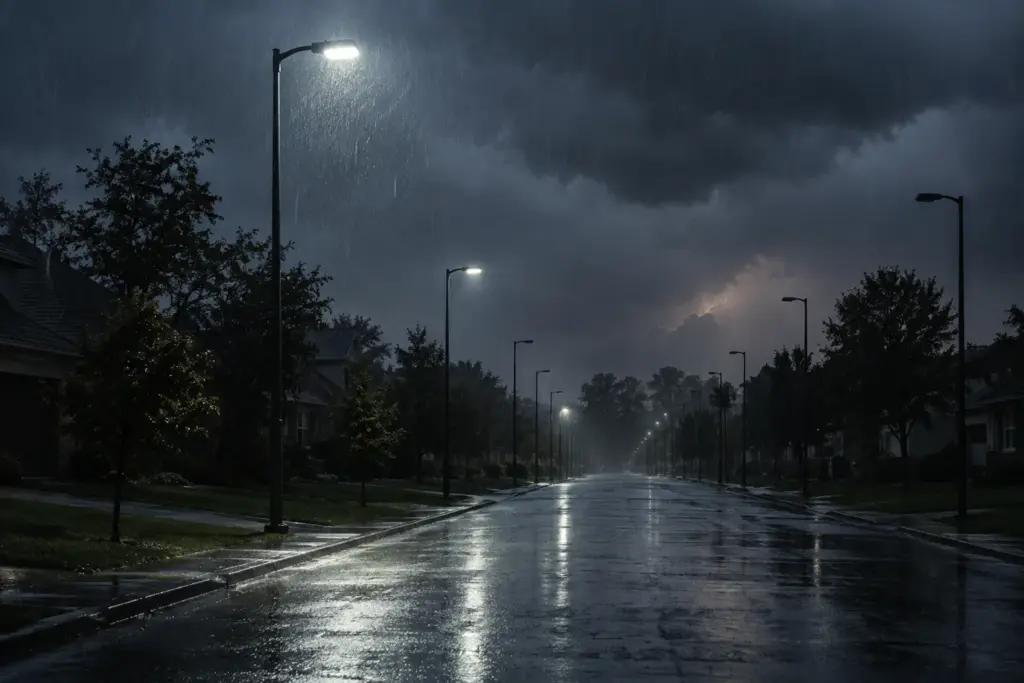
A storm rolls through, the power blinks, and by morning half the LED fixtures in a building or along a road are dark. The bulbs were supposed to last 25,000 to 50,000 hours (1000Bulbs, 2025). They lasted two years. If you have ever owned that morning, you already know surges kill LED lights faster than old age ever will.
This article follows the problem inward. First, what a surge actually does to an LED light. Then the three places a defense can live: at the outlet, at the electrical panel, and inside the fixture itself. By the last section the question has changed. It is no longer “do I need a surge protector?” It is “what surge rating belongs in my purchase spec, and how do I verify a supplier meets it?”
One clarification before we start. If you came here looking for a power-strip surge protector for a lamp or a TV, this article is not about that product. Plug strips protect whatever is plugged into them. We are talking about the protection of LED lights and the electrical systems behind them, which is a different device, a different standard, and a different purchase decision.
What a Power Surge Actually Does to LED Lights
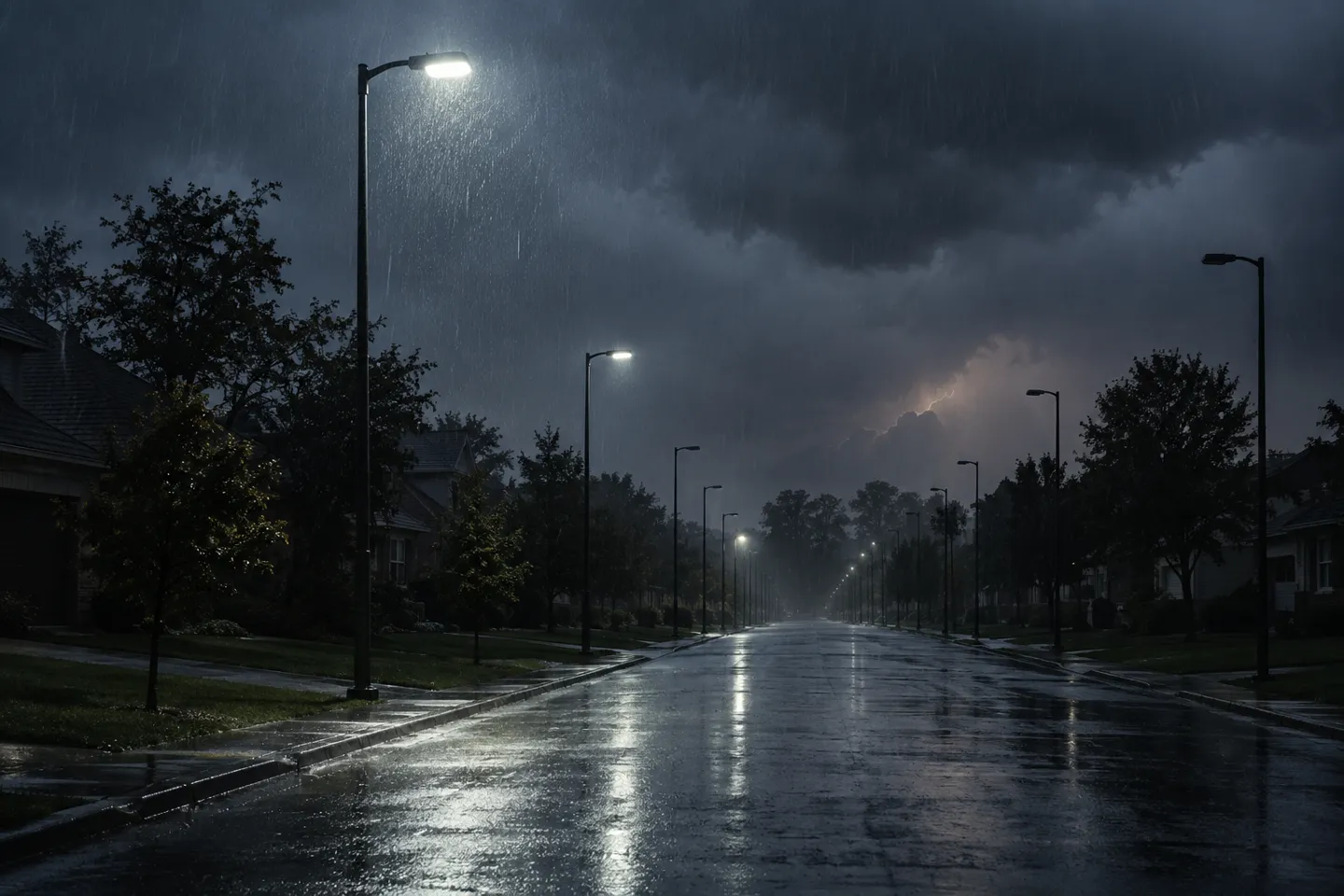
A surge is a short burst of excess voltage on the wiring, lasting microseconds to milliseconds. Three things cause most of them. Lightning does not need a direct strike; a bolt hitting a power line or even the ground induces a spike in long outdoor cable runs. Utility switching and fault clearing push temporary overvoltages through the grid, which is why some failures happen on cloudless days. And inside a building, large motors and compressors kicking on add small surges that accumulate over time.
The fragile part of an LED light is not the diode. It is the driver, the small power-supply board that converts mains AC into the low-voltage DC the LEDs need. A big spike punches through the driver’s input stage and the light goes dark instantly. Smaller repeated surges stress the driver’s capacitors and protection components until output turns unstable, and the LEDs then dim, flicker, or die ahead of schedule. This is why a “50,000-hour” fixture can fail in its first thunderstorm season: the rating assumes clean power.
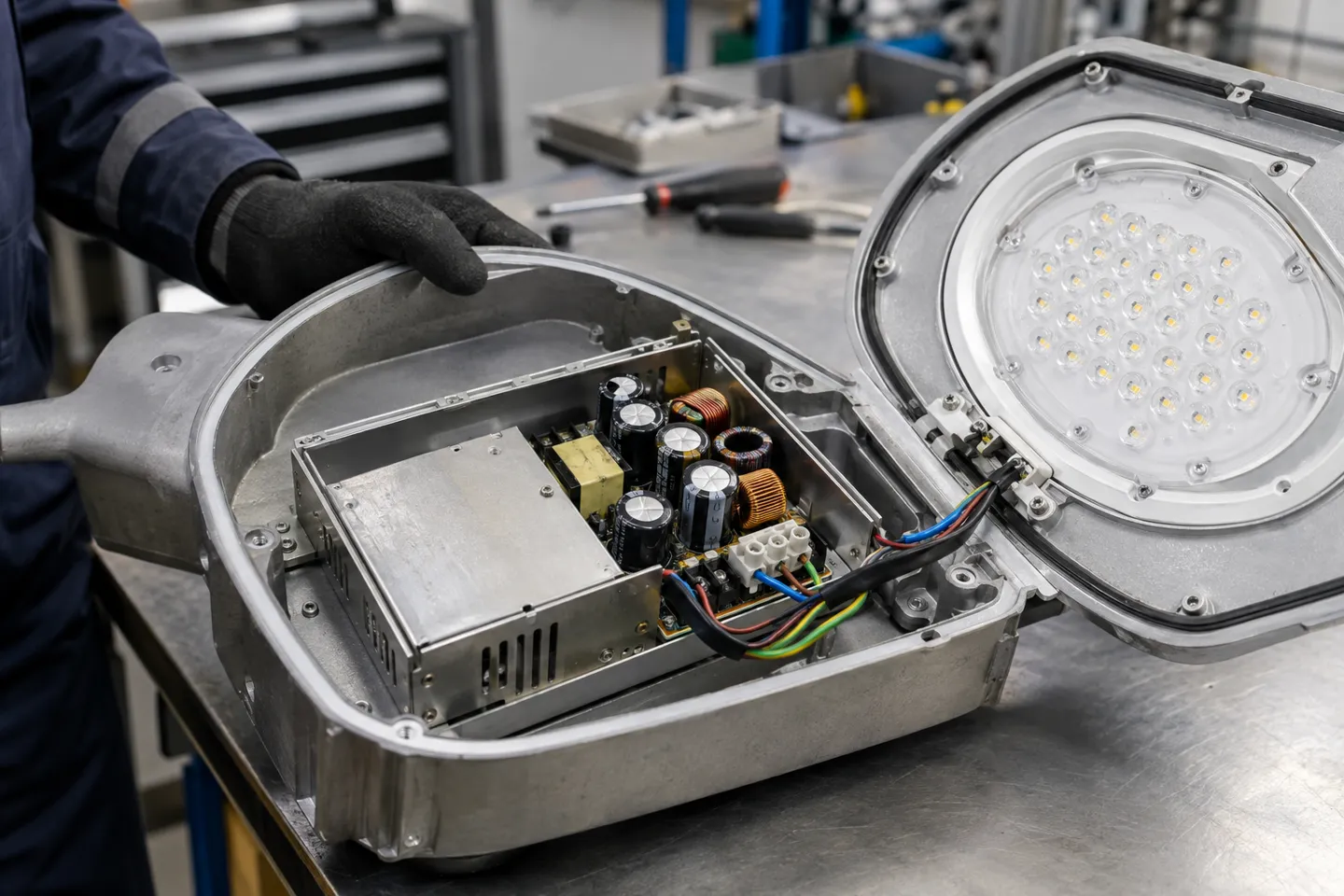
Failure style tells the story. Instant death across many fixtures at once points to a large external surge. Early dimming and flicker point to years of small hits. Either way, the LEDs themselves usually die because something upstream of them failed first.
Surges are described with two standard test waveforms: a 1.2/50 μs open-circuit voltage wave and an 8/20 μs short-circuit current wave. That pairing is where the cryptic “kV/kA” numbers on protection devices come from. Hold that thought; those two numbers matter a lot by the time we reach the buying decision.
Where Surge Protection Can Live: From the Outlet to the Fixture
Protection is not one device. It is a position on the electrical path, and each position covers a different stretch of wiring. There are three of them, and they stack.
Outlet-Level and Whole-House Protection: Where It Stops
This is the layer most people know. Plug-in surge protectors guard single devices; a whole-house unit mounted at the meter or main panel guards everything behind it. For indoor electronics on clean urban grids, this layer is often enough.
Its boundary is distance, not wattage. A whole-house SPD protects the wiring up to roughly the point of use. The long run from the panel out to a garden floodlight, a parking lot, or a streetlight pole sits at the edge of its reach. Long outdoor runs pick up induced lightning surges the whole way. Everything from the last protective device to the fixture is exposed. Homeowners with storm-damaged yard lighting discover this the hard way: the indoor gear survived while the outdoor fixtures did not.
Panel-Level Protection: Type 1 and Type 2 SPDs
Step up to the electrical infrastructure and the vocabulary becomes UL 1449 Types. A Type 1 SPD mounts at the service entrance, before the main breaker, and takes the first, largest hit. A Type 2 SPD mounts at a branch panel and clears whatever remains. Electricians routinely cascade them, Type 1 at the service and Type 2 downstream, so big surges are drained in stages. Standards bodies describe site exposure with location categories (A, B, C) under IEEE C62.41, which grades how harsh the surge environment is at each point in the building (IEEE, 1991).
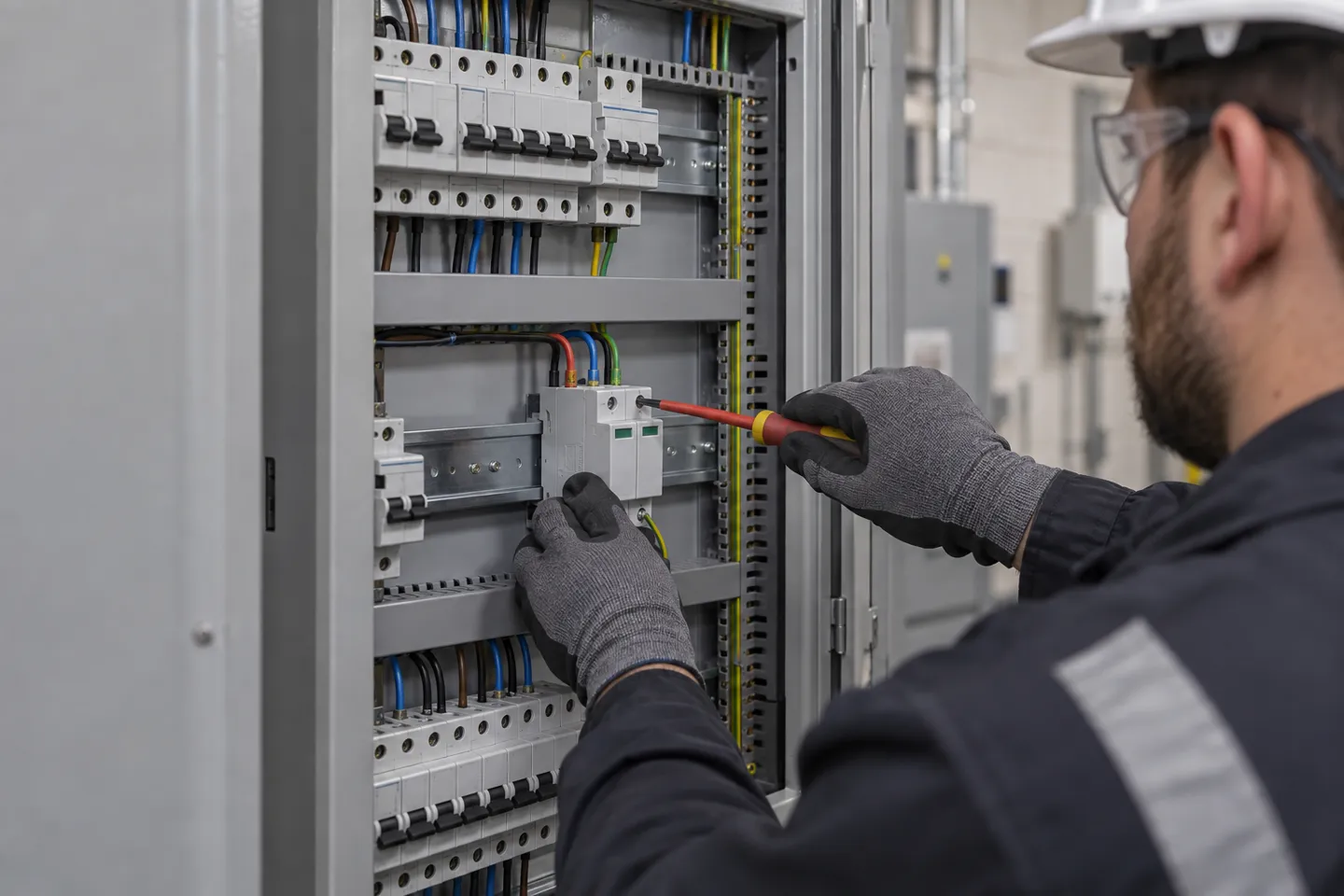
This is the layer facility managers care about, because panel-level protection defends the whole circuit at once. One electrician on a trade forum described hundreds of lay-in LED fixtures losing drivers “a handful at a time.” His fix was exactly this: surge protection at the panel feeding the light circuits, with cascaded Type 1 and Type 2 devices.
Inside the Fixture: Built-In Protection You Can Actually Specify
The third position is inside the light itself. A fixture-level surge protective module, often built to UL 1449 Type 4CA for LED lighting, sits right at the driver input. Some drivers also carry their own input-stage protection, and wide-voltage input designs tolerate the slow swells that destroy tighter supplies.
Here is why this layer decides procurement outcomes. Fixture-level protection shrinks the exposed final stretch of wiring to nearly zero. Unlike panel gear, it ships inside the product: it can be written into a purchase specification, priced per unit, and verified at acceptance. You cannot say that about the electrician’s panel install, and you definitely cannot say it about a plug strip.
| Defense position | Typical device | Covers | Does not cover | Who pays |
|---|---|---|---|---|
| Outlet / whole-house | Plug strip; meter or main-panel SPD | Indoor devices behind the unit | The long run to outdoor fixtures | Homeowner or tenant |
| Panel-level | Type 1 (service) + Type 2 (branch), cascaded | Whole circuits in the building | The final meter of wiring inside each fixture; induced surges on distant outdoor runs | Building owner |
| Fixture-level | Built-in SPD module or Type 4CA; protected driver; wide-voltage input | The fixture itself, from its input terminals | Surges still arriving at the panel (needs layer above) | Baked into the fixture purchase |
No single layer substitutes for another. Each one shrinks what the next must handle, and the layer you can actually put in a procurement document is the one inside the fixture.
Why LED Drivers Fail in Batches (Even on Clear Days)
Facility managers rarely lose one light at a time. They lose a cluster on Monday and another the week after, sometimes with no storm anywhere in the logbook. A short diagnostic sequence sorts out why, before money is spent on the wrong fix.
First, record the pattern. Simultaneous cluster failures that track storm season point to lightning-induced surges. Scattered failures on calm days point to the grid side: temporary overvoltages from utility switching, miswiring, or an unstable local network. The standards treat TOV as part of the surge environment an installation must tolerate, not as a rare anomaly (IEEE, 1991).
Second, open a failed unit. A driver damaged by overvoltage usually shows it: split MOV discs, bulged or vented capacitors, scorched input traces. Heat aging looks different: discolored circuit boards, dull cracked solder joints, and no violence anywhere.
Third, trace the supply. Note what else shares the feeder. Large motors starting, capacitor banks switching, aging transformers, and long overhead runs all raise the surge floor on that circuit.
Fourth, choose the route. Replacing fixtures one by one treats the symptom. Adding a Type 2 SPD at the panel feeding the lights lowers the incoming floor for every fixture on that circuit. And writing fixture-level surge protection into the next purchase order solves the problem permanently at the source. The three routes are not rivals; the first is first aid, the second is medication, the third is the cure.
One caution before you blame surges for everything. A bad production batch can also fail in clusters, and chronic overheating kills drivers just as dead. The opened unit tells you which story you are in.
Batch Failure Diagnostic
- 1Failure pattern: storm-correlated clusters vs calm-day scatter
- 2Open a failed unit: split MOV / bulged capacitors = overvoltage; browned solder = heat aging
- 3Trace the feeder: large motor starts, capacitor bank switching, long overhead runs
- 4Pick the route: replace (first aid) / panel SPD (medication) / specify protected fixtures (cure)
Matching Surge Ratings to Your Project: The Levels That Belong in a Spec
If you buy luminaires rather than maintain them, surge protection stops being an electrician’s add-on and becomes a line in your specification. This is where the ratings on a datasheet either earn their place or fall apart.
If you are writing that line right now, send WOSEN your project environment and target level — we will return a fixture quote with the kV/kA rating, driver platform, and warranty tier itemized.
Send Your Spec for a QuoteThe Three C136.2 Levels — and the Environments They Match
For roadway and area lighting, ANSI C136.2-2023 sets transient immunity test levels for luminaires and control devices rated up to 600 V (ANSI, 2024). The standard grades exposure in three steps, and component makers publish the numbers plainly (CITEL, 2023):
- Typical: 6 kV / 3 kA
- Enhanced: 10 kV / 5 kA
- Extreme: 20 kV / 10 kA
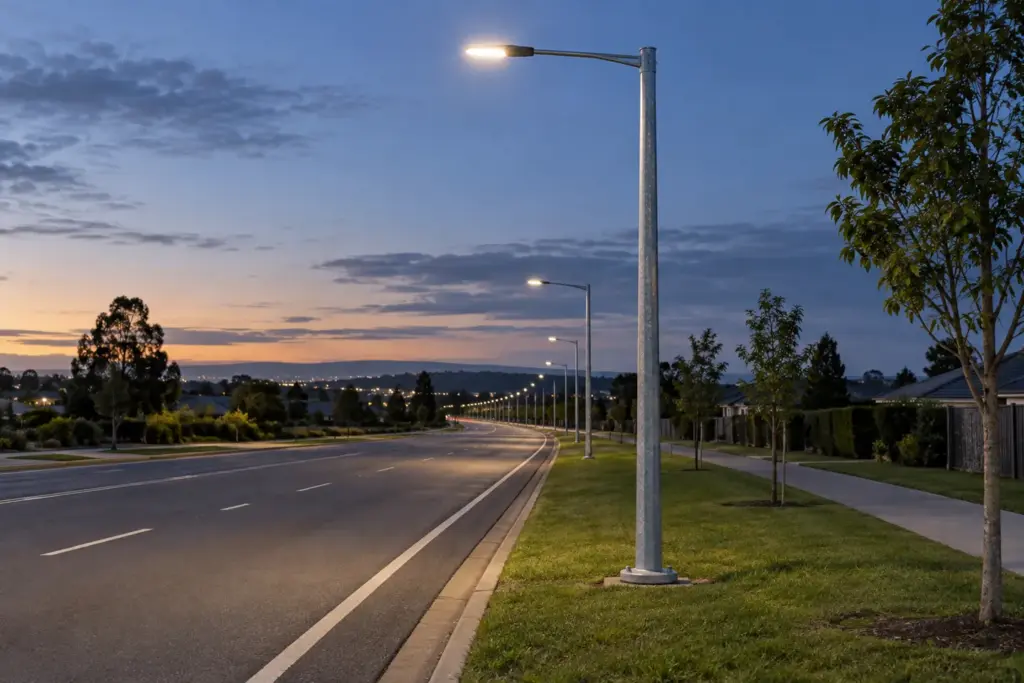
Read the pairing as “withstand voltage / discharge current,” tested with those 1.2/50 μs and 8/20 μs waveforms. Matching level to environment is straightforward. Quiet urban streets with overhead or buried feeders sit at Typical. Arterial roads, coastal strips, and regions with real storm exposure belong at Enhanced. High masts, open plains, desert sites where every pole is the tallest object for a kilometer, and grids known for instability justify Extreme. Municipal spec writers already work this way; a city roadway lighting standard, for example, typically baselines Enhanced with an Extreme option for the worst corridors.
| Project environment | Suggested level | Must verify at acceptance | What failure costs if under-specified |
|---|---|---|---|
| Urban local streets, low exposure | Typical (6 kV / 3 kA) | Level + current on datasheet | Occasional module swaps |
| Arterial roads, coastal, moderate storm zones | Enhanced (10 kV / 5 kA) | Level + current + driver brand | Seasonal driver die-off |
| High masts, open plains, desert, unstable grid | Extreme (20 kV / 10 kA) | Level + current + driver brand + built-in SPD | Pole-by-pole replacement after each storm season |
| Indoor / low exposure areas | Typical or per UL/IEC interior rules | Do not force C136.2 onto interior fixtures | Over-spend if over-specified |
Built-In Versus Bolt-On: Where Fixture Protection Belongs
Fixture-level protection comes in two forms. Built-in: a surge module or protected driver mounted inside the luminaire at the factory. Bolt-on: a Type 4CA module added in the field next to the fixture (Littelfuse). Built-in protection arrives tested, warranted, and specified; bolt-on modules let a buyer upgrade existing poles or replace a sacrificed protector without touching the luminaire. The two stack well: many road projects specify built-in protection at the chosen level and keep field modules as serviceable spares.
Wide-voltage input handles the TOV half
Input rated AC 85–265 V rides out slow grid swells and sags — the failure mode fast clamping never touches.
The Three-Element Acceptance Check (and the Bare “10kV” Trap)
A complete surge specification has three elements: withstand voltage in kV, discharge current in kA, and mode (differential, common, or both). Drop any element and the number turns to fog. That is the trap in supplier quotes that simply say “10kV surge protection”: 10 kV of what waveform, at how many kiloamps, in which mode? A claim with no current figure and no mode cannot be compared against C136.2 Enhanced, and two quotes both saying “10kV” can differ by a full grade.
Tie the check to the rest of the datasheet while you are at it. Driver pedigree and surge survival rise together; a fixture line built on Philips, Meanwell, or Inventronics drivers is a different risk profile from one built on anonymous supplies. And check how the surge spec maps to warranty. Many manufacturers run separate warranty lines: an entry tier around two years, a premium tier around five. The premium line is where the upgraded drivers and protection stages live. A 5-year warranty backed by a Typical-level surge stage is a thinner promise than the same term on an Enhanced or Extreme build.
This is the point to hold onto: ANSI C136.2-2023 grades protection as Typical 6 kV/3 kA, Enhanced 10 kV/5 kA, and Extreme 20 kV/10 kA. A kV figure without its kA partner is not a specification. Everything else in this section is detail; that sentence is the spec.
Typical
6 kV / 3 kA
Quiet urban streets
Enhanced
10 kV / 5 kA
Arterials & storm country
Extreme
20 kV / 10 kA
High masts & harsh grids
Reading a Luminaire Quote Like a Contractor
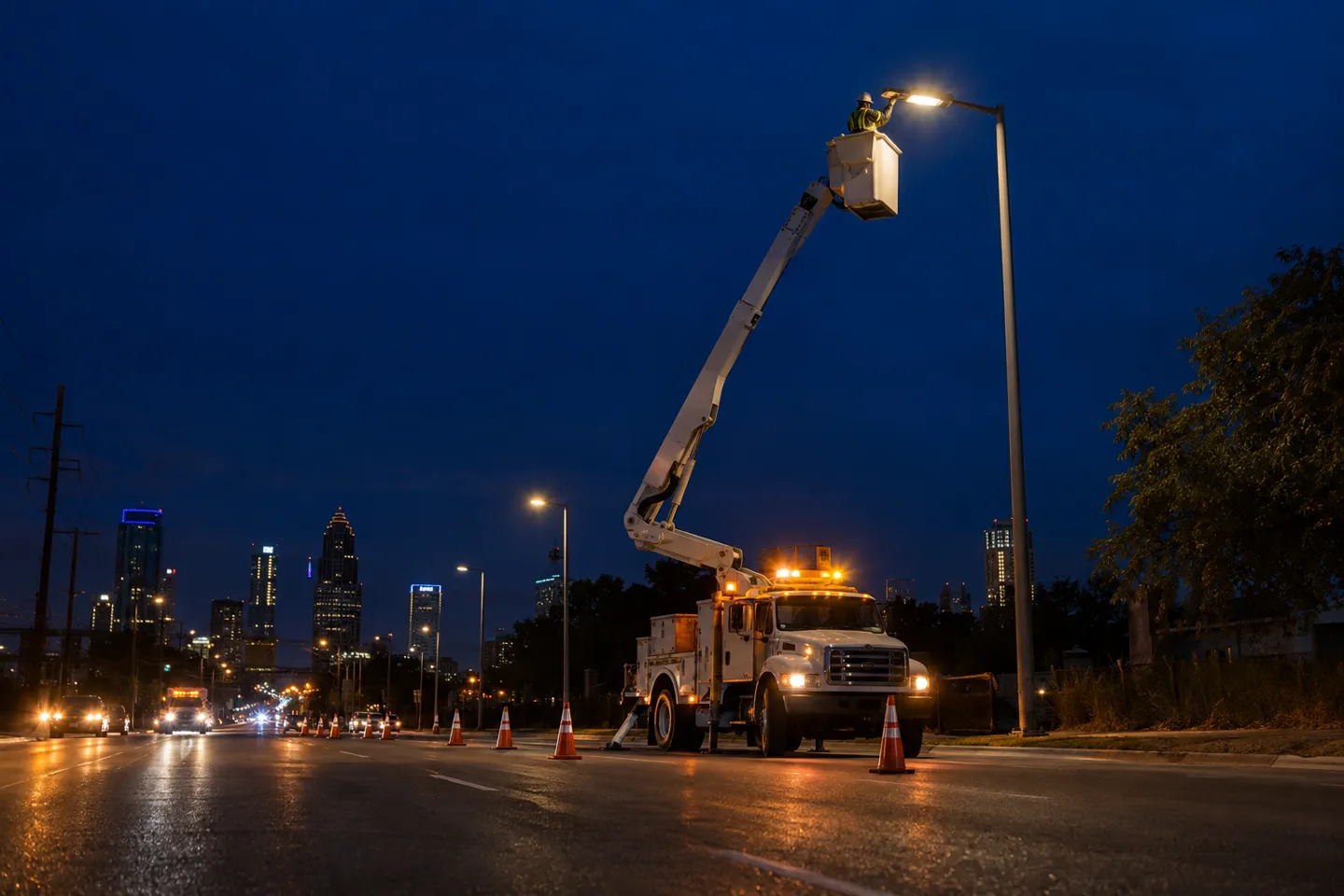
Now reread the economics. Grid-tied street lighting already carries a maintenance load of roughly $250 to $400 per fixture per year once parts, labor, traffic control, and diagnostic time are counted (Fonroche Solar Lighting). A storm season that kills drivers across a corridor turns that line item into a wave of truck rolls. The truck, the licensed electrician, and the lane closure cost several times what the fixture did. The engineering math one luminaire maker published puts it bluntly. A few dollars saved on a cheaper driver can return as hundreds of dollars of boom-lift time per failed pole (WOSEN, n.d.).
So treat the surge clause as the cheapest insurance in the tender. Write the level into the spec by environment, from the table above: Typical for quiet urban streets, Enhanced for arterials and storm country, Extreme for high masts and harsh grids. Bind it to the driver brand tier and the whole-lamp warranty term so the three promises stand or fall together. Then check the quote, not the brochure.
Before signing, run this acceptance pass:
Quote Acceptance Checklist: Surge Protection
- 1Surge rating states all three elements: kV, kA, mode
- 2Rating mapped to a named standard level (C136.2 Typical / Enhanced / Extreme) for the project environment
- 3Driver brand disclosed (e.g. Philips / Meanwell / Inventronics tier)
- 4Wide-voltage input range stated (e.g. AC 85–265 V)
- 5Warranty tier matches the protection build (entry ~2 yr vs premium ~5 yr)
- 6Factory surge test included in QC records
Skip the pass and the consequence is not abstract. It is a night call-out list after the first big storm, with the same corridor on it every year.
The boundary runs the other way too. Low-exposure interiors, short lease terms, and fixtures worth less than the protection do not need Extreme anything; specifying Typical there, or relying on panel-level protection alone, is the correct answer. Match the money to the exposure and stop there.
When you audit quotes for outdoor LED street lights, it helps to know how the fixture was built before it reached the quote. At WOSEN, we pair outdoor drivers rated for 10 kV surge protection with Philips, Meanwell, or Inventronics driver platforms. Input is wide-voltage (AC 85–265 V), and the IP65/IP66 housings are rated for 50,000 hours. Our power supplies go through a dedicated surge test on the production line, one of more than 50 factory tests per product. If a quote skips those specifics, ask why. Our outdoor LED street lights range lists the full specifications.
Get Street Lights Specified to Survive Storm Season
Tell us the environment and the C136.2 level you need — WOSEN quotes outdoor luminaires with the driver platform, surge rating, and warranty tier spelled out.
Request a Fixture QuoteReferences
- CITEL. “Surge Protectors for LED Roadway and Area Lighting to ANSI C136.2.” n.d. https://citel.us/en/surge-protectors-for-led-roadway-and-area-lighting-to-ansi-c1362
- ANSI. “ANSI C136.2-2023: Roadway And Area Lighting Equipment.” 2024. https://blog.ansi.org/ansi/ansi-c136-2-2023-roadway-and-area-lighting/
- IEEE. “IEEE C62.41-1991.” 1991. https://standards.ieee.org/ieee/C62.41/2856/
- 1000Bulbs. “How Long Do LED Lights Really Last? Understanding Lifetime Ratings.” 2025. https://blog.1000bulbs.com/home/how-long-do-led-lights-really-last-understanding-lifetime-ratings
- Fonroche Solar Lighting. “How Much Do City Streetlights Cost to Maintain?” n.d. https://www.fonrochesolarlighting.com/streetlights-cost-to-maintain/
- Littelfuse. “LED Lighting Surge Protection Modules.” n.d. https://www.mouser.com/pdfdocs/littelfuse_varistor_lsp10gihp_surge_protection_modules_flyer.pdf
- WOSEN. “What Is an LED Driver?” n.d. https://www.wosenled.com/what-is-an-led-driver/
- WOSEN. “LED Street Lights.” n.d. https://www.wosenled.com/outdoor-lights/led-street-lights/
- WOSEN. “WOSEN: Leading LED Lighting Manufacturer Since 1992.” n.d. https://www.wosenled.com/

 English
  Spanish
  French
  German
  Italian
  Arabic
  Russian
  Portuguese
  Dutch
Dutch  Indonesian
  Turkish
  Polish