
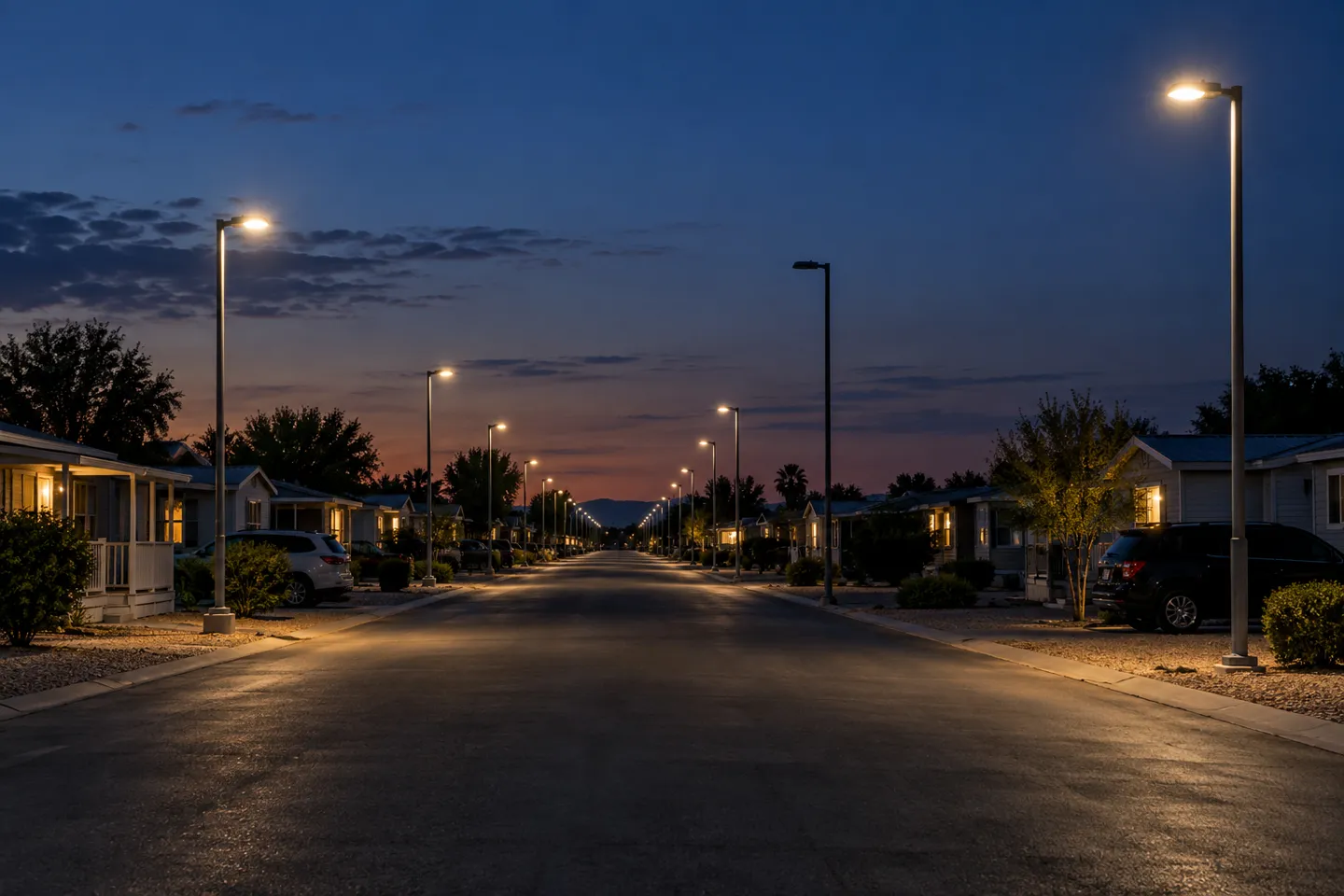
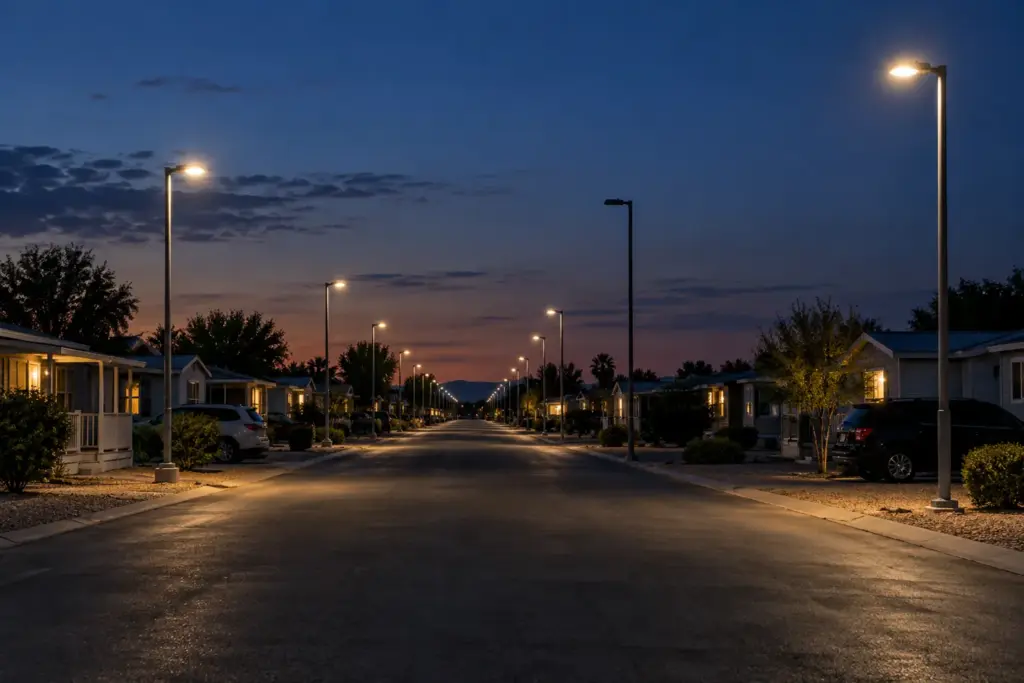
Twenty pole lights stand over a mobile home park. Within about a year, the owner had lost a quarter of them, and he went looking for the pattern. His findings were uncomfortable for anyone who assumes a broken light means a broken lamp. Not one of those failures had anything to do with an LED chip (r/CommercialRealEstate, 2026). Most outdoor lighting maintenance budgets leak in exactly that gap, between what people think fails and what actually fails.
From here, this guide walks the full chain: the routine that prevents the boring failures, the parts that really quit first, the environmental conditions that decide lifespan, and the repair-versus-replace math. It ends where the money ends up, on your maintenance plan or your bid sheet.
What Outdoor Lighting Maintenance Actually Covers
Outdoor lighting maintenance is the work of keeping exterior luminaires producing their designed light output safely. That job lasts as long as the site needs the light. It covers cleaning and inspection on a schedule, troubleshooting when something stops working, and eventually deciding whether a fixture gets repaired, upgraded, or replaced.
One clarification before the details, because the phrase covers two different worlds. Landscape lighting means the garden and pathway fixtures around a home. Area and roadway lighting means parking lots, campuses, and streets, usually on poles ten to forty feet tall. The fixtures differ, but the failure logic underneath them is the same, so everything below applies to both.
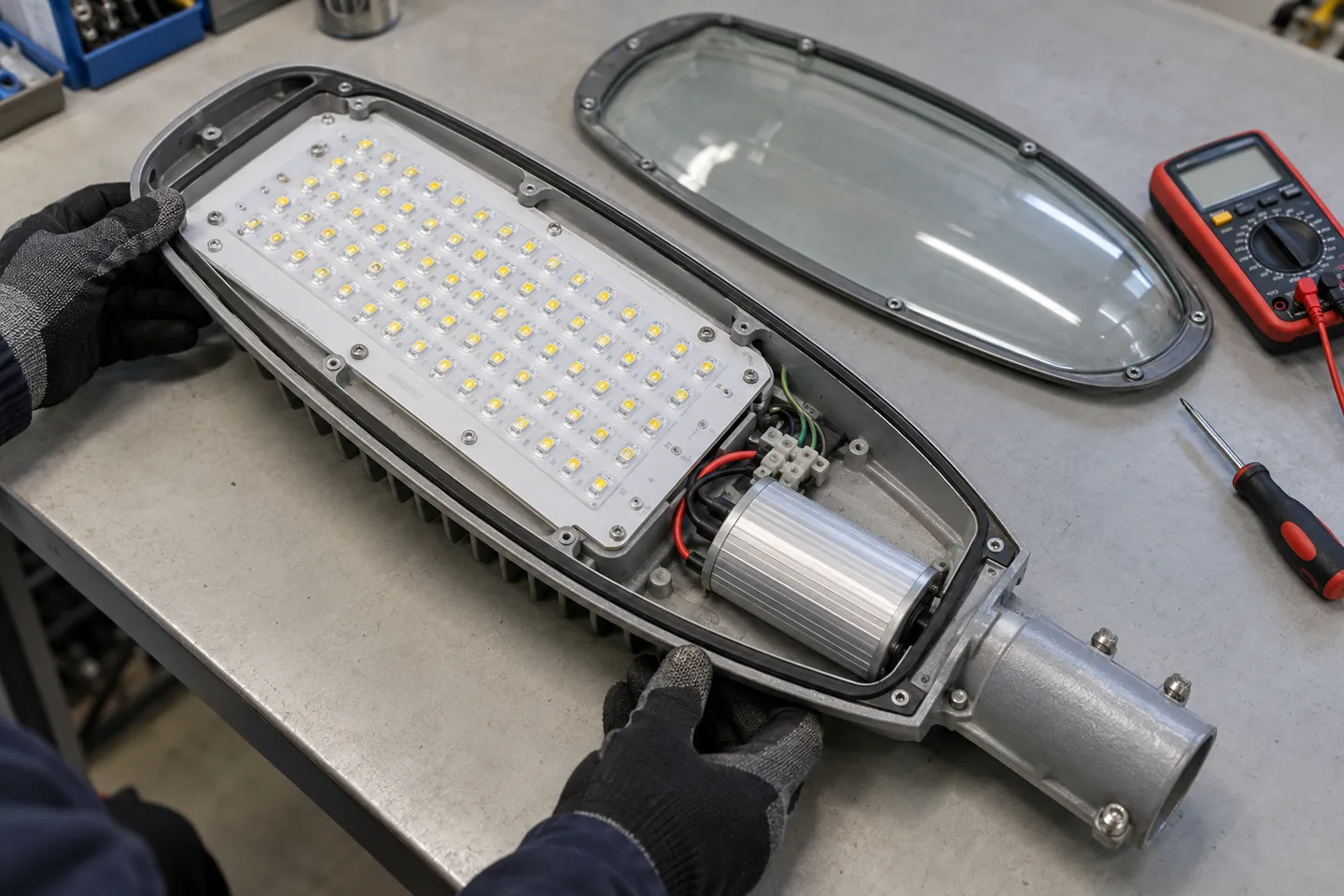
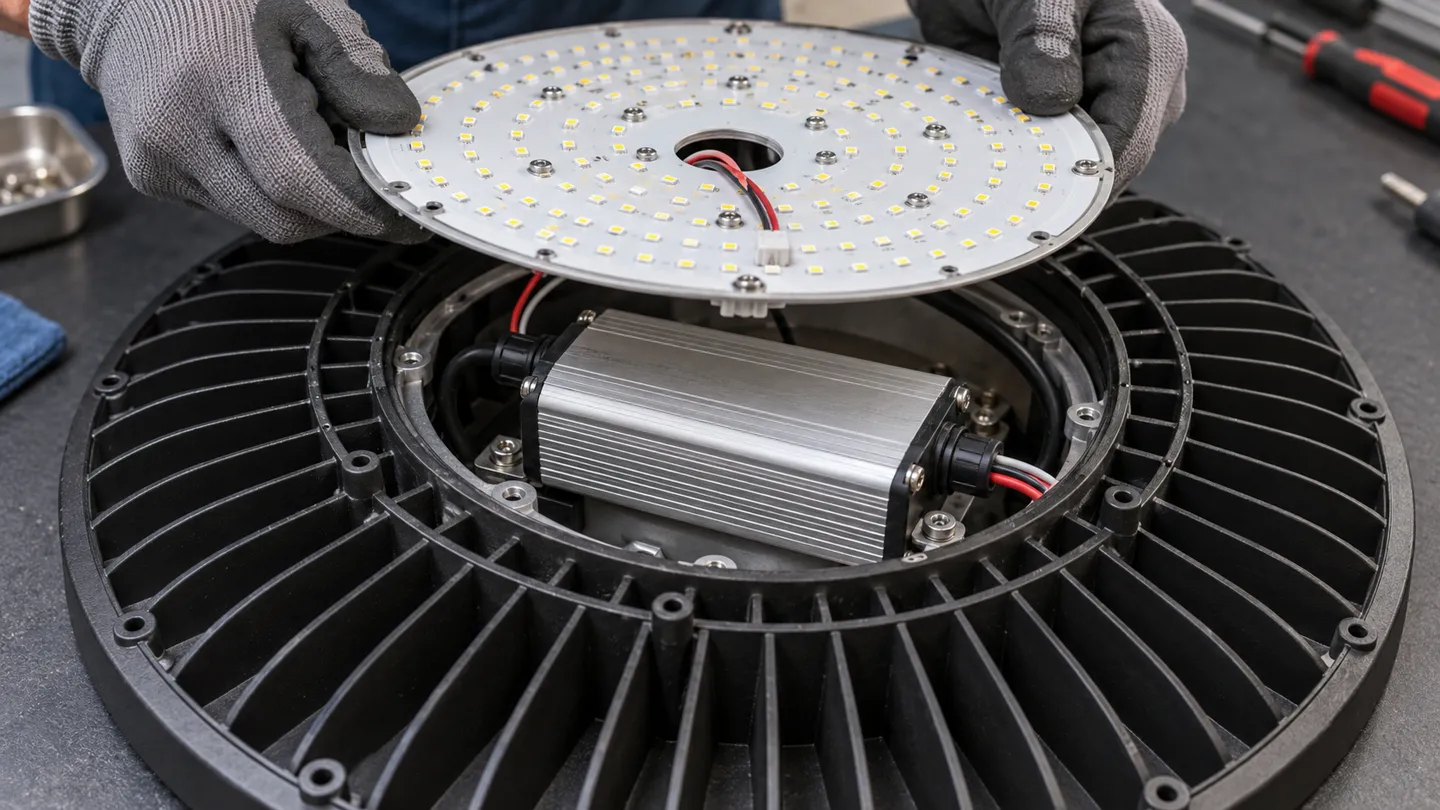
Every outdoor fixture, from a path light to a forty-foot pole unit, does its failing in one of three layers. At the center sits the light source, the LED chip or lamp itself. Around it sits the electrical periphery, everything that feeds and controls the chip: the driver, the photocell, the contactor, and the wiring. Wrapping all of it stands the structure, meaning the housing, the seals, the lens, and the pole that hold everything together against weather.
The common symptoms sort neatly into those layers. A light that never comes on at night points at the periphery, usually the sensor or the circuit. A light that cycles on and off points at a failing sensor or a loose connection. A light that has slowly dimmed over years points at the source, which is normal aging. A fixture with water inside or a corroded shell points at the structure. Keep those three layers in mind, because the rest of this article is just them, in the order they fail.
The Routine That Prevents Most Failures
Most outdoor lighting service calls trace back to a short list of preventable causes. Industry sources that track commercial properties converge on the same short routine: clean the fixtures, clear the vegetation, inspect the wiring. Just as important, they run it on a calendar rather than on complaint (Cast Lighting, 2024; TCPi, 2024).
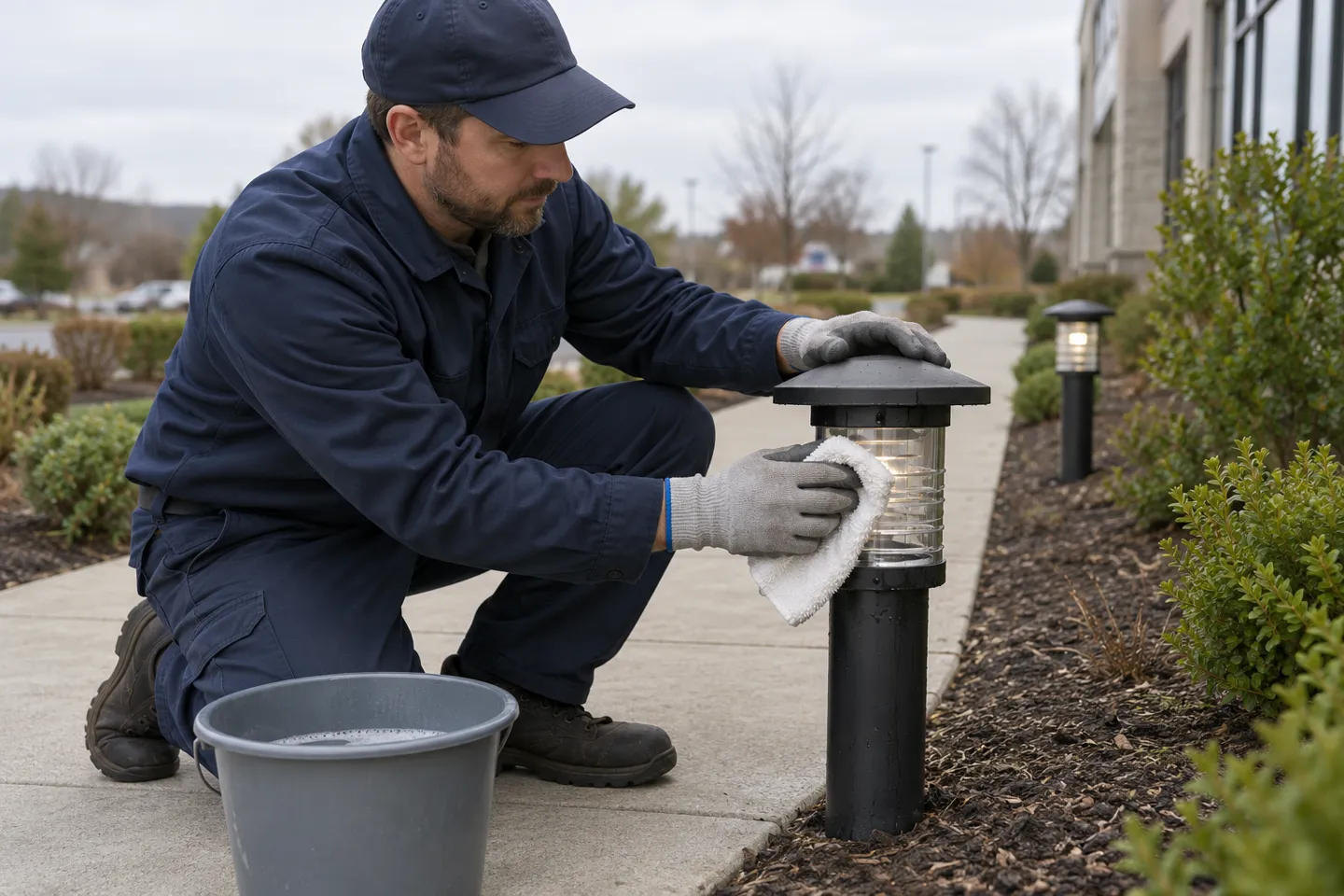
Cleaning sounds trivial until a well-meant cleaning ruins a fixture. Skip the abrasive pads and powder cleaners. They scratch and thin the powder coating that keeps corrosion out, and rust starts in the scratch. Warm water with mild soap and a soft cloth is the whole job for glass and most housings. Acrylic and polycarbonate lenses need a plastic-safe cleaner, followed by a UV protectant if the lens has already gone hazy. Polishing alone removes the oxidation and leaves the plastic naked to the sun again (Cast Lighting, 2024).
Vegetation is the quieter killer. Shrubs that grow into a fixture block its aim, trap moisture against the housing, and give rodents a highway to the wiring. Cut everything back so air moves freely around each fixture. While you are there, look for chewed insulation, one of the most common wiring faults on landscape systems (TCPi, 2024).
Wiring and connection checks are the part worth doing with the power off. Look for nicked or exposed insulation, connectors sitting in soil or standing water, and loose terminations at the fixture and at any junction box. Water in a connector does not announce itself; it just slowly raises resistance until the light at the end of the line flickers or dies.
Season adds the last entry. Freezing winters are hard on seals. One facility-maintenance analysis puts roughly 30 percent of exterior lighting failures in the January-to-March window, driven by thermal stress on gaskets during freeze-thaw cycles (Jolt Electric, 2026). An autumn walk costs an hour and prevents most of those calls: confirm lenses are sealed, drain holes are open, and fixtures sit level so water runs off instead of pooling.
Quarterly outdoor lighting routine
- Wipe lenses and housings with mild soap and a soft cloth; never use abrasives on powder coating.
- Polish hazy plastic lenses with plastic-safe cleaner, then apply UV protectant.
- Cut vegetation back to free airflow around every fixture.
- Power off, then inspect wiring for chewed or nicked insulation and waterlogged connectors.
- Confirm drain holes open and fixtures level before winter.
What Actually Fails First
When a property owner says a light failed, three different things could have happened, and they carry very different price tags. Separating them is the most valuable troubleshooting skill in outdoor lighting, because the layer that failed decides whether you pay for a part, a visit, or a fixture.
The light source rarely dies first
LED chips do not burn out the way the bulbs they replaced did. They fade. Industry ratings describe that fade with the L70 figure. Rated life is the number of operating hours by which light output declines to 70 percent of what the fixture produced new (Westinghouse Lighting, n.d.). A fixture rated 25,000 to 50,000 hours is not promised to die at hour 25,001; it is promised to still give 70 percent of its light at that mark.
That reframes what a warranty hour-count is worth. A chip aging past L70 means gradual dimming you can plan around, not a failure that puts a truck on your site. Older maintenance rhythms, where crews re-lamped entire parking lots on a group-replacement schedule, existed because incandescent and HID lamps died quickly and predictably. LED removed most of that work from the calendar, which is precisely why the remaining failures feel so scattered and expensive.
The electronics fail in years five to ten
With the source lasting longer, the periphery takes over as the failure leader. Trade analysis written for electrical contractors puts LED drivers in a five-to-ten-year failure window, often without warning. Drivers, not chips, are what maintenance contracts actually exist to manage (Lighting Smarts, n.d.).
Photocells deserve special attention, because they are the cheapest part on most poles and the one that quietly runs entire systems. Back at the mobile home park, the owner watched a quarter of his twenty street lights die within a year. He traced the pattern to the dusk-to-dawn sensors and ended up replacing every sensor in the lot, none of the lamps (r/CommercialRealEstate, 2026).
What the pattern showed
The failures were sensors, not lamps
5 of 20
pole lights dead within the first year
0
failures had anything to do with an LED chip
10 min
of attention the ten-dollar sensor actually needed
Field case: one mobile home park owner tracing a year of street light failures, r/CommercialRealEstate (2026)
That sentence is the economics of the whole layer. A sensor that costs less than a takeout dinner sits thirty feet up, and reaching it takes a bucket truck and half a day. That is why one owner was quoted $300 to change a $20 bulb, and why he braced for $400 to $500 per light as the rest aged (r/answers, 2017). The part is cheap; the reach is not.
Contactors sit one level higher and fail in batches. When an entire row or an entire lot goes dark together, the fixture-level diagnosis is usually wrong before it starts. One electrician walked that exact path: he measured 277 volts in and out at the pole, opened it up, and found the fault upstream at the contactor (r/electricians, 2025).
What this buys is a diagnosis order that runs cheapest-to-check first, at the system before the fixture and at the fixture before the part:
Symptom to likely failure layer
| Symptom | Likely layer | First check | Typical fix |
|---|---|---|---|
| One light out, others fine | Fixture periphery | Sensor and lamp socket, then driver | Sensor, driver, or lamp replacement |
| All lights dark at once | System level | Contactor, breaker, timeclock | Contactor or control replacement, not fixtures |
| Light cycles on and off through the night | Periphery | Photocell aiming, then loose connection | Re-seat or replace sensor |
| Light dimmer than its neighbors | Source | Compare lumen age and model | Planned replacement at L70 |
| Flicker in wind or rain | Structure | Connector seating and cable entry | Reseal entry, replace connector |
So before you budget a single fixture replacement, answer the layer question. A cycling light is rarely a dying lamp. It is a ten-dollar sensor asking for ten minutes of attention, and treating it as anything else is how maintenance budgets bleed.
If sensors and drivers, not chips, are what put trucks on your site, ask a fixture manufacturer what spec change ends that cycle.
Ask an Application EngineerWhere Environment Decides Lifespan
Two identical fixtures on two different sites can have very different service lives, and the difference is rarely quality control at the factory. It is what the site does to the seals, the coatings, and the electronics every day. Reading the environment tells you which failures to expect and, just as useful, which numbers to demand from the next supplier.
Water, salt, and the seal chain
Water entry is the classic structural failure, and it rarely comes through a hole. Water takes the indirect paths instead: a gasket that has taken a compression set after years of heat cycling, a cable gland that was never tightened to spec, a housing mounted so level that water ponds on the lens instead of draining off.
An IP code on a spec sheet describes how well the design resists that. IP65 means dust-tight and protected against jets of water; IP66 adds protection against powerful jets, which matters on sites where the maintenance washdown is aggressive.
Coastal and wintered sites accelerate everything in that chain. Salt attacks the least noble metal first, usually the fasteners. A fixture with ordinary steel screws can have its gasket line opened by corrosion long before the housing itself gives up. Salt-spray exposure testing quantifies this. Fastener-level testing commonly runs 48 to 72 hours, while housing-level salt-spray tests run 1,000 hours and beyond on request. Freeze-thaw does the same work mechanically, which is why that January-to-March failure spike keeps showing up in facility data (Jolt Electric, 2026).
Verify before you buy
48-72 h fastener-level salt-spray testing is common; 1,000 h and beyond is housing-level, on request.
Published hours let you compare sealed-design quality on a number instead of an adjective.
Heat, sun, and electrical surges
The other stresses work more slowly. Ultraviolet exposure embrittles acrylic lenses, plastic sensors, and gaskets, which is why fixture plastics carry UV stabilizers and why the cheap ones go yellow and crack in year three. Sustained heat is what ages drivers toward that five-to-ten-year window, so a fixture whose design sinks heat well simply buys driver years. Lightning-prone sites add the quiet one: surge events degrade the driver a little on every strike until it fails. Surge protection belongs in the fixture, not in a footnote.
Serious manufacturers test all of this before shipping rather than after. A well-equipped lighting factory runs thermal cycling from around minus 40 to 150 degrees Celsius at humidity up to 95 to 98 percent, compressing years of service into weeks. Finished lamps age 24 hours a day on soak tests, and every design passes more than 20 inspection items, including dark-room photometry, before it ships. Those laboratory numbers are procurement evidence: they convert a durability promise into a figure you can put in a purchase order.
The matrix below turns the environment-to-failure chain into lines you can act on, one per stress:
Environment stress, field signature, and what to verify
| Site stress | Field failure signature | Verify before you buy |
|---|---|---|
| Coastal salt air | Fastener corrosion opens gasket line, water follows | Salt-spray test hours and stainless fastener spec |
| Desert dust and sand | Lens abrasion, dense dust cake cuts output | IP65 or higher dust rating and lens hardness |
| Freeze-thaw winters | Gasket cracking, January-to-March failure spike | Low-temperature rating and thermal cycling reports |
| Lightning-prone plains | Drivers dying in clusters after storm seasons | Built-in surge protection specification |
| High ambient heat | Shortened driver life, early dimming | Thermal test data and driver temperature rating |
Every row ends in the same place, in a document you request rather than a claim you accept. That habit, asking for the test report instead of the assurance, is what separates a spec that controls maintenance cost from a brochure that does not.
Repair, Retrofit, or Replace: The Math
When a batch of fixtures starts aging, the decision is rarely repair-or-nothing. It has three branches, and the branch you pick determines what your maintenance calendar looks like for the next five years.
Three branches for an aging lighting batch
| Branch | Fits when | Cost logic | Effect on future maintenance |
|---|---|---|---|
| Repair | Failures are isolated and periphery-level | Per-call, typically 300 to 500 dollars at height | Unchanged; the same parts keep aging |
| Retrofit kit | Housings and seals are healthy, electronics are dated | Mid-range, parts plus one visit per pole | Reset for years if seals were verified first |
| Full LED replacement | Seals or housings are failing, or light output no longer meets the site need | Highest upfront, lowest service load after | New warranty and new failure clock |
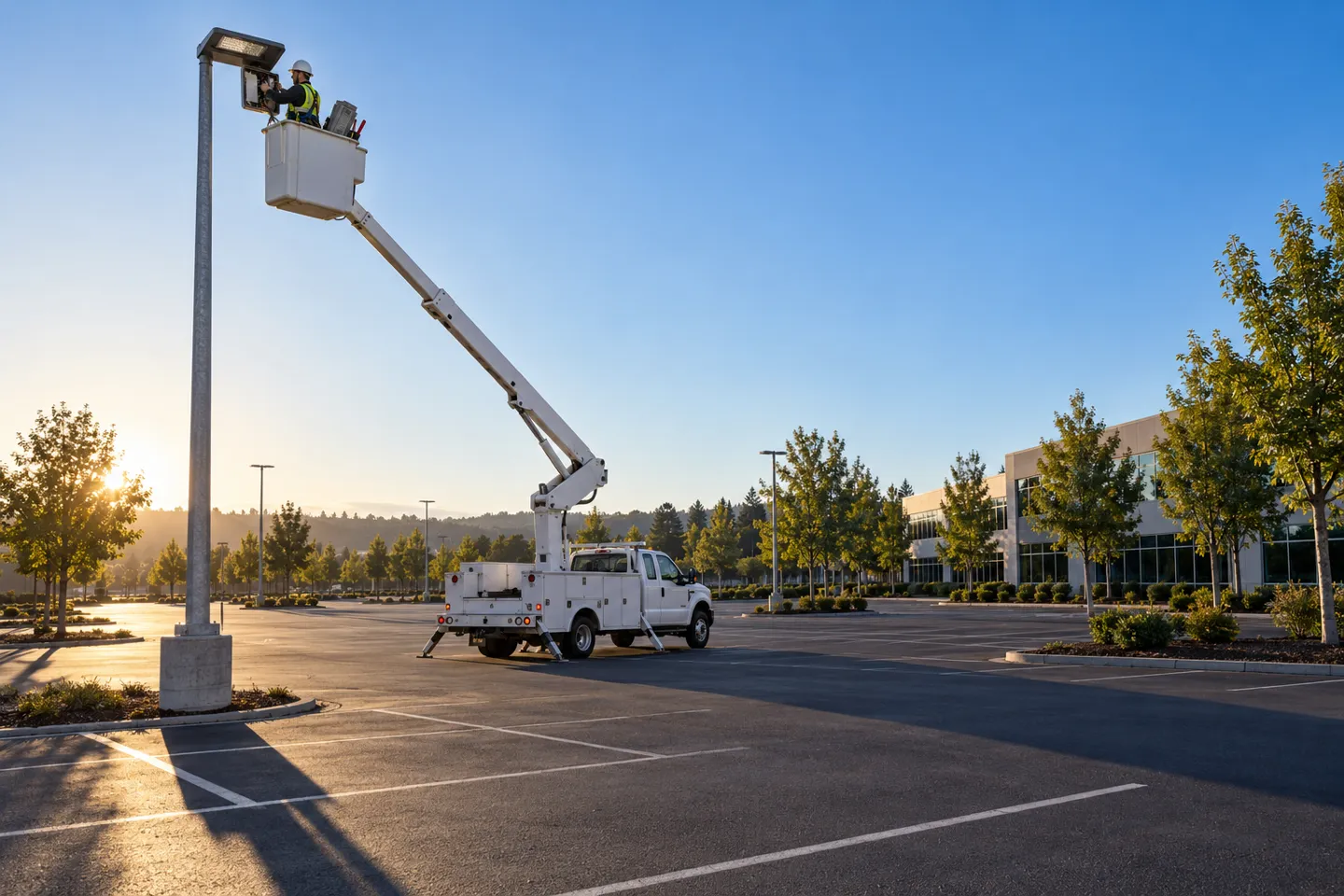
The arithmetic that drives the choice is the gap between the two cost lines. A single high visit runs 300 to 500 dollars. A maintenance contract, by contrast, prices out around 15 to 40 dollars per fixture per year for scheduled care (r/answers, 2017; r/HOA, 2026; Lighting Smarts, n.d.). Anything that multiplies visits, like sensors failing one at a time across a large lot, is therefore the most expensive failure mode per lumen in the entire system.
Frequency should follow asset scale. Six months between checks is the common commercial baseline (Jolt Electric, 2026). Portfolios large enough to care about liability buy monthly patrol subscriptions with photo-verified inspections, and facility managers running relamping programs add photometric testing, so replacement happens on measured output rather than on complaint (Facility Parking Guide, 2024).
Ownership changes who writes the check but not the logic. The HOA board weighing whether to buy its street lights out of a utility lease was staring at exactly this trade. The lease bundles maintenance and power into one bill; ownership makes the 500-dollar-per-light repair risk theirs, along with control over fixture quality (r/HOA, 2026).
One rule saves the most money in this section. Before committing a batch to retrofit kits, sample-audit the seals and housings first. A retrofit that drops a new electronic heart into a waterlogged shell just schedules the next failure. A contractor who took over maintenance on a 25-pole lot made exactly that distinction before spending (r/AskElectricians, 2024).
What to Demand From a Supplier
Everything above converges on a purchase-order question: which fixture features actually buy down maintenance cost? The answer is a short list, and every line of it maps to a failure mode from the sections above.
Low-maintenance specification checklist
- Replaceable driver, ideally with a brand-driver option, so the five-to-ten-year failure is a part swap, not a fixture scrap.
- Surge protection built into the fixture for outdoor service.
- IP65 or IP66 rating, with the test report available.
- Salt-spray test hours stated for fasteners and housing.
- Gasket material and compression design stated, not just “sealed”.
- Photocell and controls from a documented, standard-compliant supply.
- Whole-lamp warranty of 5 years on the series you are buying, not a brand-wide average.
- Aging, thermal, and photometric test reports from the factory on request.
Two of those lines deserve a note. A five-year whole-lamp warranty is not a marketing label. Factories that honor it run different component grades, and the disciplined ones go further: physically separate production lines for 2-year-warranty standard products and 5-year-warranty engineered products, so the two never share a process standard. That separation is why the warranty tier carries a real price difference. A 2-year line remains the rational choice for budget circulation projects; a 5-year line is the rational choice whenever a maintenance window of five years or more is attached to the site.
The rest of the checklist is cheaper than it looks. Drivers with brand options, published salt-spray hours, and available aging reports cost a manufacturer discipline, not necessarily your budget. They are the difference between arguing a warranty claim and citing a test report.
What This Means for Your Bid Sheet
Run the chain once more and it reads like a business case. The parts that fail are in the periphery, not the chip. Reaching them costs hundreds per visit. A five-year maintenance window therefore contains a predictable number of truck rolls, and the fixture features above are what set that number. A bid that compares only lumens per dollar is comparing the one component that almost never fails. The service load, the line item that actually swings the margin, stays unpriced.
That is the case for writing the specification into the bid rather than trusting the post-award relationship. Replaceable drivers, surge protection, sealed-and-proven housings, and a five-year whole-lamp warranty transfer the periphery failure risk back to the party best able to carry it, the manufacturer. Ownership matters here too. On leased poles the utility’s bundle hides these costs; the moment a site owns its lights, every unspecified requirement converts into its own service budget.
This is exactly why we build warranty depth into the product line rather than around it. WOSEN’s LED street light series pages list a 5-year whole-lamp warranty, our overseas teams commit to a 12-hour response on service questions, and failed units are repaired to compliance before re-shipment. One-side freight and duty are covered inside the warranty period; the specifics sit on our after-sale service terms. If a five-year maintenance window is part of your next bid, the specification, not the promise, is what carries the risk.
Put the Maintenance Math in Your Bid
WOSEN builds street lights around a five-year whole-lamp warranty, replaceable drivers, and published salt-spray and aging reports.
Get a Project QuoteReferences
- Lighting Smarts. “What Electrical Contractors Get Wrong About LED Maintenance Contracts.” n.d. https://www.lightingsmarts.com/industry/articles/view/31940
- Jolt Electric. “Your Guide to Parking Lot Lighting Maintenance.” 2026. https://www.joltelectric.biz/post/parking-lot-lighting-maintenance
- Reddit r/CommercialRealEstate. “Suggestions for Street Lights/Parking Lights?” 2026. https://www.reddit.com/r/CommercialRealEstate/comments/1rwrxrj/suggestions_for_street_lightsparking_lights/
- Reddit r/answers. “Parking Lot Light Bulb Change.” 2017. https://www.reddit.com/r/answers/comments/5mkmjc/parking_lot_light_bulb_change/
- Reddit r/HOA. “Switching from Power Company-Owned Street Lights to HOA-Owned Street Lights.” 2026. https://www.reddit.com/r/HOA/comments/1si5zns/switching_from_power_company_owned_street_lights/
- Reddit r/electricians. “What Are We Doing to Repair Pole Lights Nowadays?” 2025. https://www.reddit.com/r/electricians/comments/1ikgtx3/what_are_we_doing_to_repair_pole_lights_nowadays/
- Reddit r/AskElectricians. “Hello, Want to Replace My Parking Lot Lights.” 2024. https://www.reddit.com/r/AskElectricians/comments/1b8ikb3/hello_want_to_replace_my_parking_lot_lights/
- Facility Parking Guide. “Parking Lighting Maintenance and LED Upgrade Management.” 2024. https://facilityparkingguide.com/maintenance/parking-lighting-maintenance-upgrades/

 English
 Spanish
 French
 German
 Italian
 Arabic
 Russian
 Portuguese
 Dutch
 Indonesian
 Turkish
 Polish