
The fixture over aisle 4 went dark sometime during the night shift. By morning, forklift drivers are steering around a pool of shadow, and the maintenance log has one line in it: “light out, aisle 4.” Someone now has to schedule a lift, a technician, and a couple of dark hours to look at a unit that is supposed to last 50,000 hours. That gap between the number on the spec sheet and the fixture that just quit is exactly what LED maintenance has to manage.
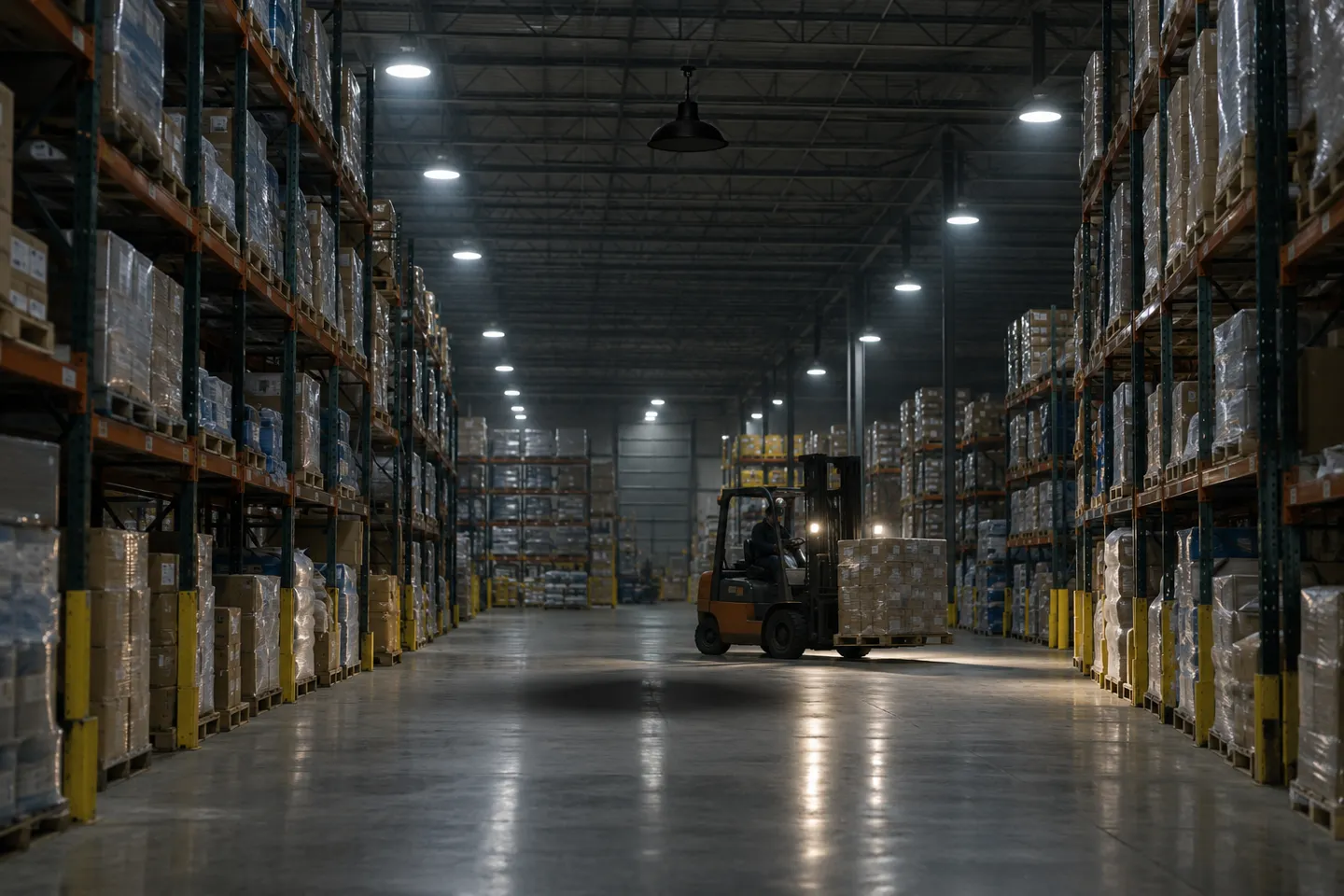
Maintenance means something different when the lamp cannot be swapped. An integrated LED fixture has no bulb to burn out, so the work settles into three buckets. You keep the light coming out (cleaning), and you keep the connections sound (inspection). Records tell you whether output is drifting.
A Working Maintenance Cadence for LED Fixtures
| Interval | Action | What it protects |
|---|---|---|
| Monthly | Wipe lenses and diffusers on fixtures in dusty or oily areas; use a damp cloth, no abrasives | Light output, before dust films it over |
| Monthly | Function-test emergency and exit units on the cycle your fire code sets (often a short monthly test plus an annual full-duration run) | Life-safety compliance |
| Quarterly | Check cord grips, cable ties, mounting hardware, and accessible connections; listen and look for flicker reports | The electrical connections that fail before chips do |
| Annually | Take spot lux readings in fixed positions and compare them to last year and to the commissioning values | Early warning on lumen maintenance |
| Annually | Clean or inspect heatsink fins in high-dust zones, power off first | Thermal headroom that keeps the driver alive longer |
Two safety lines belong in front of everything else. Kill the breaker before you touch a fixture, because a switch that is off is not a guarantee. And work at height belongs to whoever owns the lift and the training, not to whoever brought a ladder.
Cleaning has one honest limit: it protects output, and nothing else. A spotless lens does nothing for the electrical side of the fixture, which is where most early deaths actually happen.
Why “Dead” LEDs Are Usually Not Dead LEDs
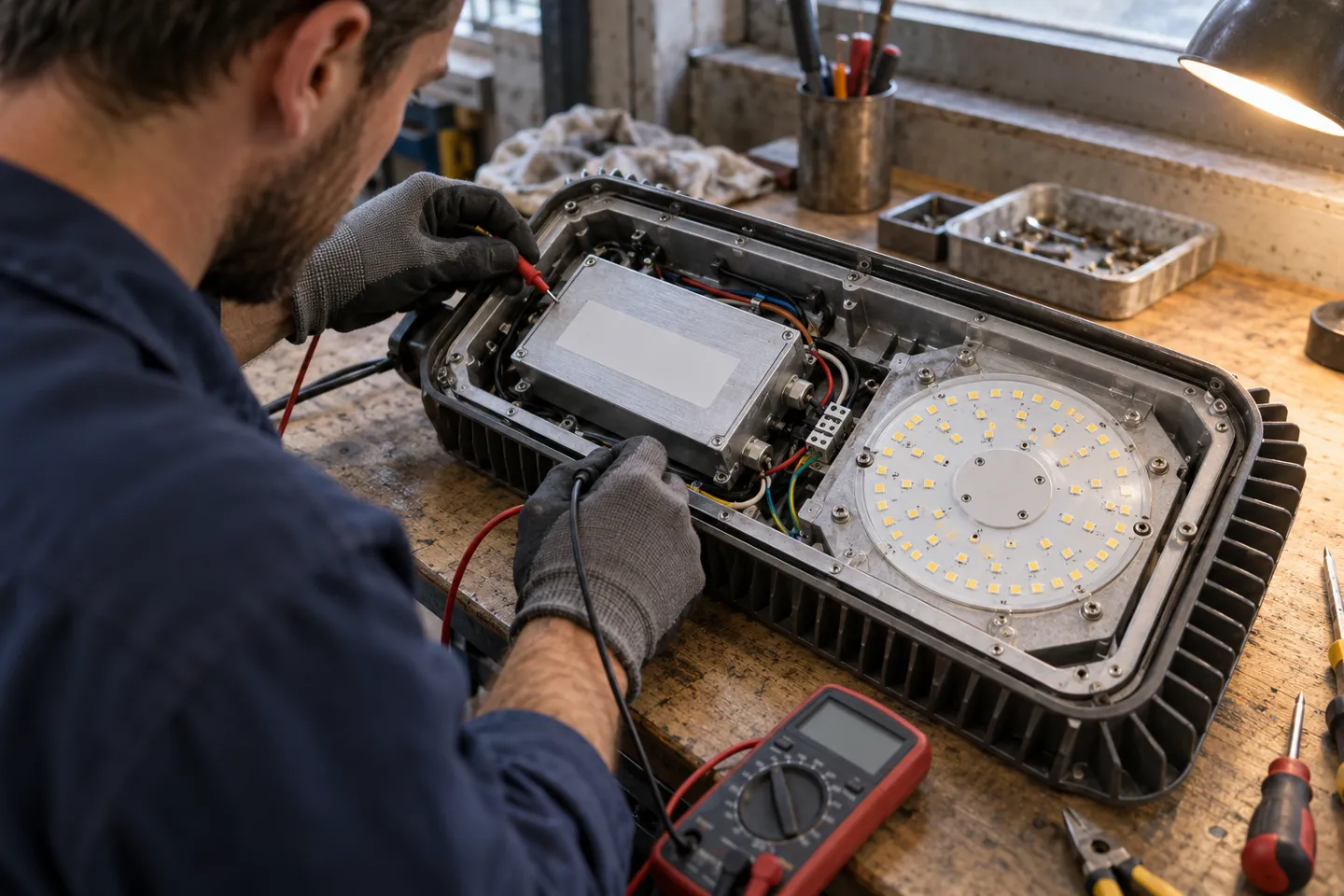
In the field, most LED failures are not the LED.
The driver and its supply side usually reach end of life first, and they take the whole fixture down with them.
Ask anyone who has opened a failed fixture. Maintenance threads are full of the same autopsy: the chips look fine, the light stays dark, and the part that gave up is the driver (r/Costco, 2026). That pattern is not bad luck. It follows from how the two halves of a fixture age, and it changes where your diagnosis should start.
Match the Symptom Before You Blame the Chip
Symptoms cluster, and each cluster points somewhere different. Reading them in order saves a wasted lift trip.
Symptom to Suspect Map
| Symptom | Most likely causes | First check |
|---|---|---|
| Flickering | Loose connection, driver at end of life, supply voltage fluctuation | Wiggle-test connections with power off, then ask whether neighbors on the same circuit flicker too |
| Gradual dimming across a zone | Normal lumen maintenance aging, or driver output sagging | Compare spot lux readings against commissioning values before buying parts |
| Whole unit dead | Driver failure, surge-damaged input parts, interrupted supply | Confirm power at the fixture, then treat the driver as the prime suspect |
| Intermittent, cuts out and restarts | Thermal protection tripping in the driver, or a marginal connection | Note whether it quits more in summer or in enclosed fixtures, which points at heat |
The order of suspicion matters: supply first, then wiring and connections, then driver, and the chips last. Most of that sequence is safe for a maintenance generalist with the circuit off. The moment mains-side components come out of their enclosure, the job belongs to a licensed electrician.
Why the Driver Usually Dies First
Inside the fixture, two clocks run at different speeds. The light-emitting chip is a semiconductor that degrades slowly when heat is managed. The driver is a box of electrolytic capacitors and switch-mode electronics, and electrolytic capacitors carry wet electrolyte that evaporates through their seals over time. A long-standing rule of thumb in capacitor engineering holds that lifetime roughly doubles for every 10°C reduction in operating temperature (Analog Devices, n.d.). A driver running hot in a sealed housing is therefore aging many times faster than the chip it serves.
The rated hours on the box do not describe the driver. LED “lifetime” ratings are lumen-maintenance figures: the industry defines rated life as the point where output has decayed to about 70% of its initial level (ENERGY STAR, n.d.; U.S. DOE, n.d.). That number is a chip clock. It says nothing about when the capacitors beside the chip will dry out. Buying on rated hours alone means pricing the part that rarely fails and ignoring the one that usually does.
Surges and Dirty Power Kill in Batches
Surges are the other early killer, and they rarely kill politely, one fixture at a time. A switching event on the grid, a large motor starting, or a lightning strike nearby arrives at every fixture on the circuit at once. Surge protection guidance treats the driver and its input parts as the standing casualties for exactly this reason (Super Bright LEDs, 2023). The sacrificial parts at the driver input absorb what they can. One repair-thread classic is a shop light that went dark after a surge: its protection component had failed short (r/ElectronicsRepair, 2025).
Power quality explains why some sites age fixtures fast while identical units elsewhere run for a decade. Garage and workshop owners see the same thing from the other side. The quality of the electricity feeding the lights strongly affects how soon fixtures need replacing. Some report being on their third set of budget shop lights in eight years (GarageJournal, 2025). Importers and contractors serving regions with unstable grids see the same story at scale, with failure reports arriving in clusters after grid events rather than as random singles.
That is the electrical story: chips endure, drivers age, and surges batch-kill the weak. The next variable is where the fixture lives.
Environment Sets the Decay Rate
Two identical fixtures can age at very different speeds, and the difference is usually the room, not the unit. Heat is the quiet one. A fixture in a hot roof void or a cramped, unventilated canopy runs its driver hotter. By the 10°C rule from the last section, that alone can halve capacitor life per step. Lumen depreciation accelerates with heat too, so the chip clock also runs faster.
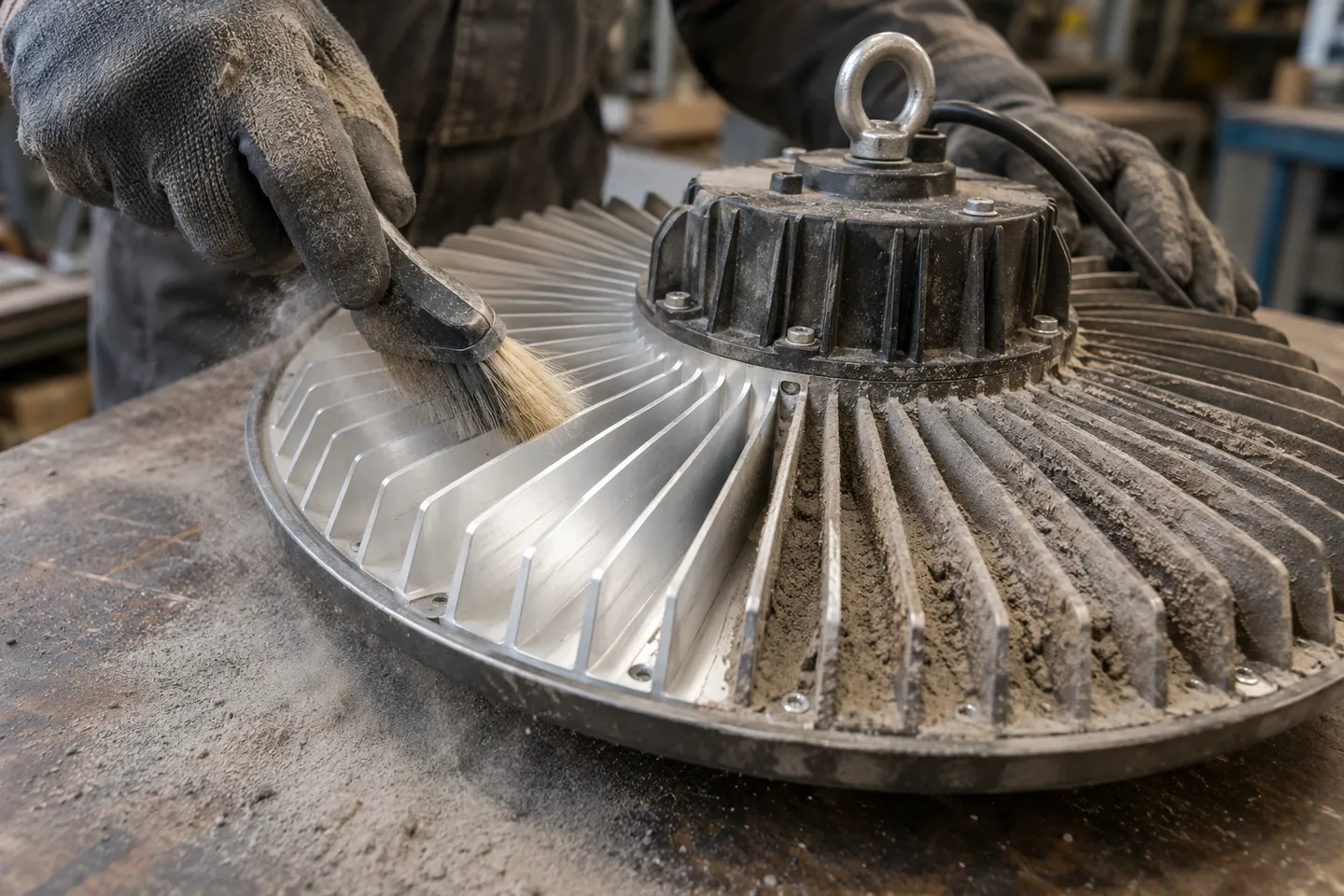
Dust lands in two places, and only one is visible. On the lens, a dust film dims the output and announces itself, which is why cleaning earns its monthly slot. On the heatsink fins, dust forms an insulating blanket that no one sees, trapping heat against the driver and chips. The invisible accumulation is usually the more damaging one, which is why high-dust zones need fin cleaning on the schedule, not just lens wiping.
Water and corrosion are where ingress protection ratings enter. IP65 and IP66 both mean dust-tight; the difference is water jets versus powerful water jets under the IEC test definitions (UL, n.d.; IEC, n.d.). Read those as laboratory classifications, not field-life promises. Directed pressure washing can force water past gaskets that passed the test rig, and coastal salt air corrodes hardware that fresh-water lab testing never encounters. Match the rating to the wash-down and climate reality of the site.
Impact rounds out the picture. IK ratings measure resistance to mechanical impact in joules, and IK07 corresponds to withstanding a 2-joule strike (UL, n.d.). Forklifts clip fixtures in warehouses, balls find floodlights, and vibration works connections loose over years, which feeds straight back into the flicker symptoms from the last section.
Four-Line Site Self-Check
Heat
Enclosed or hot spaces
Dust
Fine or fibrous airborne
Water
Wash-down, weather, salt
Impact
Vehicles, balls, vandalism
Whichever line your site fails is the one that belongs in your next procurement specification, because the environment that beats the rating does not care what the catalog said.
Repair, Replace, or Regroup
When a fixture does go down, the vocabulary of the lamp era misleads. There is no relamping an integrated fixture. What is actually replaceable is usually the driver or a power module, sometimes not even that, and the decision behind every service call is which response fits.
The Repair-or-Replace Line
Three checks sort most cases. First, is the driver identifiable and obtainable: a readable spec label and a stocked or orderable replacement make a driver swap a one-visit fix. Second, check whether the light output still has life in it. If spot lux readings sit well above the level where the task suffers, the chips are worth keeping. Then the driver is the right spend. Third, ask whether the housing is honest. Cracked lenses, corroded gaskets, or fin damage mean the protection is compromised. A new driver inside a dying shell is money into a fixture you will revisit soon.
Driver swaps get one boundary warning. If the driver is obsolete with no stocked successor, or the seal has to be destroyed to reach it, repair economics collapse. Confirm the spec label and parts availability before you schedule the lift, not after.
Group Replacement Economics
At height, the visit costs more than the part. The lift, the trained hands, and the downtime repeat for every call, which is why case-by-case response quietly becomes the most expensive policy on the books. Planned group work inverts the math: one scheduled visit handles a whole zone while the lift is up.
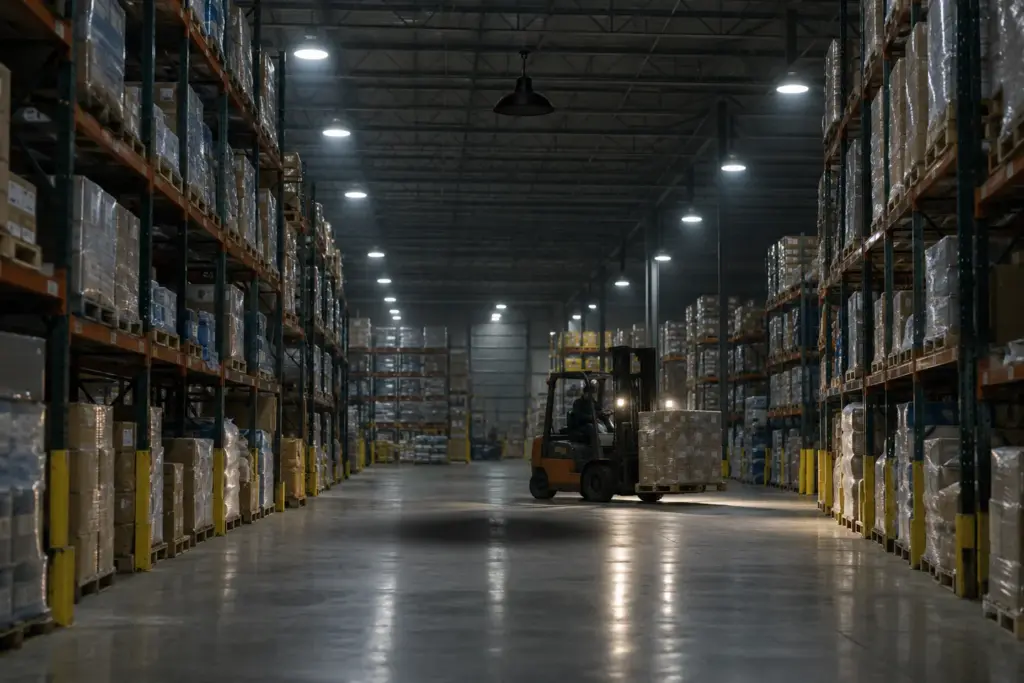
The trigger for group work is a maintained-light threshold, not a failure count. Watch the zone average. When it drifts below the levels recommended for the task, stop chasing singles and plan zone work instead. The IES reference for common warehouse aisles is roughly 15 to 30 footcandles (PacLights, n.d.). Your annual lux readings from the first section are the early warning that feeds this decision.

Spares follow the same logic. Drivers are small and comparatively cheap, so a shelf of common driver spares covers most electrical failures at a fraction of the cost of warehousing whole fixtures. Keep a few complete sealed units only where corrosion or impact is expected to kill housings faster than electronics.
Upgrading is the fourth option, and it has a clean trigger too. Sometimes a legacy high-bay or fluorescent system needs lift visits several times a year just to keep lamps changed. Add the energy savings to the retired maintenance hours. If the stack is big enough, price an LED conversion now, before the next ballast order.
Four Responses, and Where Each One Breaks
| Response | Best when | Fails when |
|---|---|---|
| Driver swap | Driver labeled and obtainable, chips still deliver task light, housing intact | Driver obsolete, seal must be destroyed, or shell damage means the fixture is compromised anyway |
| Replace fixture | Housing or optics damaged, light output below task needs, spare budget favors new stock | Failure is electrical-only and a stocked driver would have fixed it for far less |
| Group replacement program | Zone illuminance drifting below task levels, lift access costly, failures clustering by age | Site is small, failures are genuinely random, or budget cannot fund planned work |
| Full LED upgrade | Legacy system demands frequent lamp-and-ballast visits, energy plus maintenance hours stack up | Existing LED stock is young and healthy, or capital cycle forces waiting |
Spec for Maintainability
Everything above turns into a procurement position in one sentence. Failures cluster on the electrical and environmental sides, so the acceptance list should be ordered the same way. Start with the driver. Ask which unit is installed, whether it comes from an established brand with a documented replacement chain, and what its own rated life is. That last number stands apart from the chip hours. Then surge. For any site on a soft grid, require surge protection at the fixture or in the panel. Make the protected level a written spec line, not a brochure word.
Match protection to the site, not to the brochure. The four-line environment check from earlier (heat, dust, water, impact) converts directly into IP and IK requirements. Thermal design deserves its own glance: visible fin area and a stated temperature rating show the housing was engineered to keep the driver cool. That is the single variable that buys back capacitor life.
Warranty structure is the readable part of a manufacturer’s confidence. The industry quietly separates standard-warranty and extended-warranty products, sometimes running them on different production lines with different component grades, because the failure anatomy of each tier is different. Read any warranty for three things: how many years, what it actually covers (whole lamp or parts only), and what the response and parts commitment is behind it. A long number with no parts and response terms is a marketing figure, not a maintenance plan.
Keep spares and response in the same conversation as hardware. A supplier who can ship a matching driver years after purchase changes the math. So does one who answers a failure report in hours instead of weeks. Both matter more to lifetime cost than a few efficiency points.
The Acceptance List, in Failure Order
- 1
Driver tier and replaceability
Established brand, documented replacement chain, the driver’s own rated life
- 2
Surge protection
At the fixture or in the panel, written as a spec line
- 3
Ingress and impact matched to the site
IP and IK chosen from the four-line environment check
- 4
Thermal design
Visible fin area and a stated temperature rating
- 5
Warranty terms
Years, what is covered, parts and response commitment
- 6
Spares and response
Driver availability years later, answer time on a failure report
Rated chip hours still matter. They belong at the bottom of the page, because they describe the component least likely to quit first.
If you are assembling that acceptance list for your next quote, bring it to us. Our team at WOSEN answers overseas technical and after-sales inquiries within 12 hours. We are used to being asked for driver details before prices.
Bring Us Your Acceptance List
Send your environment check and spec lines to WOSEN; we reply with driver details, protection ratings, and pricing within 12 hours.
Start a Spec ReviewReferences
- Reddit r/Costco. “LED Shop Lights Life Expectancy.” 2026. https://www.reddit.com/r/Costco/comments/1x6ta2k/led_shop_lights_life_expectancy/
- Analog Devices. “Ensure Long Lifetimes from Electrolytic Capacitors: A Case Study in LED Light Bulbs.” n.d. https://www.analog.com/en/resources/technical-articles/ensure-long-lifetimes-from-electrolytic-capacitors-a-case-study-in-led-light-bulbs.html
- ENERGY STAR. “Learn About LED Lighting.” n.d. https://www.energystar.gov/products/learn-about-led-lighting
- U.S. Department of Energy. “Lifetime and Reliability of LED Lighting Products.” n.d. https://www1.eere.energy.gov/buildings/publications/pdfs/ssl/life-reliability_fact-sheet.pdf
- Reddit r/ElectronicsRepair. “LED Shop Light Usually Won’t Turn On — Is the Board Repairable?” 2025. https://www.reddit.com/r/ElectronicsRepair/comments/1lx6lc6/led_shop_light_usually_wont_turn_on_is_the_board/
- Garage Journal. “Anyone Have LED Shop Lights That Last?” 2025. https://www.garagejournal.com/forum/threads/anyone-have-led-shop-lights-that-last.552681/
- UL. “IK and IP Testing for Lighting Products.” n.d. https://code-authorities.ul.com/wp-content/uploads/sites/2/2018/06/IK-and-IP-Testing-for-Lighting-Products.pdf
- International Electrotechnical Commission. “IP Ratings.” n.d. https://www.iec.ch/ip-ratings

 English
 Spanish
 French
 German
 Italian
 Arabic
 Russian
 Portuguese
 Dutch
 Indonesian
 Turkish
 Polish