
Every report on stadium lighting agrees on one thing: the market is growing. Almost everything else depends on who published the report. Four major research houses put the 2025 market anywhere between USD 633.6 million and USD 882.55 million.
That spread is not noise. It points to the real story underneath this market: what counts as “stadium lighting” is changing, and the money is moving with it. Maybe you are a contractor pricing a first LED stadium bid. Maybe you run distribution and wonder whether sports lighting deserves line-card space. Maybe you supply the trade and are picking the next product line to back. Whichever you are, the totals matter less than the structure. This article walks the market from totals to structure: what it is, where growth comes from, who is winning, and the engineering boundaries that decide whether a retrofit pays.
What Stadium Lighting Is and Why It’s Being Replaced
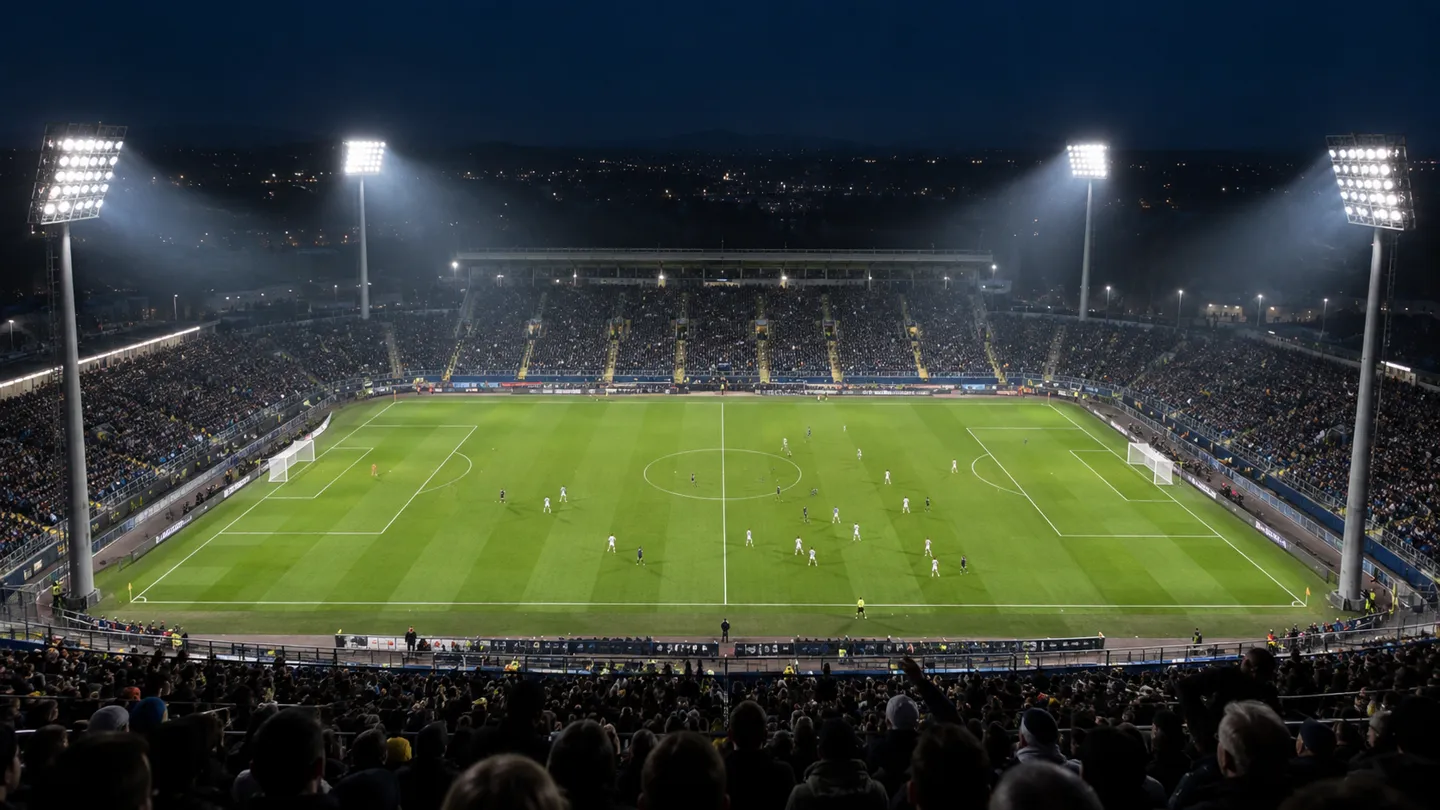
Stadium lighting is engineered flood lighting designed to hit a target illuminance and uniformity across a playing surface. The fixtures usually mount on masts or roof arrays twenty to fifty meters up. It is not the same product as a commercial flood light, even though both get called “flood” lights. A purpose-built sports luminaire uses narrow, controlled beam optics so that light lands on the field instead of spilling into stands or neighbors’ windows. That engineering is what separates a training-field setup from a broadcast venue, and the two can differ by an order of magnitude in requirements.
The old technology is metal halide, a high-intensity discharge lamp. It has three chronic problems. The lamps need several minutes to warm up and just as long to restart after a power dip, which matters enormously when a match stops for weather. They convert a lot of electricity into heat rather than light. And they burn out on schedules that send maintenance crews up masts constantly.
LED flips each of those problems. Systems switch on instantly and restrike immediately, so a delayed event can resume without a wait. Independent comparisons put energy savings at 60 to 75 percent versus metal halide systems at comparable delivered light (Stouch Lighting, 2026). Beam control gets precise enough to cut glare and light spill, which matters as much to neighbors and broadcasters as it does to players. And the better-engineered fixtures carry rated lifetimes in the 50,000-hour class, which stretches maintenance cycles from seasons to years.
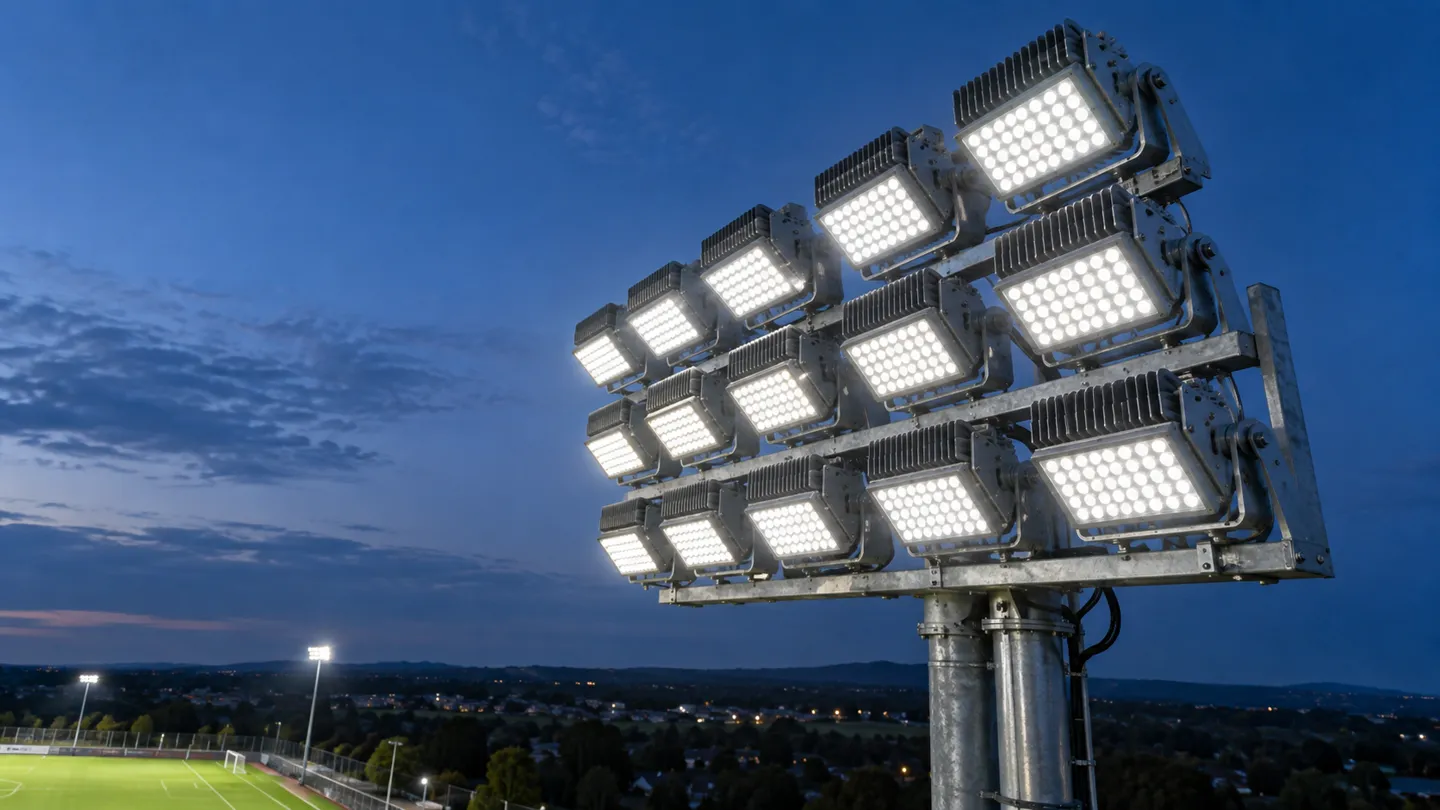
This replacement wave is the engine under the entire market’s growth story, so it is worth holding onto one caveat: LED is not an automatic win. Fixtures cost more up front, and the rated lifetime only arrives if the driver and thermal design are right. We will come back to both points when we get to retrofit projects.
How the Stadium Lighting Market Is Structured
Anyone reading market reports needs to know the four axes this market gets sliced along, because publishers count them differently.
The first axis is light source. LED now dominates new installations, while metal halide survives mainly in aging installations that have not yet been converted. The second axis is venue type: outdoor set-ups, the classic mast-and-array stadium, and indoor set-ups for arenas and sports halls. The third axis is project nature, and it is the one with the most commercial weight: new construction versus retrofit of existing venues. The fourth axis is what vendors actually sell, and the most detailed report structures split it three ways: lamps and luminaires, control systems, and services, both pre-installation and post-installation (MarketsandMarkets).
The Four Axes of the Stadium Lighting Market
| Axis | Values | Why it matters |
|---|---|---|
| Light source | LED vs. metal halide | sets the replacement cycle |
| Venue type | outdoor masts vs. indoor arenas | different fixtures and optics |
| Project nature | new build vs. retrofit | different risk profiles |
| Offering | luminaires vs. controls vs. services | different margins and different report scopes |
That fourth axis explains most of the confusion in market numbers. A report that counts only luminaires will size the market far smaller than one that also counts control systems and installation services. Neither is wrong. They are measuring different slices of the same market, and the slice boundaries are moving as value shifts toward controls and services.
Keep one more axis in your pocket for later: venue grade. A training ground, a club facility, and a broadcast venue all buy “stadium lighting,” but the standards they must hit are different animals. We will deal with that in the section on retrofit failures.
Reading the Numbers: Size, Growth, and What Drives It
Here are the headline numbers side by side, all quoting the 2025 base year.
Same Market, Same Year, Different Numbers
| Publisher | 2025 estimate | Forecast | CAGR |
|---|---|---|---|
| Persistence Market Research | USD 633.6M | USD 1,058M by 2032 | CAGR 7.6% |
| SNS Insider | USD 678.5M | USD 1,427.3M by 2035 | CAGR ~8% |
| GMInsights | USD 813.3M | USD 2.18B by 2035 | CAGR 10.9% |
| Straits Research | USD 882.55M | USD 1.81B by 2034 | CAGR 8.31% |
The spread exists for structural reasons. Some publishers count luminaires only; others add control systems and services. Base years and exchange rates differ. Forecast windows end in 2032, 2034, or 2035. Before quoting any of these figures, ask three questions: what is inside the scope, which base year, and when does the forecast end. Anyone who quotes a single number without those qualifiers is borrowing certainty the data does not have.
The more useful question is where the growth actually comes from, because it comes from two distinct tracks.
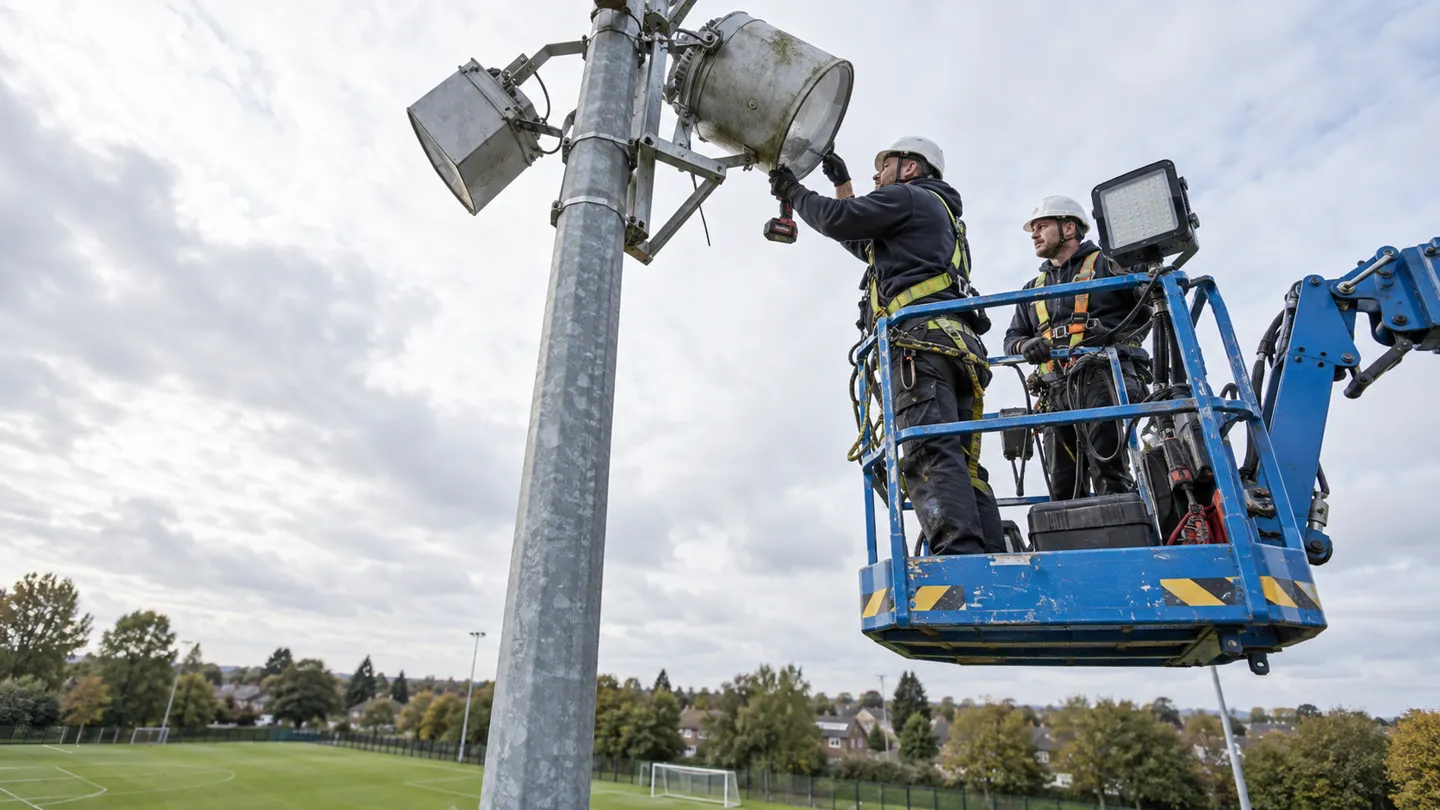
The first track is retrofit. Thousands of venues installed metal halide fleets twenty or thirty years ago, and those fleets are now past their economic life. Maintenance costs rise, energy prices make the old systems expensive to run, and every LED conversion cuts operating costs by 60 to 75 percent. Retrofit demand does not need new stadiums to be built; it needs old ones to keep operating, which is the safer bet.
The second track is new construction, driven by major events and infrastructure spending. Saudi Arabia’s 2034 FIFA World Cup bid alone lists fifteen venues across five host cities. That program combines four existing stadiums, three under construction, and eight planned new builds (Saudi 2034 bid committee). Each of those projects includes a full sports-lighting package.
The signal that matters most for the future, though, sits above the fixture. Fortune Business Insights reports that more than 53 percent of new stadium construction projects now include integrated digital technologies such as automated lighting controls. In other words, the majority of new venues are buying systems, not just lamps. The growth story is gradually migrating from the fixture to everything above it, and that is where margins are concentrating too.
One popular question deserves a one-line answer here: what does stadium lighting cost? Per fixture, or per field, the honest answer is that it depends on the venue grade, the number of poles, and whether the project is new or retrofit. That is a project question, not a market question, and treating it casually is exactly how bids go wrong.
Stadium lighting cost is a project question, not a catalog question — send WOSEN your venue grade and target class, and get a photometric simulation and configuration quote for your exact layout.
Request a Project AssessmentWho Wins in a Fragmented Market: Competitive and Regional Landscape
A market the giants have not locked up
The biggest names in sports lighting are Signify, Musco Lighting, Acuity Brands, Eaton, and Zumtobel Group. Together they held 35.5 percent of the market in 2025 (GMInsights). Let that number sink in, because it runs against the intuition that a market full of famous brands must be consolidated.
The five largest players hold about a third. The other two-thirds is a long tail of regional manufacturers, project contractors, and white-label suppliers, competing hard on price. At the top end, broadcast-tier venues gravitate to specialists like Musco and the major brands, where proven photometric performance and service networks justify premium pricing. The volume of projects, however, lives in the tail: municipal fields, school districts, community clubs, and mid-size commercial venues.
That tail is where the opportunity sits for distributors and regional suppliers. Independent Electric Supply, an American electrical distributor, built a sports-lighting practice around exactly this insight. It supported key contractors and served municipal needs that its leadership described as underserved and frequently unrecognized (LinkedIn, Channel Marketing Group interview, 2024). The municipal field that a top-five brand’s sales team never visits is a real project with a real budget.
Who wins in a fragmented market
35.5%
Combined 2025 share of the five largest sports-lighting suppliers: Signify, Musco, Acuity, Eaton, and Zumtobel Group.
In a tail this fragmented, no supplier wins a project on unit price alone. Differentiation lives in engineering support and warranty credibility — the two things the tail consistently fails to deliver.
Where the demand sits
Regional demand is not uniform, and neither are the barriers to entry.
Regional Demand Map
| Region | Demand nature | Entry gate | Sourcing implication |
|---|---|---|---|
| North America | retrofit + municipal replacement | UL/ETL certification | efficiency and controls matter |
| Asia-Pacific | new construction-led | local standards and price competition | volume tiers and cost discipline |
| Europe | steady retrofit, high standards | CE, ENEC, EN 12193 compliance | certified, glare-controlled optics |
| Middle East & Africa | event and infrastructure pipeline | certification for customs, dust/heat specs | IP66 sealing and thermal design |
The Middle East and Africa deserve a specific note because the event pipeline there is unusual. Beyond the Saudi fifteen-venue program, the region runs a steady calendar of stadium and infrastructure projects, and buyers there accept premium pricing for products that survive desert conditions. Dust protection and thermal performance are not nice-to-haves in that market; they are the specification.
One boundary applies across all regions: opportunity is not the same as access. North America without UL or ETL certification is a closed door. Europe without CE conformity and glare-controlled optics is the same. And the broadcast tier stays effectively closed to long-tail players regardless of region, because the performance bonds and service requirements exceed what most of them can carry. The realistic market for a regional supplier or a new distributor is the municipal-to-club range, which is precisely where the engineering boundaries of the next section bite hardest.
Where Retrofit Projects Fail: The Engineering Boundaries
Most of this market’s growth is retrofit work, and retrofit risk lives in the installation, not in the purchase order. Two failure zones account for most of the pain: the structures the lights hang on, and the standards the installation must meet.
The pole nobody re-checked
In 2023, an electrician posted on Reddit’s r/electricians forum. He was preparing a bid to replace every stadium light with LED. He admitted he had never done a project like it before. The post is unremarkable in the best way: it describes the normal state of the retrofit market. Demand is surging ahead of the trained workforce, and plenty of first-time bidders are pricing work they have not yet learned to scope.
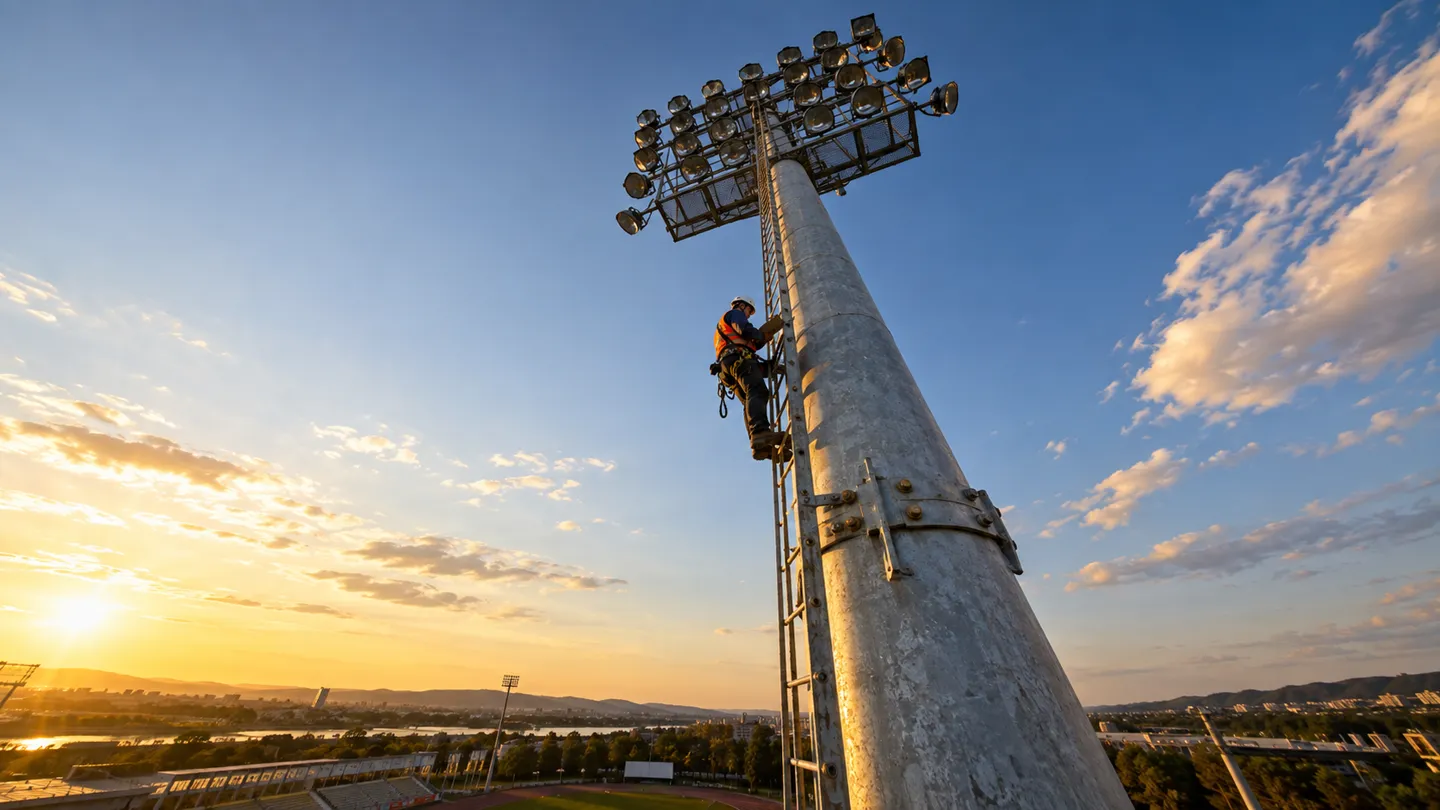
The specific trap has a name in engineering circles: EPA, the effective projected area of a fixture as seen by the wind. An industry guide on sports lighting upgrades calls this the most forgotten item in the whole process. You cannot just swap fixtures: LED luminaires are lighter, but they catch wind differently and load thirty-year-old poles in ways their original design never accounted for (Netex Netting, 2025). The guide calls this the liability gap, and notes that product-focused sellers and unqualified contractors will not bring it up.
Before any fixture swap on an existing structure: obtain the pole’s original structural specifications, run an EPA comparison between the old metal halide array and the proposed LED array, and have a structural engineer confirm the foundation and anchoring. A pole that held metal halide for thirty years has no obligation to hold LED safely.
A retrofit bid that skips this check is not saving money. It is borrowing it from a future failure, with the contractor’s name on the loan.
Standards decide the bid
The second boundary is photometric, and it starts with a mistake: treating stadium lighting as one product instead of a graded system. European standard EN 12193:2018 defines lighting requirements for sports, specifying maintained illuminance, uniformity, glare restriction, and color rendering per sport and per competition class (CEN). FIFA’s stadium guidelines work the same way for football, defining four lighting standards, A through D, for venues that broadcast live events. A training field, a semi-pro club, and an international broadcast venue are not points on one continuum with one product; they are different specifications with different price structures.
The practical consequence shows up in two directions. Quote a club-grade system against a broadcast-grade specification and the bid loses on compliance before price is even discussed. Quote a broadcast-grade system where a club grade was needed and the bid loses on price. Either way, the project went sideways at the specification stage, not at the installation stage.
Flicker and glare belong in the same conversation. Broadcast venues need flicker-free operation for slow-motion replay and tight uniformity across the camera’s field of view. That is why anti-glare optics and stable drivers are graded requirements, not upgrades (Stouch Lighting, 2026).
The matrix below compresses the boundaries into one view.
Retrofit Boundaries by Venue Grade
| Venue grade | Illuminance & uniformity | Glare & flicker | Structure & poles | Warranty & certification | Failure boundary |
|---|---|---|---|---|---|
| Training field | basic class per EN 12193 | moderate | EPA check still required | standard catalog lines, shorter warranty | fails when league play begins and classes rise |
| Amateur club | mid class, higher uniformity | glare control needed near housing | EPA recheck plus possible pole reinforcement | mid-tier warranty, CE/UL per market | fails when night events and broadcasting appear |
| Professional/broadcast | class per FIFA A-D | flicker-free, tight uniformity | full structural certification | engineered lines, 5-year-class warranty, full certification set | fails on any unverified structure or unproven photometrics |
Three verification actions turn this matrix into a bid checklist. First, obtain the existing poles’ structural documents and complete the EPA comparison before quoting anything. Second, fix the venue’s target class per EN 12193 or the relevant governing body, then require a photometric simulation of the proposed layout at that class, not a datasheet promise. Third, write the warranty tier into the contract explicitly. Catalog-grade lines typically carry shorter warranties; engineered lines in this market list five years. The difference in price is small next to the difference in risk.
What This Market Means for Your Bidding Business
Pull the threads together and the structure of this market becomes a business plan.
The growth is real and it splits into two tracks: retrofit conversions of aging metal halide fleets, and event-driven new construction. The volume of projects sits in the fragmented long tail: municipal fields, schools, and clubs. There the top five brands hold no lock, and a 35.5 percent combined share leaves the rest open. The risk, however, has migrated into the installation: wind-loaded structures and graded photometric standards decide whether a retrofit bid survives to final payment. And the value is climbing above the fixture, with most new stadium projects now buying controls and digital integration alongside the lamps.
The profit logic follows directly. In a market where two-thirds of suppliers compete on price, the unit price of a fixture is the weakest card a bidder can hold. What carries margin is everything the tail finds hard to deliver: correct photometric design at the right venue class, structural verification support, and warranty terms that survive contact with reality. A low bid that skips the engineering checks is not a discount; it is an unpriced liability.
That reframes how to choose a supplier. The four things to demand are concrete. Ask whether the supplier produces a photometric simulation for your specific layout and target class, not just a catalog. Ask whether they will support the structural review with real fixture EPA data. Ask whether warranty is tiered in writing, with engineered lines separated from catalog lines. Ask whether the certifications your market requires at customs are already on the product, not promised for later.
This is the standard we build to at WOSEN. Our LED stadium light series is engineered around exactly these checkpoints. Efficacy options run from 130 to 200 lm/W, with anti-glare optics, IP66 sealing, and listed 5-year warranties on the stadium line. The certification portfolio covers UL and ETL for North America, CE, EMC and RoHS for Europe, and SAA for Oceania. Deeper TUV and ENEC certifications round out the set (certification portfolio). Behind the product, our service commitments are written for project realities. We respond to overseas inquiries within 12 hours, produce warranty tiers on separate lines so standards never blur, and repair to compliance before any replacement ships (after-sale service commitments). When a bid’s margin depends on engineering and warranty, those are the details that decide it.
The stadium lighting market will keep posting forecast numbers that disagree with each other. The contractors and distributors who profit from it will be the ones reading past the totals. They will follow the retrofit wave, the graded standards, and the supplier checks that keep a winning bid from becoming a losing project.
Build Your Next Stadium Bid on Engineering, Not Unit Price
Compare WOSEN’s LED stadium line: 130–200 lm/W efficacy options, anti-glare optics, IP66 sealing, tiered warranties up to five years, and UL/ETL, CE, and SAA certification already on the product.
Start a Stadium Lighting InquiryReferences
- GMInsights. “Stadium Lighting Market Size Report, 2026–2035.” 2025. https://www.gminsights.com/industry-analysis/stadium-lighting-market
- Straits Research. “Stadium Lighting Market Size, Share, Growth, Forecast, 2034.” 2026. https://straitsresearch.com/report/stadium-lighting-market
- SNS Insider. “Stadium Lighting Market Size, Share, Trends & Growth, 2035.” 2026. https://www.snsinsider.com/reports/stadium-lighting-market-6409
- Persistence Market Research. “Stadium Lighting Market Size, Share & Growth Report, 2032.” 2025. https://www.persistencemarketresearch.com/market-research/stadium-lighting-market.asp
- MarketsandMarkets. “Stadium Lighting Market Size, Share, Industry Analysis and Forecast 2025 to 2035.” 2025. https://www.marketsandmarkets.com/Market-Reports/stadium-lighting-market-259106590.html
- Fortune Business Insights. “Stadium Lighting Market Size, Share | Growth Forecast [2034].” 2026. https://www.fortunebusinessinsights.com/stadium-lighting-market-116366
- Stouch Lighting. “LED vs Metal Halide Lights: Lighting Comparison.” 2026. https://www.stouchlighting.com/blog/led-lights-versus-metal-halide
- Stouch Lighting. “LED Stadium Lighting Market Analysis: Key Trends Driving the LED Lighting Market in 2026.” 2026. https://www.stouchlighting.com/blog/led-stadium-lighting-market-analysis-key-trends-driving-the-led-lighting-market-in-2026
- Netex Netting. “More Than Just Bulbs: 5 Engineering Mistakes Facility Managers Forget in an LED Sports Lighting Upgrade.” 2025. https://www.netexnetting.com/2025/11/06/more-than-just-bulbs-5-engineering-mistakes-facility-managers-forget-in-an-led-sports-lighting-upgrade
- r/electricians. “Need some advice from some of you who have retrofitted stadium lighting.” 2023. https://www.reddit.com/r/electricians/comments/11tozx8/need_some_advice_from_some_of_you_who_have
- David Gordon (Channel Marketing Group). “Sports Lighting, A Growth Opportunity.” LinkedIn. 2024. https://www.linkedin.com/posts/davidgordonchannelmkt_sports-lighting-a-growth-opportunity-activity-7224807787875233793-eWa-
- CEN. “EN 12193:2018 Light and lighting — Sports lighting.” 2018. https://webstore.ansi.org/standards/ds/dsen121932018
- FIFA. “Stadium Guidelines: Technical Systems and Services (FIFA Lighting Guide, Standards A–D).” https://inside.fifa.com/innovation/stadium-guidelines/technical-guidelines/stadiums-guidelines/technical-systems-and-services
- Saudi 2034 Bid Committee. “Saudi Arabia FIFA World Cup 2034.” https://saudi2034.com.sa/
- WOSEN. “Patents & Certificates.” https://www.wosenled.com/patents-certificates/
- WOSEN. “After-Sale Services.” https://www.wosenled.com/after-sale-services/
- WOSEN. “LED Stadium Lights.” https://www.wosenled.com/outdoor-lights/led-stadium-light/

 English
  Spanish
  French
  German
  Italian
  Arabic
  Russian
  Portuguese
  Dutch
Dutch  Indonesian
  Turkish
  Polish