
Search “stadium lighting cost” and you will find four answers that disagree by a factor of forty. A recreational softball field comes in around $20,000–$70,000 (XSYL Lights, 2025). A baseball field spans $40,000–$420,000 (Stouch Lighting, 2025). A high school football stadium LED install runs $200,000–$300,000 (GT Grandstand, 2025). And the 2026 U.S. average for a full LED stadium system is $207,770–$877,260 (Sports Venue Calculator, 2026). None of these sources is wrong. Each one is pricing a different kind of building.
This article gives you the structure behind those numbers. First, what the money buys. Then which route makes sense for an existing field, how to size a system from your venue class, and what it costs to run. It closes with how to read a supplier quote the way a contractor would.
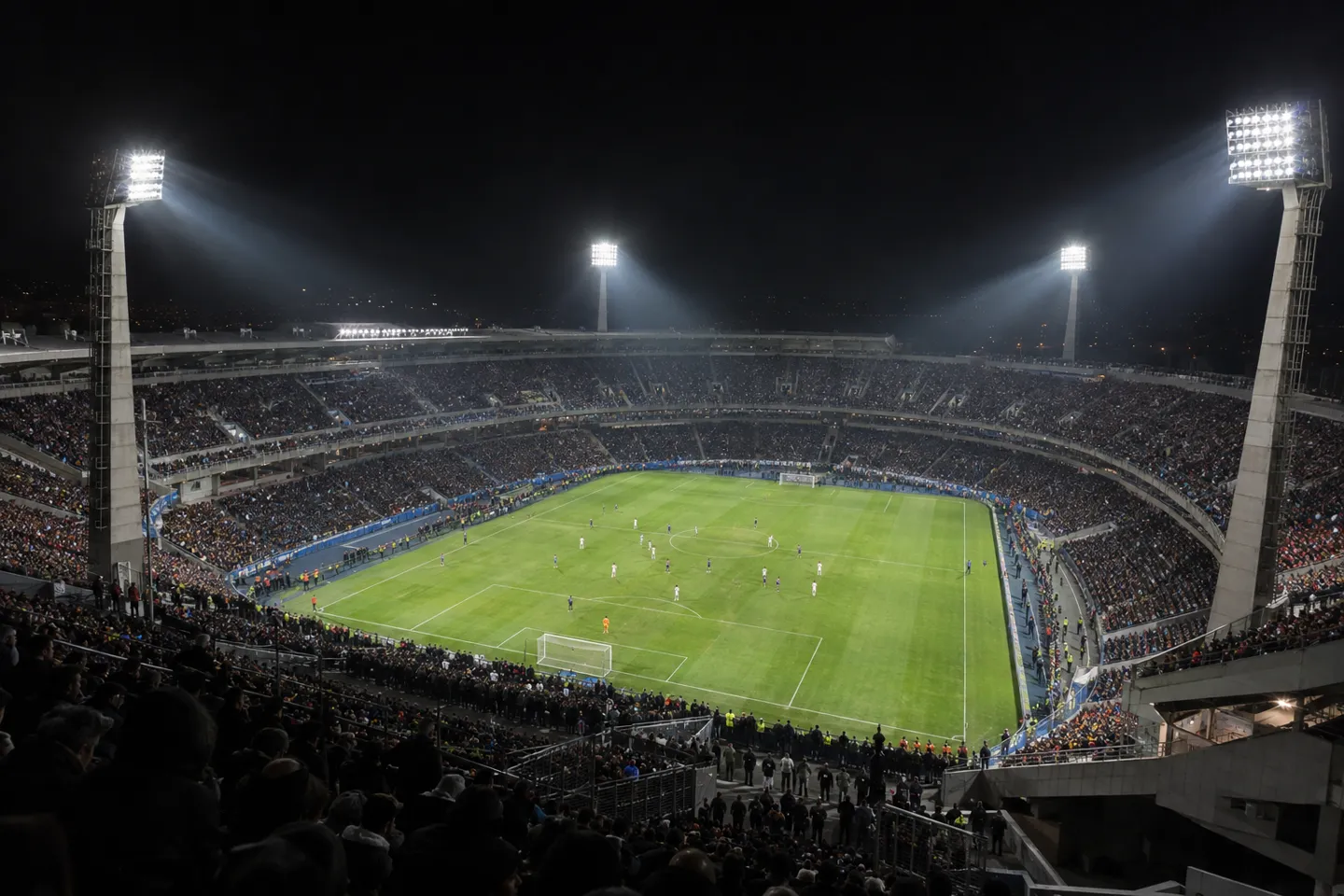
Why Stadium Lighting Cost Estimates Vary 40-Fold
The single variable that explains most of the spread is venue class. A community practice field, a high school stadium, a municipal multi-use ground, and a broadcast-ready professional venue sit at four points on one ladder. Each step up multiplies three things at once: the brightness target, the number of poles and fixtures, and the civil works underneath them.
Before comparing any number, separate three quantities that get mixed up constantly. A single LED stadium fixture has a catalog price you can check on a retail page. A system price adds poles, foundations, wiring, and installation labor. A total project cost adds design, engineering, permits, and construction management. Retail listings answer the first question only (Revolve LED, 2026). The guides that quote six-figure totals are answering the third. When a quote and a catalog price “disagree,” they are usually answering different questions.
Put the four headline ranges against their venue classes and the conflict disappears:
| Venue class | Typical project | Published range | Source |
|---|---|---|---|
| Recreational / community | Public softball and school fields | $20,000–$70,000 | XSYL Lights |
| School / club | High school football stadium, LED | $200,000–$300,000 | GT Grandstand |
| College / municipal multi-use | Baseball fields, full span | $40,000–$420,000 | Stouch Lighting |
| Professional / broadcast | 2026 U.S. LED stadium average | $207,770–$877,260 | Sports Venue Calculator |
Two right answers
$20,000 and $877,260 are both correct answers to “how much does stadium lighting cost.” The difference is not who did the math wrong. It is which venue class they were pricing.
Location moves the same class of project up or down by half again. Sports Venue Calculator’s 2026 city tables put a San Antonio stadium at $199,459–$842,170. The same scope in San Francisco lands at $328,277–$1,386,071, mostly through labor and permitting (Sports Venue Calculator, 2026). Class first, geography second. That ordering alone filters out most of the noise in published estimates.
What the Money Actually Buys: The Six Cost Components
If you have to defend a budget to a school board or a municipal committee, a single total will not survive questioning. Six line items cover essentially everything. Each one fails in a predictable way when it gets underquoted.
Sports Venue Calculator’s 2026 breakdown of a typical stadium project assigns shares like this (Sports Venue Calculator, 2026):
Stadium Lighting Cost Breakdown: Six Components
| Component | Typical Share | What It Covers | Where Quotes Underquote | What You Can Verify |
|---|---|---|---|---|
| Fixtures & lighting equipment | 40–50% | LED luminaires, drivers, controls, photometric design | Old lamp counts reused without a new photometric study | Ask which lux target the layout was modeled on |
| Steel poles & foundations | 20–28% | Galvanized poles, concrete bases, grounding | Foundation class downgraded for soil conditions | Request the foundation drawing and soil assumption |
| Electrical installation | 18–22% | Conduit, conductors, wiring, utility connection | Existing service assumed adequate without a load study | Ask for the connected-load calculation |
| Engineering | 3–5% | Structural and electrical engineering, photometric certification | Certification omitted to hit a price point | Require the photometric certification document |
| Project management | 2–3% | Coordination, scheduling, site supervision | Treated as absorbed overhead | Get a named schedule with milestones |
| Permits & inspections | 1–3% | Building permits, electrical inspections, utility approvals | Left out until the invoice arrives | List permit responsibilities in the contract |
Fixtures: where the catalog price lives
Fixtures and lighting equipment take 40–50% of the budget. That share already includes the control system and the photometric design (Sports Venue Calculator, 2026). Fixture count is not a free choice. It falls out of the brightness target and the aiming geometry, which is why two quotes for the same field can legitimately carry different lamp counts.
Poles and foundations: the part you cannot upgrade later
Steel poles and their concrete foundations run 20–28% of the project (Sports Venue Calculator, 2026). This is the one line with no cheap undo. Once the concrete cures, the pole locations and their wind-load rating are fixed for twenty years. Recreational installations typically use 4 to 8 poles at 15 to 50 feet, carrying 10 to 20 fixtures each (XSYL Lights, 2025). Larger venues push pole heights to 20–40 meters (Logos Lighting, 2025).
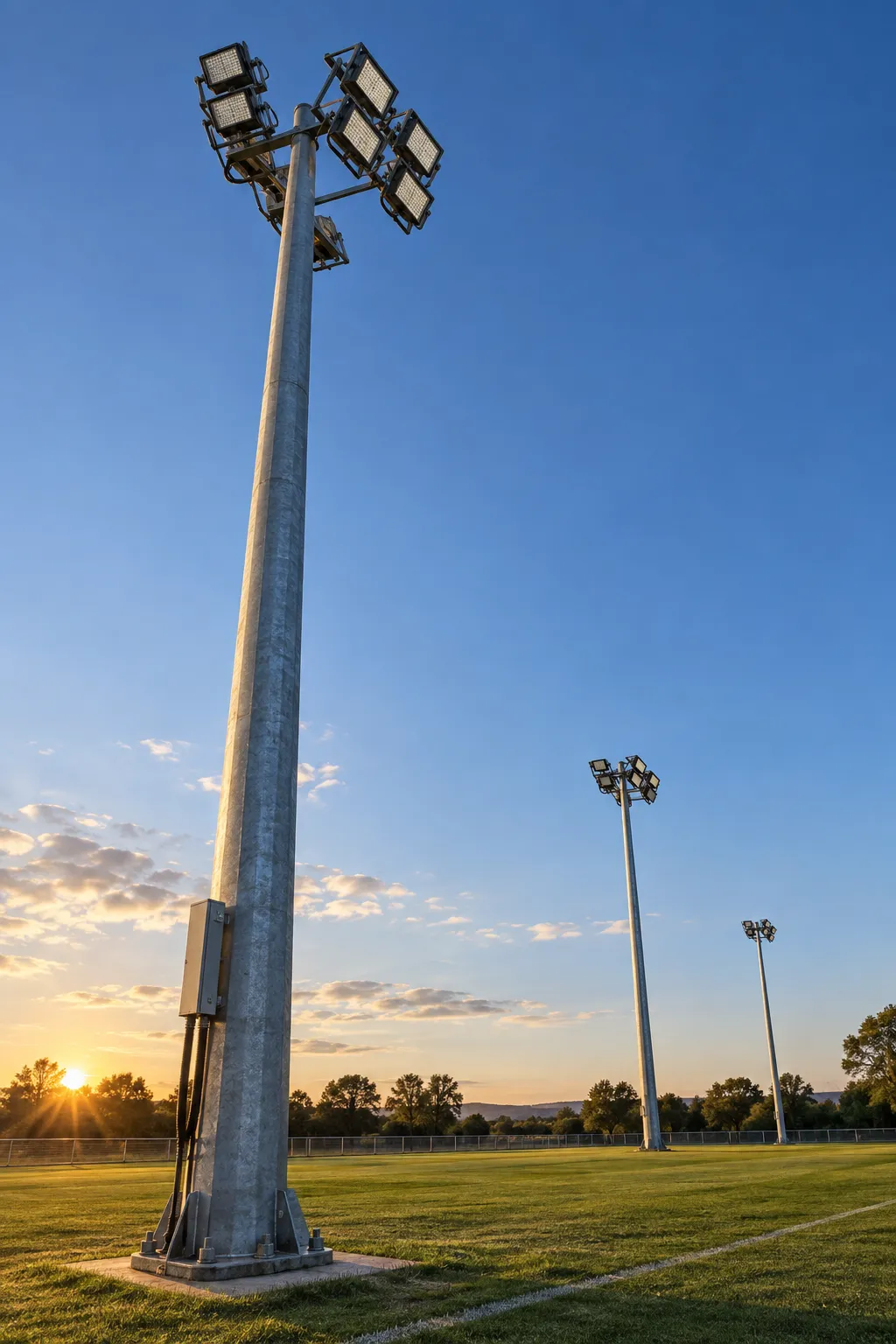
Electrical installation: the line nobody photographs
Conduit, pull boxes, conductors, and the utility connection take another 18–22% (Sports Venue Calculator, 2026). This is the quietest budget line and the most common source of change orders. Nobody photographs switchgear. On retrofit projects, the existing service capacity decides your floor cost before anyone picks a fixture.
Installation labor: the 30–80% premium
Installation cost is a multiple, not a rounding error. Aiming, mounting, and testing sports lighting runs 30–80% above the fixture price itself (XSYL Lights, 2025). The range depends on pole count, height, and local labor rates. Note that this is a different measure from the percentage shares above. It compares labor to the fixture bill, not to the whole project. A supplier who quotes “installation included” without stating which definition they used has not quoted installation at all.
Design and photometric simulation
The photometric model decides how many fixtures you buy and where they aim. Skipping it does not remove the cost. It converts the cost into extra fixtures, dark patches, or a re-aim crew coming back twice. In the SVC breakdown, design hides inside the fixture line. That is one more reason a bare lamp count tells you little.
Controls and the small lines
Switching, dimming, lightning protection, grounding, and inspection fees each look trivial. Together, the tail lines still add up: project management at 2–3% and permits at 1–3% clear 3–6% of the project (Sports Venue Calculator, 2026). Ask any bidder whose quote omits them what happened to those lines.
The pattern across all six is consistent. The components you can see in photos get priced competitively. The components buried underground, or buried in fine print, carry the surprises. When you collect quotes, require all six lines separately. A quote missing a line is a quote deferring that line to a change order.
New Build, Retrofit, or Relamp: Picking the Right Route
With the components on the table, the route question becomes concrete. Three routes exist. The existing infrastructure on your site, not the catalog, picks between them.
New build is for sites with no power and no poles. Everything in the six-component table arrives at full price, and utility coordination can dominate the schedule if the site lacks electrical access (Stouch Lighting, 2025). Retrofit means keeping the poles and much of the electrical infrastructure while replacing the luminaires. Relamping-level upgrades keep even more, changing only the light source where the fixture bodies allow it.
The market context pushes hard toward retrofit. LED already accounts for $637.5 million, or 72.2% of sports lighting revenue in 2025. Another $209.5 million in traditional metal halide systems remains in service awaiting conversion (Global Market Insights, 2025). Persistence Market Research estimates over 60% of existing stadiums worldwide still run metal halide. It puts the energy saving from a retrofit at around 50%. One caveat matters: projects that reuse existing poles and electrical infrastructure cut both cost and downtime (Persistence Market Research, 2026). The next several years of work in this trade is mostly conversion work, not greenfield.
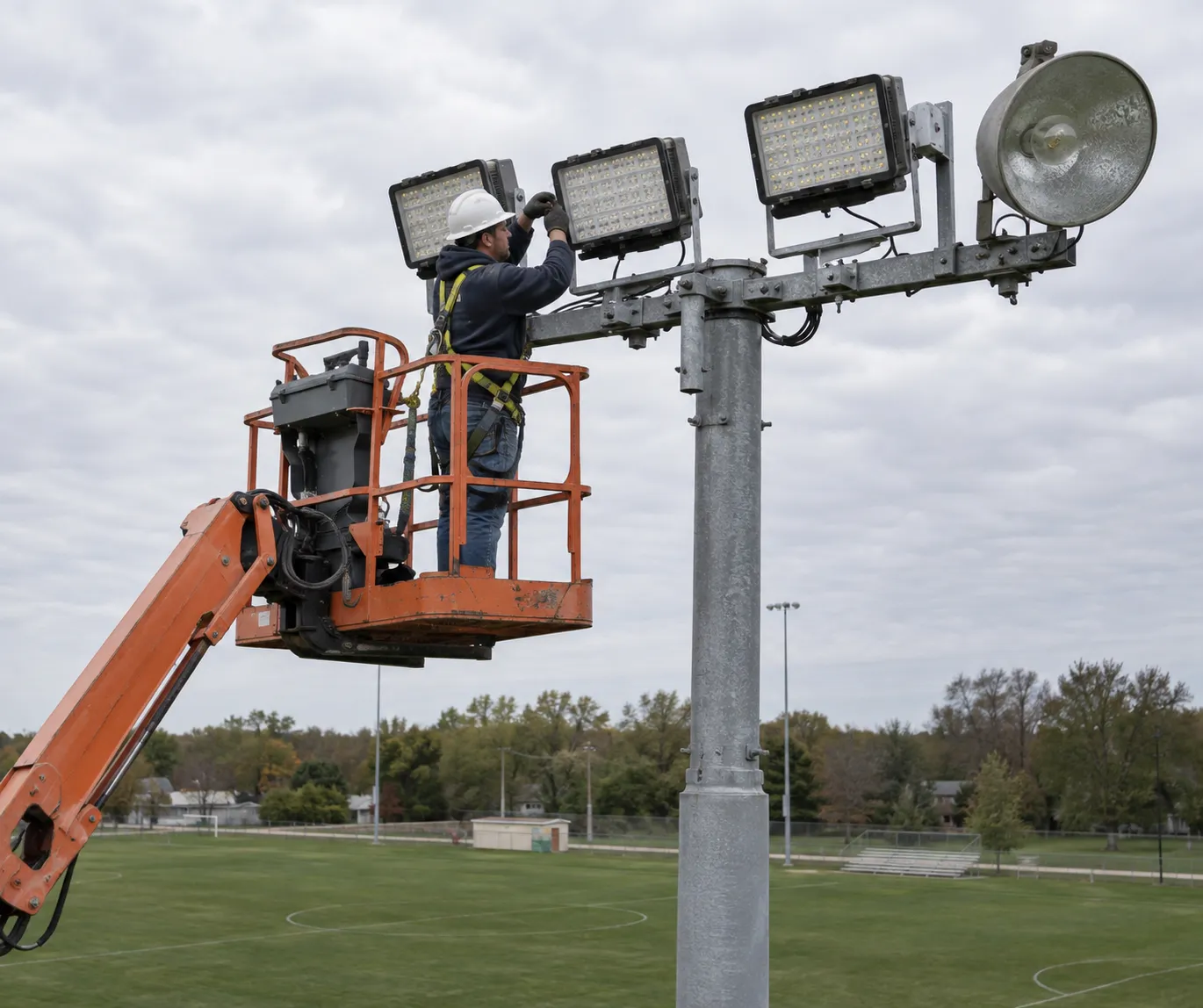
Metal halide carries a maintenance rhythm that makes the comparison concrete. Lamps get replaced every two to three years. LED systems are rated around 50,000 hours, or 5 to 10 times longer than the lamps they replace (GT Grandstand, 2025; Revolve LED, 2026). Be careful with the “20-year LED” claim you will also see. That figure assumes roughly 2,500 burning hours per year. Ask for hours, not years.
Before choosing your route, check three things
- 1) Pole structure — can existing poles carry the new fixtures’ weight and wind load?
- 2) Electrical capacity — does the existing service cover the new connected load, or does it need a study and upgrade?
- 3) Photometric gap — what lux level does your use actually require compared to what the field has now?
Route choice falls out of these three answers.
The checklist is also the boundary. Retrofit stops being the cheap route when the poles fail the wind-load check or the electrical service fails the capacity check. At that point you are paying demolition and replacement on top of the retrofit. The new-build comparison deserves a fresh look.
From Venue Class to a Number You Can Quote
The class ladder becomes most useful when you walk it downward into arithmetic. Five steps take you from “I have a field” to “I expect a number in this range, structured like this.”
THE FIVE-STEP WALK
Step 1: Place your venue on the class ladder
Be honest about the primary use. A field that hosts U13 practice on weekdays and two club matches a month is a club-class venue with occasional higher demands, not a professional venue. Overclassing is the most expensive forecasting error in this budget. Every downstream step multiplies it.
Step 2: Pick the lux target the use demands
Illuminance targets are published per level of play. Recreational and training use sits around 300 lux. Club level calls for 500 lux, and national and international games call for 750 lux (LEDVANCE, 2025). Televised competition pushes beyond that. Professional competition targets run to about 1,000 lux (XSYL Lights, 2025). If your venue hosts several uses, set the class by the primary use. Write the exceptions into the spec as explicit exemptions rather than silently raising the whole design.
Step 3: Derive pole count, height, and fixtures
Fixture count comes from the lux target, the field size, and the aiming geometry, not from a catalog. At the recreational end, 4–8 poles at 15–50 feet with 10–20 fixtures per pole is the typical envelope (XSYL Lights, 2025). Whole-venue fixture counts scale from there into the 50-to-200-plus range as competition level rises (Logos Lighting, 2025). The failure mode in this step is uniformity. A layout that hits average lux on paper can still throw dark patches and glare if the beam angles are wrong. That is why the photometric model, not the arithmetic, has the final word.
Step 4: Add electrical and installation reality
Take the fixture system and apply the six-component shares from the previous section. A quick sanity check: if your fixtures land near half the budget, poles and electrical should add roughly another 40–50% before engineering and soft costs (Sports Venue Calculator, 2026). Quotes that compress the non-fixture share below that are usually assuming away site reality. Trenching distance, service upgrades, or soil conditions they have not surveyed.
Step 5: Land on a range you can defend
| Class | Lux target | System scale | Defensible range |
|---|---|---|---|
| Recreational / community | ~300 lux | 4–8 poles, 15–50 ft, 10–20 fixtures each | $20,000–$70,000 |
| School / club | 300–500 lux | Tens of fixtures, 4+ poles | $200,000–$300,000 (HS football, LED) |
| College / municipal | 500–750 lux | 50+ fixtures | Upper span of $40,000–$420,000 (baseball) |
| Professional / broadcast | 750–1,000 lux | 100–200+ fixtures, 20–40 m poles | $207,770–$877,260 (2026 U.S. average) |
This table is a quoting tool, not a price list. It tells you which published number your project should resemble before regional labor shifts it. Hand it to bidders alongside the lux target and the six-line structure. The numbers you get back become comparable.
What It Costs to Turn On: Running Costs by Venue Class
Capital cost is only half the ledger. The running side follows one formula: running cost = total system kW × hours used × electricity rate (Cary Lighting, 2026). Every input is checkable. Each one is where estimates go wrong.
RUNNING COST PER HOUR AT $0.12/KWH
The two ends of that scale come from the same source and the same rate assumption, so the gap is purely system size (Cary Lighting, 2026). At broadcast venues, one more line appears: demand charges. A single televised event carries only $30–$50 in direct energy. But the demand spike can add materially more depending on the tariff (Cary Lighting, 2026). If your proposal compares running costs without asking about the utility’s demand structure, it will miss the largest single line on some venues’ bills.
Maintenance belongs in the same ledger, briefly. Metal halide lamps cycle out every two to three years. LED fixtures carry no lamp replacements across a ~50,000-hour rating (GT Grandstand, 2025; Revolve LED, 2026). One honest boundary on the LED side: the payback math assumes usage. A field that burns 150 hours a year saves little energy, and the retrofit payback stretches accordingly. Estimate your annual burning hours before quoting payback to anyone who signs budgets.
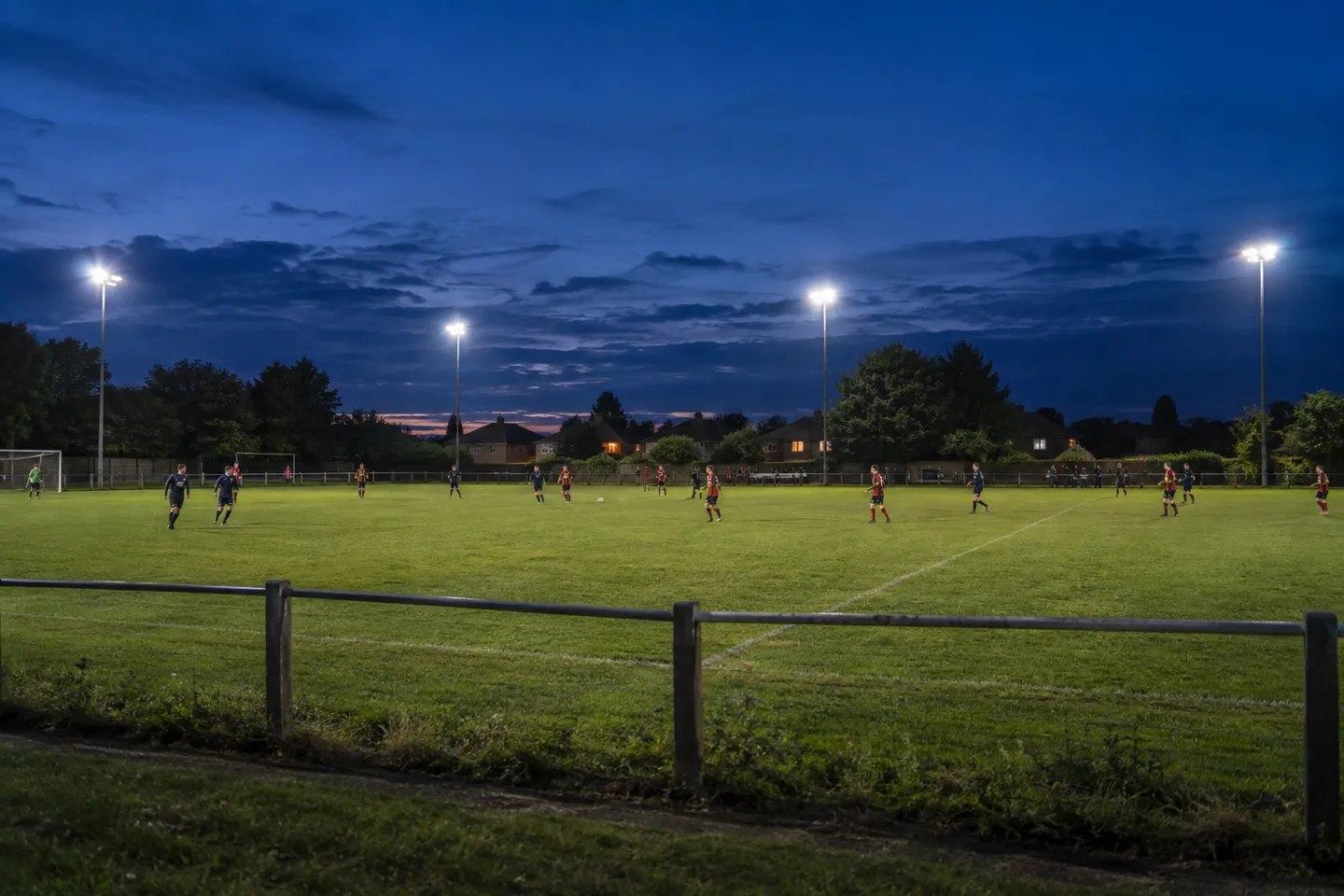
Reading a Quote Like a Contractor
Everything above collapses into a discipline for reading the two quotes on your desk. Total price is not a comparison axis. Two bids for the same field differ by 30% for reasons that live in specific lines, and the lines are findable.
Start with class and structure. Confirm both bidders priced the same venue class and lux target. If one modeled 300 lux and the other 500, the cheaper number is describing a smaller building. Then require the six-line structure: fixtures, poles and foundations, electrical, labor, engineering, soft costs. Installation labor deserves its own challenge, because 30–80% of the fixture bill is the honest envelope (XSYL Lights, 2025). A labor line far below that range deserves a question, not a celebration. On the equipment side, the spec items that separate quote tiers are luminous efficacy, IP rating, driver and chip grade, and the warranty tier behind the number. The same items, delivered at a higher grade, are what the higher quote is actually buying.
Prioritize accordingly. Poles, foundations, and electrical infrastructure are the components you cannot economically revisit, so grade them first and cut there last. Fixture unit price is the most misleading axis in the comparison. The fixture share is the most competitive line in the market. The money a low-bid fixture saves evaporates the first time a dark patch forces a re-aim crew, or a failed driver forces a lift rental. Low bids do not delete costs. They reschedule them into the construction phase or the warranty period.
One boundary on all of this. At the very small end (a single practice field, a basic recreational install), the structure is simple enough that comparing total prices is reasonably safe. Quote discipline scales with project size. The checklist below earns its keep somewhere around the six-figure mark.
When you issue the RFQ, make your checklist the bidder’s problem too:
Five checks before accepting a stadium lighting quote
- 1) Same venue class and lux target as your spec, stated in writing.
- 2) Six cost lines shown separately, no “installation included” without a definition.
- 3) Labor line inside a defensible range vs the fixture bill.
- 4) Efficacy, IP rating, driver/chip grade, and photometric certification named per fixture.
- 5) Warranty tier, coverage, and response commitment written into the offer.
That fifth check is where supply partners separate themselves. Ask what the warranty line actually covers before you compare prices. WOSEN lists its stadium series at a 5-year warranty on the product pages, part of the solar and stadium lines that carry 5-year coverage above the standard whole-lamp warranty. You can see the fixtures installed in a stadium lighting project in Texas, or read the spec sheets behind the stadium series before you shortlist anyone. We would rather be measured against that checklist than against a fixture price.
Send Your Next RFQ to WOSEN
Stadium-series LED fixtures with a 5-year warranty — send your venue class, lux target, and pole count, and get a quote structured line by line.
Request a Stadium Lighting QuoteReferences
- Sports Venue Calculator. “LED Stadium Lighting Cost, Design and Funding Guide (2026).” 2026. https://sportsvenuecalculator.com/knowledge/led-sports-lighting/stadium-lighting-cost-guide/
- Stouch Lighting. “How Much Does Baseball Field Lighting Cost?” 2025. https://www.stouchlighting.com/blog/how-much-does-baseball-field-lighting-cost
- XSYL Lights. “How much does the baseball field lighting cost?” 2025. https://xsylights.com/how-much-baseball-field-lighting-cost/
- GT Grandstand. “How Much Do Stadium Lights Cost?” 2025. https://www.gtgrandstands.com/how-much-do-stadium-lights-cost
- LEDVANCE. “Choose the Right Lumens for Stadium Lights.” 2025. https://www.ledvance.com/en-us/professional-lighting/insights/blog/application/right-lumens-for-stadium-lights
- Global Market Insights. “Sports Lighting Market Size, Growth Outlook 2026-2035.” 2025. https://www.gminsights.com/industry-analysis/sports-lighting-market
- Persistence Market Research. “Stadium Lighting Market Size, Share & Growth Report, 2032.” 2026. https://www.persistencemarketresearch.com/market-research/stadium-lighting-market.asp
- Cary Lighting. “How Much Does It Cost to Keep Stadium Lights On?” 2026. https://www.carylighting.com/info/how-much-does-it-cost-to-keep-stadium-lights-103470191.html
- Logos Lighting. “How Much Does Stadium Lighting Cost?” 2025. https://logoslighting.com/blog/how-much-does-stadium-lighting-cost
- Revolve LED. “LED Stadium Lights.” 2026. https://revolveled.com/collections/led-stadium-lights
- WOSEN. “Stadium Lighting Project in Texas.” https://www.wosenled.com/projects/stadium-lighting-project-in-texas/
- WOSEN. “LED Stadium Light.” https://www.wosenled.com/outdoor-lights/led-stadium-light/
- WOSEN. https://www.wosenled.com/

 English
  Spanish
  French
  German
  Italian
  Arabic
  Russian
  Portuguese
  Dutch
Dutch  Indonesian
  Turkish
  Polish