
Sports lighting design is not the act of picking lamps. It is a chain of decisions that starts with one question, what level of play this field is built for, and ends with a signed acceptance document. Every step in between inherits the step before it. A field scoped at the wrong level cannot be fixed by better fixtures, and a fixture bought without the right paperwork cannot be defended when something goes wrong.
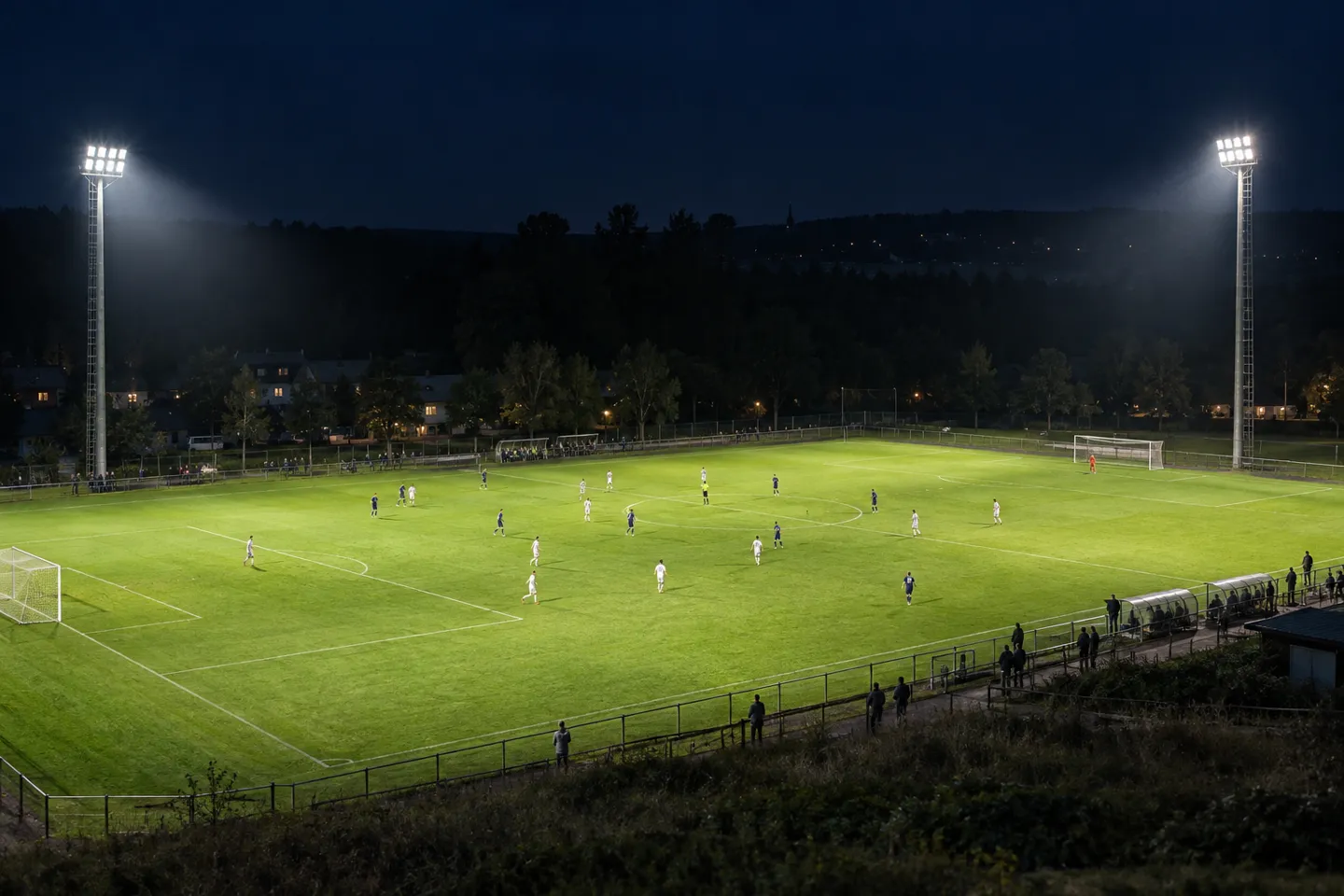
The work runs through five steps: survey the site, fix the lighting class, lay out the photometric design, aim and install, then document and hand over. Each step filters what the next one is allowed to do. When a project blows its budget or triggers complaints, the cause is almost always upstream of where the pain shows up.
One premise is settled before any of this starts. LED now dominates new stadium installations, so the interesting question is no longer LED versus metal halide. It is which LED configuration, documented how well, for the class you actually need.
That last point is where the money sits. The expensive failures in sports lighting (dark patches, blinding angles, neighbors calling the council) surface after handover, when the invoice is already paid. This article walks the chain in order, then shows how to lock it into a spec you can defend.
From survey to hand-over
- 1Survey the site — dimensions, surroundings, power, neighbors.
- 2Fix the lighting class — who plays, how often, broadcast or not.
- 3Photometric layout — fixtures, poles, beam angles, uniformity.
- 4Install and aim — commissioning decides everything.
- 5Document and hand over — photometric report, IES files, warranty terms.
Which Lighting Class Does Your Venue Need?
Lighting classes describe who plays and what is at stake, not how much money you have. Class III covers recreational and training use: evenings, leagues, schools. Class II covers club competition. Class I covers professional play and broadcast, where cameras need vertical illuminance on faces as much as horizontal light on grass. American practice works from ANSI/IES RP-6, which defines maintained horizontal illuminance at the playing surface (FSG, 2026). European tenders usually reference EN 12193, its counterpart standard, and the logic transfers even when the numbers are dressed in lux.
For pickleball, one published breakdown puts Class III at 30 foot-candles horizontal, Class II at 45 fc, and Class I at 70 fc. Vertical targets run roughly two-thirds of those (Lightmart, 2024). Broader planning bands used across guides land in the same territory. Recreational play sits near 20–30 fc (200–300 lux), club competition near 30–50 fc, and broadcast venues at 50–75+ fc (500–750+ lux).
| Class | Who it serves | Typical horizontal target | Typical lux equivalent |
|---|---|---|---|
| Class III | Recreational, training, school use | 20–30 fc | 200–300 lux |
| Class II | Club and league competition | 30–50 fc | 300–500 lux |
| Class I | Professional and broadcast venues | 50–75+ fc | 500–750+ lux |
Here is the trap hiding in that table. Marketing pages routinely quote a recreational minimum and a professional recommendation as if both were “the standard” for the same sport. Pickleball’s 30 fc and 70 fc figures are both real — for different jobs. If you copy a number without its class, you either under-light a competition venue or gold-plate a training court. Fix the class first by asking who plays, how often, and whether cameras are involved. The number follows from the class, never the other way around.
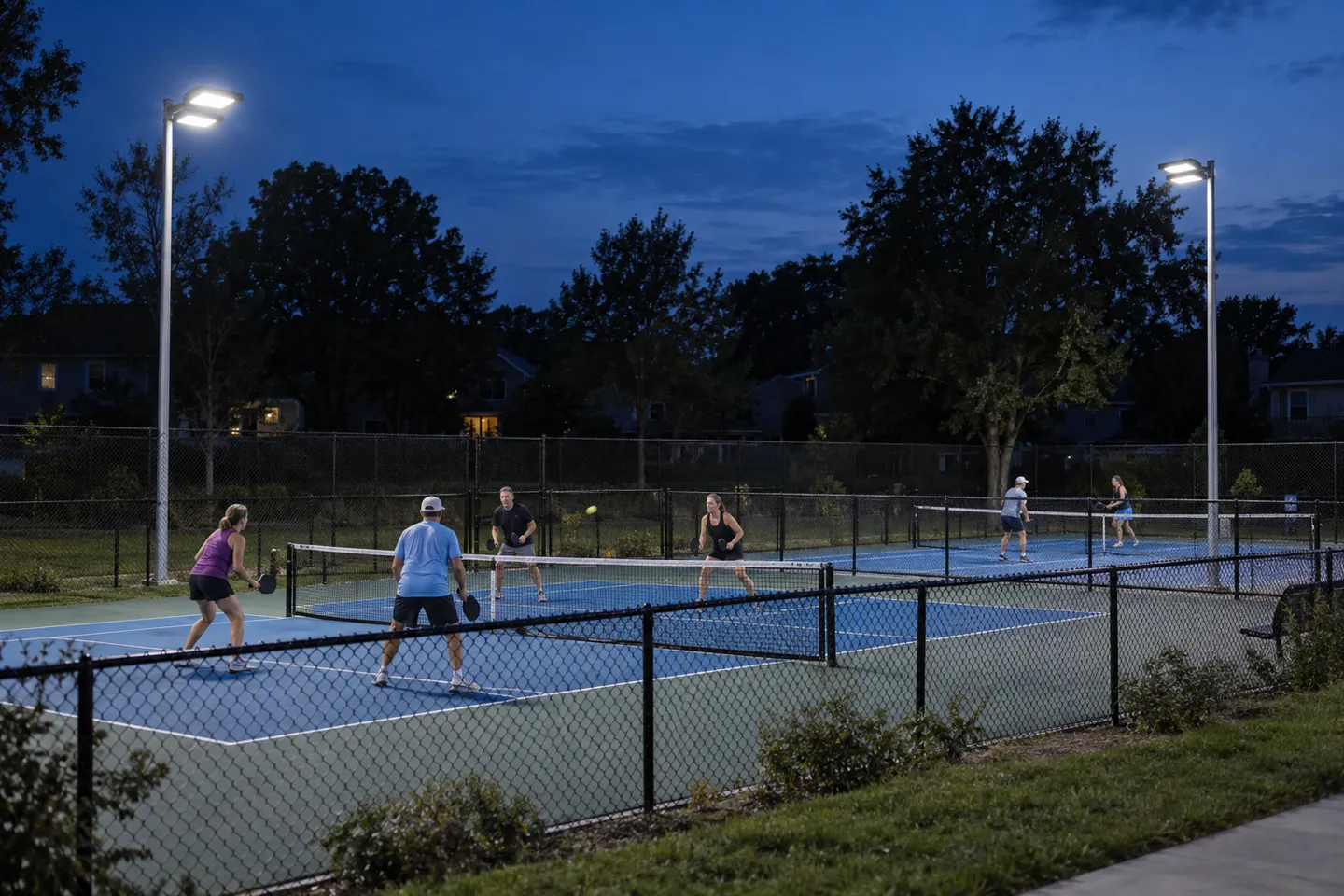
The other settled question is the light source itself. The LED segment held a 61.8% share of the stadium lighting market in 2025 and is forecast to grow fastest through 2034 (Straits Research, 2026). LED fixtures also typically cut energy use 60–70% against metal halide (RevolveLED, 2025). Choosing LED is no longer a decision; it is the default. What still separates projects is configuration and documentation, and that is where the rest of this article lives.
From Class to Configuration: Fixtures, Poles and Optics
A class is an input. Configuration is the translation. Two bidders can both promise “LED sports lighting” for the same Class II field and describe hardware that differs in fixture count by half. Efficacy, optics and pole placement all move the arithmetic. This section walks that translation so a quote can be read instead of trusted.
How Many Fixtures a Class Really Takes
The count follows a plain formula: target illuminance multiplied by area, divided by what each fixture actually delivers on the ground. Delivered light is nameplate lumens times the utilization factor times the maintenance factor, which is why two 50,000-lumen fixtures are not interchangeable. Efficacy decides the energy bill and the fixture count together. Economy lines run 80–100 lumens per watt; performance stadium fixtures run 150–200 or higher. At the same lumen package, the high-efficacy fixture draws half the current, runs cooler and stretches the maintenance cycle.
One number on the datasheet quietly moves all of this: power tolerance. The international norm allows rated wattage within ±10%. Factories that hold ±5% deliver measurably closer to the photometric prediction, and over a forty-fixture field that gap compounds into the difference between passing and failing an illuminance test.
POWER TOLERANCE
±10%
allowed by the international norm
±5%
held by disciplined factories
Poles, Height and Placement
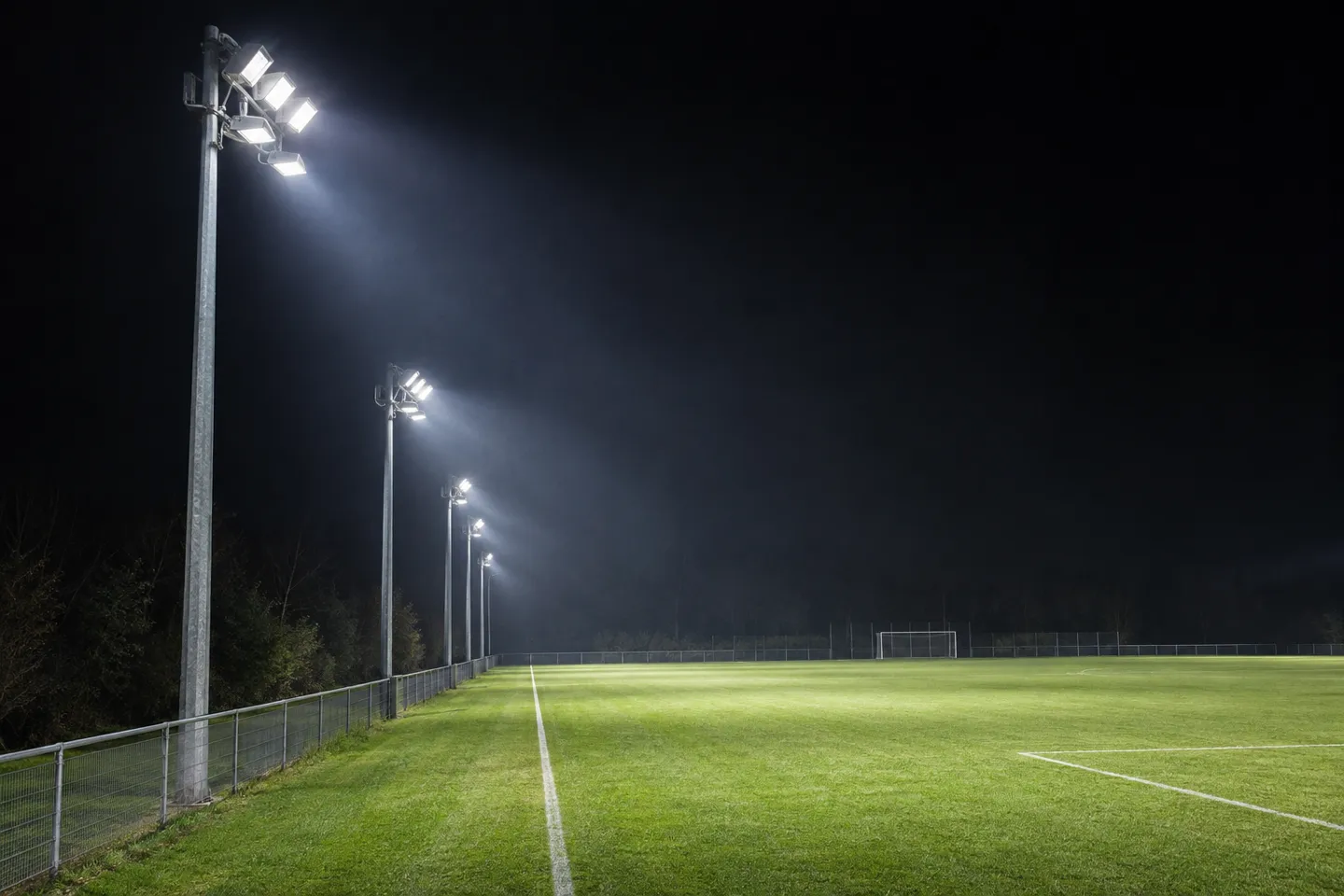
Courts and fields want different geometry. Pickleball and tennis layouts hang fixtures near 20-foot (6 m) poles along the sidelines (Lightmart, 2024). Side lighting keeps beams out of players’ sight lines when they track a ball upward. Larger rectangular fields move to four, six or eight poles. Stadiums push lighting onto corner towers measured in tens of meters, where narrow optics do the work that wide optics would do badly.
Placement is a neighbor question as much as a lighting one. A pole line drawn along the residential side of a site will spray private property no matter how good the fixtures are. Poles and their positions belong in the tender, not in the installer’s improvisation on delivery day.
Beam Angles and Aiming
Beam angle is the third translation lever. Narrow 15–30° beams suit tall masts, where light must travel and land precisely. Mid-range 45–60° optics serve typical field layouts from medium poles. Wide 90–120° distributions fit low-mounted recreational courts where coverage, not punch, is the goal. Asymmetric optics push light across a playing surface while holding it back at the property line, and visors or shields trim the residual spill (OEO, 2025).
| Configuration tier | Efficacy band | Typical beam angles | Typical mounting |
|---|---|---|---|
| Recreational courts (Class III) | 80–100 lm/W | 90–120° | 6 m poles, side-mounted |
| Club fields (Class II) | 100–150 lm/W | 45–90° | 8–15 m poles, 4–6 per field |
| Stadium and broadcast (Class I) | 150–200+ lm/W | 15–30° (+asymmetric edge fills) | Corner towers, tens of meters |
The boundary case worth naming: beam-height mismatch. Wide beams on tall poles scatter light across the sky and the neighborhood; narrow beams on short poles print hot circles on the grass with darkness between them. Both mistakes pass a casual glance and fail a real one.
Confirm before you order
- Beam angle matched to mounting height — per fixture, against the aiming plan.
- Photometric file proving the pairing works — no file, no order; a missing deliverable, not a formality.
Design Targets That Decide Delivery: Uniformity, Glare and Spill
Average illuminance is the number everyone negotiates. It is not the number that decides whether the field plays well. Three targets — uniformity, glare and spill — decide how the installation feels at ground level, and all three fail loudly after handover, when correction means retrofit.
Uniformity Targets by Class
Uniformity measures how evenly light covers the surface, usually as an average-to-minimum ratio. For most sports, guides target an average-to-minimum ratio below 2.0, meaning the dimmest spot on the field receives at least half the average (LED Lighting Supply, 2026). A field can hit its average lux number and still be unplayable if one corner sits in shadow and a winger vanishes into it at the decisive moment. Broadcast adds a vertical dimension. For televised events, vertical-to-horizontal illuminance typically ranges from 0.5 to 2.0 depending on sport (LED Lighting Supply, 2026). That is why Class I venues buy optics and aiming studies, not fixtures alone.
Engineering Glare Out
Glare is light arriving from the wrong direction at the wrong intensity. It matters more in sports than in almost any other application because players track small, fast objects against the sky, straight into the mounting zone. Over-lighting makes it worse: pushing fixtures brighter than the task needs raises brightness at the source faster than it raises visibility on the surface. The engineering countermeasures are unglamorous and effective: full cutoff shielding and asymmetric optics that keep emitting surfaces out of sightlines. Disciplined aiming gets verified during commissioning rather than assumed from the datasheet.
Spill Light and Neighbor Relations
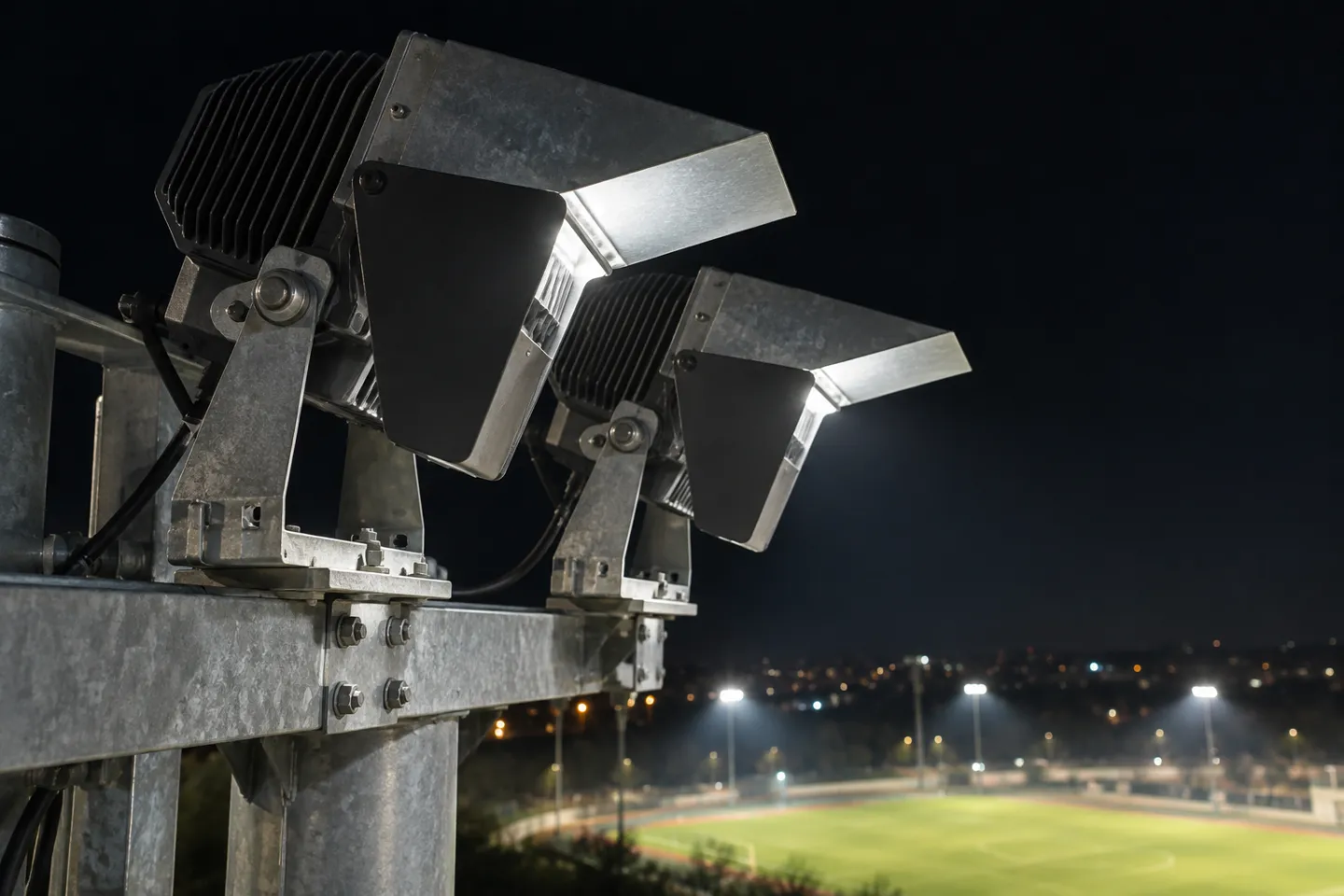
Spill light is what lands beyond the property line. It reaches there three ways: directly off poorly aimed or unshielded fixtures, by reflection off bright surfaces, and through atmospheric scattering on humid nights. The escalation path is predictable. First complaints, then homeowner associations, then the municipality. Municipal lighting bylaws now explicitly require sports facilities to control trespass and sky glow, with retrofit obligations attached (Southborough MA lighting rules, 2020). Standard countermeasures run in escalating cost: shields and visors at the fixture, back-aiming at the property-line row, and curfew zoning that dims non-essential banks after a set hour (OEO, 2025).
A glare complaint escalates: curfew, retrofit order, lawsuit. And the rework follows the spec sheet, not the price gap.
Uniformity misses, glare and spill complaints surface only after acceptance, when correction means retrofit. Every row in the matrix below is a check to run before the poles are ordered.
The matrix below turns those failure modes into a check-before-you-order tool.
| Site context | What works | Where it fails | Check first |
|---|---|---|---|
| Residential adjacency | Full shields, asymmetric optics, back-aimed property row | Any bare wide-beam fixture facing homes | Aiming plan + shield spec in writing |
| Dense urban plot | Tight beam set, curfew zoning, tall side screening | Over-lighting that reads as “bright” but plants glare in sightlines | Uniformity model at min:avg < 2.0 |
| Coastal salt air | Marine-grade coating, sealed IP66 housings, 304 hardware | Standard aluminum trims corroding within warranty years | Salt-spray test hours on the housing |
| Cold climate | Frost-rated seals, drivers rated below −20°C operating | Standard sealing strips stiffening and leaking in freeze cycles | Low-temperature rating on the seal spec |
| Desert and high dust | High IP dust rating, elevated IP66 enclosures | Vented or gasket-poor housing ingesting fine dust | Dust ingress test evidence |
| Off-grid site | Solar packages for Class III recreational loads | Expecting solar to carry Class I broadcast budgets | Load calculation against class target |
Every cell in the right-hand column is a verifiable action, not an attitude. That is the standard a design-phase document should meet. Before the poles are ordered, someone has confirmed the shield spec, the aiming plan, the uniformity model and the environmental rating.
Send WOSEN your site context and aiming plan, and get a spill-and-glare check before the poles are ordered.
Request a Pre-Order CheckTurning Design into Procurement Requirements
A design becomes enforceable when it is written as procurement requirements. The conversion takes three moves: fix the class, copy the parameters it implies, and demand the documents that prove both.
| Requirement | Why it is in the spec | How to verify at acceptance |
|---|---|---|
| Photometric validation report | Proves the layout hits class targets before purchase | Cross-check computed lux against the class band |
| IES/LDT photometric files | Lets your designer reproduce the vendor’s numbers independently | Import into your own software and compare |
| LM-80 report for the LED packages | Lumen maintenance is the backbone of any life claim | Request the report for the exact LED part used |
| DIALux simulation file | Shows uniformity and glare, not averages alone | Open the file; check min points, not averages |
| Market-specific certification | UL/ETL for North America, CE for Europe, SAA for Australia | Match the certificate to the model number shipped |
| Power tolerance ±5% | Tighter than the ±10% norm; delivered lux stays near prediction | Metered wattage on a sample from the shipment |
| Warranty term in years, in the contract | Component-grade claims need dated, signed backing | Read the clause; check who pays freight and duty |
Two clauses deserve a second look. Certifications should name the target market, because “internationally certified” is a phrase, not a document. And warranty length only means something alongside its component story. A five-year claim backed by branded drivers and separately managed production lines is a different object from the same number printed on an economy build. Finally, hold the line on files: without a photometric report there is no evidence illuminance was ever met, and acceptance becomes an opinion.
The Business Read: Why Spec Quality Beats Fixture Price
Set the three facts from this article side by side. Configuration differences put a wide price spread inside the same product label. Score bids on unit price alone and you will systematically select the wrong configuration for the class. The failures that cost real money (uniformity misses, glare, spill complaints) all surface after handover, and contracts allocate that liability, not discounts. And with LED holding roughly 62% of a market that has already settled on LED (Straits Research, 2026), the source question is closed. Suppliers no longer compete on whether their light is LED; they compete on configuration and paperwork at a given price point.
That is why the spec sheet is the profit instrument. A tender that names the class, the parameters and the required files converts every vague promise into a checkable line item. It also gives you somewhere to stand when a fixture fails in year four.
Our stadium series carries 5–7 year warranties, the top tier in this market. We answer international queries within 12 hours, cover one-way freight and customs on warranted claims, and repair fixtures to compliance before they ship again. When you put a warranty clause in a tender, that is the standard of backing it needs. See how the fixtures themselves are documented in WOSEN’s LED stadium light series.
Three numbers worth writing down
61.8%
LED share of stadium lighting, 2025
Straits Research
<2.0
avg:min uniformity target
most sports
5–7
years of warranty
top tier in this market
Low bids are not automatically wrong bids. When the class is genuinely recreational, the budget genuinely fixed, and the shortened warranty written plainly into the contract, a value configuration is a rational choice. What destroys margin is the silent version: a Class I expectation carrying an economy build, discovered at the first night game. Score the spec first, then the price — in that order.
If you want a second pair of eyes on a spec sheet before it goes out to bid, WOSEN reviews sports lighting drawings and returns quotes backed by photometric files.
Put a Bid-Proof Spec Behind Your Next Tender
Drawings reviewed, quotes backed by photometric files, and warranties written to 5–7 years.
Start Your Spec Review

 English
  Spanish
  French
  German
  Italian
  Arabic
  Russian
  Portuguese
  Dutch
Dutch  Indonesian
  Turkish
  Polish