
Two tenders can specify the same “500 lux” sports field and end up with very different invoices, schedules and acceptance results. The number is identical. The class behind the number, the measurement that produced it and the paperwork that proves it are not. Most disputes over sports lighting trace back to one of those three gaps, not to the fixtures themselves.
This guide walks the full chain: which standards actually govern a sports field, how the class ladder works, how to read the numbers without getting fooled by mismatched definitions, how a class turns into poles and hardware, and what evidence you must lock in before handover. Facility owners planning an upgrade will find the vocabulary; contractors and EPC buyers writing or answering tenders will find the checklist their contract is missing.
What Standards Govern a Sports Field (and Which Ones Don’t)
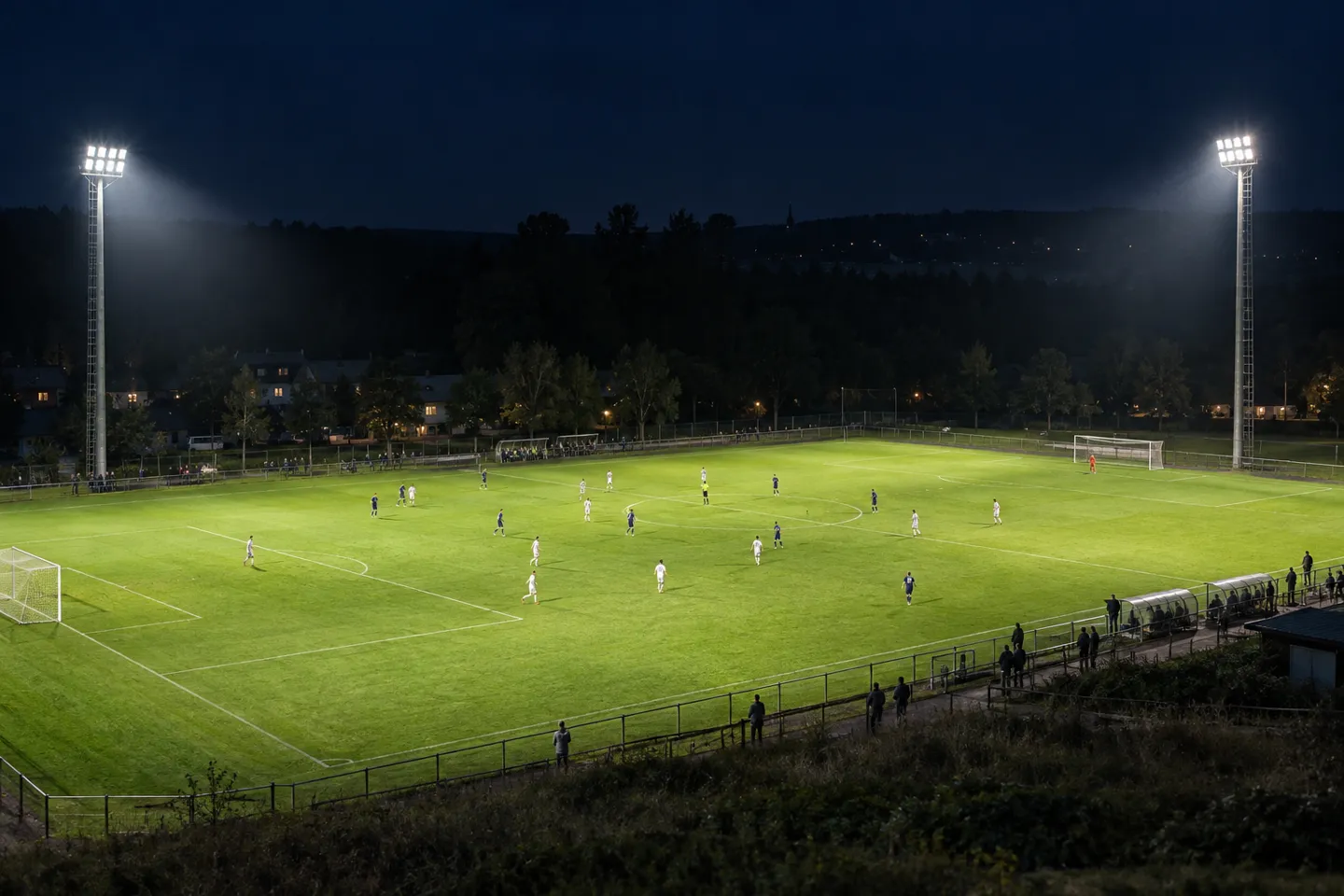
Sports field lighting is governed by numerical standards, not by manufacturer marketing. A standard turns “bright enough” into a contract term: a defined average illuminance, a defined uniformity, a defined way to measure both. Without that conversion, an acceptance test has no referee.
Four families of standards cover most projects. In North America, the reference document is ANSI/IES RP-6, the Illuminating Engineering Society’s recommended practice for sports and recreational area lighting, first issued as RP-6-15 and updated in the RP-6-20 series (ANSI blog, 2021). Across Europe and much of the international procurement world, the working standard is EN 12193, which tabulates illuminance and uniformity requirements for dozens of sports (BEGA knowledge base). Football adds a layer on top: FIFA’s stadium guidelines define the technical criteria for televised and non-televised events, from mounting geometry to glare (FIFA Football Stadiums Guidelines, 5.6). Australia and New Zealand work to AS 2560.2, whose 2021 edition raised recommended minimum levels in the first major revision since LED became dominant (Legacy Sport Lighting, 2021). Sporting associations can then layer their own codes on top, as NCAA and federation rules do.
Two clarifications prevent common tender mistakes. OSHA lighting requirements are written for workplaces, not playing fields, so citing them in a field tender is a category error. And environmental rules such as dark-sky ordinances or local spill-light codes sit beside the sports standards, not inside them; a design can satisfy lux tables and still fail a neighborhood ordinance.
Lighting Classes: The Ladder from Training Nights to Broadcast
Two class systems, one ladder
Every standard sorts fields into classes by level of play. The labels differ, the logic does not: the higher the competition level and the farther the spectators, the higher the class, and the higher every number goes.
EN 12193 uses three classes. For outdoor football, the standard’s tabulated values are 500 lux average horizontal illuminance with 0.70 uniformity for Class I, 200 lux with 0.60 for Class II, and 75 lux with 0.50 for Class III (Luxon LED EN 12193 guide). A youth match needs the bottom of that ladder; a national-team fixture needs the top, which is how the BEGA knowledge base summarizes the class logic (BEGA). ANSI/IES RP-6 works with five play classes and sets foot-candle and uniformity targets per sport (IES Store), which is why North American spec sheets read in fc while European tenders read in lux.
Broadcast television adds its own tier above all of this. Industry summaries of FIFA’s competition tiers typically cite roughly 400 lux average vertical illuminance for basic TV support at the entry tier, 700–1,000 lux for standard professional broadcast, and 1,500 lux and above with horizontal levels of 2,500 lux or more for World Cup-class venues (REITA FIFA standards guide). Vertical illuminance, measured on players and faces rather than on the grass, is what separates a competent training field from a broadcast stadium.
The class ladder at a glance (football examples, dual units)
| Level | Typical use | Avg horizontal illuminance | Uniformity | What it buys you |
|---|---|---|---|---|
| EN Class III / RP-6 lower classes | Training, recreation, school practice | 75 lx ≈ 7 fc | 0.50 | Safe play on training nights |
| EN Class II / RP-6 mid classes | Club and school matches, regional league | 200 lx ≈ 19 fc | 0.60 | Spectator-ready matches |
| EN Class I / RP-6 higher classes | High-level competition, large viewing distances | 500 lx ≈ 46 fc | 0.70 | Federation-level play |
| Broadcast tiers (FIFA A–D summaries) | Televised professional football | Ev 400–1,500+ lx vertical | Tighter, per-tier | Television, slow-motion replay |
Note the units: 1 foot-candle equals about 10.76 lux, so a 75 lux training field is roughly 7 fc and a 500 lux Class I field is roughly 46 fc. Numbers quoted without their unit and class travel badly.
What decides your class
Three questions fix the class. First, what happens on the field: training, league matches, or televised fixtures. Second, how far the spectators sit, because viewing distance drives the illuminance the standard demands. Third, which sport, because a 90-foot baseball diamond and a five-a-side pitch carry different tables in the same standard. School sports at 200 lux, matching EN Class II, is a worked example in the BEGA knowledge base (BEGA). Most municipal and school projects live on the middle rungs; broadcast tiers are the exception, not the default.
What each step up actually costs
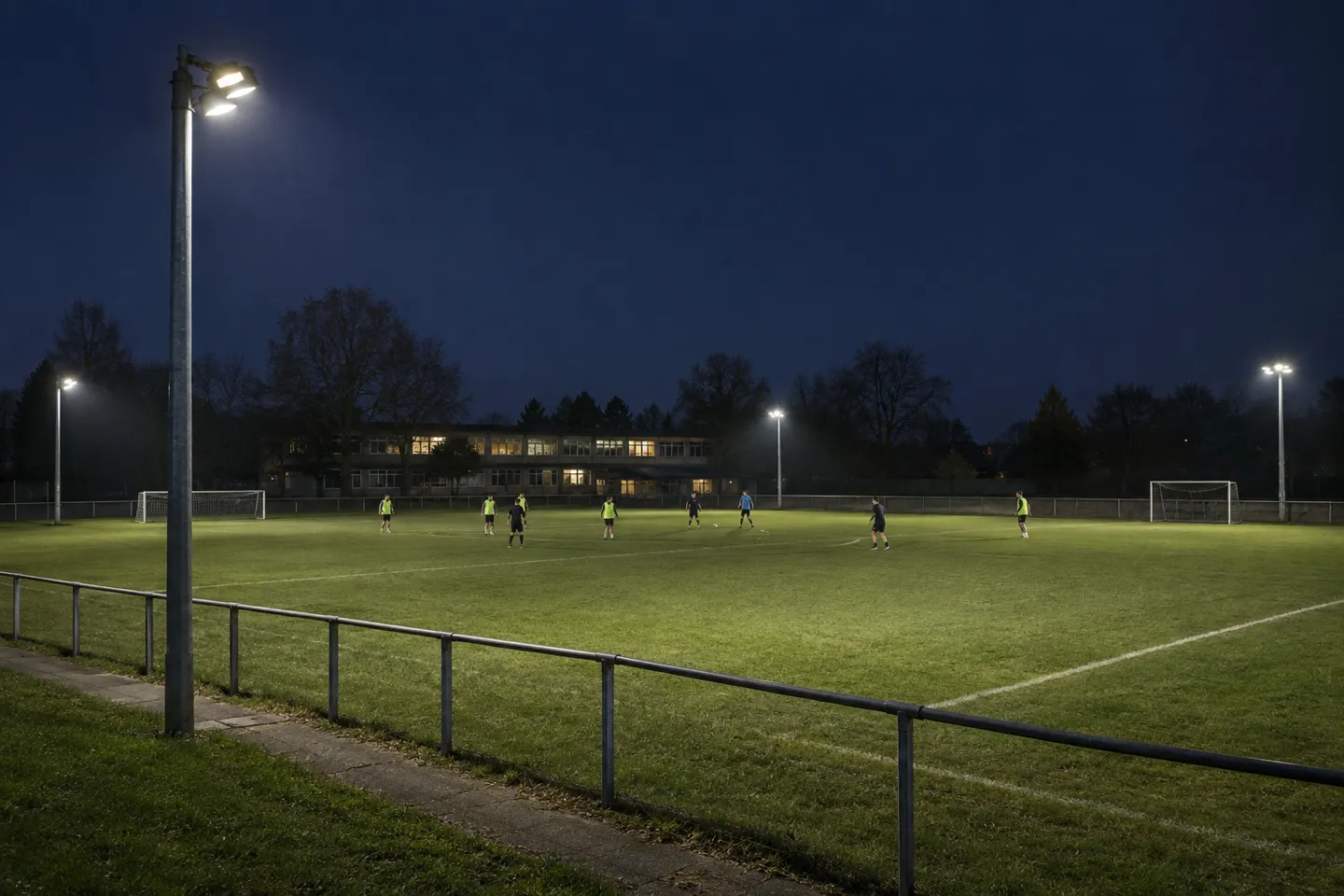
A class is a price tag in disguise. Step up one rung and three costs arrive together. More fixtures on more poles, because both the average level and the uniformity floor rise. A tighter acceptance test, because the same grid now has to hit a higher minimum everywhere, not just on average. And a longer documentation chain, because higher classes attract consultant review and, where television is involved, federation inspection. A Pennsylvania school district’s recent $1.4 million field upgrade illustrates the middle of the ladder: measured levels roughly double from about 20–25 foot-candles to 50 (SkookNews, 2025). That is one rung of the ladder for one field set. Budget the ladder before you fall in love with a stadium photo.
Stepping up a class multiplies fixtures, acceptance risk and paperwork, and WOSEN quotes each rung as a complete package: poles, optics and the DIALux calculation, itemized before you commit.
Get a class-itemized quoteHow to Read the Numbers (and Why Sources Disagree)
Anyone who compares two sports lighting guides meets the same wall: the numbers disagree. One supplier guide puts a competitive soccer field at 10 to 50 foot-candles (LED Lighting Supply); another describes Class I baseball as roughly 1,000 to 1,500 lux (LEDVANCE). Both can be right, because they are quoting different standards, different classes, different sports and different measurement planes. Reading lighting numbers means attaching the right qualifiers, and four of them do most of the work.
Qualifier one: the unit. One fc ≈ 10.76 lx. A quote of “50” without its unit is half a specification. Qualifier two: the measurement plane. Horizontal illuminance (Eh) lands on the grass and serves the players; vertical illuminance (Ev) lands on the players and serves the cameras. FIFA’s guidelines make the point directly: performance standards must examine a range of criteria rather than focusing on a single measure such as lux (FIFA, 5.6). A field can pass its horizontal table and still look flat on television.
Qualifier three: the uniformity definition. Uniformity is a ratio, and sources define the labels differently; some write min÷average, others min÷max, and the same “0.7” can mean different things. Real tenders sidestep the labels by demanding the raw figures: minimum, maximum, average, the max-to-min and max-to-average ratios, the coefficient of variance and the uniformity gradient (Patriot Park & Legion Field IFB #12-05-24). Ask for the same fields in your own paperwork. Qualifier four: the maintenance factor. Every accepted number is a maintained level, net of lumen depreciation and dirt, which is why tenders require an explicit light loss factor (FindRFP IFB).
The four qualifiers to attach to every lighting number
| Qualifier | What it fixes | What goes wrong without it |
|---|---|---|
| Unit (fc vs lux) | Factor-of-10.76 conversion | Quotes that look 10x apart |
| Plane (Eh vs Ev) | Players vs cameras | Broadcast failure at a “passing” field |
| Uniformity definition | min/avg vs min/max | Two “0.7” specs that are not the same |
| Light loss factor | Maintained vs initial levels | Fields that dim below spec within seasons |
Two softer numbers complete the picture. Professional venues typically specify 5000–6500K color temperature for a daylight-like image (REITA), and glare is controlled through a glare rating, with values below 50 commonly cited for sports installations (MIC LED football stadium guide). Before comparing two supplier quotes, align the qualifiers. A cheaper quote at an undefined “500 lux” is not a discount; it is a different product.
From Class to Design: Poles, Beams and the Hardware Behind the Numbers
A class becomes real on paper before it becomes real on poles. The photometric layout, the pole positions, mounting heights, aiming angles and beam choices that determine whether the grid test passes, is not an optional extra. Generic layouts produce uneven coverage and rework, as the FSG sports lighting guide puts it bluntly (FSG complete guide).
The hardware follows the class. Mounting height sets the geometry: for a regulation baseball field with 90-foot base paths, the recommended minimum is about 21 meters (70 feet), raised further as light levels climb, with beams aimed so the top of the beam sits at least 10 degrees below the luminaire to cut glare (National LED baseball footcandle guide). Beam angle narrows as class rises, because a tighter optic throws light further without spill. Ingress protection is typically IP65 or IP66 on outdoor sports fixtures, and efficacy in the 150–200 lm/W range is what current LED stadium hardware delivers, which decides how much power a Class I field draws. At the broadcast tier, mounting position becomes a camera question as much as a lighting one, which is why FIFA’s guidelines diagram mounting heights, exclusion zones and aiming angles for televised venues (FIFA, 5.6).
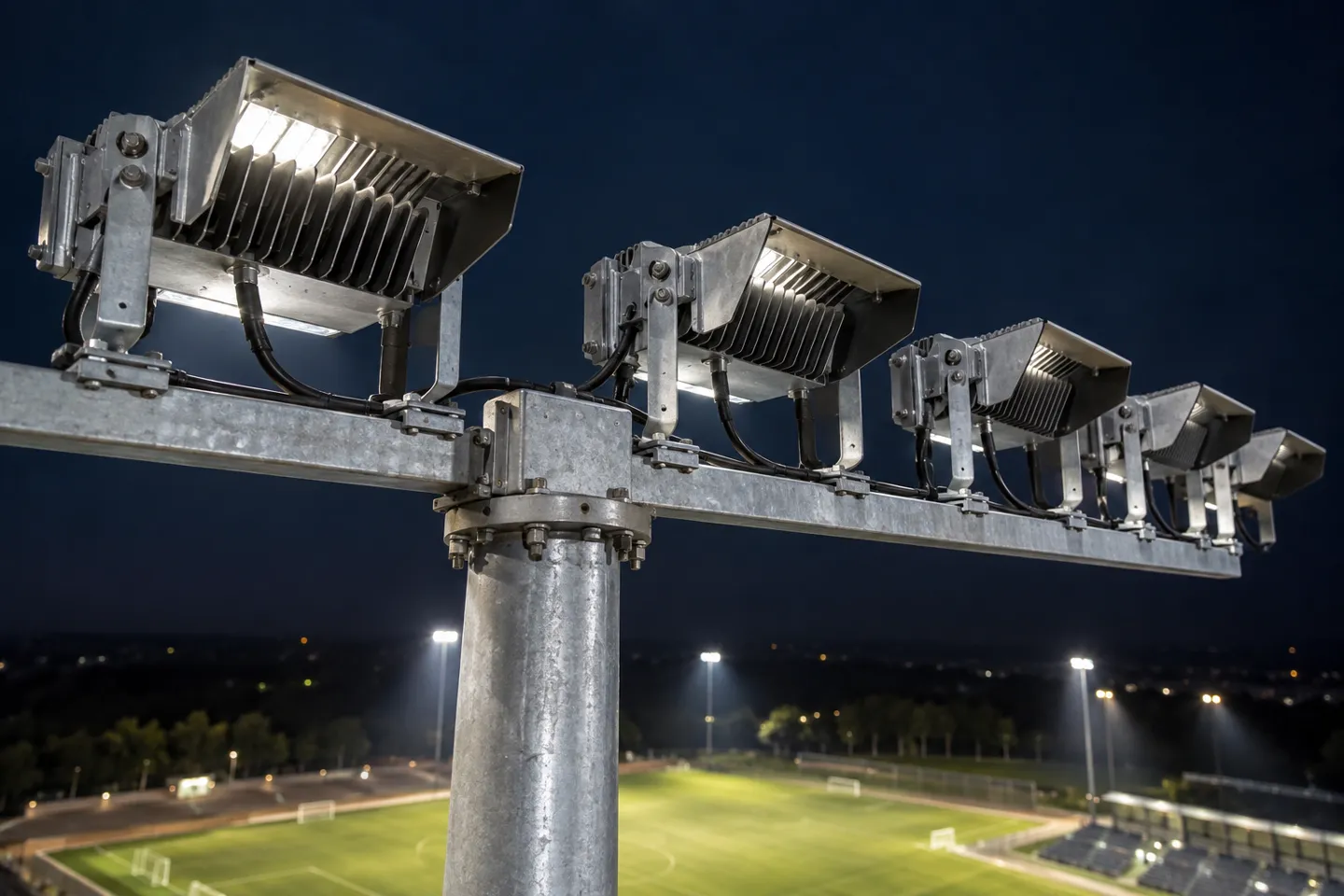
Spill light belongs in the hardware conversation too. DarkSky’s outdoor sports program caps luminous intensity at 1,000 candelas per luminaire toward the glare-evaluation perimeter, measured 1.5 meters above grade at points spaced 3 meters apart (DarkSky guidelines). Asymmetric optics, visors and shielding are the tools that meet such limits; field audits after LED retrofits consistently find that glare and spill, not dimness, draw the first complaints (Hyperlite uniformity guide).
Scenario matrix: the path that meets the class, and the boundary that forces a redesign
| Scenario | Path that meets the class | Boundary: switch approach when |
|---|---|---|
| Training / recreation field (Class III) | 4–6 poles, wide-beam flood or stadium optics, ~75 lx | Utility costs or grid power make 75 lx unmaintainable; consider partial lighting of the key area |
| School / club match field (Class II) | 4–8 poles, asymmetric optics, ~200 lx with 0.60 uniformity | Neighbor spill complaints survive visors and re-aiming; move to full cutoff optics or relocate poles |
| Regional league / multi-use field (Class I–II) | 6–8 poles, 500 lx-class design with documented grid | Uniformity fails on the multi-sport overlay; split designs per sport instead of one compromise grid |
| Professional / broadcast venue | High-mast or roof positions, Ev-first design, federation review | Camera positions change the venue; re-run the photometric design, do not patch aiming |
The matrix is the working tool: find your scenario row, then treat the third column as the trigger list for a redesign rather than a patch.
Proving Compliance: The Evidence Chain That Gets You Paid
Lock the documents at design stage
Acceptance is decided by documents long before the meter comes out. The first link is the photometric calculation itself, run in DIALux or AGi32 against the agreed class and grid. The second link is the fixture-level evidence: IES or LDT photometric files so the calculation can be reproduced, LM-80 lumen-maintenance reports for the LED packages behind the light-loss factor, and integrating-sphere test reports confirming the rated output. A supplier who can produce these with the quote is a different category of supplier from one who promises “500 lux” in an email.
What the field test actually measures
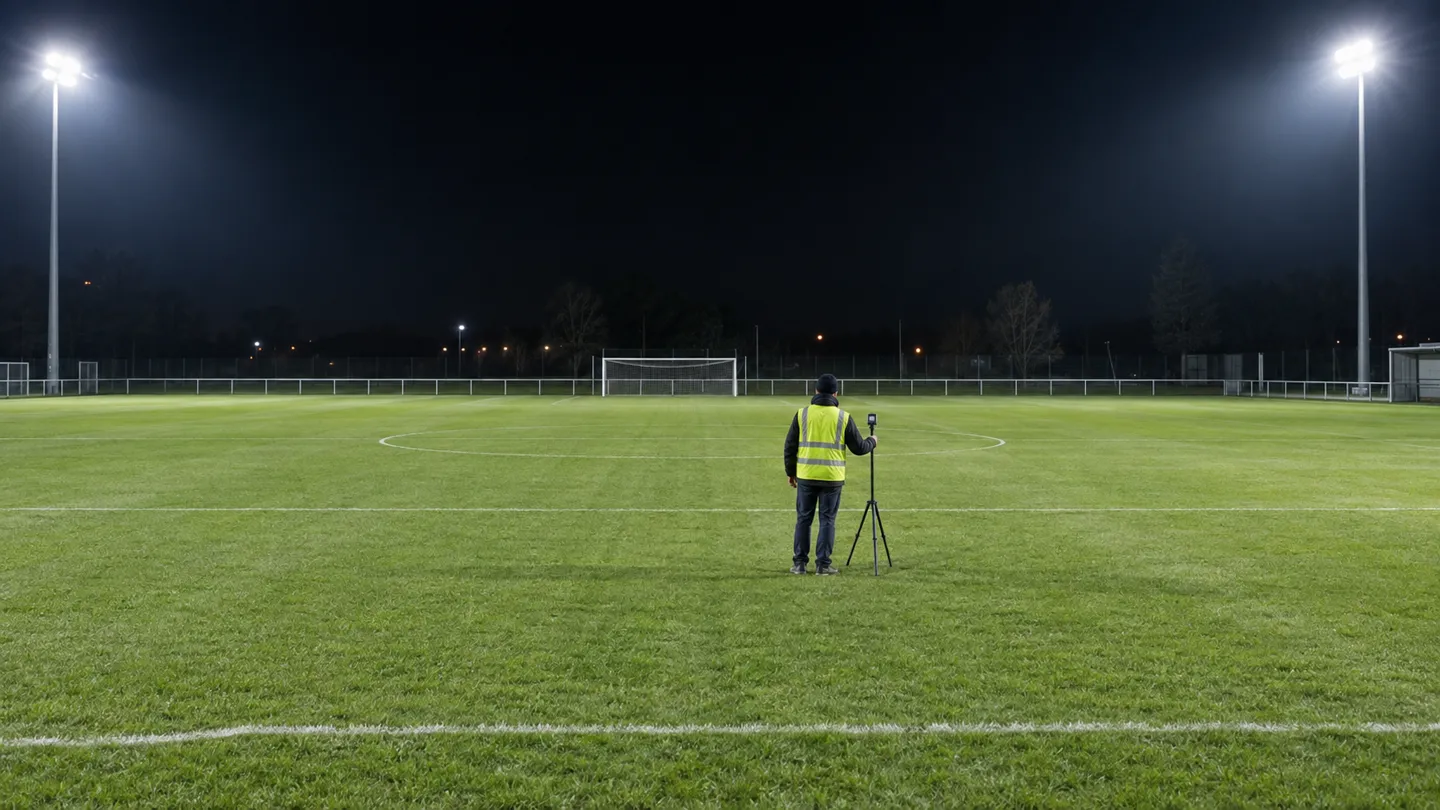
The acceptance test is a grid walk. Real tender documents enumerate the deliverables precisely: a summary table of grid points and spacing per field, average, minimum and maximum illuminance in fc, the uniformity ratios including max-to-min and max-to-average, the coefficient of variance, the uniformity gradient, plus meter height fixed at 3 feet above the surface (Patriot Park & Legion Field IFB #12-05-24). Broadcast venues run the same logic on a denser grid; professional football assessments commonly use a 96-point test pattern across the pitch (REITA). Two design-stage facts decide whether this walk passes: the calculation must model the actual grid, and the installation must hold aiming tolerances. A photometric pass with sloppy aiming is still a failed field.
When verification fails, who pays
Failure has a price list, and it is worth reading before signing. DarkSky’s program charges $1,000 per Phase 1 design review; a failed design can be resubmitted up to three times, after which the applicant restarts the process and pays another $1,000 application fee before Phase 2 field verification (DarkSky Outdoor Sports Lighting Program). A field running well below its prescribed foot-candle level is not a dim field but a compliance violation (FSG). And supplier failure is its own tier of cost: one independent baseball club changed lighting suppliers mid-project after the first failed to deliver equipment and start services (WDAZ via Facebook, 2025).
The price of a failed verification
$1,000
A DarkSky design review costs $1,000 per submission. Three failed reviews restart the program, with another $1,000 application fee, before field verification can even begin.
The evidence chain, contract to sign-off
- 1Agree class, grid and maintained levels in the contract.
- 2Collect photometric calculation, IES/LDT files, LM-80 and integrating-sphere reports with the quote.
- 3Install to aiming tolerances; document as-built aiming.
- 4Walk the grid: avg/min/max, uniformity ratios, CoV, gradient at the agreed meter height.
- 5Sign off against the contract numbers, not the sales brochure.
What This Means for Your Next Tender
Read back through the chain and the procurement lesson writes itself. Choose the class for the use, not for the brochure: a training field that carries broadcast-tier numbers pays broadcast-tier acceptance bills for its whole life. Align the qualifiers first, unit, plane, uniformity definition and light loss factor, because two quotes at “the same” lux are rarely the same product. Then put the evidence chain in the contract, where it does its work.
That last clause is where tenders are won and lost quietly. Specify in the documents: the class and sport table the design must meet, the grid and meter height for acceptance, the document package due with the quote (photometric calculation, IES/LDT files, LM-80, test reports), and who pays for a failed retest. Check the edition while you are at it; Australia’s 2021 revision of AS 2560.2 was the first since LED took over, and tenders still cite superseded versions (Legacy Sport Lighting). None of this adds cost to a serious supplier’s quote. It prices out the ones whose numbers would not have survived the grid walk.
The tender checklist, item by item
- Class chosen for actual use, with the sport table named
- Unit, measurement plane, uniformity definition and LLF aligned across all quotes
- Photometric calculation, IES/LDT files, LM-80 and test reports due with the quotation
- Acceptance method in contract: grid spacing, meter height, avg/min/max, ratios, CoV, gradient
- Retest responsibility and cost assigned before award
- Standard editions checked against the current versions
On the documentation side, WOSEN builds the evidence chain into the offer itself: our LED stadium light line ships with CE, RoHS and EMC for Europe, UL/ETL for North America, SAA for Oceania plus TUV and ENEC, under ISO 9001-certified production (certification overview), and we provide DIALux calculations and test documentation with project quotes so the grid walk lands on verified numbers (LED stadium light line).
Build your tender’s evidence chain with WOSEN
WOSEN ships IES/LDT photometric files, LM-80 reports and DIALux calculations with every LED stadium-light quote, certified CE, UL/ETL and SAA for your market.
Start your stadium-light quoteReferences
- ANSI. “ANSI/IES RP-6-20: Sports and Recreational Area Lighting.” 2021. https://blog.ansi.org/ansi/ansi-ies-rp-6-20-sports-recreational-lighting/
- IES Store. “Lighting Sports and Recreational Areas (ANSI/IES RP-6).” https://store.ies.org/product/recommended-practice-lighting-sports-and-recreational-areas/
- BEGA. “DIN EN 12193 · Sports lighting.” https://www.bega.com/en/knowledge/lighting-theory/reference-values-for-illumination/dinen12193-sports-lighting/
- Luxon LED. “EN 12193: A Practical Guide to Sports Lighting Standards.” https://luxonled.eu/knowledge/en-12193-a-practical-guide-to-sports-lighting-standards/
- FIFA Publications. “Football Stadiums Guidelines, 5.6 Technical Systems and Services.” https://publications.fifa.com/de/football-stadiums-guidelines/technical-guideline/stadium-guidelines/technical-systems-and-services/
- REITA Lighting. “FIFA Stadium Lighting Standards Guide.” https://reitalight.com/fifa-stadium-lighting-standards-guide/
- Legacy Sport Lighting. “What are the lighting standards AS2560.2?” https://legacysportlighting.com/what-are-the-lighting-standards-as2560-2/
- TAAF. “Lighting Standards (referencing IESNA RP-6-15).” 2017. https://taaf.com/wp-content/uploads/2025/01/TAAF-Lighting-Standards-2017.pdf
- Patriot Park & Legion Field Lights, IFB #12-05-24. https://gov.findrfp.com/docs/12732_12-05-24.pdf
- DarkSky International. “Outdoor Sports Lighting Program.” https://darksky.org/what-we-do/darksky-approved/outdoor-sports-lighting
- DarkSky International. “Outdoor Sports Lighting guidelines.” 2023. https://darksky.org/what-we-do/darksky-approved/outdoor-sports-lighting/guidelines/
- FSG. “Sports Field Lighting Standards & Layouts: Complete Guide.” https://fsg.com/sports-field-lighting-standards-layouts-complete-guide/
- National LED. “Footcandle Standards For Baseball Fields.” https://nationalled.com/footcandle-standards-baseball
- SkookNews. “North Schuylkill School Board Approves $1.4 Million Athletic Field Lighting Project.” 2025. https://www.facebook.com/SkookNews/posts/north-schuylkill-school-board-approves-14-million-athletic-field-lighting-projec/1238663961598097
- WDAZ via Facebook. “Independent baseball club turns to another lighting supplier.” 2025. https://www.facebook.com/wdaytv/posts/the-independent-baseball-club-turned-to-another-lighting-supplier-after-first-su/1158130729681731
- Hyperlite. “Uniformity Ratios for Outdoor Court Lighting Design.” https://hi-hyperlite.com/blogs/comprehensive-guides/uniformity-ratios-outdoor-sports-court-lighting-design
- MIC LED. “Football Stadium Lighting Standards Explained.” 2026. https://www.mic-led.com/news/football-stadium-lighting-standards-explained/
- LED Lighting Supply. “Design Guide for Lighting a Sports Field.” https://www.ledlightingsupply.com/blog/sports-lighting-design-guide
- LEDVANCE. “The Basics of Baseball Field Lighting.” https://www.ledvance.com/en-us/professional-lighting/insights/blog/application/the-basics-of-baseball-field-lighting
- WOSEN. “Patents & Certificates.” https://www.wosenled.com/patents-certificates/
- WOSEN. “LED Stadium Lights.” https://www.wosenled.com/outdoor-lights/led-stadium-light/
- WOSEN. Homepage. https://www.wosenled.com/

 English
  Spanish
  French
  German
  Italian
  Arabic
  Russian
  Portuguese
  Dutch
Dutch  Indonesian
  Turkish
  Polish