
Ask anyone who maintains solar lights long enough and you will hear the same story. The panel still works. The LED still works. The light dies anyway, because the battery gave out. In a solar street light, the battery is the only component that cycles deeply every single night, which makes it the de facto clock of the whole system. Yet it is also the most loosely specified part of most purchase orders: a chemistry name, maybe an Ah figure, and little else.
That gap between how precisely batteries fail and how loosely they get specified is what this article is about. We will walk the full ladder. It runs from a garden light that died in a year to the battery clauses that decide who pays for year-4 replacements on a municipal project.
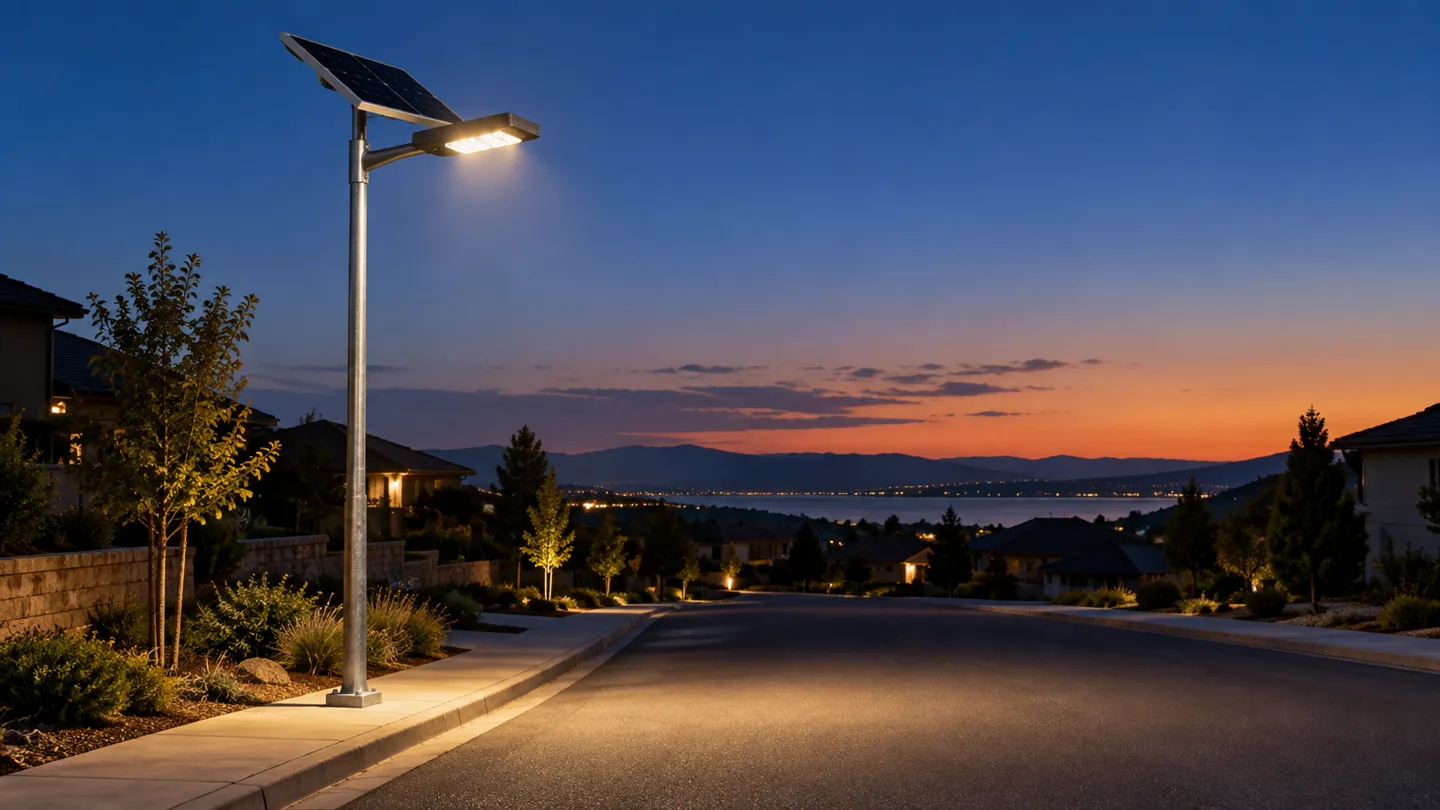
What the Battery in a Solar Street Light Actually Does
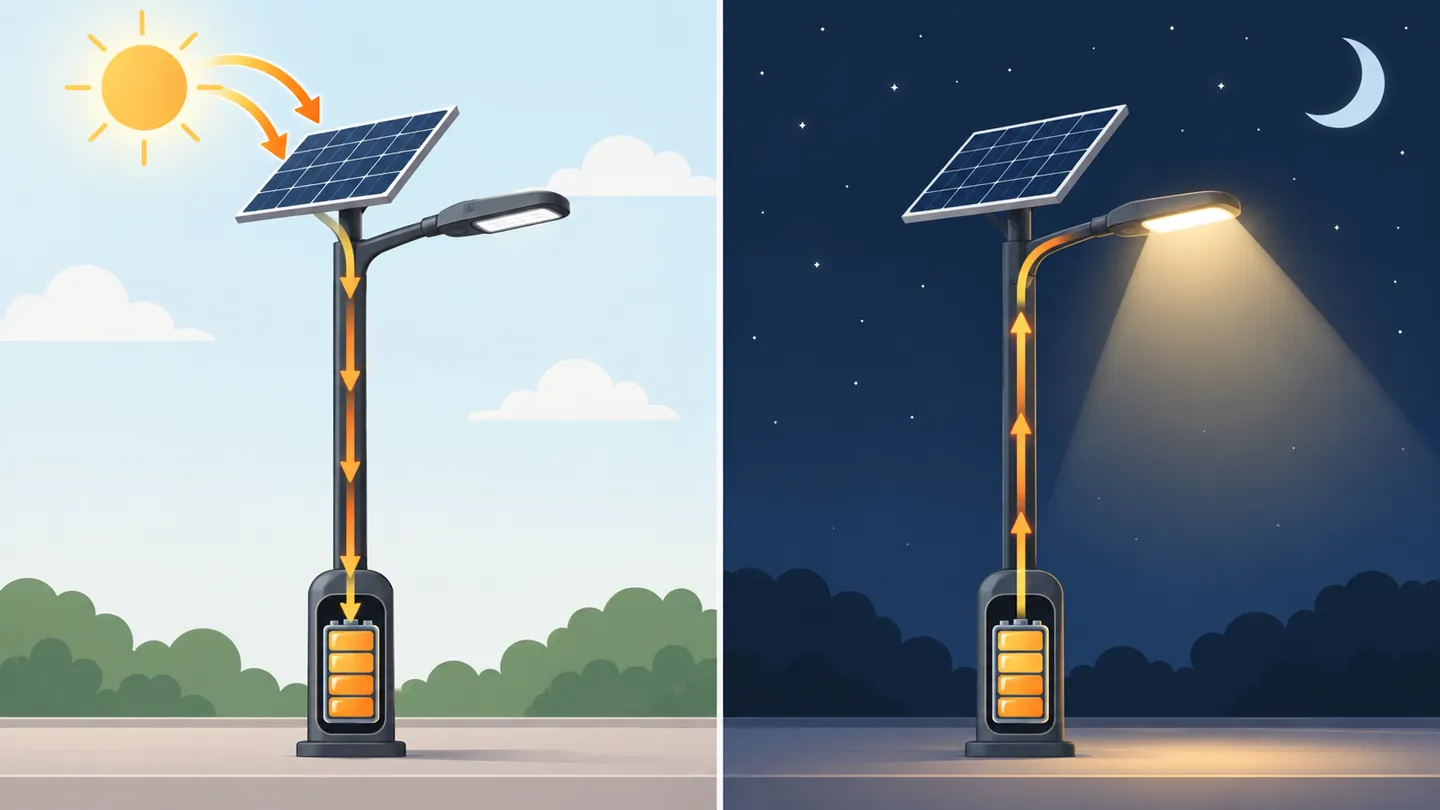
A solar street light runs a daily loop. The panel charges the battery through the day; the charge controller manages how that charge goes in. After dark, the battery discharges through the driver to power the LED. Between the battery and the LED sits a BMS, a battery management board. Its job is to stop overcharging, over-discharging, short circuits, and out-of-range temperatures before they do permanent damage.
One full night of discharge counts as one cycle. A street light that runs dusk-to-dawn completes roughly 365 cycles a year, every year, rain or shine. Nothing else in the lamp works that hard: an LED source is typically rated for tens of thousands of hours, and a PV module for decades of gradual decline. The battery, by design, is the consumable core of the system. That is why “the light stopped working” is, more often than not, “the battery stopped holding charge.”
That is true whether the light in question is a $30 garden spike or a 60 W roadway luminaire. The scale differs and the chemistry may differ, but the mechanism is the same problem at two magnitudes: a small pack cycling every night under whatever conditions the site imposes. If you are here because a garden light died in its first year, the sections below will still explain why. If you are specifying roadway units, the same mechanics determine your maintenance budget.
The useful question, then, goes beyond “which battery lasts longest.” It asks how long the battery actually lasts once installed. Those two numbers are rarely the same.
The Four Battery Types and Their Rated Numbers
Four chemistry families show up in solar lighting. Their rated numbers tell you what each promises on paper:
| Chemistry | Nominal voltage | Rated cycle life | Rated service life | Where it fits |
|---|---|---|---|---|
| Lead-acid (flooded / AGM / gel) | 12 V (2.0 V/cell) | ~300–800 cycles at ≤50% DoD | 2–5 years | Budget projects that accept frequent swaps |
| Ternary lithium (NMC / li-ion) | 3.7 V/cell | ~500–1,000 cycles | 5–10 years | Where compact size matters more than cycle life |
| LiFePO4 (lithium iron phosphate) | 3.2 V/cell, 12.8 V / 25.6 V packs | ~2,000–6,000 cycles at a stated DoD | 5–10+ years | Street-grade standard today |
| NiMH / NiCd | 1.2 V/cell | a few hundred cycles | 1–3 years | Small garden-level lights only |
The overall spread is wide. Public industry sources put the realistic service life anywhere from 2 to 10 years (RoadSky Safety, 2025). The exact figure depends on battery type, system design, and operating conditions. Within that, lead-acid sits at the short end and lithium chemistry at the long end of the same scale (RoadSky Safety, 2025).
Which battery is best? For street-grade, dusk-to-dawn duty, LiFePO4 is the current default answer, and the numbers explain why. A 12.8 V 30 Ah LiFePO4 pack weighs around 5 kg and carries about 4,000 rated cycles at 80% depth of discharge. It ships with a BMS as standard (Langy Energy, 2025). Rated cycle-life claims from battery makers run higher still, at 5,000 to 6,000 cycles at 80% DoD. A public tender specification for solar street lights, by contrast, sets its floor at 2,000 cycles at 80% discharge. All of these numbers are true at their own test conditions, which is exactly the catch this article keeps coming back to.
The market shift is already written into procurement. A 2023 tender for solar street lights, for example, specifies a 12.8 V, 24 Ah LiFePO4 battery as standard equipment. Low-first-cost projects that still award on price continue to install lead-acid, which is why battery replacement remains an active retrofit market rather than a historical one.
Two side notes complete the map. Form factor matters almost as much as chemistry. An all-in-one light with the battery sealed inside the lamp body behaves very differently in service than one with a pole-mounted or buried battery box. Station three covers why. If you arrived here while researching grid-powered LED street lights, note that those have no battery at all. Their lifespan story is driven by drivers and heat sinks instead, and most of this article will not apply.
Every number in the table above, though, carries fine print the table cannot show. Rated cycles assume a stated depth of discharge, a temperature window, and a charging regime. Field installations routinely violate all three. That is where rated life and real life part ways.
Why Field Life Differs from Rated Life
Field life vs rated life
Two batteries stamped with the same “2,000 cycles” can finish their field lives five years apart.
The rating is only valid at the conditions printed next to it.
Public sources disagree about battery life by a factor of five, spanning 2 to 10 years (RoadSky Safety, 2025). The disagreement is not sloppy writing; it reflects real deployments (RoadSky Safety, 2025). The same rated pack can age at very different speeds depending on five conditions the rating label usually leaves out.
Cells and BMS: What the Label Doesn’t Say
Cycle-life ratings describe best-grade cells. The market also sells B-grade and repurposed cells in packs with identical labels and noticeably different endurance. No outward marking distinguishes them, which is why “ask for the cell brand and grade in writing” is a purchasing action, not a formality. The same applies to the BMS: its job is to cut off overcharge, over-discharge, short circuit, and out-of-range temperature. A poorly made protection board fails quietly. A single uncontrolled deep discharge can permanently damage a lithium cell, no matter what its cycle rating promised.
The consumer market demonstrates the failure mode in miniature. Garden-light owners who disassemble dead units routinely find a small cell that has been cycled to death within a year. It sits potted in polymer with minimal heat dissipation and little effective over-discharge protection. A sealed street-light integrated unit scales that pattern up. The battery lives inside the lamp housing, absorbing heat from the electronics around it, with no realistic way to service it.
The verifiable actions here are simple. Treat a supplier who cannot produce either as quoting a number rather than a battery.
Get it in writing before the PO
- The cell manufacturer, model, and grade declaration, with the cell datasheet.
- The BMS specification sheet, listing its protection functions and cutoff thresholds.
DoD and System Matching: How Ratings Get Spent Faster
Depth of discharge (DoD) is the fine print on every cycle count. Lead-acid chemistry is conventionally operated at no more than ~50% DoD; LiFePO4 tolerates around 80%, and cycle ratings are quoted at those specific depths. Run a battery deeper than its rating assumes and you spend its cycles faster than the calendar suggests; the label says cycles, but the site enforces them.
System design determines how deep each night’s discharge actually goes. If the panel array is undersized for the load or the local winter sun, the battery starts each night part-charged. It then reaches the low-voltage disconnect (LVD), the last-line cutoff against destructive over-discharge, earlier every evening. Chronic undercharging also degrades lead-acid chemistry through sulfation. Autonomy settings work the same lever. A public tender spec that sizes the battery at 24 Ah for one day of autonomy is explicitly choosing a shallower daily cycle. A design that must ride through three cloudy days on the same pack ages it differently. Neither choice is wrong. They will not age the same way.
Temperature and Packaging: The Conditions That Void the Math
LiFePO4 cells charge poorly below freezing. Charging below 0°C requires the charge current to be cut to 0.1C, and below −10°C to 0.05C, because lithium plating can cause irreversible damage (RELiON Battery, n.d.). A solar light in a cold climate therefore needs a temperature-compensated charging strategy or a self-heating pack. That is a spec-sheet line, not an accident to discover in winter. Heat works the other direction by accelerating chemical aging. Sustained high ambient temperatures, as in desert installations, shorten the same rated life without any single dramatic event.
Packaging decides how much of this the battery must endure. An all-in-one unit puts the pack inside the lamp body: compact and theft-resistant, but living with electronics waste heat and sealed away from service. A pole-mounted battery box is accessible and serviceable but exposed to ambient swings; a buried box is temperature-stable but the hardest to reach when the day comes. None of these is universally right; each moves a different real-world failure to the top of the list.
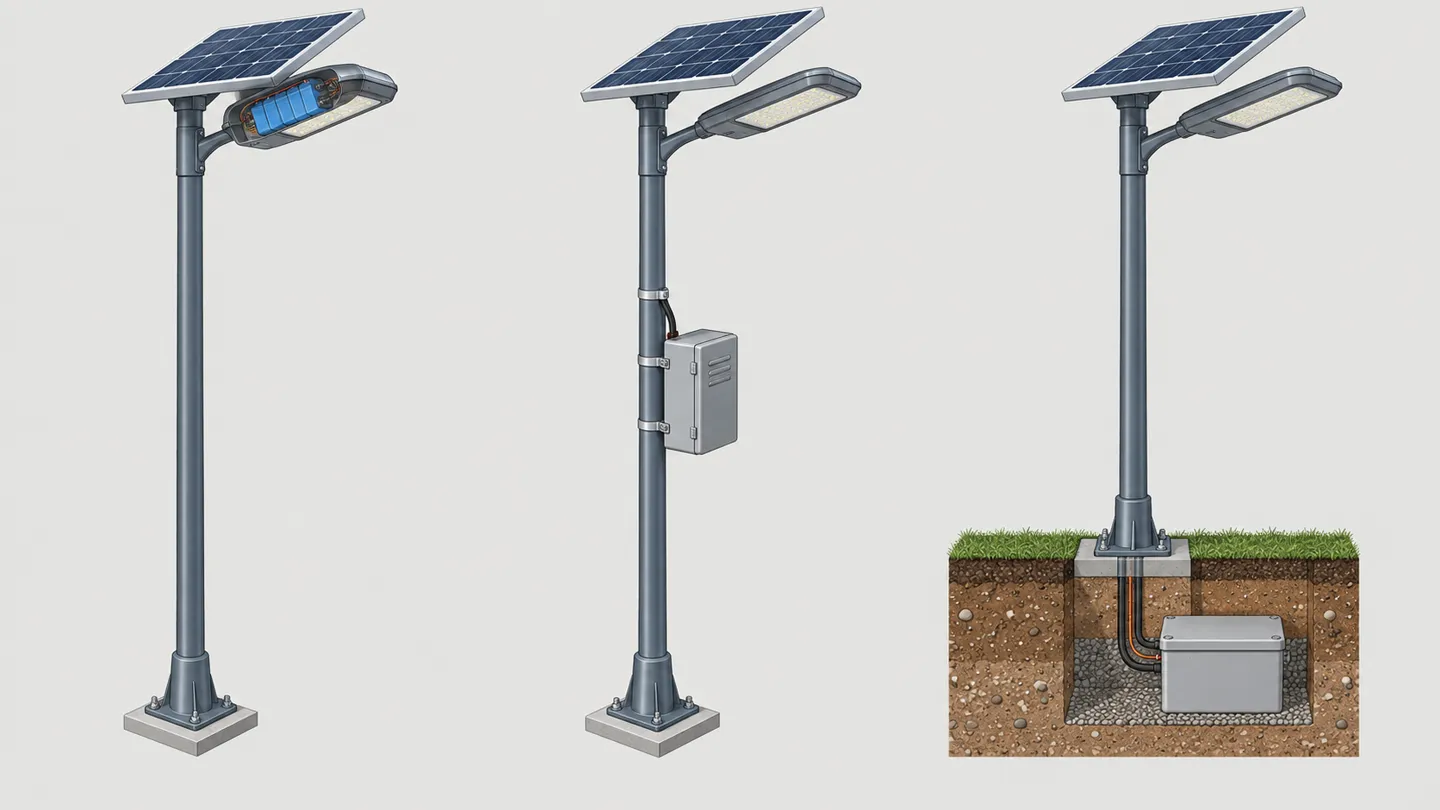
The composite lesson: rated life is a laboratory answer, and every one of these five conditions is a way the field overrides it. That raises the practical follow-up. When a light has already gone dark, how do you tell which condition killed the battery, and what do you replace?
Diagnosing and Replacing the Battery
Work through the charge path in order before condemning the battery. A large share of “dead battery” calls are actually charge-side problems:
Diagnose in this order
Panel first
Dirt, shading, or storm damage; measure its open-circuit voltage on a sunny day.
Controller and wiring next
Indicator states, loose or corroded connectors, rodent damage.
Battery last
Rest voltage against its nominal (a 12.8 V pack resting far below ~12 V signals deep discharge or cell failure), then a discharge test if the voltage looks healthy.
If the battery is confirmed as the fault, replacement compatibility rests on three matches. Voltage: a 12.8 V LiFePO4 pack replaces a 12 V-class system; never mix nominal voltages. Capacity: match or exceed the original Ah, because less capacity means shorter autonomy and deeper nightly discharge. Interface: connector type, physical dimensions, and a BMS that talks to the same charge controller logic. Retail availability makes this easy at small scale. 12.8 V LiFePO4 packs in 10–80 Ah capacities are widely listed as solar street light replacements, and consumer-grade packs sell for tens of dollars; a pack of two batteries for a 60 W consumer unit lists at $39.95 (Home and Lighting, 2026).
When should you replace the whole light instead of the battery? Three conditions tip the scale. The unit is an integrated design with no serviceable battery compartment. The light is past the midpoint of its expected life, so the panel and driver will follow the battery soon. Or, at roadway scale, the access equipment and labor for a pole-top battery swap approach the cost of a new luminaire. The math is site-specific, which is precisely why it belongs in the maintenance plan rather than being improvised at year three.
Send WOSEN your load, autonomy, and climate numbers, and get a battery spec written to survive them.
Request a Battery Spec ReviewWriting Battery Specs You Can Actually Enforce
Everything so far reduces to one purchasing conclusion: battery life is not bought, it is configured. The chemistry name alone does not carry the configuration; the written conditions do. This section turns the five field conditions into contract language.
What Real Tender Clauses Get Right — and What They Miss
A publicly circulating tender specification for solar street lights (2023) shows both halves of the picture. It gets right what many purchase orders still omit. The battery clause ties cycle life to depth of discharge (2,000 cycles at 80% discharge). It defines the capacity at standard test conditions (12.8 V nominal, 24 Ah) against an explicit autonomy target of one day, with type testing by accredited labs. That is a defensible floor.
What it leaves open are exactly the field conditions from earlier. There is no operating temperature range tied to the installation climate. No cell grade or manufacturer declaration is required. And no acceptance test method lets the buyer verify any of it at delivery. Each omission maps to a failure mode. An unspecified temperature window allows a pack rated for temperate duty into a desert or highland site. A missing grade declaration invites B-grade cells into a 2,000-cycle envelope. The absence of an acceptance method turns every other clause into an honor system.
Acceptance You Can Actually Run
Verification actions that fit inside a normal incoming inspection: require the cell manufacturer, model, and grade in writing with the cell datasheet. Sample-test delivered packs with a discharge test against rated Ah. Exercise the BMS protections (overcharge, over-discharge, short circuit, temperature cutoff) on a sample. Demand the transport certification, too: nearly all lithium batteries must pass Section 38.3 of the UN Manual of Tests and Criteria before shipment (Intertek, n.d.; UNECE, 2015). For cell-level safety, request reports against IEC 62133 for sealed secondary cells or IEC 62619 for industrial applications. These are the same standards accredited battery test labs certify against (MET Labs, n.d.; TÜV SÜD, n.d.).
Warranty Alignment: Who Owns Year Four
The last clause is temporal, not technical: ask the supplier to put the battery inside the same warranty envelope as the whole light. The market norm for outdoor luminaires runs from a standard 3-year whole-light warranty up to 5–7 years for project-grade commitments. A battery’s realistic field life may sit at the short end of the 2–10 year spread. In that case, a light “covered for 5 years” is a cost center wearing a promise if the battery is implicitly excluded from meaningful coverage. So ask two questions: does the battery carry the same years, and what does the replacement procedure cost me.
The Spec Clause Matrix
| Clause to write | Field condition it constrains | What goes wrong without it |
|---|---|---|
| Chemistry + cell brand & grade declaration | Cells and BMS quality | B-grade cells inside a premium cycle rating |
| Cycle life at a stated DoD (e.g., ≥2,000 @ 80%) | DoD and cycling regime | A number quoted at lab conditions the site never honors |
| Rated capacity at STC + autonomy days | System matching / panel ratio | Chronic undercharge and early LVD cutoffs each night |
| Operating temperature range (charge & discharge) | Temperature and climate | Lithium plating below 0°C; accelerated aging in heat |
| Acceptance test method (discharge test, BMS check) | Verification | Every other clause runs on trust |
| Battery inside the whole-light warranty | Long-term cost ownership | Year-4 battery replacement lands entirely on your budget |
RFQ quick checklist
- Chemistry named with cell brand and grade
- Cycles quoted at a stated DoD
- Capacity at STC with autonomy days
- Charge/discharge temperature range
- UN 38.3 + IEC 62133/62619 report references
- Acceptance test method
- Battery warranty years matched to the light
One honest caveat: full clause enforcement has its own cost, and for small, fast-turn orders it can exceed what the order justifies. Buyers who relax the acceptance clauses for small lots should recover the ground elsewhere, through a spares agreement or warranty terms with teeth, rather than hoping the gap never opens.
The 10-Year Math: What Batteries Mean for Your Project
Run the same facts through a project ledger and the stakes reorganize themselves into three accounts.
The first-cost account is where low specifications win. Lead-acid keeps the initial quote low, and on a one-shot budget with no maintenance plan, that can be a rational choice. This article’s clauses have a cost too.
The replacement account is where the choice comes due. Practitioners reviewing solar street light installations after a decade in the field report the battery as the first component needing replacement. Lead-acid packs last roughly 2–4 years; LiFePO4 roughly 5–8 (Sresky, n.d.). Each replacement costs far more than the battery: access equipment, labor, and traffic management often add up to several times the price of the pack itself at roadway height. A project that swaps lead-acid twice before a LiFePO4 unit is swapped once pays the difference in kind.
Battery field life after 10-year project reviews
Lead-acid packs
LiFePO4 packs
The battery is the first component a solar street light project replaces.
The responsibility account is the one buyers write themselves. Every clause missing from the spec is a cost that stays on the buyer’s ledger by default: the unnamed cell grade, the unspecified temperature window, the untested acceptance. Writing the conditions into the RFQ does not make a battery immortal; it moves the consequences of not meeting the rating back to the party that quoted the rating.
This is also, not coincidentally, how to read a supplier’s warranty letter. A manufacturer that puts its own name on multi-year whole-light coverage, batteries and all, is underwriting the same field conditions described above. Our WOSEN solar street light series carries a standard 3-year whole-light warranty, extendable to 7 years for project contracts. It covers all components. One-way shipping and customs duties on warranty repairs are handled on our side, and a 12-hour response commitment applies to international inquiries. A failure-analysis loop feeds returned units’ data back into the next production run. See our warranty terms or browse the solar street light series. A clause structure like that is worth having precisely because year four always arrives. The only question the spec decides is whose budget it lands on.
A Warranty That Includes the Battery
WOSEN solar street lights carry a 3-year whole-light warranty, extendable to 7 years for projects — every component covered. Send your specification and get a line-item answer.
Start a Project InquiryReferences
- RoadSky Safety. “What is the Life of the Battery in a Solar Street Light?” 2025. https://roadskysafety.com/what-is-the-life-of-the-battery-in-a-solar-street-light
- Langy Energy. “Solar Street Light Batteries: Powering the Night with Sunlight.” 2025. https://www.langy-energy.com/blogs/solar-lights/solar-street-light-batteries-powering-the-night-with-sunlight
- Public tender specification, “Solar Street Lights with LiFePO4 Battery” (2023, via public document archive). https://www.scribd.com/document/877591663/solar-street-ctpt-2023-08-08-20-36-03-a3d2686dc52fa61213f6c05faad6c1c9
- RELiON Battery. “How do LiFePO4 batteries perform in cold temperatures?” n.d. https://www.relionbattery.com/knowledge/how-do-lifepo4-batteries-perform-in-cold-temperatures
- Sresky Solar Light. “After 10 years of operation, what parts of a solar streetlight project are most [problematic]” (Facebook post). n.d. https://www.facebook.com/sreskysolarlight/posts/1436853105147598
- Home and Lighting LLC. “Battery Pack 60W Solar Street Light 6000 Lumens” (product listing). 2026. https://homeandlighting.co/products/battery-pack-60w-solar-street-light-6000-lumens
- Intertek. “UN 38.3 Testing for Lithium Batteries.” n.d. https://www.intertek.com/batteries/un-38-3-testing
- UNECE. “Manual of Tests and Criteria, Section 38.3 — Lithium metal and lithium ion batteries.” 2015. https://unece.org/fileadmin/DAM/trans/danger/publi/manual/Manual%20Rev5%20Section%2038-3.pdf
- MET Labs. “Top 3 Standards for Lithium Battery Safety Testing.” n.d. https://metlabs.com/battery/top-3-standards-for-lithium-battery-safety-testing
- TÜV SÜD. “Battery Testing according to UN 38.3, IEC 62133, IEC 62619 and other standards.” n.d. https://www.tuvsud.com/en-my/industries/mobility-and-automotive/automotive-and-oem/automotive-testing-solutions/battery-testing/battery-testing-according-to-un-38-3-iec-62133-iec-62619-and-other-standards
- WOSEN. “After-Sale Services.” https://www.wosenled.com/after-sale-services
- WOSEN. “Solar Street Lights.” https://www.wosenled.com/solar-lights/solar-street-lights
- WOSEN. “Trusted LED Lighting Manufacturer in China.” https://www.wosenled.com/

 English
  Spanish
  French
  German
  Italian
  Arabic
  Russian
  Portuguese
  Dutch
Dutch  Indonesian
  Turkish
  Polish