
Most people meeting about a baseball field lighting project for the first time share the same frustration. Every source quotes different foot-candle numbers, different pole counts, and cost figures that swing by a factor of ten. The disagreement is not random. It comes from three grading systems, two measurement habits, and quotes that bundle very different scopes under one price. This guide walks the full chain. First, what the system consists of. Then how much light your level of play actually requires, how poles and wiring shape the budget, and how to read a quote before you sign it. The last section translates the same logic into buying decisions for distributors and wholesalers.
What a Baseball Field Lighting System Actually Is
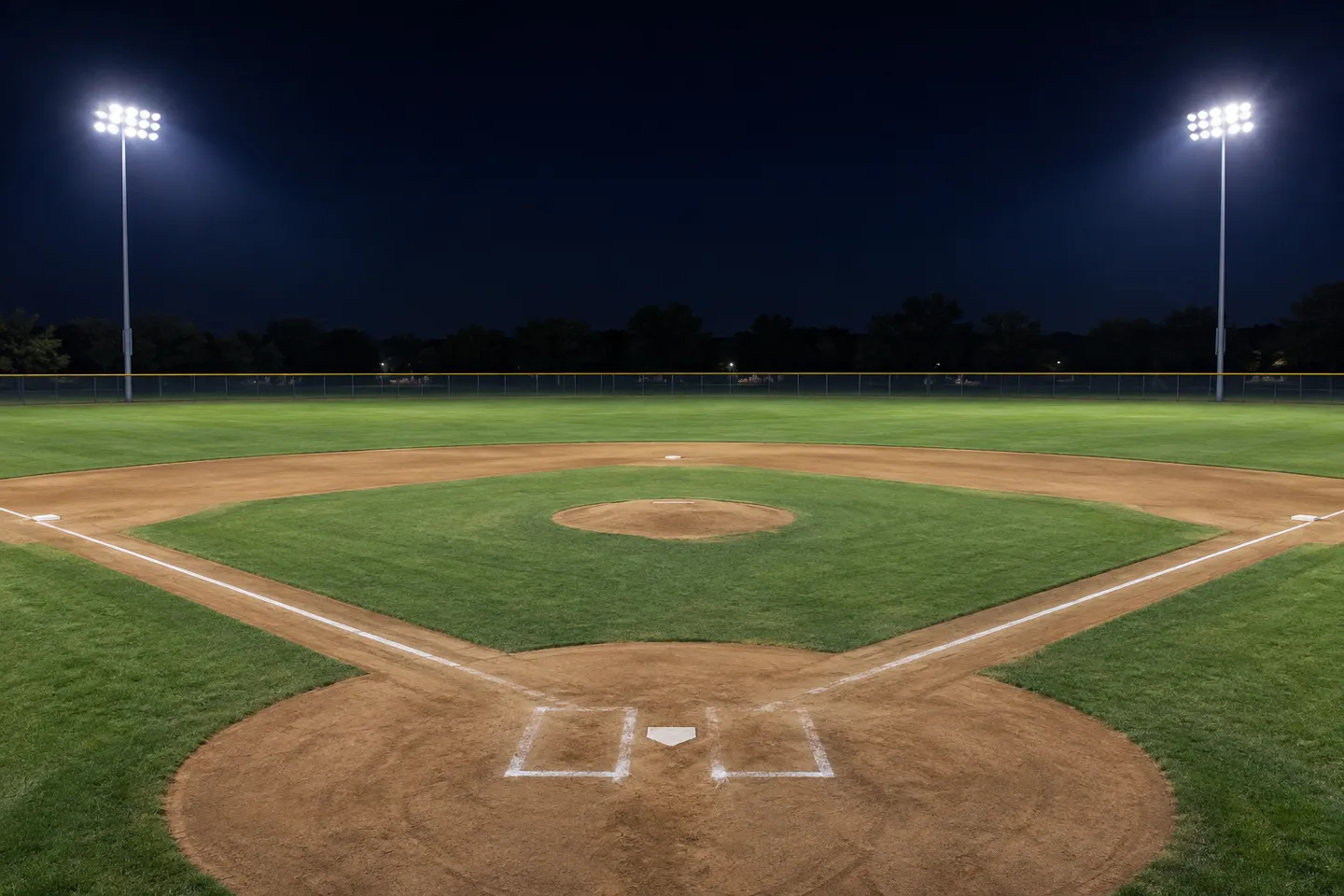
A baseball field lighting system is four things working together: the fixtures (often called sports lighters or field lights), the poles that carry them, the electrical infrastructure that feeds them, and the controls that switch and dim them. When a vendor quotes “lighting,” any one of those four may or may not be included, which is the first reason prices look incomparable.
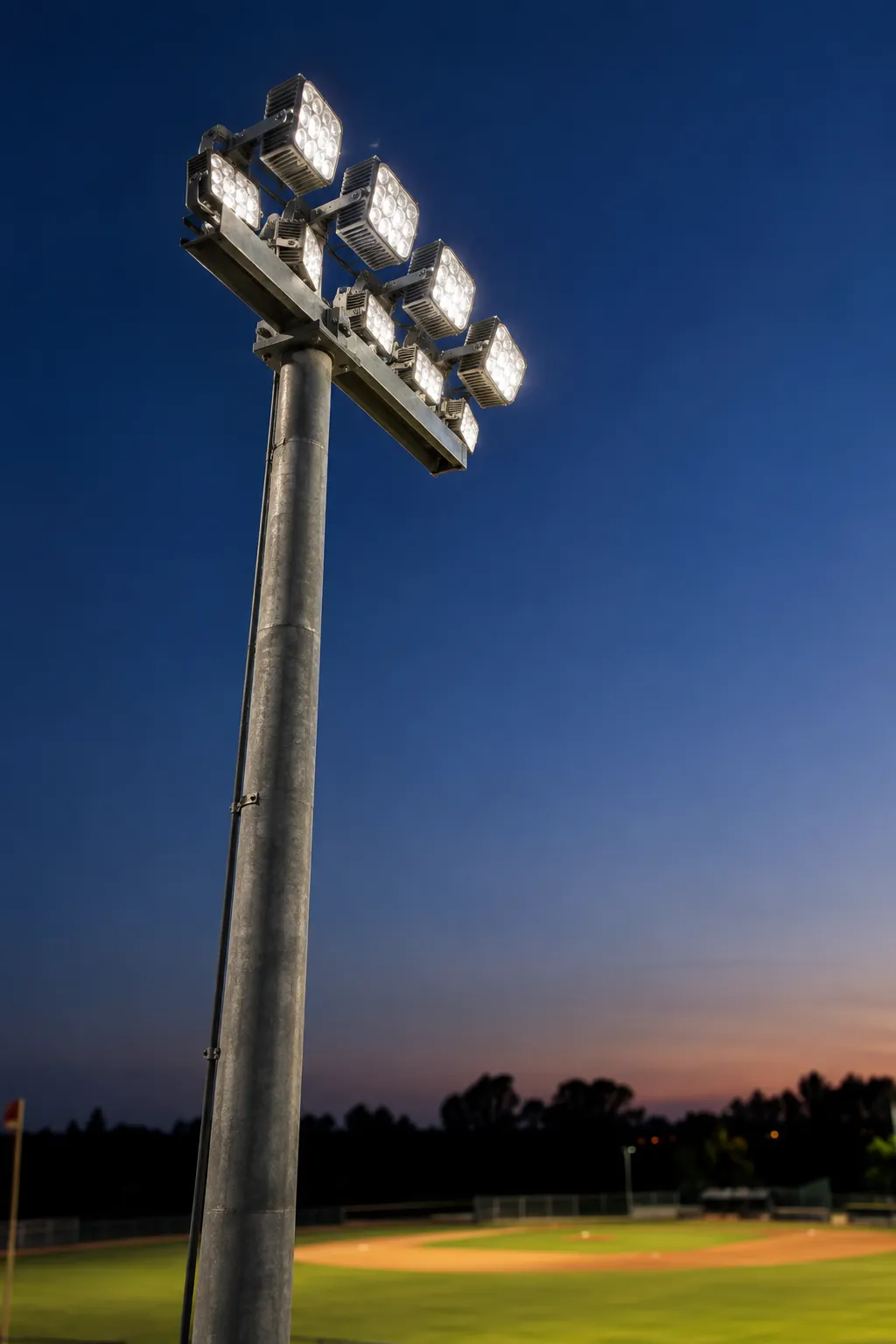
The second confusion is what “bright enough” means. Adequate field lighting is not a single brightness number. It is a set. The first item is an illuminance target measured in foot-candles (fc) or lux. The second is a uniformity requirement that limits how much brighter the lit spots are than the dark spots. The third is a glare control expectation for players and neighbors. A field can satisfy the first and fail the other two, which is exactly why some “bright enough” fields still draw complaints.
The numbers themselves deserve early suspicion. Guides quote anywhere from 20 fc for recreational play to 150 fc at the professional infield, and both can be correct for different fields. The next section covers where those numbers come from and which one applies to your field.
One practical takeaway before that: the fixture is the visible part of the system, but it is rarely where a project succeeds or fails. Layout, electricity, and paperwork decide most outcomes.
How Many Foot Candles? Why Every Source Disagrees
The direct answer: it depends on the class of play, and most confusion online comes from three rating systems being mixed together.
Three rating systems, one playing field
The IES (Illuminating Engineering Society) lighting practice for sports assigns classes I through IV. Class I covers professional and broadcast venues, and Class IV covers training and recreational play. In between sit Class II (college and minor league) and Class III (high school and competitive amateur). On this scale, baseball needs roughly 100 fc average in Class I down to 30 fc in Class IV (FSG, 2026).
European projects work from EN 12193, which grades by competition level in a similar spirit but not identical numbers. Meanwhile, a lot of US web content skips formal classes entirely and writes “recreational / high school / college.” That habit is how the same field ends up labeled 20–30 fc on one page and 50 fc on another. A page calling recreational play “20–30 fc” and a standards page calling Class III “50 fc” are using different rulers, not disagreeing about the same one.
The workable move: before comparing any design or quote, pin down which system your project will be judged by. If a league, school district, or sanctioning body has its own lighting rule, that rule overrides all three.
Why infield and outfield are listed separately
Baseball is not a uniform field, so serious specifications never use one number. The infield is where the ball moves fastest and the batter tracks it, so it carries a higher target than the outfield. For Class II play (up to about 5,000 spectators), the recommended practice is 100 fc infield and 70 fc outfield. For the highest class it is 150 fc infield and 100 fc outfield, with tighter uniformity limits in the infield (National LED, 2022).
This is the second source of “conflicting” numbers. A guide that says Class I baseball needs 100 fc is quoting the whole-field average; a page saying 150/100 is quoting infield and outfield separately (National LED, 2022). Both describe the same design when read in their own units. Many sources also write in lux. One fc equals 10.76 lux, so a Class I figure of “1,000–1,500 lux” is the same 100–150 fc range (LEDVANCE, 2026).
Meeting the average and still getting complaints: uniformity and glare
Illuminance averages hide the failures that generate complaints. The recommended practice therefore also sets uniformity limits, expressed as the ratio of maximum to minimum illuminance (Emax/Emin) or as a coefficient of variation. For the top baseball class, the infield ratio should be about 1.2:1 or better; for Class II, about 1.5:1 (National LED, 2022). A field that averages its fc target but scatters it unevenly produces the dark spots players misjudge and the bright zones batters squint through.
Glare is the third member of the set, and it is the one neighbors experience most. High-intensity field light aimed carelessly does not stay on the field. Community groups file light-trespass complaints about sports installations regularly, and the fix is aiming and shielding discipline rather than fewer fixtures (OEO, 2025).
Before you request quotes
- Your class of play — the IES class (I–IV) or your league’s own governing rule.
- Infield and outfield targets — separate numbers, set within that class.
- The uniformity limit — the maximum-to-minimum ratio you will accept.
With those three fixed, every design and every quote can be compared like-for-like.
| Class (IES) | Typical use | Infield target | Outfield target | Uniformity (Emax/Emin) |
|---|---|---|---|---|
| Class I | Professional / broadcast | 150 fc | 100 fc | ≤1.2:1 infield |
| Class II | College / minor league | 100 fc | 70 fc | ≤1.5:1 infield |
| Class III | High school / competitive amateur | 50 fc | 30 fc | relaxed |
| Class IV | Training / recreational | 30 fc | 20 fc | relaxed |
Ranges compiled from the IES practice as published by National LED and FSG; confirm the governing standard for your project before design.
Pole Count, Height and Layout
A standard Little League field (200-foot fences) works with four poles: two flanking home plate and two behind the left-center and right-center gaps (Stouch Lighting, 2025). Regulation 300-foot fields generally move to six poles, and large or broadcast-grade venues six to eight.
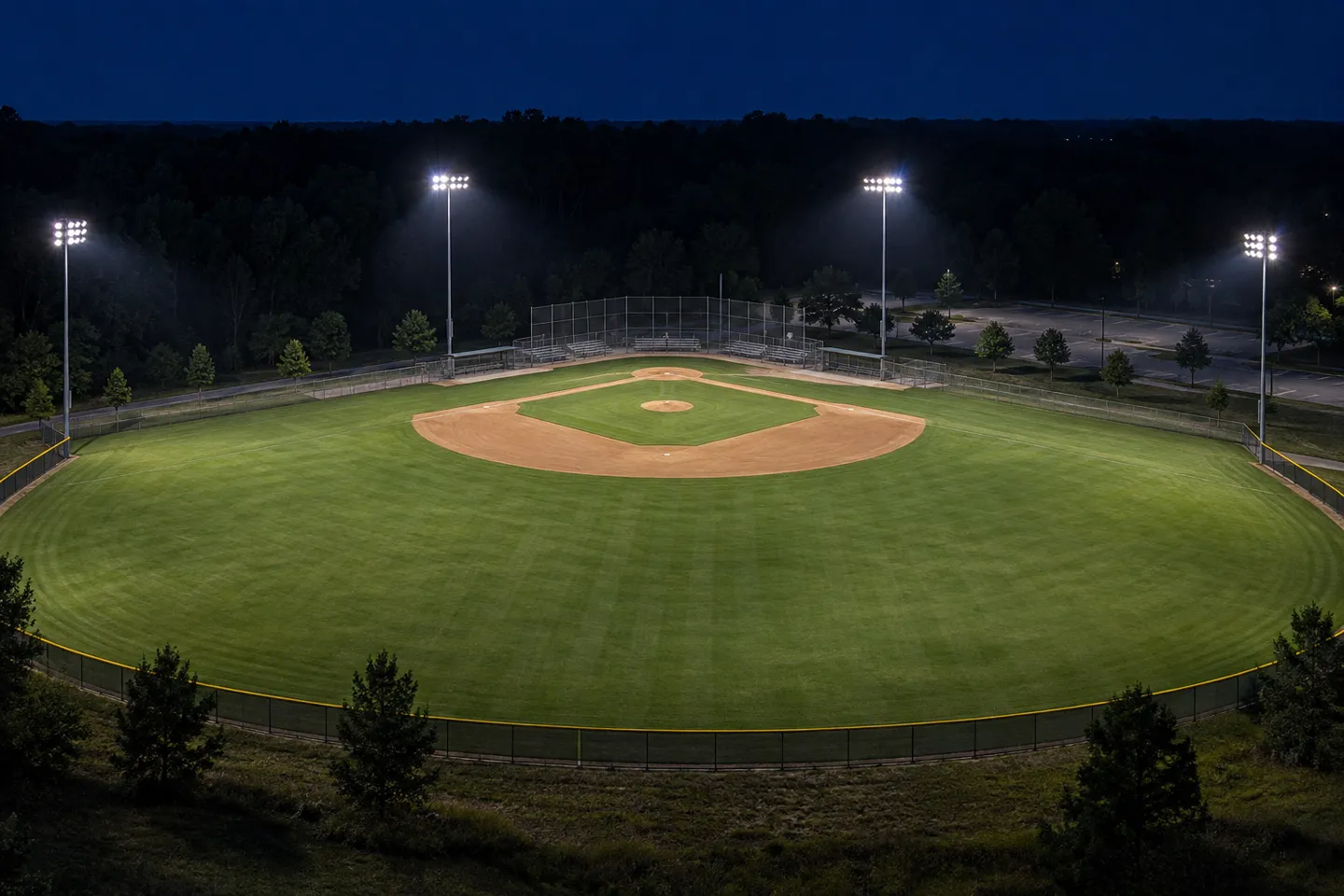
Pole height guidance varies by source for the same reason fc numbers do: level of play and aiming philosophy. High school and college layouts commonly sit at 40–50 feet, with additional outfield poles for competitive play; professional venues climb to 100–180 feet (LEDVANCE, 2026). Other guides recommend 60–80 feet as the working band for baseball specifically (LED Light Expert, 2026). One standards page goes further: it sets a minimum near 70 feet for regulation 90-foot-base-path fields, so aiming angles stay shallow enough to limit glare. Treat the lower bands as budget options for lower classes, not as a universal default.
Here is the cost logic most guides skip. Extending a field from a 200-foot to a 325-foot outfield grows the lit area by roughly 164%, yet installed pricing typically rises only about 69% (Sports Venue Calculator, 2026). The reason: the additional fixtures mount on poles the layout already required. Layout, not field size, is the cost driver.
+164%
lit area, 200-ft to 325-ft outfield
+69%
installed price
The layout boundary matrix below is the one table to check before accepting any pole plan.
Baseball Field Lighting Layout: Scheme × Fit × Failure Boundary
| Layout scheme | Fits | Watch-outs (verify before signing) |
|---|---|---|
| 4 poles | 200-ft-class community and Little League fields; budget-sensitive | Night play at higher competition classes will exceed uniformity limits; never compensate by bolting on higher-wattage heads, re-verify the photometric plan instead |
| 6 poles | Regulation 300-ft fields, school and competitive amateur | Without separate outfield circuits you pay full light for practice sessions; confirm zone switching in the electrical design |
| 8 poles | Large venues, broadcast ambitions | Without professional aiming and commissioning, glare and spill exceed limits; commissioning must appear as a contract line item |
| Retrofit on existing poles | HID-to-LED upgrades on intact structures | Poles and foundations must be re-verified for wind load and weight before new heads are specified; a structural letter is a precondition, not a courtesy |
Spill light deserves its own line in the contract. Neighbors near community fields do complain, and locally the words are blunt: “stadium-type lighting shining into homes.” What separates a tolerated facility from a contentious one is usually aiming precision and cutoff discipline, decided during commissioning (OEO, 2025). Ask the vendor to state, in writing, who performs aiming and what spill limits they commit to at the property line.
The Electrical Front End Nobody Prices Until It’s Too Late
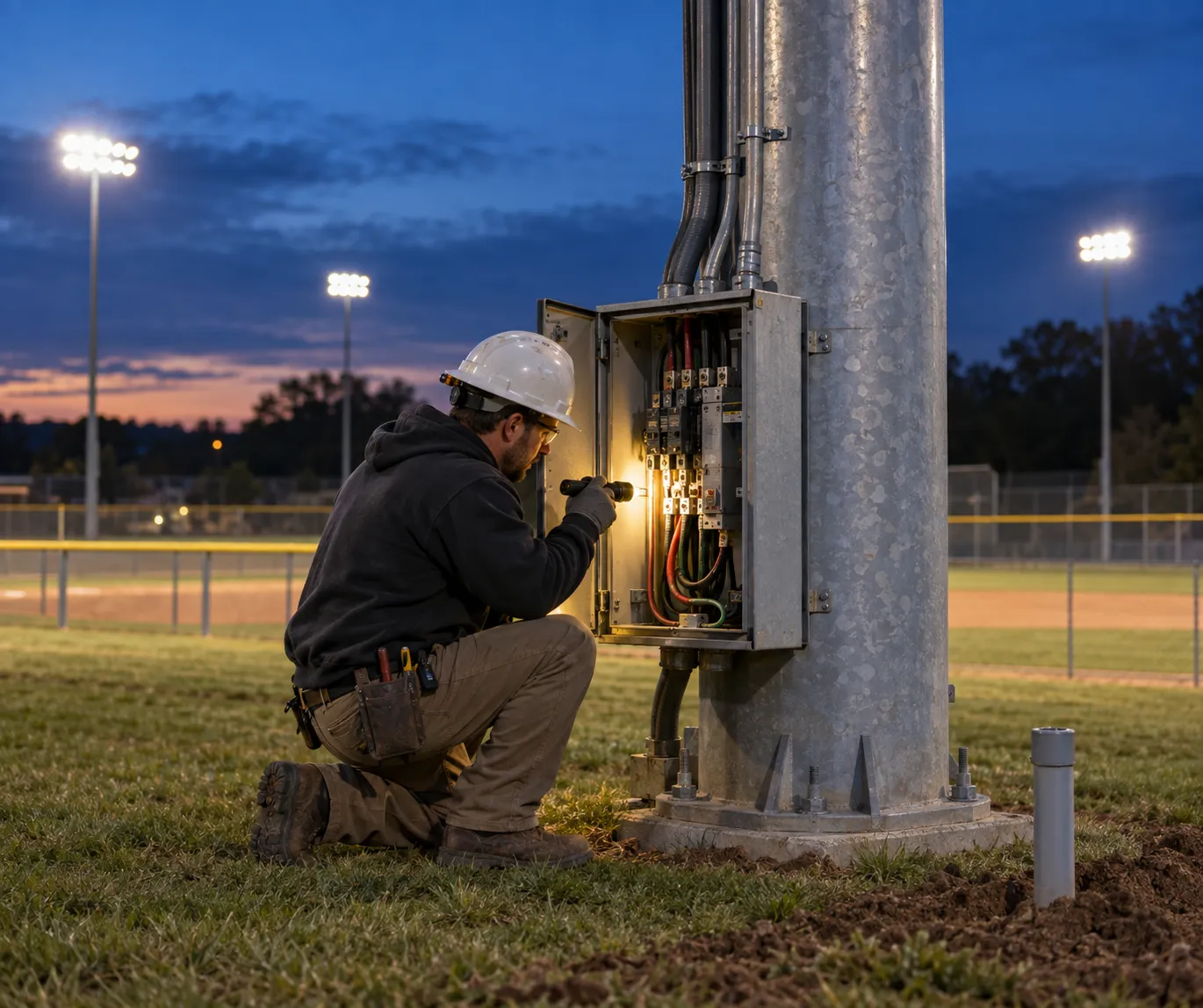
Fixture catalogs get all the attention, but on installation day the electrical front end decides whether the project ships or stalls. This is the layer field guides skip and electricians live in. On trade forums, the recurring questions are service capacity, voltage choice, and long wire runs, not lumens (ElectricianTalk, 2013).
Step 1: Audit the existing service before designing anything
A real scenario from the trade forums: a Little League league preparing quotes found its park running on a 120/240 V, 200 A service and could not tell whether it needed 480 V power or just an upgrade (ElectricianTalk, 2013). That audit comes first because its result reshapes the whole budget. One structural advantage helps here. For comparable delivered light, LED loads often land at half or less of the HID load they replace. That is why many retrofits dodge a service upgrade entirely, a savings that never shows up on a fixture price list.
Send WOSEN your field layout and existing service details, and a documented fixture spec with the load math comes back inside 12 hours.
Request a Layout ReviewStep 2: Choose the voltage system deliberately
Single-phase 120/240 V serves small fields fine. Multi-pole installations with real loads favor 277/480 V three-phase: smaller conductors for the same power, and shorter voltage-drop headaches across 300-to-600-foot pole runs. The decision belongs in the design phase, priced openly. A quote that silently assumes you have 480 V when you do not will resurface as a five-figure change order.
Step 3: Size conductors for voltage drop, not just ampacity
Over long pole runs, voltage drop, not wire heating, sets the conductor size. The NEC’s fine-print guidance, as explained by Mike Holt Enterprises, recommends keeping branch-circuit drop within 3% and total drop (feeder plus branch) within 5% (Mike Holt Enterprises, 2014). Exceed it and you get dimmer fixtures at the far pole plus drivers that run hot and age early. That is the failure pattern behind more than one redo.
Step 4: Lock the control scheme into the electrical design
Contactors by zone, astronomical time clocks, photocells, and step-dimming scenes belong on the drawing before conduit goes in. Nightly operating cost is decided here: a six-pole field that can run infield-only for practice pays far less per season than one that is all-or-nothing. Retrofitting controls after the fact means pulling wire twice.
Electrical Front End: Four Checks Before You Sign
Service audit — total connected load vs. panel capacity, nameplate trap flagged
Voltage decision — 120/240 V single-phase vs. 277/480 V three-phase, priced openly
Conductor sizing — voltage drop held to 3% branch / 5% total, far-pole fixtures verified
Control plan — zone contactors and scheduling fixed on the drawing, not after installation
Choosing Fixtures: Wattage Myths, Beam Angles and the Photometric Plan
With power and poles settled, fixture selection becomes a specification exercise, and the first trap is the phrase “LED equivalent.”
Ask one vendor and 500 watts of LED replaces a 1,500-watt metal halide. Ask another and a 2,000-watt metal halide needs 1,600–1,700 watts of LED to “come close” (Legacy Sport Lighting, 2024). Both claims circulate because they measure different things: initial lamp lumens against delivered light at the playing surface. Metal halide loses output through the reflector, aiming geometry, and lamp depreciation; LED optics put more of their lumens where the photometric model wants them. The honest conclusion: delete wattage-equivalence language from your specification entirely, and replace it with a delivered fc target verified at the infield and outfield grids. Whatever ratio a salesperson quotes, only the photometric plan proves the outcome.
That plan is also where beam angles get decided. Narrow optics (15–30°) throw light to the deep outfield from tall poles; medium and wide beams (45–120°) cover infield zones from shorter structures. On a serious fixture line the angles are a designed family matched to pole heights, not one compromise lens. That is why the beam-angle set is a fair question for any supplier, alongside the items below.
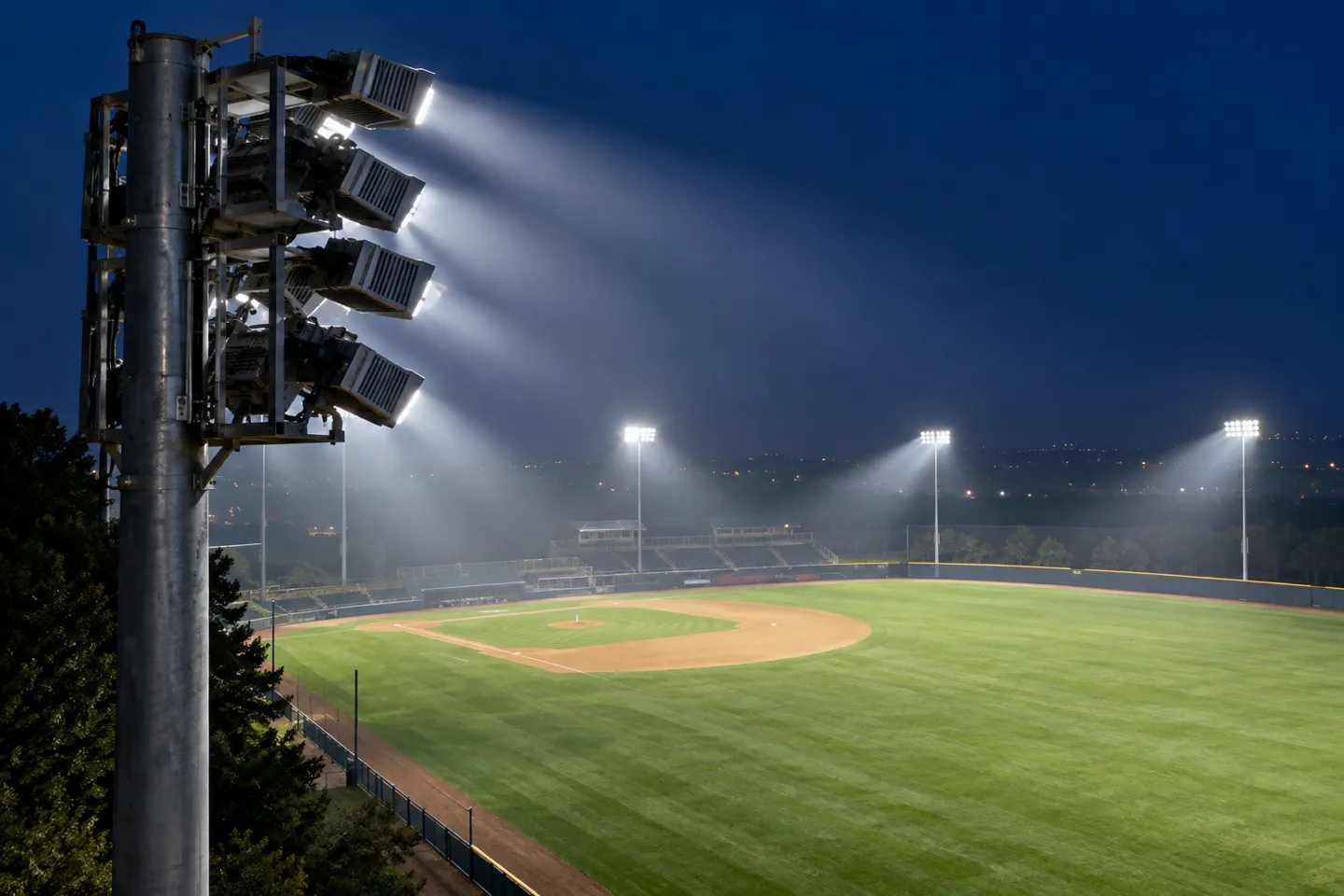
The verification table for any fixture quote:
Fixture Specification: What to Demand vs. Red Flags
| Spec item | What to demand | Red flag |
|---|---|---|
| Photometric plan | Point-by-point fc at infield/outfield grids, uniformity and spill contours | “Equivalent to 1500 W MH” with no plan file |
| Beam angles | A designed set (narrow/medium/wide) matched to your pole heights | One fixed lens for every pole |
| Ingress & impact | IP65/IP66 minimum; impact rating stated for lens and housing | No IK claim or unsealed vents |
| Surge protection | Stated kV/kA rating, matched to local storm exposure | “Protected” with no number |
| Drivers | Branded units with warranty terms in writing | Unbranded drivers, warranty not covering the driver |
| Certification | UL/ETL for North America, CE for EU, SAA for Oceania as applicable | “CE-like” or certificate numbers that don’t resolve |
The market context rewards this discipline. Industry analyses describe LED systems displacing metal halide across outdoor sports lighting (Fortune Business Insights, 2026), with cited energy savings for LED conversions running up to 64% (LEDVANCE, 2026). Vendors who document performance are riding that shift; vendors who quote equivalence ratios are guessing at it.
That is the standard we hold our own platform to. Our UNILUX stadium series is listed at 150 lm/W efficacy, 2700–6500 K CCT, IP65/IP66 protection, a 50,000-hour rated life and a 5-year warranty on its published spec sheet (WOSEN, 2026). We also build the optics to match the layout rather than the shelf. Custom optics packages across 15°, 30°, 45°, 60°, 90° and 120° let a six-pole plan and a broadcast-grade eight-pole plan run on the same fixture family. And we ship the certification files with the order: UL and ETL for North America, CE/EMC/RoHS for the EU, SAA for Oceania. The documents your inspector asks for are the ones we already gave you.
Reading a Quote Before You Sign
Baseball lighting quotes diverge wildly because they bundle different scopes. Published ranges make the point. A packaged lighting kit for a 200-foot-radius Little League field lists around $38,418 (LED Spot, 2026). Full four-pole Little League installations, including poles and installation, run $135,000–$350,000 (Stouch Lighting, 2025). Full baseball-field LED systems span roughly $40,000–$420,000 depending on scope (Stouch Lighting, 2025). Stadium-class systems average $207,770–$877,260 installed in 2026 estimates (Sports Venue Calculator, 2026).
Where a Field Lighting Budget Actually Goes
45%
fixtures
- Steel poles25%
- Electrical installation20%
- Concrete & foundations7%
- Other materials3%
That composition comes from an index of typical project costs built on U.S. Bureau of Labor Statistics price data (Sports Venue Calculator, 2026). Its practical meaning: a fixture that costs half as much moves your total budget by roughly twenty percent. If that fixture arrives without documentation, it jeopardizes the other eighty.
Four checks turn any quote into a comparable document:
Quote Audit: Four Checks
Decompose — fixtures, poles, electrical, foundations, controls itemized; a one-line total hides the scope
Verify documents — photometric plan, safety certifications, and written warranty terms present and specific
Check edges — spill contours at property lines, pole structural letters for retrofits, and which voltage service the design assumes
Rehearse operations — night-by-night running costs and zone switching demonstrated, not promised
Funding can soften the number. Youth-sports grant programs routinely contribute six figures in kind or cash. Parks agencies have received $50,000–$100,000 lighting infrastructure donations through national programs (NRPA, 2026). Typical baseball-lighting grants run near $40,000, covering roughly 15% of a new system (Sports Venue Calculator, 2026). Grant applications favor documented designs, one more reason the paperwork matters.
What the Market Shift Means for Distributors
Everything above reads like a buyer’s guide, but it adds up to a supplier-side verdict, and it lands hardest on lighting distributors and wholesalers. The conditions described (conflicting fc standards, unverifiable equivalence claims, quotes hiding scope) are exactly what forces project buyers to judge suppliers on verifiability rather than on catalog price. A distributor holding that insight buys differently from one who does not.
Start with what the numbers already showed. If fixtures are only 45% of a project’s cost, the buyer’s risk sits in the undocumented 55%: poles, wiring, commissioning. The winning bid is the one whose paperwork survives scrutiny, not the one with the lowest per-fixture price. If equivalence ratios vary by a factor of three between vendors, the buyer stops trusting ratios and asks for the photometric model. Suppliers who cannot produce one are excluded before price is discussed. LED is already replacing metal halide as the market’s baseline. The stadium lighting market was worth $547.3 million in 2023 and is projected to reach $910.9 million by 2030, a 7.6% annual growth rate (Grand View Research, 2024). The inventory implication follows directly.
The stance, stated plainly: shift stadium-light inventory toward high-output LED platforms that cover a real beam-angle family and arrive with photometric support, certification files, and driver-brand warranties in writing. Treat remaining metal halide stock as clearance inventory, because its buyer base is shrinking by design of the market itself, not by temporary fashion. And filter suppliers on three checks that survive due diligence. Complete certification for your market: UL/ETL, CE, SAA as applicable. Warranty terms a service claim can actually exercise. Production lead times steady enough to promise projects. Treat a 35–40 day production cycle as the benchmark you hold suppliers to.
Distributors who adjust early will hold the inventory project buyers can actually specify. Those who compete on unit price alone will keep winning quotes that lose projects.
Shortlisting Stadium-Light Suppliers?
WOSEN’s UNILUX stadium series ships with photometric support, UL/ETL/CE/SAA certification files, branded drivers and a written 5-year warranty.
Start an InquiryReferences
- FSG. “Sports Field Lighting Standards & Layouts: Complete Guide for 2026.” 2026. https://fsg.com/sports-field-lighting-standards-layouts-complete-guide/
- National LED. “Footcandle Standards For Baseball Fields.” 2022. https://www.nationalled.com/footcandle-standards-baseball/
- LEDVANCE. “Baseball Field Lighting Ideas.” 2026. https://www.ledvance.com/en-us/professional-lighting/insights/blog/application/the-basics-of-baseball-field-lighting
- Stouch Lighting. “The Ultimate Guide to Little League Field Lighting.” 2025. https://www.stouchlighting.com/blog/the-ultimate-guide-to-little-league-field-lighting
- Stouch Lighting. “How Much Does Baseball Field Lighting Cost?” 2025. https://www.stouchlighting.com/blog/how-much-does-baseball-field-lighting-cost
- Sports Venue Calculator. “LED Baseball Field Lighting: Cost, Funding & Design Guide (2026).” 2026. https://sportsvenuecalculator.com/knowledge/led-sports-lighting/complete-guide-to-baseball-field-lighting
- LED Spot. “LED Little League Baseball Field Lighting Kit (200ft Radius).” 2026. https://www.ledspot.com/sports-lighting/baseball-softball-field-lighting/led-little-league-baseball-field-lighting-kit/200ft-radius-little-league-baseball-lighting-kit/
- LED Light Expert. “Stadium Light Poles Guide: Heights, Materials, Installation.” 2026. https://www.ledlightexpert.com/stadium-light-poles-guide
- OEO. “How to Avoid Light Spill With Stadium Lighting.” 2025. https://oeo.com/blog/how-to-avoid-light-spill-with-stadium-lighting
- Mike Holt Enterprises. “Voltage Drop Calculations, Part One.” 2014. https://www.mikeholt.com/technical-voltage-drop-calculations-part-one.php
- ElectricianTalk. “Baseball Field Lighting” (trade forum thread). 2013. https://www.electriciantalk.com/threads/baseball-field-lighting.56945/
- Legacy Sport Lighting. “How Can I Calculate ROI on LED Lighting for Sports Fields Compared to Metal Halide?” 2024. https://legacysportlighting.com/all-things-led/how-can-i-calculate-roi-on-led-lighting-for-sports-fields-compared-to-metal-halide/
- Fortune Business Insights. “Stadium Lighting Market Size, Share | Growth Forecast [2034].” 2026. https://www.fortunebusinessinsights.com/stadium-lighting-market-116366
- Grand View Research. “Stadium Lighting Market Size And Share Report, 2024-2030.” 2024. https://www.grandviewresearch.com/industry-analysis/stadium-lighting-market-report
- NRPA. “Game-Changing Grants to Increase Access to Youth Sports.” 2026. https://www.nrpa.org/our-work/partnerships/initiatives/youth-sports/game-changing-grants-to-increase-access-to-sports/
- Sports Venue Calculator. “Grants for New Lighting Systems at Baseball Diamonds and Football Fields.” 2026. https://sportsvenuecalculator.com/knowledge/led-sports-lighting/grants-for-new-lighting-systems-at-baseball-diamonds-and-football-fields/
- WOSEN. “Series UNILUX Durable Full-Spectrum LED Stadium Lights.” 2026. https://www.wosenled.com/portfolio/series-unilux-durable-full-spectrum-led-stadium-lights/
- WOSEN. “Customization.” 2026. https://www.wosenled.com/customization/

 English
  Spanish
  French
  German
  Italian
  Arabic
  Russian
  Portuguese
  Dutch
Dutch  Indonesian
  Turkish
  Polish