
Navigating football field lighting standards is no longer just about meeting minimum brightness requirements; it is a complex engineering balancing act between official compliance, player safety, and long-term financial viability. Whether you are upgrading a high school facility or designing a competitive regional stadium, understanding the precise metrics mandated by governing bodies is the critical first step. This guide decodes the intricate optical parameters, physical layout geometries, and Total Cost of Ownership (TCO) strategies required to build a compliant, high-performance, and economically sustainable lighting architecture.
Why LED is the Undisputed Standard for Stadium Lighting
The transition from traditional Metal Halide (MH) or High-Pressure Sodium (HPS) fixtures to LED technology is no longer a luxury—it is an engineering imperative mandated by modern sports regulations. Traditional gas-discharge lamps suffer from massive energy inefficiencies, transforming the majority of their consumed electricity into useless heat rather than visible light. By contrast, solid-state LED fixtures deliver an immediate 70% to 80% reduction in energy consumption, fundamentally altering the operational expenditure (Opex) of any sports facility.
Beyond raw efficiency, the physical mechanisms of LED solve the most frustrating operational hurdles. Metal Halides require a notorious 10-to-15-minute warm-up period and face mandatory cool-down cycles if power is briefly interrupted. LEDs offer an Instant ON/OFF capability, providing immediate, full-lumen output. Furthermore, as high-definition broadcasting and mobile streaming become standard even at the high school level, the inherent zero-flicker performance of premium LED chips ensures that slow-motion cameras capture seamless footage, a feat physically impossible for aging MH ballasts to achieve.
Common Types of Football Field Lighting Fixtures
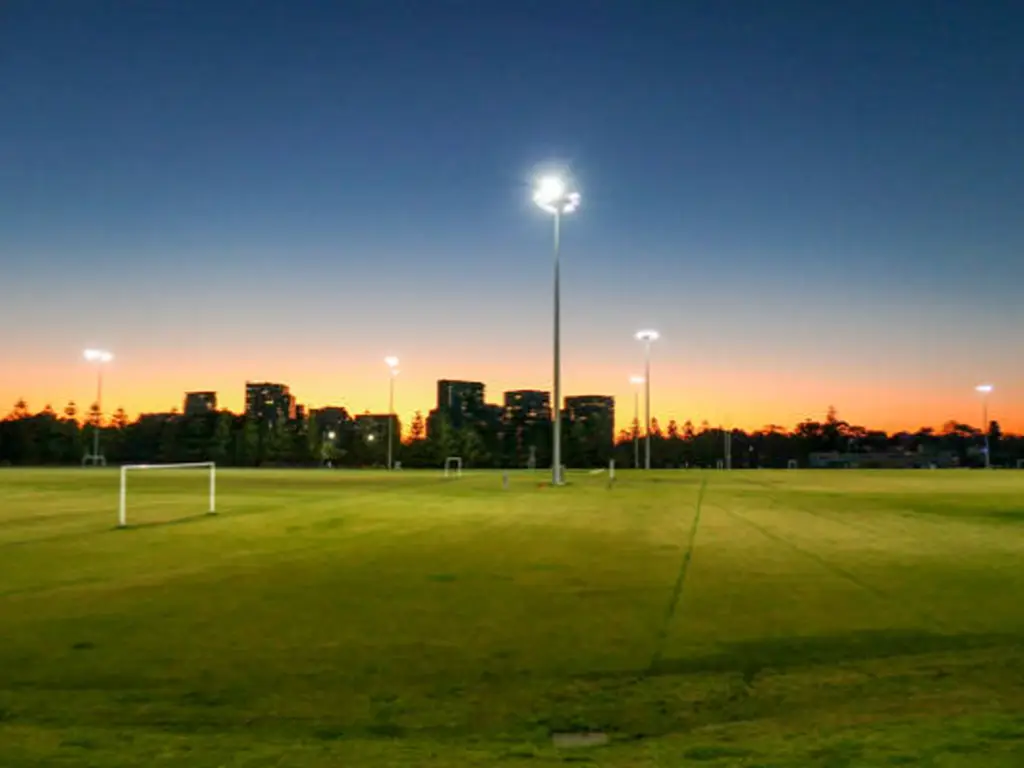
Before analyzing official lux requirements, it is essential to understand the physical and optical classifications of the fixtures themselves. Modern LED stadium lights are not generic floodlights; they are highly specialized engineering instruments categorized across three primary dimensions: optical distribution, structural form factor, and beam spread.
The first major categorization is based on Optical Distribution. Symmetrical floodlights project light evenly in all directions from the central axis, creating a uniform cone of illumination. In contrast, Asymmetrical fixtures utilize specialized internal lenses to refract light forward while sharply cutting off backward illumination. The second dimension is the Structural Form Factor. Integrated area lights feature a single, large light-emitting panel that moves as one solid unit. Conversely, true professional sports lighting often relies on a Modular design, where multiple independent LED engines are mounted to a single chassis, allowing different modules on the same fixture to be aimed independently. Finally, fixtures are classified by their NEMA Beam Spread, a numerical rating system (NEMA 1 through 7) that defines how tightly focused or widely dispersed the light beam is as it exits the lens.
| Fixture Category | Core Characteristic & Context | Engineering Pros | Engineering Cons | Estimated Cost Range (Per 1000W+ Fixture) |
|---|---|---|---|---|
| Symmetrical Optics | Uniform, circular beam. Used on high poles far from the field. | Maximum candela punch; highly efficient for long-distance throw. | Massive light spill behind the pole; severe glare risk if mounted too low. | $400 – $750 (Standard lenses are cheaper to manufacture) |
| Asymmetrical Optics | Refracts light forward with a sharp backward cut-off. Used near residential boundaries. | Zero backward spill light; strictly dark-sky compliant; completely eliminates boundary glare. | Shorter maximum throw distance; highly complex internal optics increase manufacturing costs. | $650 – $1,100+ (Premium custom optics) |
| Integrated Form Factor | Single solid flat-panel or shoebox design. Used for basic community pitches. | Low upfront hardware cost; simple, fast installation process. | High EPA (wind resistance hazard); poor thermal dissipation; impossible to micro-aim different field zones. | $250 – $550 (Budget tier) |
| Modular Form Factor | Multiple independent LED engines on one bracket. Used for professional stadiums. | Allows precise micro-aiming for perfect >0.70 uniformity; gaps between modules provide superior cooling and near-zero EPA wind resistance. | Higher initial Capex; heavier physical footprint requires sturdy pole mounting brackets. | $800 – $1,400+ (Professional tier) |
| Narrow Beam (NEMA 2/3) | Tight 10°–39° spread. Used on 80ft+ tall masts. | Acts like a laser, delivering intense lux levels to the center circle over 70+ yards away. | Will create blinding, distinct “hotspots” on the turf if aimed incorrectly. | Included in base fixture cost |
| Wide Beam (NEMA 5/6) | Broad 70°–130° spread. Used on 40ft-50ft low masts. | Provides a smooth, soft wash of light that eliminates harsh shadows directly under the poles. | Lacks the required intensity to reach the center of a wide soccer pitch. | Included in base fixture cost |
Official Football Field Lighting Standards and Core Metrics
Designing a compliant lighting system requires strict adherence to the exact governing body overseeing your facility. Applying the wrong standard not only guarantees a failed inspection but can also lead to massive capital waste through over-illumination.
American Football vs. Soccer: Clarifying the Guidelines
A critical blind spot for many facility managers is conflating the standards of American Football (Gridiron) with Soccer (Association Football). American Football fields have a strict geometric footprint of 120 by 53.3 yards. Consequently, the lighting design typically follows the guidelines set by the Illuminating Engineering Society of North America (IESNA), the NCAA, or the NFHS. In contrast, Soccer pitches are significantly wider, heavily altering the required photometric distribution. Soccer standards are strictly governed by FIFA or regional bodies like UEFA, which demand highly specialized asymmetrical optics to push light across the wider turf without creating hazardous glare for the spectators.
Core Optical Parameters Demystified
To read a lighting regulation sheet and evaluate system performance, you must understand the following non-negotiable optical metrics:
- Illuminance (Lux or Foot-candles): This measures the actual volume of light arriving on the playing surface. Horizontal illuminance ensures players can clearly see the turf and the ball at ground level, while vertical illuminance ensures that high-speed tracking cameras and spectators can clearly distinguish the athletes’ faces and aerial passes.
- Uniformity Ratio (Min/Max or Min/Ave): Often considered more critical than peak brightness, this ratio dictates the evenness of the light spread. A strict uniformity ratio (typically >0.50 to 0.70) guarantees there are no hazardous dark spots or “zebra-striping” on the field, which can severely hinder a player’s depth perception and visual reaction time.
- Glare Rating (GR): Excessive glare can temporarily blind athletes during crucial aerial plays and cause severe discomfort for the audience. Professional standards mandate that the Glare Rating must be kept strictly below 50, which requires precise fixture aiming and advanced optic lens designs.
- Color Rendering Index (CRI) and Color Temperature: These dictate visual clarity and broadcast quality. Standards demand a CRI of >80 (often >90 for 4K televised events) to accurately render team colors, paired with a crisp daylight temperature of 5000K to 6000K to perfectly mimic natural sunlight.
- Flicker Factor: As high-definition broadcasting and mobile streaming become standard, the inherent zero-flicker performance of premium LED drivers is mandatory. The flicker rate must remain <1% to ensure slow-motion cameras capture seamless, high-speed footage without visual stuttering.
Governing Body Requirements by Play Level
As established earlier, the physical difference between an American Football field and a wider Soccer pitch directly impacts the official photometric requirements. Below is a comparative baseline for target illuminance based on the distinct governing bodies of both sports:
| Play Level / Classification | American Football (NFHS/NCAA) Target | Soccer (FIFA/EN 12193) Target | Minimum Uniformity (U1) |
|---|---|---|---|
| Recreational / Training (Class IV) | 100 – 200 Lux | 75 – 200 Lux | 0.30 – 0.40 |
| High School / Regional (Class III) | 200 – 300 Lux | 200 – 500 Lux | 0.50 |
| College / NCAA (Class II) | 500 – 1000 Lux | 500 – 750 Lux | 0.60 |
| Professional / Televised (Class I) | 1000+ Lux | 1000 – 2000+ Lux | 0.70+ |
How to Achieve the Standards: Layout & Fixture Selection
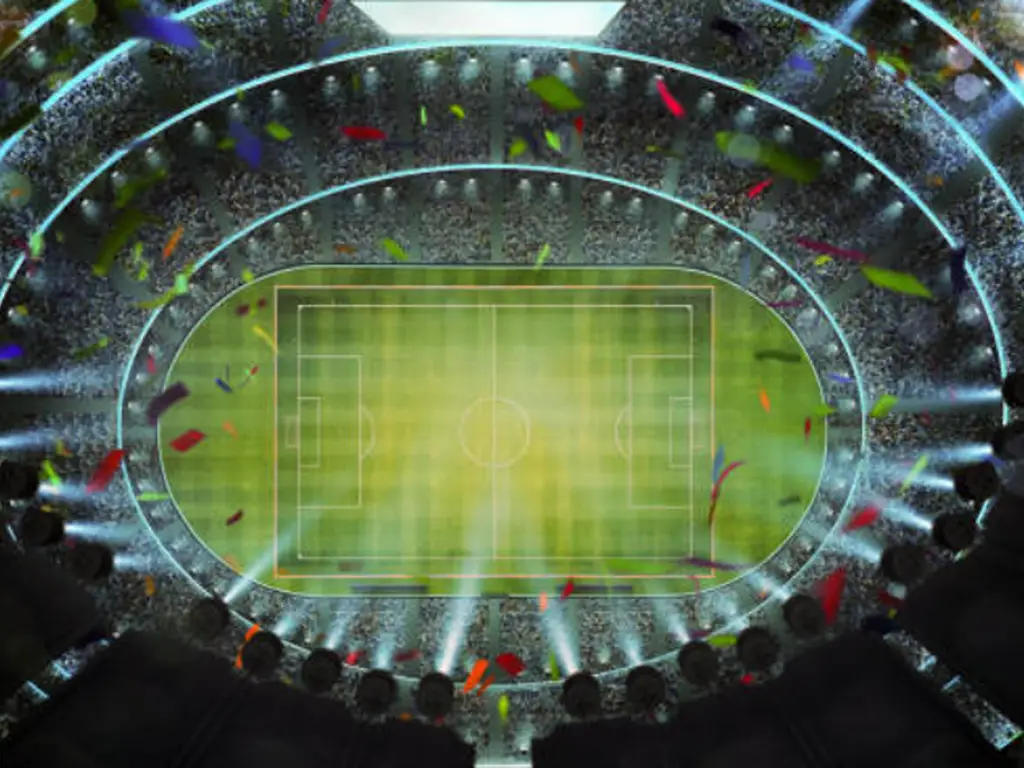
Achieving official lighting standards is not just about raw power; it is an exercise in Geometric Balancing. The three variables—pole placement, pole height, and optic lens selection—must work in a locked-step causal chain to ensure compliance and player safety.
Phase 1: Selecting Your Pole Placement Strategy
The layout of your poles defines how many “angles of attack” the light has on the pitch. As the competition level rises, so does the need for more poles to eliminate player shadows.
- 4-Pole Corner Layout: Standard for community and basic high school fields. Poles are set 15–20 meters behind the corners. Engineering Note: This requires extremely high-intensity optics because the light must travel nearly 80 yards to the center circle.
- 6-Pole Lateral Layout: The most common regional competitive setup. Adds two mid-field poles. This creates a much higher Uniformity Ratio (U1) and is significantly easier to commission for 500+ Lux requirements.
- 8-Pole Professional Layout: The gold standard for collegiate and televised venues. By spacing eight poles evenly along the sidelines, you create a “curtain of light.” This configuration virtually eliminates player shadows and is the only reliable way to meet the stringent vertical illuminance requirements for 4K broadcast cameras.
Phase 2: The Height-to-Optic Correlation Matrix
This is where most procurement errors occur. You cannot select a fixture without knowing your pole height. The height of the pole dictates the required NEMA Beam Spread to prevent blinding players, and directly impacts your ratio of Structural Capex (poles) versus Hardware Capex (fixtures).
| Pole Height Class | Recommended Layout | Required NEMA Optic | The Engineering “Why?” | Budget Anchor (Estimated Capex) |
|---|---|---|---|---|
| High Mast (80ft – 100ft) | 4-Pole or 6-Pole | NEMA 2 or 3 (Narrow) | High altitude allows for a steep downward angle. Tight beams are needed to “punch” the light long-distance to the field center. | High Structural / Low Fixture Qty: Masts and deep concrete bases cost roughly $3,500 – $6,000+ per pole. Heavy crane rental is required, but you buy fewer total fixtures. |
| Medium Mast (60ft – 75ft) | 6-Pole | NEMA 4 (Medium) | The optimal balance for most high schools. Provides a wide coverage footprint while maintaining enough intensity for the mid-field. | Balanced ROI: Standard municipal poles average $2,000 – $3,500 per pole. Offers the best balance between steel costs and LED fixture quantities. |
| Low Mast (40ft – 55ft) | 8-Pole (Required) | NEMA 5 / 6 / Asymmetrical | Because the poles are low, light enters at a flat, horizontal angle. You must use more poles and wide/asymmetrical optics to spread the light safely. | Low Structural / High Fixture Qty: Poles are cheaper ($1,000 – $2,000 each), but you must buy 8 poles worth of fixtures equipped with premium asymmetrical lenses to pass glare inspections. |
Expert Tip: The 30-Degree Glare Dead-Line
To ensure a field is safe for competitive play, an engineer must calculate the “Aiming Angle.” For any professional layout (especially the 8-pole soccer configuration), the angle from the top fixture to the field’s center-line must be at least 30 degrees. If your poles are too low and your optics are too narrow, the light will hit the players’ eyes horizontally rather than from above. This results in hazardous glare that will fail an inspection, regardless of how bright the field appears on a lux meter.
Compliance Cost Estimation and TCO Analysis
Procurement for sports lighting requires shifting the boardroom conversation from Capital Expenditure (Capex) to Total Cost of Ownership (TCO). Before diving into a vendor’s quote, facility managers must understand the fundamental engineering math used to calculate the required LED load.
The Calculation Methodology: Estimating your power requirement is not guesswork; it follows a strict photometric formula. First, calculate the Total Lumens Required: (Target Lux × Field Area in square meters) ÷ (Maintenance Factor × Utilization Factor). The Maintenance Factor accounts for future dust and light degradation (usually calculated at 0.8), while the Utilization Factor accounts for the light that actually hits the grass versus spilling off-field (roughly 0.6 to 0.75 depending on lens quality). Once you have the total lumens required, divide that number by the LED fixture’s luminous efficacy (e.g., 140 to 160 lumens per watt) to determine the total wattage needed.
Real-World Cost Benchmarks (US Market Examples)
To contextualize this math, let us examine two distinct, real-world financial breakdowns based on current US market averages for LED hardware and commercial electricity rates ($0.15 per kWh).
Case Study 1: US High School American Football Field (Retrofit)
A typical Texas high school (Class III standard) upgrading an aging Metal Halide system to achieve a compliant 300 Lux (approx. 30 Foot-candles), reusing existing 70-foot poles.
- Fixture Requirement: 36 to 40 units of 1200W premium LED sports lighters (Total load: ~45,000W).
- Estimated Hardware Capex: $30,000 to $45,000 (depending on wireless controls and NEMA lens configurations).
- Installation Labor: $12,000 to $18,000.
- Total Project Cost: $42,000 to $63,000.
Case Study 2: Collegiate/Semi-Pro Soccer Pitch (New Build)
A university constructing a new FIFA-compliant Soccer pitch (Class II standard). Because soccer pitches are significantly wider and Class II demands 500 Lux (approx. 50 Foot-candles), the engineering requirements scale up dramatically.
- Fixture Requirement: 72 to 80 units of 1200W LED fixtures equipped with Asymmetrical lenses for boundary poles (Total load: ~90,000W).
- Estimated Hardware Capex: $65,000 to $90,000.
- Structural Capex (Poles & Foundations): 6 new medium-mast poles (70ft) adding roughly $25,000 to $35,000.
- Total Project Cost: $110,000 to $145,000 (including labor).
Opex Savings & The TCO Payback Formula
Whether investing $50,000 or $150,000, boardroom approval hinges on Operational Expenditure (Opex) savings. Let us look at the TCO payback for Case Study 1 (The High School Retrofit). Assuming the field is lit for 1,000 hours annually:
- Old MH System Energy Cost: 100 kW × 1,000 hours × $0.15 = $15,000 / year.
- New LED System Energy Cost: 45 kW × 1,000 hours × $0.15 = $6,750 / year.
- Direct Utility Savings: $8,250 annually.
The Hidden Maintenance Dividend: Metal Halide bulbs lose 30% of their light quickly and frequently burn out. Renting a boom lift and hiring certified electricians for bi-annual re-lamping costs an average facility $3,500 to $5,000 per year. Premium LED fixtures eliminate this maintenance line item entirely for over a decade.
The Final ROI Verdict: By combining the $8,250 in energy savings and $4,000 in eliminated maintenance costs, the school generates roughly $12,250 in positive cash flow every year. Against a $45,000 initial hardware Capex, the TCO break-even point is reached in a remarkably short 3.6 years. After year four, the lighting system is completely paid for by its own operational efficiency.
Maintenance Factor and Structural Safety
While hitting the required lux levels on day one is essential, the true test of a stadium lighting system is surviving lumen depreciation and severe weather over a decade. Sub-par LEDs often suffer from poor thermal management, leading to rapid light degradation that causes non-compliance by year two. Furthermore, retrofitting old poles with bulky fixtures dramatically increases the Effective Projected Area (EPA), creating a massive wind load hazard that risks catastrophic pole failure during storms. To mitigate these liabilities, professional engineering teams specify fixtures built strictly for aerodynamic and thermal endurance, such as the WOSEN LED Stadium series. By utilizing aerospace-grade die-cast aluminum alongside an advanced matrix heat dissipation structure, WOSEN strictly controls the core junction temperature to ensure a 50,000-hour L80 lifespan without light fade anxiety.
Architecturally, WOSEN pairs this thermal supremacy with an incredibly slim, aerodynamic profile that presents a near-zero EPA. This allows facilities to safely mount high-output fixtures on aging poles without risking structural integrity or spending capital on new masts. Beyond wind resistance, environmental corrosion is the final silent killer of stadium infrastructure, especially in humid regions where condensation destroys sensitive drivers. Seamlessly addressing this threat, WOSEN fortifies its aerodynamic housing with rigorous IP66/IP67 waterproof sealing and IK08 impact-resistant certifications. This precise combination of rapid heat dissipation, minimized wind resistance, and ultimate weatherproof integrity transforms a lighting upgrade into a decade-long, zero-maintenance asset, shielding facility managers from structural liabilities and operational overruns.
Conclusion and Next Steps
Mastering football field lighting standards is a precise exercise in balancing official photometrics, engineered layouts, and long-term financial strategy. Transitioning to a compliant LED system ensures player safety, satisfies broadcasting demands, and drastically reduces operational costs while eliminating ongoing maintenance hazards. To move your project forward successfully, begin by accurately measuring your field’s physical dimensions and pole setbacks, firmly establish your target play level to identify the correct Lux standard, and commission a professional 3D DIALux simulation to guarantee zero-risk compliance before finalizing any procurement decisions.
Ready to Upgrade Your Stadium?
Contact WOSEN’s engineering team today for a free DIALux 3D simulation and a custom project quote tailored to your facility’s exact standards.
Request a Custom Quote

 English
  Spanish
  French
  German
  Italian
  Arabic
  Russian
  Portuguese
  Dutch
Dutch  Indonesian
  Turkish
  Polish