
Search “soccer field lighting cost” and you will meet two numbers that seem to describe the same thing: a fixture package for $15,000–$30,000 and a finished project at $208,000 or more. Both are real. Neither is wrong. They are answers to different questions, and the gap between them, roughly ten times, is where most budgets go sideways.
This article takes the word “cost” apart into five scopes, shows what moves each one, and ends with the spec sheet that makes any two quotes comparable. Whether you are budgeting one practice field or pricing a bid, the sequence is the same: decide which money you are counting before you argue about the amount.
Five scopes of “soccer field lighting cost”
| Scope | What it includes | Typical US figure | Who quotes this way |
|---|---|---|---|
| Fixtures only | The LED floodlight fixtures, nothing else | $15,000–$30,000 (4-pole youth field) | Retail fixture sellers |
| Fixture package | Fixtures plus mounting brackets and crossarms | $30,000–$60,000+ (6-pole regulation field) | Online sports lighting retailers |
| Installation system | Package plus poles, foundations, trenching, wiring, electrical service | Adds roughly half or more on top of fixture cost | Electrical contractors |
| Turnkey project | Everything above plus design, permitting, freight, project management | $208,616–$343,976 per field (US, 2026) | Design-build firms and cost guides |
| Retrofit project | Re-lamping an existing field, reusing or replacing infrastructure | $142,460–$340,960 (US, condition-dependent) | Cost guides and retrofit specialists |
Source: Sports Venue Calculator soccer cost guide 2026; LED Light Expert soccer field lights page
Three of these buckets deserve one caution each. The fixture figures above are equipment only; poles, arms, wiring, and installation are explicitly excluded (LED Light Expert, 2025). The turnkey range is US-specific and 2026-priced; the same field built elsewhere, or quoted in another currency, will not map onto it. And UK figures you may encounter (roughly £35,000–£75,000 for a full-size 11-a-side pitch) come from a different market with different labor and standards, so never mix them into a dollar budget.
One keyword, two answers: a $15K fixture package and a $344K turnkey project.
Same keyword. Different scope.
That sentence is the whole article in miniature. The sections that follow walk the scopes in order of how much money sits in each, so you can place your own project before you place your order.
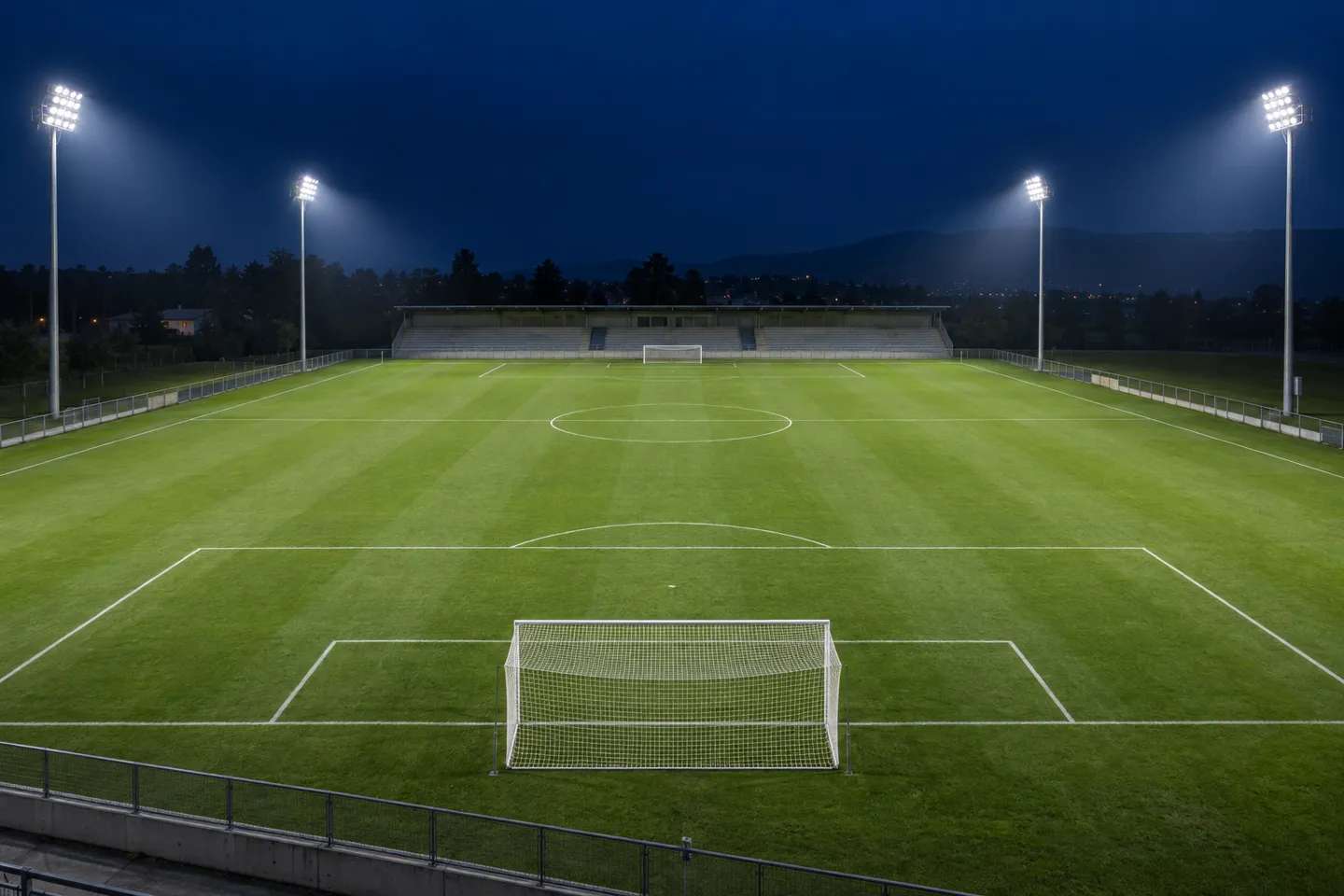
What Moves the Number: Play Level, Pole Count, and Pitch Size
Play level sets the light target — and the light target sets everything else
The Illuminating Engineering Society (IES) publishes recommended illuminance targets by level of play, and each step up multiplies the fixture count. For soccer specifically, the commonly cited ladder looks like this:
IES-recommended soccer field illuminance by level of play
| Level of play | Average footcandles | Uniformity | Typical CCT / CRI |
|---|---|---|---|
| Elementary and recreational | 20 fc | 0.5 | 4200–6200K / ≥70 |
| Small high school fields, training | 30 fc | 0.6 | 5000–6200K / ≥70 |
| Large high school fields, amateur leagues | 50 fc | 0.7 | 5000–6200K / ≥80 |
| Collegiate, semi-pro, clubs | 75 fc | 0.7 | 5000–6200K / ≥80 |
| Professional and broadcast | 100 fc (Class I) | stricter | per governing body |
Source: Lightmart summary of IES recommendations, 2025; National LED soccer footcandle standards, 2022
Two habits keep this table useful. First, buy light by level, not by wattage: a fixture list that hits 30 fc average with 0.6 uniformity is a training field, whatever the box says. Second, lock the target level before design starts, because it drives fixture count, pole count, and the electrical service all at once. Promising a board a recreational field but designing for league play wastes money; doing the reverse produces a field you cannot play matches on.
Pole count and height: 4, 6, or 8 masts
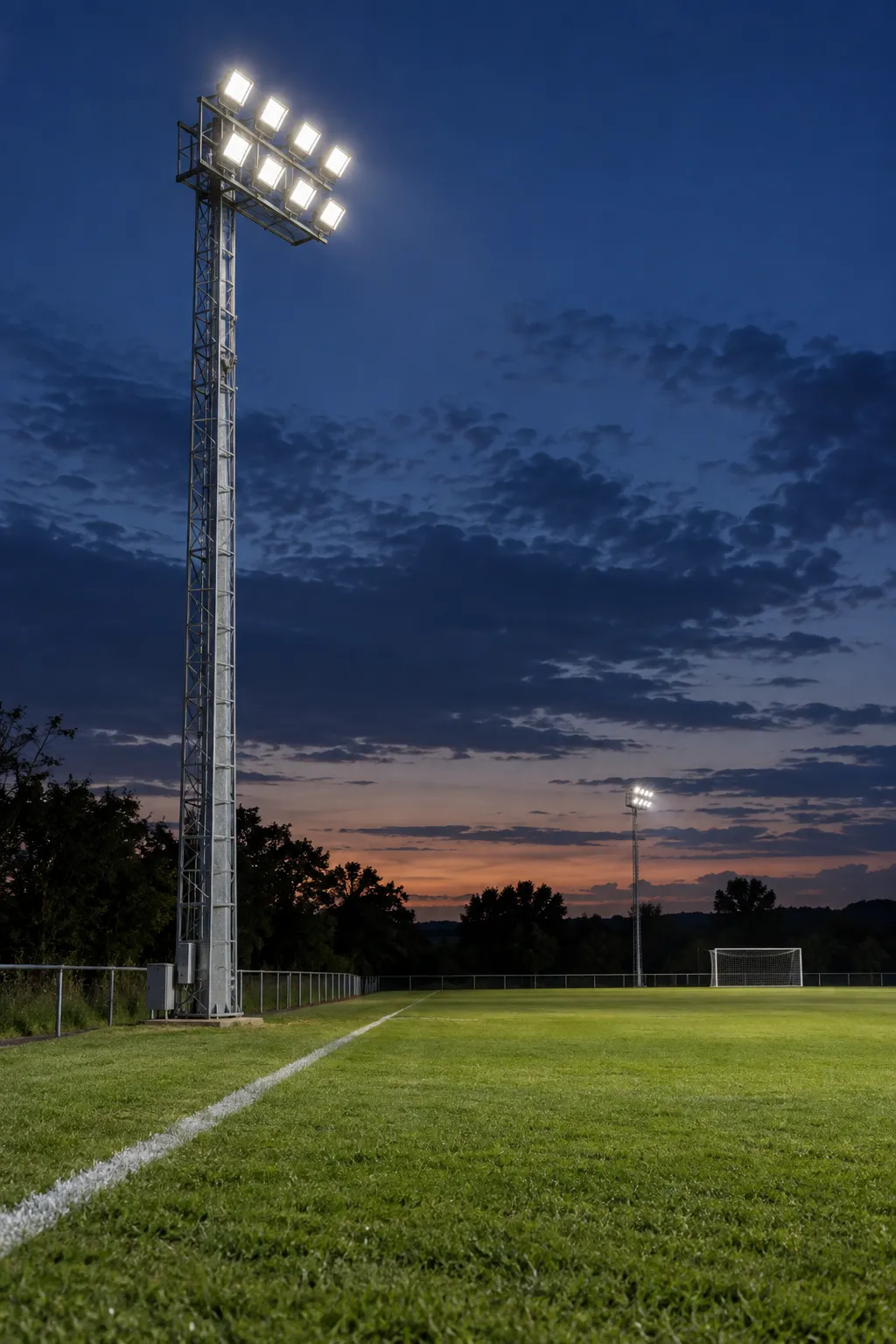
Youth and recreational fields commonly run four poles; regulation fields chasing higher uniformity move to six or more. Pole height (roughly 40 to 90 feet for outdoor fields) trades fixture efficiency against glare and light spill: taller masts throw light more evenly across the pitch with fewer fixtures, shorter installations save steel but need more of it and control spill less well. The pole package is also where a fixture scope quietly becomes a construction scope. Every mast needs a foundation, and heavier LED arrays change the wind-load calculation on structures that were sized for lighter lamps.
Pitch size: why soccer’s bill grows faster than its area
Soccer has no small priority zone. Unlike baseball, where the infield can justify a brighter pocket, the whole pitch has to perform, and the geometry punishes upsizing at high light levels. One 2026 cost analysis puts it in numbers. Growing a field about 26% raises new-build pricing 19% at 30 footcandles, but 35% at 50 (Sports Venue Calculator, 2026). The higher target has already pushed the design toward its pole and fixture limits, so extra area costs proportionally more.
Put the three drivers together and the ordering is clear: the play-level decision moves your budget by multiples, pitch size moves it by fractions that grow with ambition, and pole configuration decides how much of your “lighting” line item is actually steel and concrete.
The Money Outside the Fixture: Poles, Trenching, and Power
Ask an electrician what a field lighting job really costs and the answer is rarely about the fixtures. The line items that turn a $30k fixture package into a $200k+ project are the ones you cannot photograph: masts and their foundations, trenching and duct banks, a new electrical service, and the photometric design that proves the whole thing hits target before anyone digs.
How much those items move your number depends almost entirely on what your site already has. That is a checkable question, and it is worth answering before you collect quotes:
Site condition and what it does to the budget
| Site condition | What it means for the budget | Typical move | Confirm before signing |
|---|---|---|---|
| Greenfield, no poles | Full structural scope: masts, foundations, trenching, new service | Budget the electrical and civil work as its own line, not an allowance | Soil bearing and the distance to adequate power |
| Existing concrete poles and foundations | Fixtures and wiring only, if structures verify | Commission a structural review for the higher weight and wind load of LED arrays | Pole structural report and bolt pattern compatibility |
| Aging wooden poles | Usually replacement, not reuse (wood rarely carries modern arrays safely) | Price the replacement into the project from day one | Utility coordination for the new service |
| Insufficient electrical capacity | Service upgrade or new feeder, often the longest lead item | Talk to the utility early; permitting extends schedules | Available capacity at the nearest transformer |
Source: Stouch Lighting football field lighting cost guide 2025; Sports Venue Calculator stadium cost guide 2026
The installation side has its own arithmetic. A working example from an electrical forum: a ballfield fed at 480V three-phase with 90-foot poles, each pole on its own three-pole breaker (Mike Holt Forums, 2010). Voltage drop on a 500-foot run came out at 4.5% using #12 AWG conductors; no upsizing was needed once the math was done. The same thread records a division of labor that still matters: the county supplied materials while the club supplied the labor. Materials and installation are separable, and treating them as separable is what later lets you bid each on its own merits.
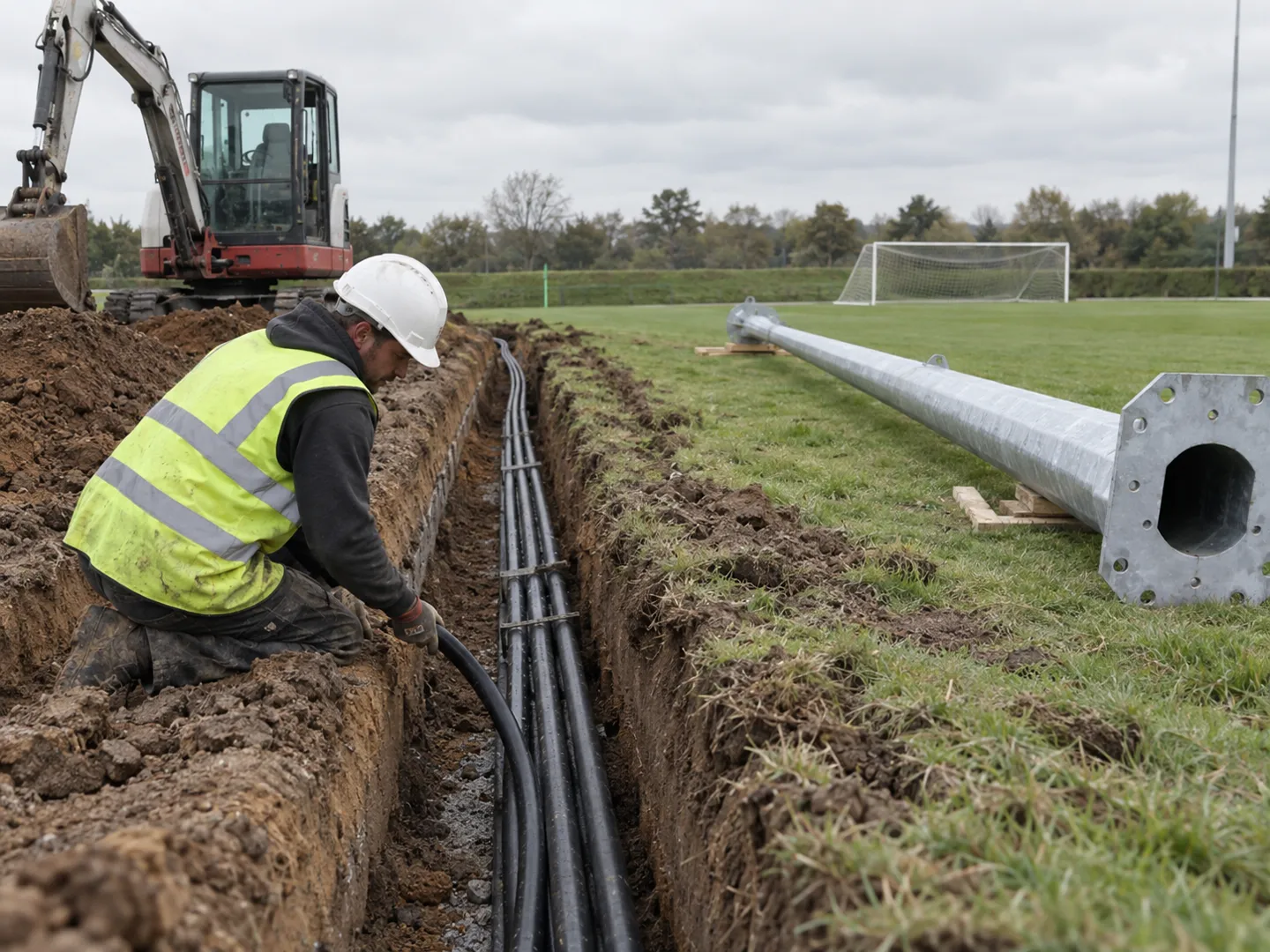
Timing follows the same logic. Installers quote roughly 4–8 weeks on the tools, but permitting and electrical work stretch the calendar (Sports Venue Calculator, 2026). If your season starts in March, the pole assessment in the table above is a winter job.
If your site’s pole and power picture is still fuzzy, WOSEN’s lighting-simulation team can price your fixture scope against real field data before you commit to civil work.
Send Your Site SpecsWhat It Costs to Run: The Bill After the Invoice
Running cost is the number your finance committee will ask about, and it is also the number most often quoted without its qualifiers. The honest form is a formula: watts × hours × your electricity rate. Any per-hour figure you cannot decompose into those three parts is decoration.
One worked example makes the arithmetic concrete. For a stadium-level system producing 300–400 lux, metal halide needs about 70,000 watts where LED needs about 35,000. At the US average of $0.12 per kWh, that is roughly $8.40 per hour for metal halide against $4.20 for LED. Run six hours an evening, fifteen evenings a month, and the bills are $756 versus $378 (GT Grandstands, n.d.).
Run-cost formula
Verify all three before trusting any “$ per hour” claim: a figure quoted without a rate and a wattage is not data.
Per-hour figures floating around social media ($7.50 is a common one) usually hide their assumptions. Rebuild them with the formula and they either match the math above or they were describing a different system entirely. Metal halide also carries costs the meter never shows: lamp replacements, warm-up time, higher maintenance scheduling. On fields that already have usable infrastructure, those extras tip retrofit economics further toward LED.
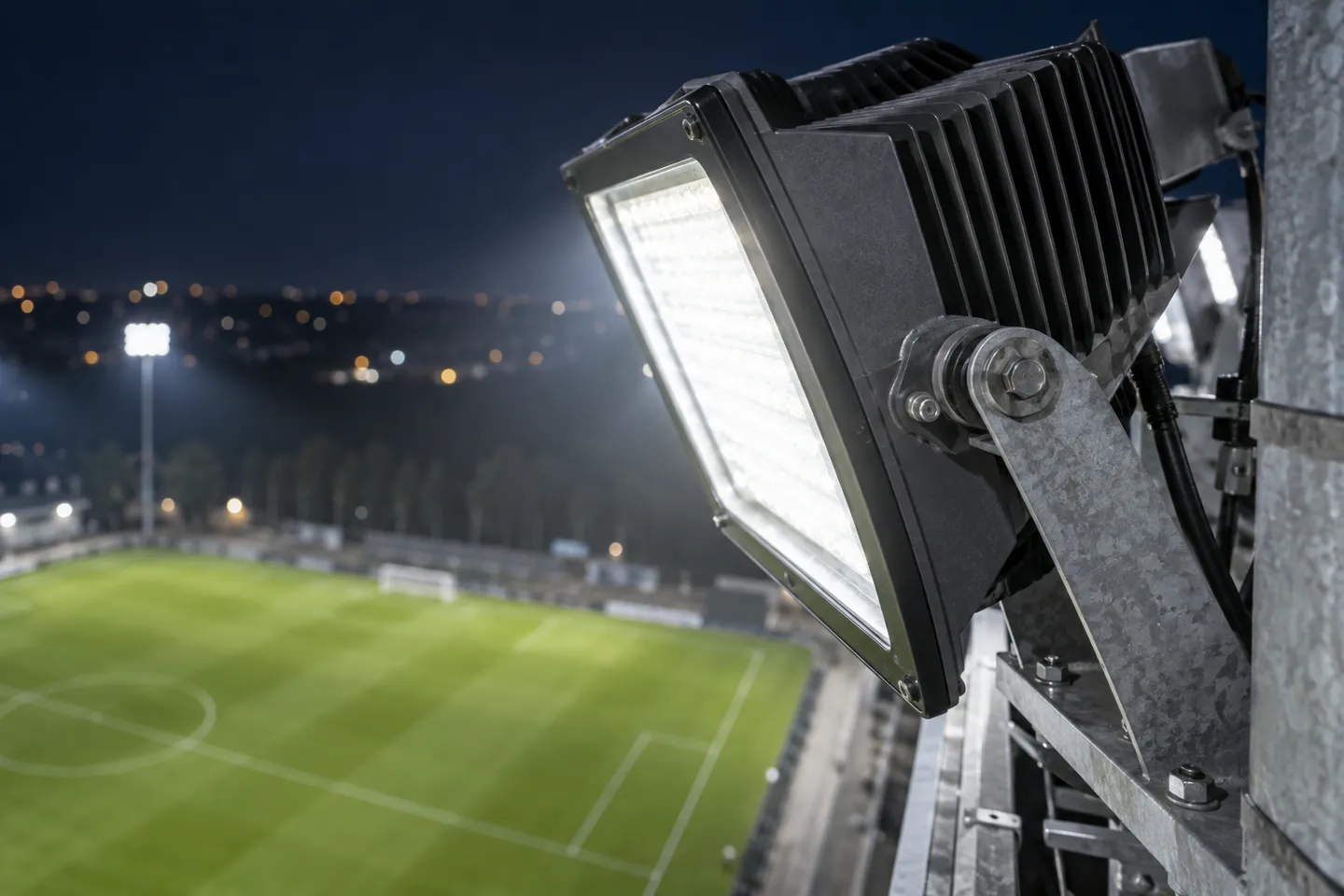
Two boundary cases use a different ledger entirely. Solar-powered setups trade an electricity bill for a higher equipment cost and make sense off-grid; towed light towers, the stopgap many leagues rent, solve an evening and then keep billing by the week. Neither replaces a grid-tied design for a permanent field; both are worth a line in your options memo so nobody re-litigates them mid-project.
How Projects Get Funded: Paths That Actually Close
The sticker number kills more field-lighting projects than any technical failure, and the projects that get built are usually the ones that changed the shape of the payment rather than the size of the number. Five paths cover most situations:
- Phase the ambition: install to a Class IV/rec target now on a layout that accepts more fixtures later, and upgrade when usage justifies it.
- Fundraise: campaigns led by athletes, club members, students, and parents have a real track record for floodlighting projects.
- Finance it: loans, including financing programs some floodlight manufacturers run with banks, repaid monthly, quarterly, or annually.
- Utility programs: check whether your utility offers efficiency rebates that attach to an LED conversion.
- Retrofit instead of rebuild: on fields with verifiable structures, reusing poles shifts the budget back toward fixtures.
Source: Sports Venue Calculator stadium cost and funding guide 2026; LED Light Expert
Each path has an owner and a proof requirement. Phasing needs a board vote on the target level. Fundraising needs a campaign team; financing needs a credit decision. Rebates need paperwork filed before purchase, and the retrofit path needs the structural review from the section above. The failure mode is not choosing the wrong path; it is presenting a single unfunded number to a board and letting the meeting end there.
One geographic caveat: these paths are US-flavored. Projects in markets where sports facilities are procured by municipalities or contractors against owner budgets will run on appropriations and bid schedules instead; the cost logic in the rest of this article still applies, the funding choreography does not.
Getting Quotes You Can Compare: The Spec Sheet That Sets the Price
The parameter list that makes two quotes comparable
Quotes diverge for two reasons: real differences in hardware, and differences in what each bidder assumed you wanted. You eliminate the second kind by sending every bidder the same one-page specification:
- Target class and uniformity: the play level from Section 2 (for example, 30 fc average at 0.6 uniformity), not “bright enough for games”
- Fixture efficacy and total lumens: lumens per watt and the delivered total, so a 1,500-fixture quote cannot hide behind vague “high output” claims
- Ingress and impact ratings: IP65/66 as the outdoor baseline; IK rating where balls, vandalism, or storms are part of the site’s life
- Wind-load rating: for the fixtures and brackets, matched to your pole heights and local codes
- Optics: symmetric or asymmetric distribution, and beam angles matched to pole positions; wrong optics waste light on the car park
- Controls: dimming, scheduling, zone switching; the run-cost lever from Section 4
- Certification for the destination market: UL/ETL for North America, CE for Europe, SAA for Australia, and the destination country’s own import requirements
- Warranty tier: years covered and the grade of drivers and chips behind it, because that is where cheap quotes go to hide
Three buying paths — and when factory-direct is the wrong tool
The same specification can be priced through three channels. Retail and online sports-lighting sellers move fast and fit small fields, at the highest per-fixture price. A general contractor or design-build firm takes one contract for everything; the premium buys coordination and a single throat to choke. The third path separates the two halves of the project: buy fixtures directly from a manufacturer against your specification, and contract the civil and electrical work locally.
Retail and online sellers
Fast to buy, fits small fields.
Watch out
Highest per-fixture price.
Contractor or design-build
One contract covers everything.
Watch out
The premium buys coordination.
Factory-direct + local install
Fixtures from the maker, civil and electrical local.
Watch out
MOQ in the hundreds; lead time in weeks.
That third path is where procurement experience pays. Manufacturers quote on specification rather than catalog price, which is exactly why the parameter list above comes first. It is also the path with real preconditions. Expect minimum-order quantities measured in hundreds of units and production windows measured in weeks, so it rewards planned projects and punishes urgent small ones. If the answer to any of the following is no, buy locally and stop optimizing: Can you import and clear customs in the destination market? Can you hold the certification your market requires? Can you absorb a longer lead time for a better unit price?
The cross-check discipline is the same on every path. Send one specification to three bidders and require line-item pricing: fixtures, poles, electrical, civil, design, freight. Disqualify any quote that arrives as a single number. A bidder who cannot show the scope of their own price is not cheaper; they are just quoting a smaller scope quietly.
Reading the Same Numbers as a Business
Everything above is a cost conversation. For contractors, EPC firms, and distributors who price soccer-field projects for a living, it is also a margin conversation, and the five scopes read differently from that side of the table.
Bid by scope, not by anchor
The US turnkey figure of $208k to $344k travels well as a reference point and travels badly as a cost structure. A bid built by splitting the project at its real joints behaves differently: fixtures priced ex-works against the specification, poles and civil works and electrical installation contracted locally, design and permitting carried as their own lines. The materials-versus-labor split in the ballfield example from Section 3 is not a curiosity; it is the precedent that makes the two-part bid legitimate. Bidders who anchor on a foreign turnkey number either lose the project to someone who split it, or win it and discover during execution which half of the number was soft.
Stock and quote by play level, and lock the risk items at inquiry
The same logic runs the shelf. Inventory and quotation tiers that follow the play-level ladder map onto how buyers actually arrive: a training-grade package, a competition-grade package, a professional grade above it. The question that starts their search is “what level are we building for,” never “how many watts.” Lock the risk items at inquiry stage: wind-load ratings for your market’s mast heights, IP and dust performance where the climate demands it, and the certification set for the destination market. Each is cheap to specify on paper and expensive to fix in a container.
This is the logic we build on at WOSEN. Our stadium-light line is quoted against exactly such a spec sheet: configurable optics in 15/30/45/60/90/120-degree beams, plus lighting-simulation support against your field’s photometric data. We hold the commercial side to the same discipline: 100-piece minimums, 35–40-day production windows you can schedule a project around, and quotes broken out line by line so your bid math survives contact with your client.
The practical next step is small: put the eight-line spec from the quotes section in front of three suppliers (us at WOSEN included) and let the line-item replies show you which scope each one was actually pricing.
Get a Quote That Survives Your Bid Math
Send your play level, pole plan, and target footcandles — WOSEN replies with line-item stadium-light pricing: 15–120 degree beam optics, 100-piece MOQ, 35–40-day production.
Request a Line-Item QuoteReferences
- Sports Venue Calculator. “LED Soccer Field Lighting: Cost, Funding & Design Guide.” 2026. sportsvenuecalculator.com/knowledge/led-sports-lighting/led-soccer-field-lighting-cost-guide/
- Sports Venue Calculator. “LED Stadium Lighting Cost, Design and Funding Guide.” 2026. sportsvenuecalculator.com/knowledge/led-sports-lighting/stadium-lighting-cost-guide/
- LED Light Expert. “LED Soccer Field Lights.” 2025. ledlightexpert.com/led-soccer-field-lights
- GT Grandstands. “How Much Do Stadium Lights Cost?” n.d. gtgrandstands.com/how-much-do-stadium-lights-cost/
- Lightmart. “Understanding Lighting Standards for Soccer Fields.” 2025. lightmart.com/blog/understanding-lighting-standards-for-soccer-fields/
- National LED. “Footcandle Standards For Soccer Field Lighting.” 2022. nationalled.com/sports-lighting-footcandle-standards-for-soccer/
- Mike Holt Forums. “Ball Field Sport Lights.” 2010. forums.mikeholt.com/threads/ball-field-sport-lights.74929
- Stouch Lighting. “Football Field Lighting Cost Guide.” 2025. stouchlighting.com/blog/football-field-lighting-cost-guide
- WOSEN. “Customization.” n.d. wosenled.com/customization/
- WOSEN. “LED Stadium Lights.” n.d. wosenled.com/outdoor-lights/led-stadium-light/

 English
  Spanish
  French
  German
  Italian
  Arabic
  Russian
  Portuguese
  Dutch
Dutch  Indonesian
  Turkish
  Polish