
Most “football lighting design” searches end at a lux table. That table is where the work starts, not where it ends. This guide walks the full chain: what a system consists of, which competition class applies to your field, where the money really goes, and how the layout gets designed. It ends with the supplier demands that get a project through verification the first time.
What a Football Lighting System Actually Is
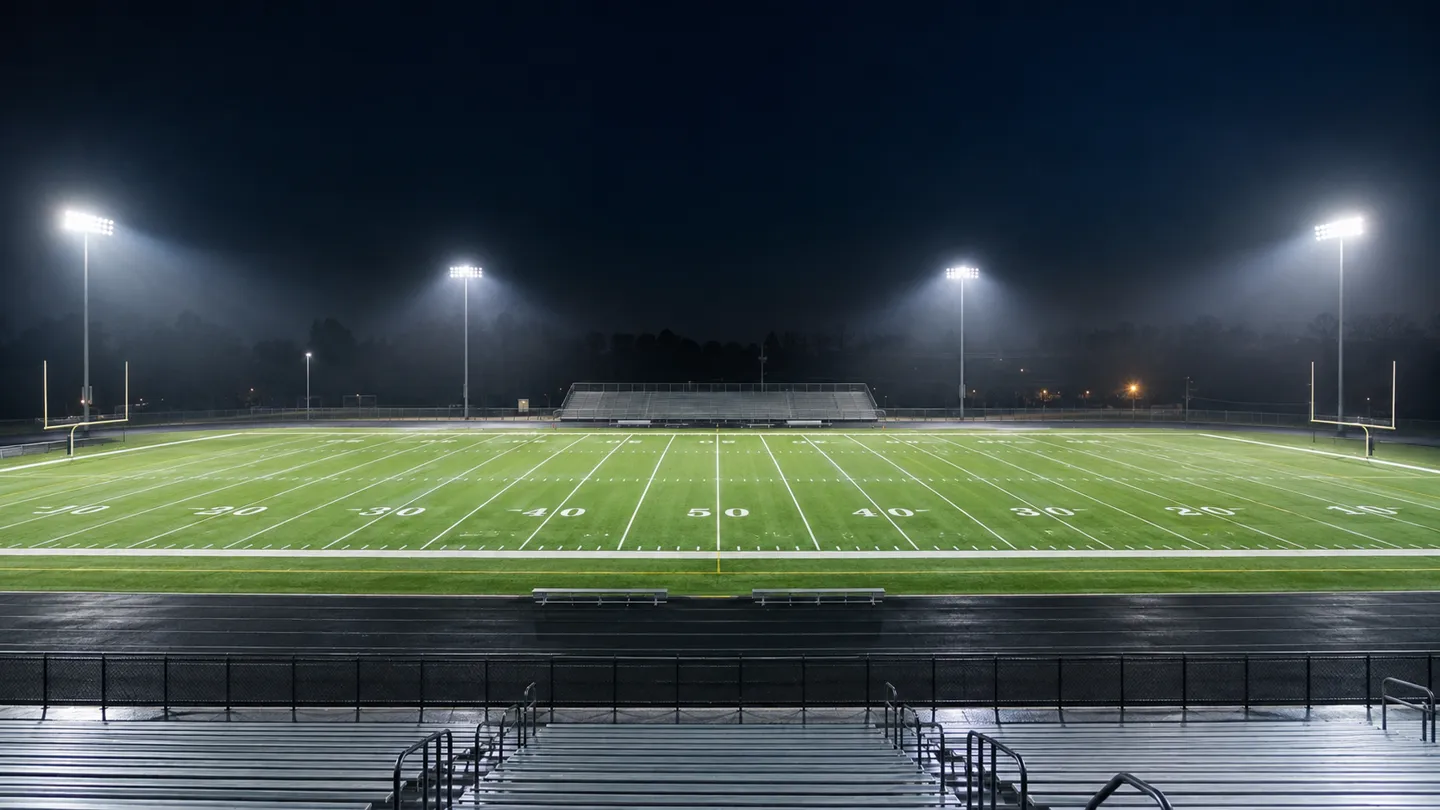
A football field lighting system is four things bolted together: fixtures, poles, electrical infrastructure, and controls. The fixtures are the floodlights: high-output LED units built to throw light a few hundred feet, not a few dozen. The poles carry them, typically fifty to seventy feet up on competition fields. The electrical side includes the service, breakers, conduit and the branch circuits feeding each fixture. The controls decide when the system runs and at what output.
Quick clarification on the word itself. In American usage “football” means the gridiron game: a 360-by-160-foot field (120 yards by 53⅓ yards including the end zones) (Outdoorlink, 2025). In most of the world it means soccer. The design method in this guide applies to both; only the rulebook and the numbers shift, and we’ll flag where.
Football lighting differs from street lighting in one fundamental way. A streetlight only has to light a surface. A football light has to light a surface and the air above it. Players track a ball overhead on every punt and pass. That is why the sport demands horizontal illuminance across the full field and vertical illuminance too, so faces and the ball stay visible (FSG, 2026). That dual requirement drives everything else: the pole placement, the beam angles, the cost.
And LED has effectively ended the metal-halide era for new builds. LED stadium fixtures run 50,000 to 100,000 hours against 15,000 to 20,000 for HID. They cut energy use dramatically, and they switch back on instantly after a power dip; there is no fifteen-minute strike delay (Outdoorlink, 2025). The interesting questions now are not LED-or-not. They are: how bright, at what class, and at what cost. Which brings us to the axis that decides everything.
Competition Classes: The Axis That Decides Everything
Here is the mistake most first-time buyers make. They ask “how many lumens do I need?” before asking “what level of play am I hosting?” The level of competition, the class, sets the illuminance target, the uniformity requirement, whether vertical illuminance matters at all, and ultimately the entire budget. Get the class wrong in either direction and you lose. Under-light it and the field fails inspection, or players can’t track the ball. Over-light it and you paid for lumens nobody uses. You may have bought a glare complaint with them.
One warning before the table. Public sources contradict each other on these numbers, sometimes within the same article. One widely-cited manufacturer blog lists high school requirements as “200 to 500 lux (or 30 to 50 foot-candles)”. But 30 foot-candles is about 320 lux, not 200 (Outdoorlink, 2025). The conversion is off inside its own parentheses. The figures below are reconciled across ANSI/IES RP-6-20 guidance, IES-based contractor guides, and the European EN 12193 standard, with both units given correctly (ANSI, 2021; FSG, 2026; Legacy Sport Lighting).
Football Field Lighting by Competition Class
| Class | Typical use | Avg. horizontal illuminance | Uniformity (min/avg) | Vertical illuminance demand |
|---|---|---|---|---|
| Training / recreational | Practice, youth, elementary | 20–30 fc (≈215–320 lux) | ≥0.5 | Not required |
| High school / community | Regular interscholastic play | 30–50 fc (≈320–540 lux) | 0.5–0.7 | Not required |
| College / semi-pro | Competitive amateur, small spectator stands | 50–75 fc (≈540–810 lux) | ≥0.6 | Recommended |
| Professional / broadcast | Professional clubs, televised events | 100+ fc (≈1,080+ lux) | ≥0.7 | Required — see below |
Recreational and Training Fields
If your field hosts practice sessions, youth leagues, or physical-education classes, the target sits around 20–30 footcandles. Honestly, the design conversation is mostly about not over-building it. It’s the most common over-design trap in the sport. A treasurer sees “football lighting” figures online and panics. The club then budgets for a broadcast field it will never host. Recreational fields also lean on the simplest controls and the shortest pole heights. The goal is safe play at night, at minimum lifetime cost.
High School and Community Fields
This is the class most readers actually sit in, and the one where published guidance is messiest. The working target for regular high school play is 30–50 footcandles average horizontal illuminance, with a uniformity ratio around 0.5–0.7 (Outdoorlink, 2025; LED Light Expert, 2025). That ratio means the dimmest spot on the field should be at least half the average reading. If a supplier’s proposal quotes you average lux without a uniformity number, push back. A field can hit its average with bright zones and visible dark patches. The dark patches are exactly where players get hurt and referees miss calls.
Community fields in this class also carry a constraint the standards don’t print: they usually sit inside neighborhoods. The spill-light consequences of that get their own section below, because they end more projects than photometrics do.
College and Semi-Professional
From this class upward, budget realism changes. Illuminance targets of 50–75 footcandles mean more fixtures, taller or additional poles, and — the part that surprises school districts — electrical service upgrades. A system at this level may draw more power than the rest of the campus outdoor infrastructure combined, and the utility connection becomes a line item, not an afterthought. Vertical illuminance starts appearing in specifications here because semi-pro and college games increasingly get streamed, even when nobody calls it a broadcast.
Professional and Broadcast
Television changes the physics of the requirement. Cameras don’t see the field; they see players lit from the camera’s side. That is why broadcast standards are written around vertical illuminance on the plane facing the camera, not horizontal readings on the grass (FIFA). FIFA’s stadium guidance ties broadcast readiness to average vertical illuminance. Entry broadcast tiers start around 700 lux vertical, paired with roughly 1,250 lux horizontal; the steepest requirements are reserved for top-tier and UHD productions (Reita Light, 2025). This is also where flicker performance enters the spec, because a fixture that flickers on camera is a fixture that fails, regardless of how it looks to the naked eye.
Which Rulebook Applies to Your Project
American projects usually reference ANSI/IES RP-6-20 along with NFHS guidance, and the numbers are expressed in footcandles (ANSI, 2021). Projects almost anywhere else, and any international tender, reference EN 12193 or FIFA documents, expressed in lux. EN 12193 sets three maintained horizontal classes for football: 500 lux (Class I, competition), 200 lux (Class II, league play), and 75 lux (Class III, training) (Legacy Sport Lighting; BEGA). If you build or procure across borders, and most EPC contractors reading this do, write the governing standard into the contract by name and edition. “Meets international standards” is not a specification; it’s a dispute.
The takeaway from this whole section: pick the class first, in writing, with the owner. Every decision after it (pole count, fixture count, budget, acceptance criteria) inherits from that one choice.
From Class to Cost: Budget Decisions
Class chosen, the money conversation starts. It starts by killing the most common assumption in the room. Most people assume the lights are the project. The numbers say otherwise.
A typical high school football lighting installation runs $100,000 to $300,000 all-in (Outdoorlink, 2025). Full LED football field projects across all competition levels span roughly $222,000 to $877,000. Converting an existing system to LED typically lands between $150,000 and $350,000 (Sports Venue Calculator, 2026).
The number that changes how you read every quote
Where the Money Actually Goes
Optimize the fixture price and you’re arguing over pocket change; get the poles and power wrong and you’re re-building the project. (Outdoorlink, 2025)
That ratio, fixtures as the small line item, explains real-world quotes that otherwise look irrational. A youth league administrator recently posted about adding lights to a Little League field. The quotes on the table: roughly $250,000 from Musco for a standard four-pole, 60-foot installation, against about $175,000 from a local contractor. That is a 43% spread for the same field (Reddit r/LittleLeague, 2026). Nobody in that thread was comparing light bulbs. The spread lives in pole engineering, foundations, electrical scope, photometric service and warranty terms. Which is exactly where a buyer should look.
The decision sequence that keeps budgets honest runs in four steps. First, fix the class and write it into the bid documents. Everything downstream inherits from it. Second, price the poles and electrical before the fixtures, because they’re the majority of the spend and the least reversible. Third, set the light-environment boundaries (property-line limits, nearby residences) before design starts, since retrofitting optics after a complaint costs multiples of designing them in. Fourth, only then compare fixture and supplier quotes, on identical photometric targets.
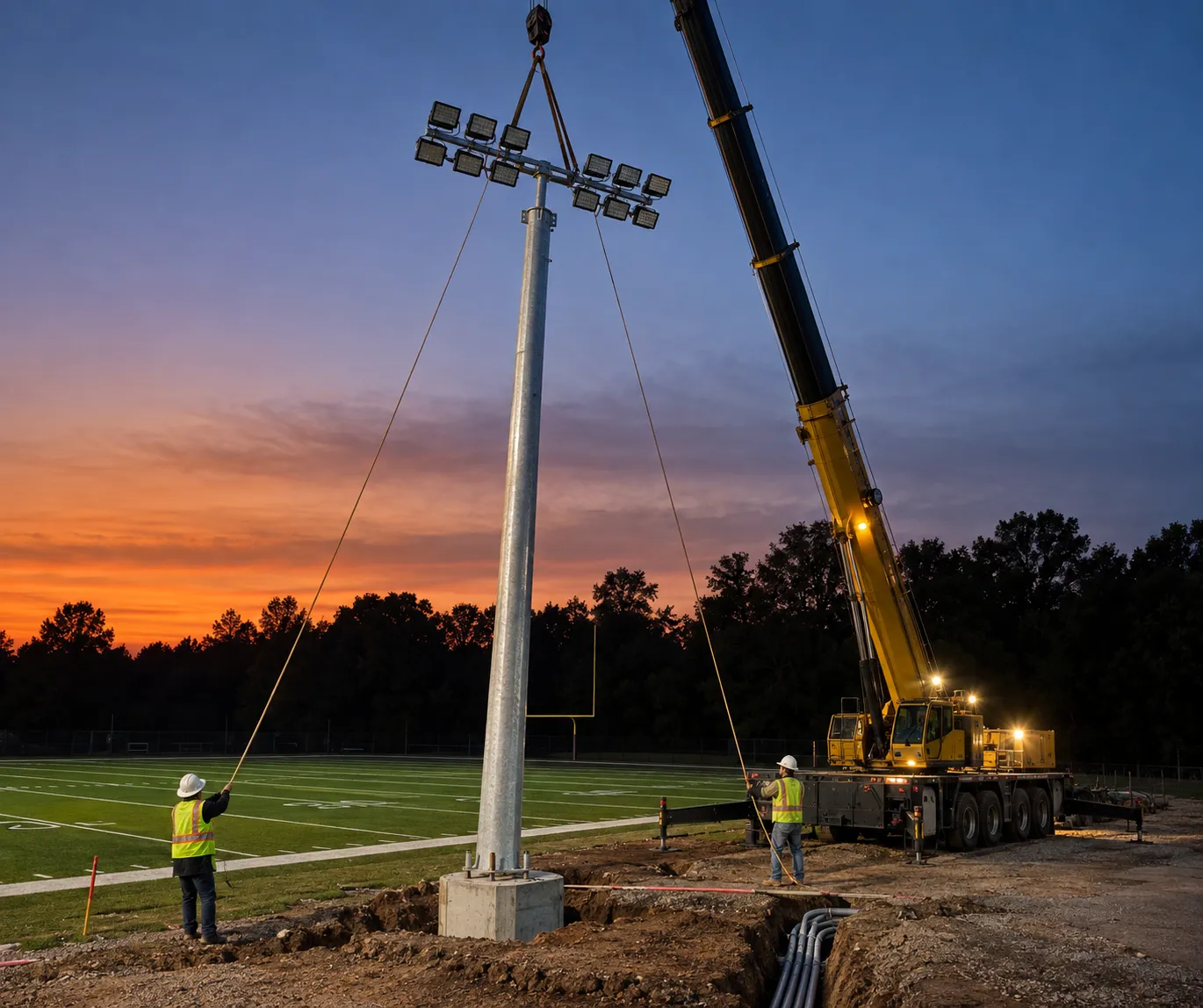
One legitimate saving deserves its own paragraph: phased builds. Poles, foundations and electrical service can be sized for the final class while the first phase installs only the fixtures needed for a lower class. That path genuinely saves money when growth is plausible. It is fake savings when the poles are sized for phase one: upgrading later then means tearing out foundations, the most expensive concrete in the entire project. If a phased plan is on the table, ask one question. Are the poles and service rated for the end state?
Before fixture quotes go out, get the poles, the power and the photometrics sized on your actual field — WOSEN runs the lighting simulation before you commit to a fixture count.
Request a Free Lighting SimulationDesigning the Layout: Poles, Optics, Verification
With class and budget fixed, design begins in earnest. This is the section for the people who actually produce the drawings. Five decisions, in order.
Pole Count and Placement
Football fields commonly carry four to six poles per side, fifty to seventy feet tall (FSG, 2026). Fewer, taller poles minimize foundations and simplify aiming; more, shorter poles improve uniformity and reduce glare but multiply civil works. Layout is a physics trade before it is a cost trade. Pole height sets the aiming angle. Aiming angle decides how much light lands where you want it, and how much lands in the fullback’s eyes.
Layout Options Compared
| Layout | Best for | Uniformity potential | Watch out for |
|---|---|---|---|
| 4-pole corner | Training and HS fields, tight budgets | Moderate | Long throwing distances; glare control depends on optics |
| 6-pole side | Community and college fields | Good | Higher civil cost; more aiming points to maintain |
| 8-pole full | Semi-pro and broadcast | Best | Highest foundation and electrical cost; usually reserved for Class II+ venues |
Height deserves one more note, because public guidance is all over it: you’ll find 30, 40, 50, 70 and 100 feet in various articles. The honest summary is that competition fields concentrate in the 50–70 foot band. Below it, aiming angles steepen and glare and uniformity both degrade. Above it, structure and cost climb for a benefit only broadcast-level venues need (FSG, 2026; Outdoorlink, 2025).
Optics: Beam Angles Work as a Team
A football field is not lit by one beam angle. It’s lit by a distribution of them. Narrow optics (roughly 15–30°) throw light the long distances from tall poles to the field’s far side. Medium optics (roughly 45–60°) cover the transition zones and the area directly around each pole base. Wide optics (roughly 90–120°) handle perimeters and, where they exist, the stands. On a combined football-and-track venue, the pattern is narrow beams on the playing area, medium beams on the track lanes, and wider beams on the seating (LED Light Expert).
The beginner error is buying one high-output fixture type and repeating it everywhere. It produces exactly what you’d predict: hot spots under the poles, gray zones between them, and spill past the sideline that the neighbors will describe for you in detail. Optic selection is also the cheapest glare-control tool you own, far cheaper than shields bolted on after the complaint.
Wattage, Lumens and the Math That Gets Botched
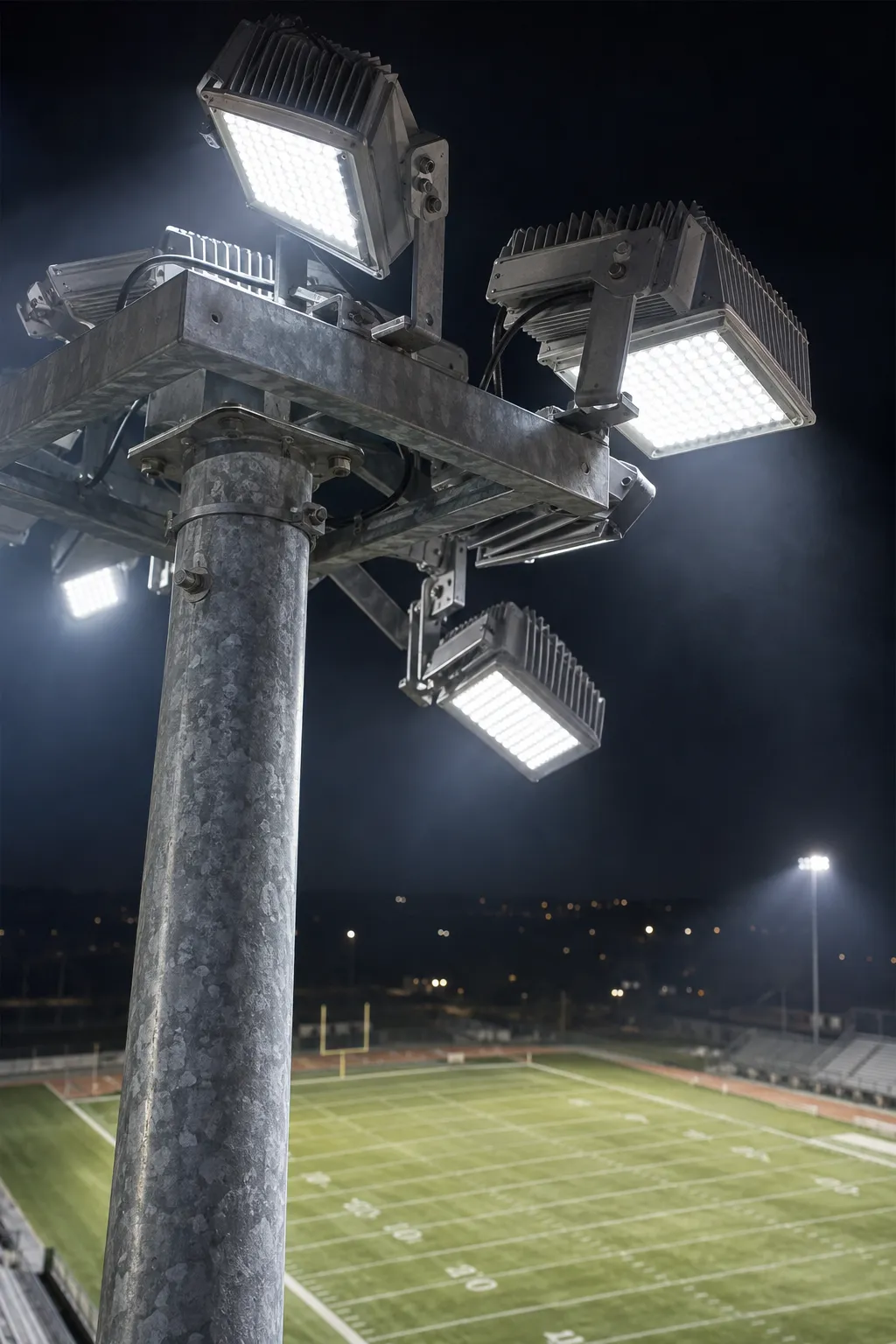
Modern LED stadium fixtures span roughly 300 to 1,250 watts (Stouch Lighting, 2023). Heavy-duty stadium units reach 1,400 watts and around 210,000 lumens from a single unit (LED Light Expert). Those single-unit figures give a feel for scale, but the fixture count comes from arithmetic that deserves care, because a widely-circulated version of it is wrong.
The naive version goes: field area × target footcandles = total lumens, pick fixtures, done. One guide applies it to an NFL field and lands on about 5.4 million lumens for a 1,000-lux field (PacLights). Class I facilities actually specify roughly 22.5 million lumens by spectator class (Stouch Lighting, 2023). The two figures cannot both be right, and the gap is the missing factors. Installed lumens must exceed target lumens because fixtures degrade, optics lose light to depreciation and dirt, and not every lumen lands on the field. The working formula:
Installed lumens = (target illuminance × area) ÷ (utilization factor × maintenance factor)
Maintenance factors for sports installations typically run 0.7–0.9 (ZCLED, 2026). LED sources hold 70–90% of their initial output over their service life (LED Lighting Supply, 2026). The rest of the factor accounts for dirt on lenses and driver drift. Skip the factors and you’ll under-build the field by a third or more, then discover it during night one of the season.
The lumen shortcut is a sizing hint, not a design. It cannot see aiming, obstructions, pole shadows or uniformity. Treat its output as an order-of-magnitude check on any photometric study. Let the study, not the shortcut, set the final fixture count.
Retrofit or New Build: The Decision Chain
Retrofit means hanging new LED heads on existing poles, and it is where margins quietly die. Walk the decision chain explicitly. Check the structure first: pole condition, weld integrity, and whether the original design’s wind-load margin covers the new fixture array’s drag profile. Check the electrical second: existing conductors, breaker capacity and whether the service can feed the new load with headroom. Check controls third: HID-era contactor panels sometimes need replacement to unlock LED dimming and scheduling. When all three checks pass, retrofit makes sense in the typical $150,000–$350,000 range (Sports Venue Calculator, 2026). When the structure or service fails the check, the honest answer is new poles, and the earlier that’s known, the cheaper the project.
The Photometric Study: Proving the Design
The photometric study is the simulation that predicts illuminance and uniformity on a grid across the field before anyone pours concrete. Reputable practice: have the study performed by the manufacturer or an independent lighting designer, using the actual fixture photometric files (Outdoorlink, 2025; ANSI, 2021). Then treat the report as a contract document. Agreed grid, agreed class targets, agreed acceptance. Demand the deliverables by name: point-by-point calculation grid, average/minimum/maximum values, uniformity ratios, and the luminaire aiming diagram.
Then, at commissioning, measure the field and compare. Design versus as-built discrepancies of a few percent are normal. Larger ones usually mean aiming drifted during installation. Caught at handover, that is fixable in an afternoon; caught later, it is a season-long argument.
Before you commit: three checks
What to Demand From a Supplier
Everything above reduces to a procurement checklist. If you’re writing an RFQ, these are the lines that separate a supplier who solves problems from one who ships boxes. Send it to bidders as-is.
Supplier RFQ checklist — every line below should be answerable in writing before you sign:
- Photometric service: Will they run the study on your actual field dimensions and target class, on their own fixture files, before purchase order and at no charge? Do they deliver point-by-point grids and an aiming diagram?
- Warranty terms: Years matter less than coverage. Ask what the warranty covers: parts replacement procedure, freight responsibility, batch-failure protocol and response time for overseas projects.
- Protection and materials: IP65/IP66 minimum for open-air venues; request salt-spray and high-temperature test reports if the site is coastal or desert; housing should be die-cast aluminum, not stamped steel.
- Key components: Which LED chip and driver brands — and can you specify them? Brand-name drivers and chips are the difference between a 5-year warranty that’s honored and one that’s argued about.
- Delivery and inspection: A written production lead time; willingness to host your third-party inspection before shipment; spare-part availability commitment for at least the warranty period.
Read item 2 twice. A warranty is a promise about years five through ten of an asset. By then the fixture, the cheapest component, was chosen long ago. The suppliers who put photometric service, coverage terms and component transparency in writing are the ones who’ve actually engineered for that timeline. The ones who lead with a lower unit price and a one-line warranty have, whether they admit it or not, priced your rework risk into their margin.
When Designs Fail: Spill, Glare and Rework
Now the part nobody’s landing page advertises: how these projects go wrong. Industry experience keeps pointing at the same three failure modes: spill light trespassing onto neighboring properties, glare hitting players and neighbors, and sky glow over the venue (Athletic Business, 2011). None of them are exotic. All of them were preventable at design time.
The stakes are real. A Florida college’s new athletic field lights drew neighbor complaints that escalated to county lighting-ordinance involvement (St. Augustine News community group, 2025). In disputes like these, the complainant’s path runs through the municipal code, and the codes have teeth. Typical US ordinances cap light at the residential property line between 0.2 and 0.5 footcandles. The City of Asheville enforces 0.5 footcandles at the property line (Asheville NC Code); proposed amendments in Wilton, Connecticut would tighten residential limits to 0.2 footcandles (Town of Wilton, 2025). The engineering countermeasures are equally concrete: fixtures carry BUG ratings (backlight, uplight, glare) that quantify exactly how much light escapes where, and municipalities increasingly reference them (City of Austin). Check the local ordinance and the fixture BUG rating before the photometric study, not after the first angry letter.
Spill light is the only failure mode on this list that can stop a finished project. Verify property-line illuminance limits, fixture BUG ratings and aiming discipline during design. Retrofitting optics after a complaint means re-aiming, re-shielding or re-poling, each an order of magnitude costlier than specifying it correctly.
The matrix below is the field version of everything this guide has argued. Before you commit to any design decision, find its row and run its check.
Design Decisions and Where They Break
| Design choice | Works when | Fails when | Verify before committing |
|---|---|---|---|
| 4-pole corner layout | Rectangular fields, Class III-IV targets, tight budgets | Field is long/narrow, or uniformity target ≥0.6 | Run uniformity sim at 5m grid before quote |
| Tall poles, few fixtures | Open surroundings, minimal spill constraints | Neighbors within ~100m or local BUG/property-line limits | Check property-line fc and ordinance first |
| Single wide-optic fixture type | Pure recreational play, no vertical targets | Any streaming or broadcast ambition; glare complaints | Confirm vertical lux need now, not after upgrades |
| Reuse existing poles (retrofit) | Structure sound, wind-load margin verified, service capacity confirmed | Corroded sections, undersized conductors, unverified foundations | Structural inspection + electrical capacity calc, in writing |
| Stay on metal halide | Very low usage hours, rock-bottom capex | Weekly night use, dimming/scheduling wanted, energy budget exists | Total cost of ownership over 10 years, not fixture price |
| Off-grid solar floodlights | Remote training areas, no grid access | Match-grade illuminance or multi-hour continuous play | Verify solar autonomy vs. actual dusk usage hours |
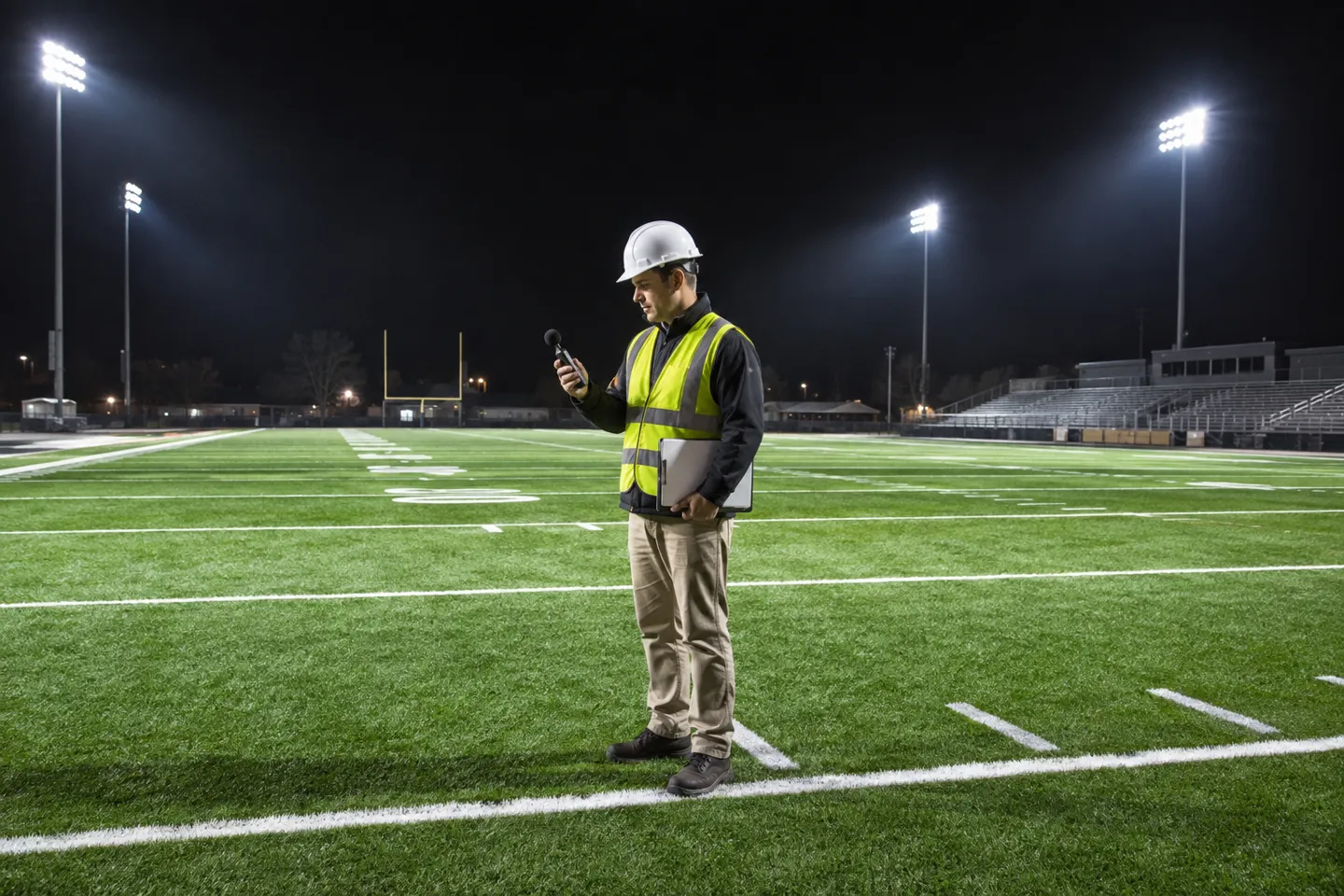
Acceptance failures deserve a final word, because they’re the rework nobody budgets. When a completed field misses its photometric targets, the cause is almost always one of three. Aiming drifted during installation. The maintenance factor was assumed optimistically at design. Or an obstruction (stands, trees, new fencing) was never in the model. All three are checkable on paper before installation and on the field at handover. The five minutes it takes to compare design values against meter readings at commissioning is the cheapest inspection in the entire project.
The Business Read: Where Projects Win or Lose
Step back from the technical chain and the business pattern is blunt. The fixtures are the smallest line item in the budget. The poles, foundations and electrical are the largest and the least reversible. And the failures that actually destroy margin all trace back to decisions made, or skipped, before a single purchase order: spill complaints, failed acceptance, phased builds with undersized infrastructure. A contractor who wins on fixture unit price has optimized the cheapest slice of the project and left the expensive rest to chance.
That reshuffles where bid discipline pays. Locking the competition class, the property-line boundaries and the acceptance procedure into the tender documents moves the three biggest risks onto paper before they can move onto your budget. And it reframes supplier evaluation. Photometric support, warranty coverage and delivery certainty vary more between suppliers than unit prices do. The lowest quote is simply the most expensive uncertainty you can buy.
Which is why we argue, and we’d cite our own record for it, that the supplier decision in this market is a capability decision. At WOSEN, the lighting simulation runs on your actual field dimensions and target class before you commit to a fixture count. It is the same workflow behind our stadium lighting project in Texas. Our stadium line is IP66, dimmable and comes with a 5-year warranty, built in-house from die-casting through assembly. The photometric report, the warranty and the price arrive in the same envelope.
Do the next project the same way the good ones were done: class in writing, boundaries in writing, acceptance in writing. Then the lighting design stops being a gamble on game night and starts being what it should be: infrastructure you don’t think about again for a decade.
Get a Bid You Can Defend
WOSEN builds IP66, dimmable stadium floodlights with a 5-year warranty — and sends the photometric report, the warranty and the price in the same envelope.
Get Your Lighting Design QuoteReferences
- ANSI. “ANSI/IES RP-6-20: Sports and Recreational Area Lighting.” 2021. https://blog.ansi.org/ansi/ansi-ies-rp-6-20-sports-recreational-lighting/
- Athletic Business. “Outdoor Sports Lighting Projects Don’t Need to Rile the Neighbors.” 2011. https://www.athleticbusiness.com/facilities/outdoor-fields/article/15142614/outdoor-sports-lighting-projects-dont-need-to-rile-the-neighbors
- BEGA. “DIN EN 12193 · Sports Lighting.” https://www.bega.com/en/knowledge/lighting-theory/reference-values-for-illumination/dinen12193-sports-lighting/
- City of Asheville, NC. “Sec. 7-11-10. Outdoor Lighting Standards.” https://codelibrary.amlegal.com/codes/ashevillenc/latest/asheville_nc/0-0-0-7201
- City of Austin, TX. “Outdoor Lighting Regulation (BUG rating guidance).” https://services.austintexas.gov/edims/document.cfm?id=187322
- FIFA. “Football Stadiums Guidelines — Technical Systems and Services.” https://publications.fifa.com/de/football-stadiums-guidelines/technical-guideline/stadium-guidelines/technical-systems-and-services/
- FSG. “Sports Field Lighting Standards & Layouts: Complete Guide for 2026.” 2026. https://fsg.com/sports-field-lighting-standards-layouts-complete-guide/
- LED Light Expert. “Football and Track Field Photometric Study Examples.” https://www.ledlightexpert.com/football-and-track-field-lighting-examples-photometric-light-studies
- LED Light Expert. “How to Ensure Your LED Softball Lighting Meets Sports Lighting Standards.” 2025. https://www.ledlightexpert.com/led-softball-lighting-standards
- LED Lighting Supply. “Lighting Maintenance Factor Explained.” 2026. https://www.ledlightingsupply.com/blog/lighting-maintenance-factor
- Legacy Sport Lighting. “What Lighting Levels Are Required for Sport and How Is It Regulated?” https://legacysportlighting.com/lighting-levels-required-for-sport/
- Outdoorlink. “Key Considerations for Football Stadium Lighting Design.” 2025. https://outdoorlink.com/high-school-football-stadium-lighting-design
- PacLights. “Football Lighting Design Calculation Guide.” https://www.paclights.com/learning-center/football-lighting-design-calculation-guide/
- Reita Light. “FIFA Stadium Lighting Standards Guide.” 2025. https://reitalight.com/fifa-stadium-lighting-standards-guide/
- Reddit r/LittleLeague. “Adding Lights to the Field — Who Did You Use? Cost?” 2026. https://www.reddit.com/r/LittleLeague/comments/1uf0xw8/adding_lights_to_the_field_who_did_you_use_cost
- Sports Venue Calculator. “LED Football Field Lighting Cost Guide (2026).” 2026. https://sportsvenuecalculator.com/knowledge/led-sports-lighting/led-football-field-lighting-costs
- Sports Destinations. “Seeing the Light: When Sports Venue Lighting Creates Conflict.” 2019. https://www.sportsdestinations.com/sports/sports-facilities/seeing-light-when-sports-venue-lighting-creates-17412
- Stouch Lighting. “Enhancing Safety and Performance with Proper Football Field Lighting.” 2023. https://www.stouchlighting.com/blog/enhancing-safety-and-performance-with-proper-football-field-lighting
- Stouch Lighting. “How Many Lumens and Watts Does It Take to Light a Football Field?” 2023. https://www.stouchlighting.com/blog/how-many-lumens-and-watts-does-it-take-to-light-a-football-field
- St. Augustine News community group (Facebook). “Flagler College’s New Athletic Field Lights Invade Neighbor’s Property.” 2025. https://www.facebook.com/groups/StAugustineNews/posts/24081460508202410
- Town of Wilton, CT. “Proposed Text Amendment §29-9.D — Municipal Recreation Lighting.” 2025. https://www.wiltonct.gov/sites/g/files/vyhlif10026/f/uploads/proposed_lighting_text_amendment_ss29-9_draft_for_oct_22_rvw.pdf
- WOSEN. “Stadium Lighting Project in Texas.” https://www.wosenled.com/projects/stadium-lighting-project-in-texas/
- WOSEN. Homepage. https://www.wosenled.com/
- ZCLED. “Lumens Required for Stadium Lighting: Full Calculation Guide.” 2026. https://www.zcleds.com/blogs/blog/lumens-required-for-stadium-lighting-full-calculation-guide

 English
  Spanish
  French
  German
  Italian
  Arabic
  Russian
  Portuguese
  Dutch
Dutch  Indonesian
  Turkish
  Polish