
Facade lighting is far more than mere nighttime aesthetics—it is a high-stakes engineering challenge where architectural vision collides with harsh outdoor environments. For B2B procurement managers and commercial real estate developers, selecting the right exterior luminaires is an exercise in mitigating long-term liabilities. An improper specification does not just result in uneven shadows; it triggers a cascade of catastrophic maintenance bills that can shatter a project’s Total Cost of Ownership (TCO). This comprehensive guide provides a ruthless engineering audit of the various types of facade lighting, matching cutting-edge optical techniques with uncompromising physical defense parameters to help you avoid the industry’s most expensive maintenance traps.
The Complete Spectrum of Facade Lighting Fixtures
Before diving into specific technical applications, it is critical to establish a global mental map of the hardware available in the commercial market. The following matrix categorizes the core fixtures based on their primary lighting purpose, ideal installation scenarios, and most importantly, their intrinsic maintenance risk index. Understanding these baseline parameters will prevent specifiers from deploying high-risk fixtures in hard-to-reach architectural zones.
| Fixture Type | Primary Lighting Purpose | Ideal Application Scenario | Maintenance Risk Index |
|---|---|---|---|
| Floodlights | Broad, high-intensity coverage | High-rise building facades, large commercial bases | Medium Risk |
| Wall Washers | Uniform, shadow-free illumination | Wide, flat vertical surfaces, podiums | Medium Risk |
| Linear LEDs | Outlining architectural contours | Rooflines, building edges, skylines | High Risk |
| Accent Spotlights | Targeted feature accentuation | Columns, statues, structural details | Medium Risk |
| In-Ground Uplights | Foundation and ground-up lighting | Pavements, pathways, structural bases | Extreme Risk |
| Dynamic Pixel / Media LEDs | Dynamic digital displays and video | Full-scale media facades, commercial hubs | Extreme Risk |
High-Intensity Floodlights and Precision Wall Washers
For large-scale structural illumination, understanding the distinction in beam control is the foundation of a successful lighting design. Floodlights act as the broad brush strokes for massive architectural areas. However, electrical engineers must rely heavily on the NEMA beam angle classification to avoid severe optical waste and light trespass. When illuminating narrow architectural spires or skyscrapers exceeding 30 meters in height, specifiers must demand fixtures with NEMA 1 or NEMA 2 classifications. These ultra-narrow beam angles (ranging from 10° to 29°) ensure tight optical cohesion, driving the lumens up the vertical surface without scattering light into the night sky. Conversely, for low-slung, wide commercial podiums, specifications should default to NEMA 5 or NEMA 6 wide beams.
Wall washers, in contrast, are engineered to provide a seamless flat wash of light. Their mechanical design relies heavily on advanced asymmetrical lens technology to ensure a dark-zone-free splicing effect when daisy-chained across a continuous facade. Because these fixtures are typically mounted on accessible ledges or lower tiers, they carry a Medium Maintenance Risk, meaning localized failures can generally be addressed using standard scissor lifts without halting building operations.
Linear LEDs and Accent Spotlights for Architectural Details
When the architectural goal shifts from overwhelming brightness to targeted accentuation, precision takes over. Linear LEDs offer seamless end-to-end connections to trace skylines and structural borders, creating a striking Tron-like effect at night. Accent spotlights are deployed to highlight high-contrast features such as classical Roman columns or modern steel trusses. To comply with modern light pollution regulations (such as those governing LZ0 to LZ4 environmental zones), these fixtures must be equipped with anti-glare accessories like honeycomb louvers or directional snoots to strictly restrict stray light from blinding pedestrians or entering adjacent residential windows.
It is vital to note that Linear LEDs carry a High Maintenance Risk. Because they are frequently installed on the highest architectural edges to outline the skyline, gaining physical access requires specialized high-altitude equipment. Furthermore, their daisy-chain wiring topology means that a single point of failure (such as a compromised connector) can knock out an entire segment of the architectural outline, magnifying the visual impact of the failure.
In-Ground Uplights for Foundation Illumination
Many novice lighting designers assume that the core challenge of in-ground lighting is merely impact resistance. While physical toughness is required, the deadliest and most hidden threat is the physical breathing effect (capillary action). During standard operation, the internal components of the LED fixture generate heat, causing the internal air to expand and push outward. However, when the fixture is turned off in the cold dead of night, a sharp temperature drop occurs. This rapid cooling creates a powerful internal vacuum. If the luminaire is submerged in ground moisture, this vacuum will literally suck water straight through the micro-gaps of the cable joints or degraded silicone seals.
To survive this extreme environment, relying solely on an IP68 rating and a well-planned soil drainage system is vastly insufficient. The fixture itself must be engineered with a stainless steel Breather Valve (pressure equalization valve) to balance internal and external air pressure instantly, paired with an anti-capillary waterproof cable connector. Due to the relentless barrage of water pressure and mechanical stress, this category carries an Extreme Maintenance Risk.
Dynamic Pixel and Media LEDs for Digital Facades
Operating in an entirely different technological paradigm, pixel or dot LEDs transform static physical architecture into dynamic digital media screens. The procurement and engineering logic here shifts dramatically from raw lumen output to data transmission integrity and system linkage. Success relies heavily on robust control protocols, such as DMX512 or SPI, which guarantee zero latency and high-frame-rate synchronization across vast arrays of lights.
Because a single commercial media facade may utilize tens of thousands of individual pixel nodes, troubleshooting a signal failure requires highly specialized low-voltage technicians. A corrupted data signal can cause entire sections of the building to flicker sporadically, completely ruining the commercial advertising value of the facade. Consequently, this system naturally commands an Extreme Maintenance Risk rating.
Matching Lighting Techniques with Building Architecture & Materials
Selecting the highest quality fixture is only half the equation; applying the correct lighting technique relative to the facade’s specific material composition is what separates amateur installations from award-winning designs. A mismatch between optical distribution and surface texture will instantly highlight construction flaws rather than architectural beauty.
Wall Washing vs. Wall Grazing (Texture Dictates Technique)
To resolve the frequent industry dilemma of how to apply light to different building skins, electrical engineers utilize a texture-based decision tree:
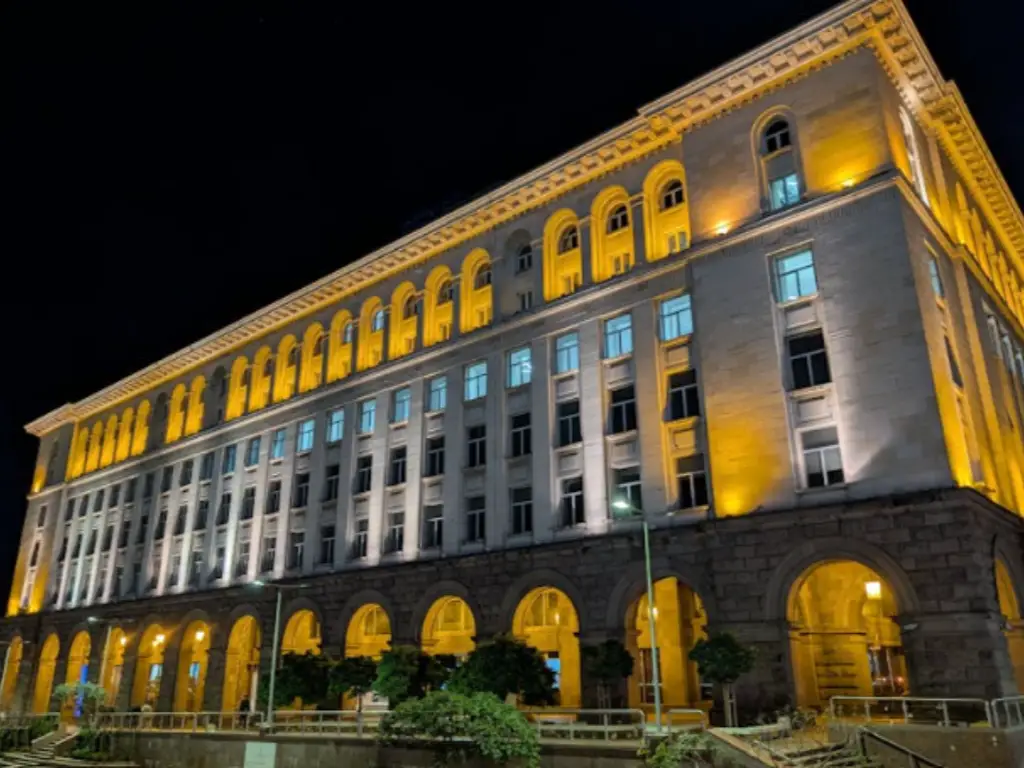
- For Smooth Surfaces (Aluminum composite panels, flat marble): The design must utilize the Wall Washing technique. Fixtures must be installed at a calculated setback distance away from the wall. This allows the beam to open up, casting a wide, forgiving wash of light that effectively masks minor surface imperfections and installation tolerances.
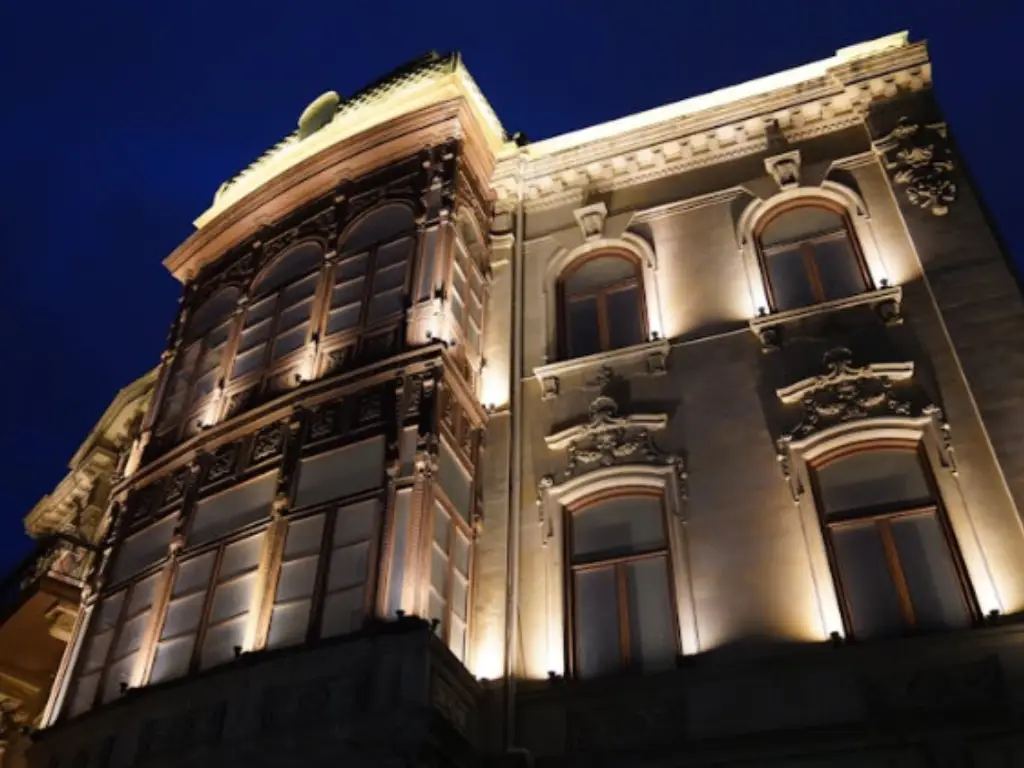
- For Deep Textured Surfaces (Rough dry-hung stone, exposed brick, corrugated steel): The design mandates the Wall Grazing technique. Fixtures must be mounted extremely close to the wall—typically within a strict limit of 12 inches. By utilizing ultra-narrow optical lenses, the light rakes across the surface, amplifying shadows and highlighting the 3D depth of the material.
When executing a Wall Grazing setup, precision is non-negotiable. At such a narrow setback distance, the slightest deviation in the mounting angle will create hideous optical distortion. Therefore, it is absolutely critical that the specified fixtures are equipped with adjustable mounting brackets featuring engraved aiming scales, empowering installation crews to make micro-adjustments on-site to eliminate shadow warping.
Managing Highly Reflective Surfaces (Glass Facades)
Modern commercial towers dominated by sleek glass curtain walls present a severe optical challenge. Directly illuminating glass from the exterior is physically flawed; the light either passes straight through into the interior offices or creates blinding, mirrored glare for pedestrians on the street. The professional engineering workaround involves utilizing the “interior glowing” technique, where the internal ceiling planes of the building are illuminated to create a lantern effect. Alternatively, custom micro-linear fixtures can be seamlessly integrated directly into the exterior aluminum window mullions, ensuring the light source is completely hidden from direct sightlines.
The “Air, Sea, and Land” Engineering Defense Parameters
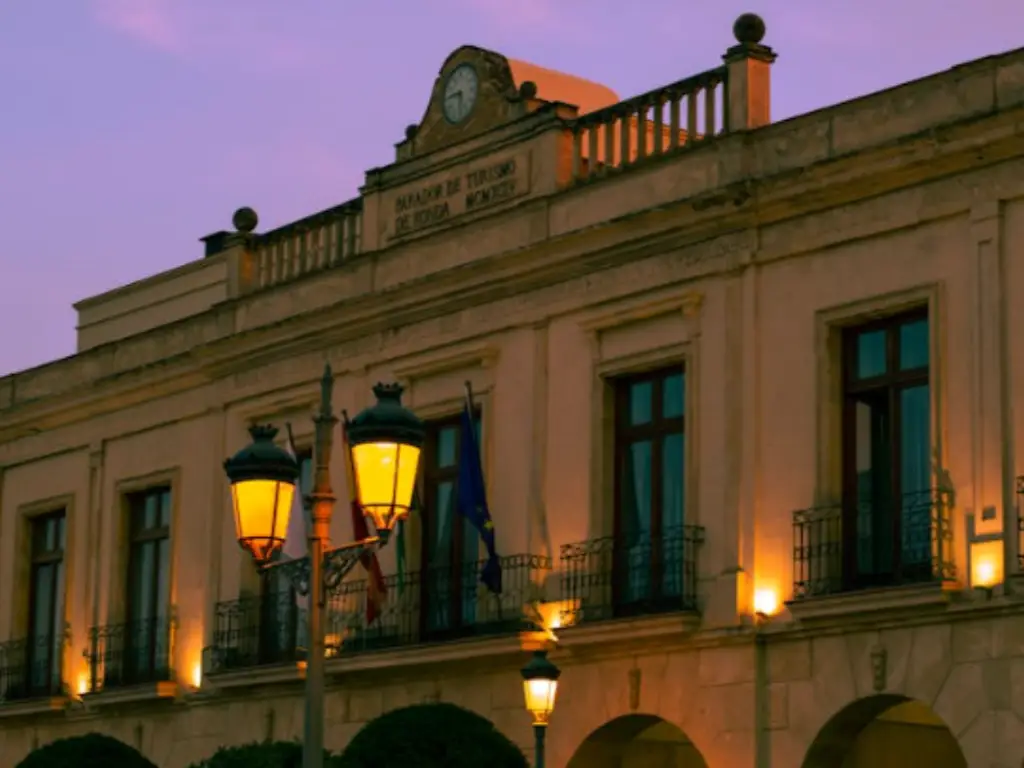
We must now move past the realm of aesthetics and confront the brutal realities of commercial operation. In the high-stakes B2B sector, outdoor lighting is an investment measured against the ruthless forces of nature. To properly audit a fixture’s survival capabilities, industry experts categorize physical hardware defenses into a three-dimensional “Air, Sea, and Land” framework.
“Land” Defenses: Ground-Level Compaction and Structural Integrity
Recalling the extreme risks associated with in-ground uplights, the “Land” defense parameter focuses entirely on mechanical survival. In bustling commercial real estate plazas or industrial parks, ground-level fixtures are routinely subjected to devastating static loads. It is not just foot traffic; maintenance vehicles, heavy scissor lifts, and commercial delivery trucks will inevitably roll over these luminaires.
To prevent the housing from collapsing and immediately compromising the watertight seal, ground-level fixtures must pass rigorous impact resistance testing. Specifications must explicitly demand an IK10 impact resistance rating combined with ultra-thick, anti-slip tempered glass. Without this mechanical land defense, the crushing weight of a single commercial vehicle will destroy the fixture, creating an instant electrical hazard and a costly replacement scenario.
“Air & Sea” Defenses: High-Altitude Wind Load and Coastal Corrosion
When fixtures are mounted on the upper tiers of skyscrapers or deployed in coastal zones, they face the relentless dual-threat of “Air and Sea.” High-altitude fixtures endure extreme wind load deformation and relentless UV-induced thermal stress. Heat is the ultimate enemy of LED longevity; if thermal energy cannot escape, lumen decay accelerates exponentially. Simultaneously, coastal installations face airborne saline moisture that rapidly deteriorates standard metals. To survive here, fixtures must pass the authoritative ASTM B117 salt spray test, proving they can withstand over 1,000 hours of highly corrosive salt fog exposure without blistering.
In a highly fragmented lighting supply chain, many so-called engineering-grade fixtures are pieced together in assembly workshops, where blueprint-specified ADC12 aluminum is secretly swapped for recycled scrap, leading to rapid thermal and corrosive failure. This is exactly why Wosen LED refuses to rely on external supply chains and maintains a highly vertically integrated manufacturing system. To physically eradicate these high-altitude thermal and coastal corrosion vulnerabilities from the source, we operate our own in-house die-casting facility, allowing us to strictly control the density and thermal conductivity of the ADC12 aluminum right from the melting stage. Furthermore, to completely eliminate assembly-induced water ingress and premature component failure, every core PCB undergoes automated SMT processing before being subjected to a mandatory 48-hour extreme temperature and high-pressure waterproof aging test. This heavy-asset commitment to controlling the underlying manufacturing reality is how we consistently shield our clients from early failure risks.
The TCO Trap: Initial Price vs. High-Altitude Maintenance
If the aforementioned “Air, Sea, and Land” defenses collapse due to budget cuts during procurement, the financial consequences are catastrophic. Many purchasing managers mistakenly focus entirely on the initial unit price of a luminaire, utterly ignoring the Total Cost of Ownership (TCO) associated with commercial high-altitude maintenance.
Let us calculate a realistic, destructive financial scenario based on documented industry averages. Suppose a procurement team opts for a sub-standard linear LED priced at $25 instead of a premium, thermally validated fixture priced at $75. They save $50 upfront on the balance sheet. Fourteen months later, due to poor heat dissipation and compromised seals, that fixture dies on the exterior wall of the 20th floor.
To replace this single unit, the cost of the new light remains a trivial $25. However, according to the public baseline pricing of major North American equipment providers such as Sunbelt Rentals, dispatching an articulating Boom Lift capable of reaching the 20th floor starts at a minimum of $1,200 per day. When you add the mandatory union wages for two certified high-altitude rope-access technicians (approximately $600 per day) and the administrative costs of municipal sidewalk closure permits, the operation becomes financially toxic. The initial $50 saved in procurement has instantly mutated into an $1,800 financial black hole. This brutal mathematics proves that over-engineering the hardware is the only viable method to secure long-term ROI.
The B2B Buyer’s Pitfall Guide for Facade Lighting
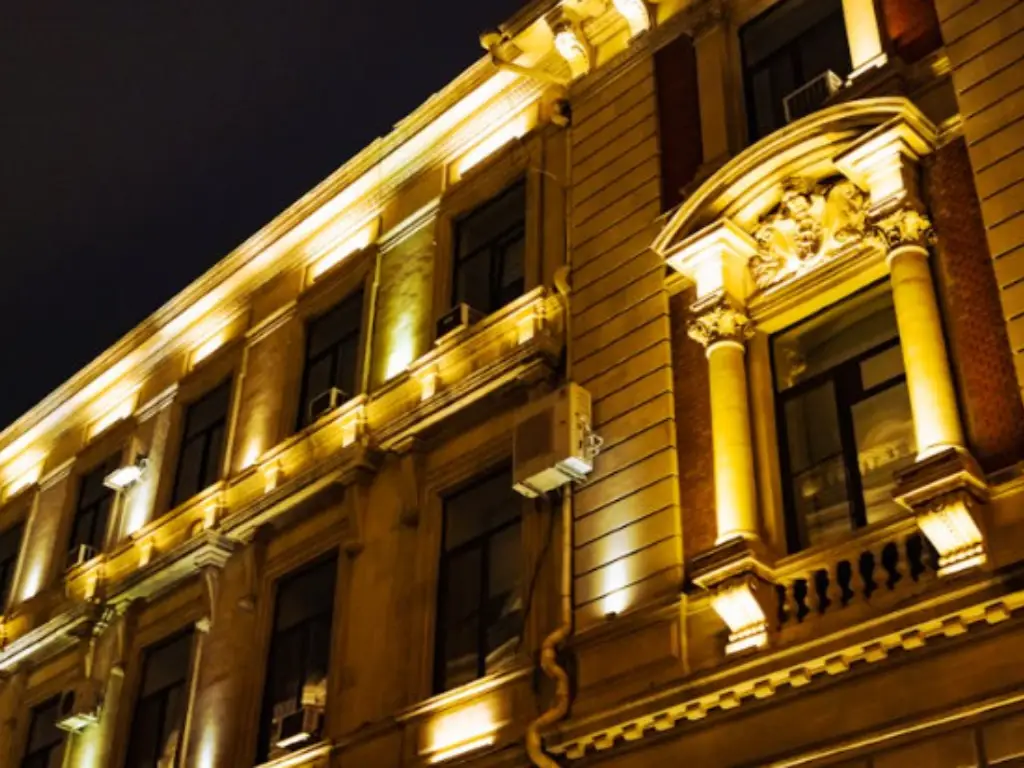
Armed with the knowledge of mechanical defenses and TCO realities, procurement teams must actively audit their supply chains. When reviewing vendor submissions for a commercial facade project, utilize this actionable checklist to identify hidden traps before signing the purchase order:
- Trap 1: Unverified IP Ratings: Do not accept a manufacturer’s self-declared IP66 or IP67 stamp on a spec sheet. Always demand the independent third-party laboratory test reports. If the manufacturer cannot produce a verifiable document from a recognized testing body, the fixture will likely fail during the first heavy storm.
- Trap 2: Compromised Driver Components: The LED chip rarely fails first; it is almost always the power supply. Inspect the driver specifications closely. Avoid vendors utilizing cheap liquid electrolytic capacitors, which boil off and dry out under intense outdoor heat. Demand solid-state components built to withstand extreme thermal fluctuations.
- Trap 3: Missing Photometric Data: If a supplier cannot provide IES (Illuminating Engineering Society) photometric files for their fixtures, do not buy them. Without accurate IES files, electrical engineers cannot run software simulations (like DIALux), resulting in blind guesswork that leads to severe dark spots and non-compliant light pollution levels upon installation.
Conclusion
Facade lighting represents the ultimate intersection of architectural artistry and uncompromising material science. As we have explored, analyzing beam angles and aesthetic techniques is a futile exercise if the chosen hardware cannot withstand the crushing weight of ground traffic, the corrosive assault of coastal winds, or the brutal financial realities of high-altitude maintenance. By leveraging this engineering audit, project stakeholders can confidently filter out fragile components and mandate the rigorous physical parameters required to ensure their building remains a brilliant, maintenance-free landmark for decades to come.
Stop risking your project’s ROI on fragmented supply chains and unverified hardware.
Request a Technical Lighting Audit

 English
  Spanish
  French
  German
  Italian
  Arabic
  Russian
  Portuguese
  Dutch
Dutch  Indonesian
  Turkish
  Polish