
Aging legacy grids quietly drain municipal budgets while posing severe public safety and environmental risks. Transforming a city’s lighting infrastructure is a complex engineering challenge that requires far more than simply replacing a bulb. Discover the engineer’s comprehensive blueprint for a fiscally responsible LED transition—balancing strict regulatory compliance, extreme grid resilience, and maximizing taxpayer ROI through strategic infrastructural modernization and advanced photometric planning.
The Strategic Transition to LED Municipal Street Lighting
For municipal engineers, city planners, and public works directors, transitioning an entire urban electrical grid from legacy High-Pressure Sodium (HPS) or Metal Halide (MH) to Light Emitting Diode (LED) technology is no longer an experimental pilot concept—it is an absolute fiscal and operational imperative. Traditional legacy lighting systems are plagued by catastrophic, systemic inefficiencies that silently erode municipal budgets year after year. Beyond the obvious and heavily documented lumen-per-watt deficit, the true financial drain of legacy infrastructure lies in what optical engineers refer to as “omni-directional waste.”
HPS fixtures operate much like a leaky water pipe. Because the gas-discharge light source emits illumination in a full 360-degree sphere, these fixtures rely entirely on internal metallic reflectors to bounce the light downward toward the pavement. However, this mechanical reflection process is highly inefficient. Depending on the degradation of the reflector, up to 40% of the generated lumens are trapped within the housing, scattered uselessly into the night sky, or spilled into adjacent residential windows as invasive light trespass. Consequently, municipalities are essentially paying premium utility rates for wasted electricity that never performs its primary function of illuminating the roadway.
Compounded by heavy magnetic ballast energy losses—which often add 15% to 20% more wattage draw than the bulb’s stated rating—and rapid lumen depreciation, legacy grids become massive financial liabilities. Furthermore, the exceptionally low Color Rendering Index (CRI) of HPS lamps (typically hovering around 20) casts a monochromatic orange hue that makes it nearly impossible for drivers and security cameras to distinguish the color of a pedestrian’s clothing or a vehicle’s paint, severely hampering law enforcement and public safety efforts.
Conversely, engineering-grade LED luminaires act with surgical optical precision. LEDs are inherently directional semiconductor light sources. Utilizing advanced, injection-molded polycarbonate or optical-grade glass lenses directly over the diode arrays, they refract and direct photons exactly where required by the roadway photometrics. This absolute optical control eliminates trapped light and significantly boosts the overall “System Efficacy” (the actual useful light delivered to the target area per watt of energy consumed).
Furthermore, the physical degradation curve of LEDs presents a total paradigm shift in municipal asset management. While an HPS bulb typically requires physical replacement every 20,000 to 24,000 hours due to severe arc-tube burnout or unacceptable dimming, a properly thermally-managed LED luminaire boasts an L70 lifetime exceeding 100,000 hours. This means the fixture will retain at least 70% of its initial light output for over a decade of continuous nighttime operation, fundamentally rewriting the rules of municipal infrastructure maintenance, eliminating thousands of maintenance man-hours, and drastically reducing long-term utility expenditures.
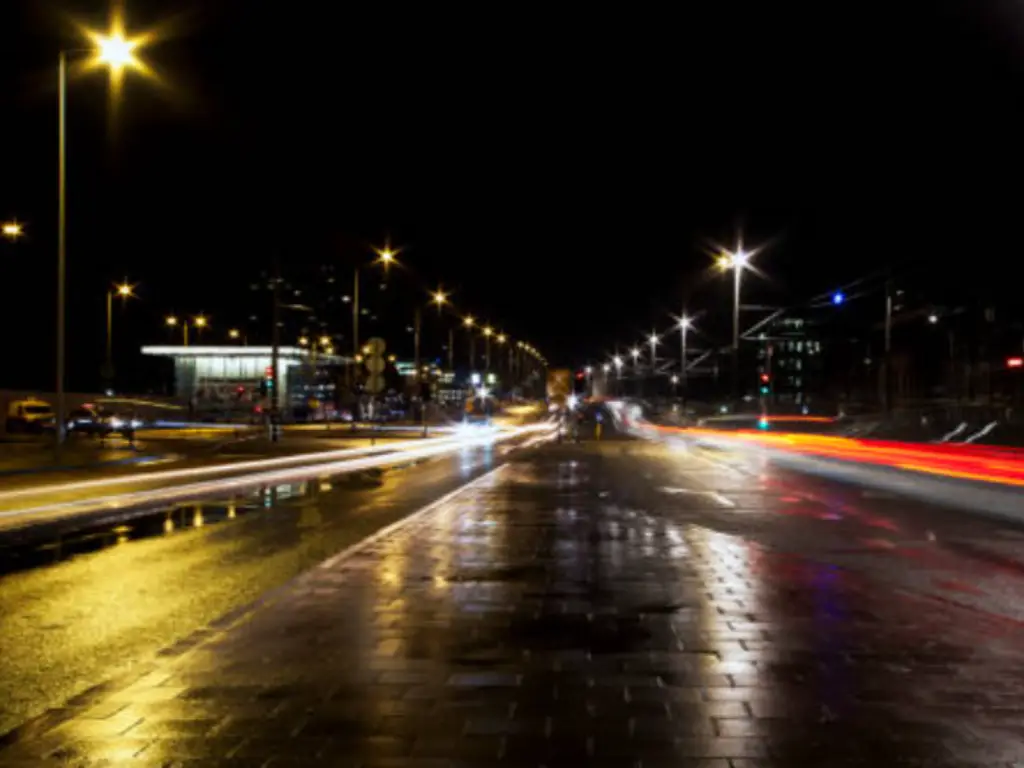
Municipal Engineering Design Standards and Photometric Compliance
Eliminating the risk of citizen complaints, vehicular accidents, and subsequent municipal civil liability requires strict adherence to documented, peer-reviewed engineering standards. A fully compliant municipal lighting grid does not rely on a layman’s subjective perception of “brightness”; rather, it operates within a strict regulatory framework that governs every aspect of the physical deployment and optical distribution.
Navigating the Regulatory Triangle: IESNA, AASHTO, and CIE
To establish a grid that is both legally defensible and structurally sound under extreme conditions, procurement and engineering teams must synthesize guidelines from three primary authorities, each governing a different axis of the street lighting ecosystem:
- IESNA (Illuminating Engineering Society of North America): Specifically, the RP-8-18 Recommended Practice for Design and Maintenance of Roadway and Parking Facility Lighting. This is the definitive bible for photometric layouts. It dictates exact illuminance levels (the amount of light hitting the road), luminance levels (the amount of light reflecting off the road into the driver’s eye), and the critical uniformity ratios required to prevent visual fatigue. It factors in pavement reflectivity classifications (R1 through R4) to ensure accurate calculations.
- AASHTO (American Association of State Highway and Transportation Officials): While IESNA governs the light, AASHTO governs the physical steel and aluminum. AASHTO standards dictate the structural wind-load calculations, pole deflection limits, and breakaway requirements of the lighting poles and mounting arms. It references standards like ANSI C136.31, which mandates that luminaires undergo rigorous 100,000-cycle vibration testing (often at 3G for normal applications and 1.5G for bridge applications) to ensure they do not detach and fall into traffic during high winds or heavy truck traffic resonance.
- CIE (International Commission on Illumination): Particularly document CIE 115: Lighting of Roads for Motor and Pedestrian Traffic. This provides the globally recognized benchmarks for categorizing roads into M-classes (Motorized traffic) and P-classes (Pedestrian areas). CIE harmonization ensures that lighting designs meet international best practices for contrast reveal and obstacle detection under mesopic (low-light) human vision conditions.
The Duality of Optics: Connecting Downward Safety and Upward Ecology
In municipal engineering, it is a common misconception that lighting the road safely (downward illumination) and protecting the environment (upward mitigation) are conflicting goals. In reality, they are deeply interconnected; they are two sides of the same optical coin.
Every rogue photon that escapes upward into the night sky or backward into a resident’s window is a photon that failed to reach the dark spots on the asphalt. Advanced LED optics solve both problems simultaneously. A precision-engineered lens captures the light that would normally create “Uplight” skyglow (ecological harm) and physically refracts it downward and laterally to fill the dangerous, shadowed gaps between poles (improving the uniformity ratio for human safety). Therefore, achieving strict ecological compliance actively and mathematically enhances roadway safety. You cannot have optimal downward uniformity without eliminating upward waste.
Downward Illumination: Roadway Illuminance and Defeating the Zebra Effect
A dangerous misconception among city councils is that “brighter is always safer.” In roadway engineering, absolute horizontal illuminance is entirely secondary to the critical metric of the Uniformity Ratio (Average-to-Minimum).
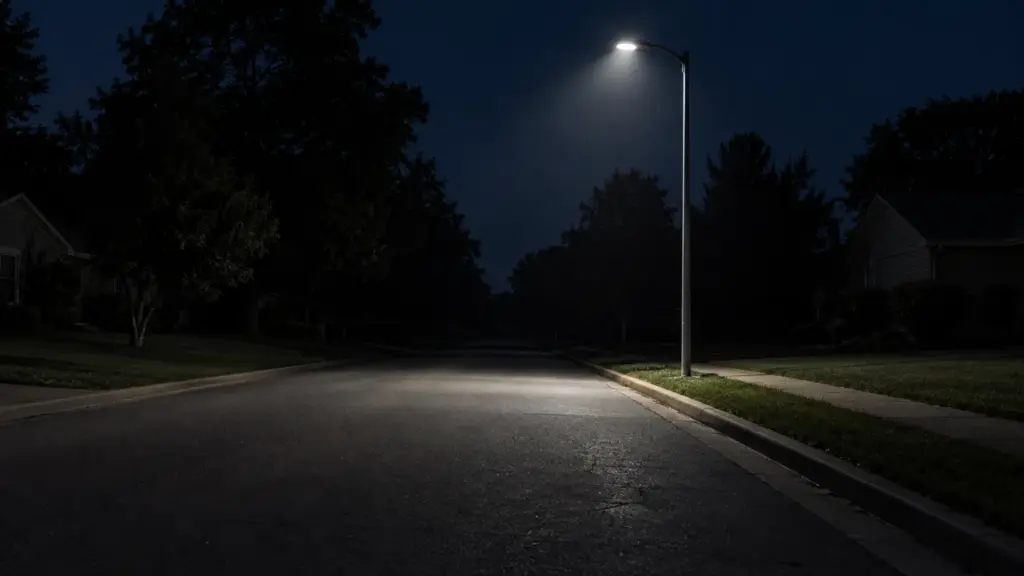
When vehicles travel at 60 mph along an arterial road, alternating pools of intensely bright light directly under the pole and dark shadows between poles create the dreaded “Zebra Effect.” This rapid fluctuation in contrast forces the driver’s pupils to constantly dilate and constrict. Over a prolonged 30-minute commute, this biological strain causes severe visual fatigue, drastically delayed reaction times, and momentary blindness when entering a dark patch, significantly increasing the likelihood of fatal pedestrian collisions.
Upward Mitigation: Dark Sky Compliance and BUG Ratings
Once the ground is safely illuminated uniformly, the engineering focus shifts to mitigating ecological disruption. Modern municipalities are rapidly standardizing on 3000K (warm-white) color temperatures. According to official guidance published by the American Medical Association (AMA), high-intensity LED lighting exceeding 4000K emits significant amounts of blue light. Because blue light scatters more easily in the atmosphere (Rayleigh scattering), it exacerbates glare, suppresses human melatonin production (disrupting circadian rhythms), and severely alters the navigational instincts of nocturnal wildlife and migratory birds.
Optical compliance is mechanically verified through the BUG Rating System (Backlight, Uplight, Glare):
- Backlight (B): Measures light spilling behind the pole. Strict control here eliminates citizen complaints regarding light trespassing into private bedrooms.
- Uplight (U): Measures artificial sky glow. To achieve International Dark-Sky Association (IDA) fixture seals of approval, the Uplight value must be absolute zero (U0), achieved through flat-glass optics.
- Glare (G): Measures harsh, high-angle light emitted directly into the driver’s eyes, causing disabling visual discomfort. Deeply recessed diode arrays solve this.
Standard-to-Application Translation Matrix
To help procurement officers and engineers translate these abstract regulatory standards into actionable design criteria, consult the following matrix. This demonstrates how to map a specific standard directly to an optical design requirement before ever looking at a hardware catalog.
| Regulatory Classification (CIE/IESNA) | Primary Application Zone | Photometric Focus (Downward) | Ecological Focus (Upward BUG) | Required Optical Distribution |
|---|---|---|---|---|
| High-Speed Motorized (M1/M2) | Major Arterials / Highways | Min. 17-22 Lux; Strict 3:1 Uniformity Ratio to prevent visual fatigue. | Absolute U0 (Zero Uplight) to prevent atmospheric scattering. | Type III (Pushes light far laterally across wide roadways). |
| Mixed Pedestrian/Traffic (M4/P1) | Downtown Commercial Districts | Min. 10-15 Lux; High Vertical Illuminance for facial recognition. | Strict Backlight control (B1 or B0) to prevent storefront glare. | Type IV (Pushes light forward, keeping light off buildings behind the pole). |
| Strict Pedestrian (P3/P4) | Residential Neighborhoods | Min. 4-6 Lux; Relaxed 6:1 Uniformity Ratio. | Strict Glare control (G1) to ensure pedestrian comfort; 3000K mandatory. | Type II (Narrow lateral distribution along tight residential streets). |
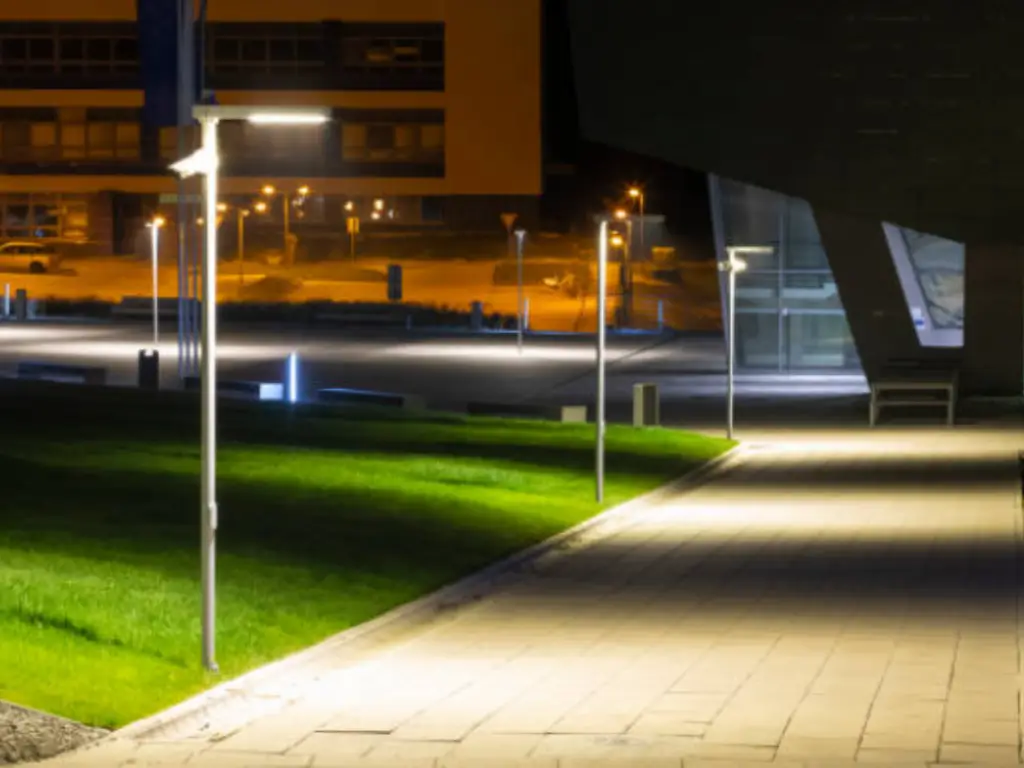
Translating Standards into Hardware: The Comprehensive Selection Guide
Theoretical photometric data exists in a vacuum until it is housed in hardware capable of surviving a decade or more of relentless environmental assault, salt spray, and extreme temperature fluctuations. Procurement officers must evaluate physical resilience alongside digital readiness. You are not just buying a light; you are purchasing a ruggedized physical armor (the body) designed to protect a sophisticated IoT node (the brain).
Luminaire Form Factors for Every Municipal Application
Because form must strictly follow function in municipal engineering, a single luminaire style cannot serve an entire city. Depending on the AASHTO wind-load limits, pole height, and the specific urban zone, cities must deploy a unified but functionally diverse matrix of form factors. All municipal-grade housings must utilize heavy-duty Die-cast Aluminum to ensure rapid heat dissipation, paired with an IK10 impact resistance rating to withstand vandalism, and an IP66 optical chamber seal to prevent water and dust ingress.
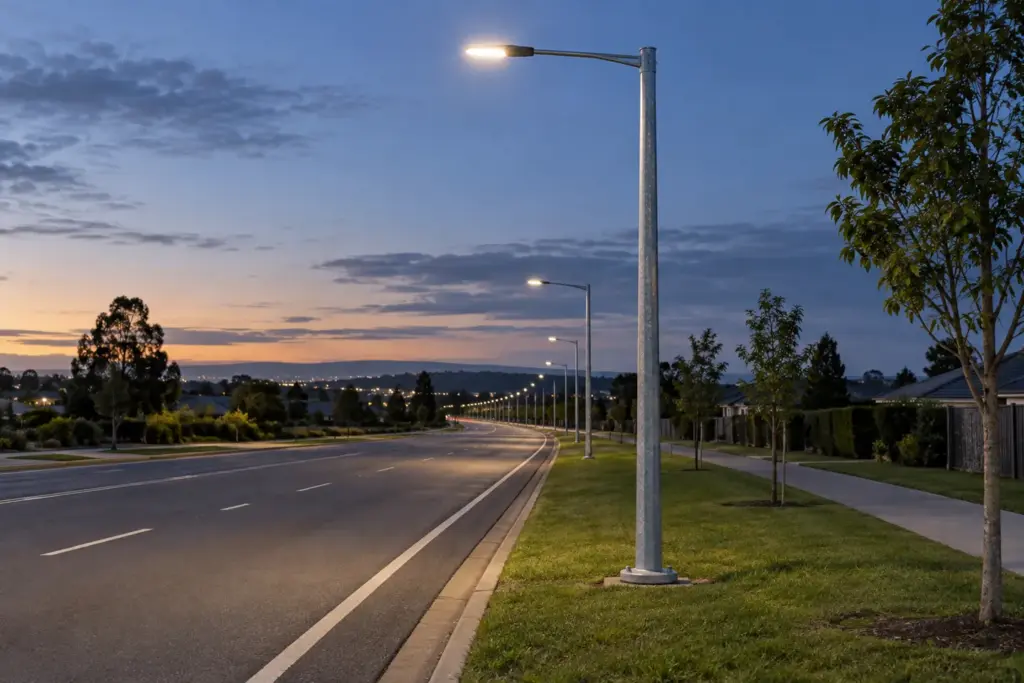
- Cobra Head Luminaires: The absolute workhorse of the urban grid. Named for their distinct shape, they are specifically engineered for major arterials and highways. Their sleek, aerodynamic teardrop profile provides an exceptionally low EPA (Effective Projected Area), minimizing wind resistance and preventing pole fatigue during hurricanes or severe storms.
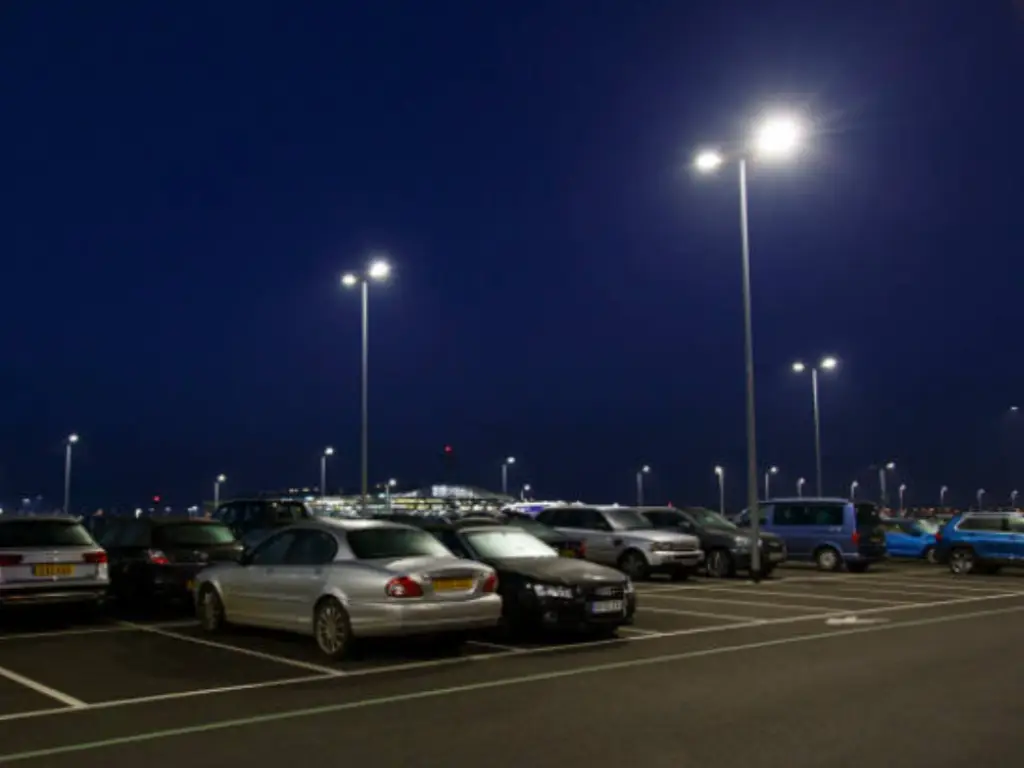
- Shoebox / Area Lights: Designed for expansive municipal parking lots, transit hubs, and large public squares. These fixtures utilize a flat, rectangular profile with wide, asymmetrical Type III, IV, or V distribution optics to push light evenly across massive square footage from a limited number of perimeter poles.
- High Mast Systems: Deployed at extreme heights of 20 to 30 meters, these specialized, multi-module fixtures are reserved for complex highway interchanges, toll plazas, and port facilities. They prioritize raw lumen output (often exceeding 80,000 lumens per fixture) and deep light penetration, mounted on lowering rings for maintenance access.
- Post Top Luminaires: Deployed in historic downtown districts, pedestrian plazas, and park walkways at lower mounting heights (3 to 5 meters). These fixtures balance stringent photometric distribution with architectural aesthetics, featuring frosted or prismatic lensing to eliminate eye-level glare.
- Wall Packs and Floodlights: Rugged, highly directional fixtures utilized for critical gap-filling. They provide essential vertical illumination for highway underpasses, tunnel entrances, and the dark undersides of overpasses where standard pole-mounted lighting cannot physically reach.
Hardware Decision & Pricing Matrix
To streamline the procurement process, the following matrix breaks down the parameters, ideal scenarios, and estimated baseline CapEx for each form factor.
Note: Prices below are baseline estimates for high-quality, spec-grade LED fixtures. Actual project pricing will vary significantly depending on total wattage, integrated smart controls, and volume discounts.
| Hardware Form Factor | Typical Wattage Range | Ideal Deployment Scenario | Key Mechanical Requirement | Est. Unit Price (CapEx) |
|---|---|---|---|---|
| Cobra Head | 40W – 250W | Highways, Arterial Roads, Local Streets. | Ultra-low EPA rating (< 0.5 sq ft) for wind resistance; 3G vibration rating. | $150 – $350 |
| Shoebox / Area | 100W – 350W | Municipal Parking Lots, Civic Plazas, Transit Hubs. | Slip-fitter or Trunnion mounts; robust heat sinks for high-wattage arrays. | $250 – $450 |
| High Mast | 400W – 1000W+ | Highway Interchanges, Ports, Railyards (20m+ height). | Modular LED engines for redundancy; compatibility with mechanical lowering rings. | $800 – $1,500+ |
| Post Top | 30W – 100W | Historic Districts, Parks, Pedestrian Walkways. | Architectural die-cast detailing; strict glare control (G0 or G1) for pedestrian eye-level. | $200 – $500 |
| Wall Pack/Flood | 50W – 200W | Underpasses, Bridge Supports, Tunnel Entrances. | Extreme IK10 vandal resistance; adjustable trunnion brackets for directional aiming. | $120 – $280 |
Practical Application Case Study: Designing a Mixed-Use Boulevard
How does an engineer actually use these tables? Let’s walk through a real-world decision process for upgrading “Main Street Boulevard,” a road featuring four lanes of high-speed traffic in the center, flanked by wide pedestrian sidewalks and historic storefronts on the edges.
-
Identify Regulatory Needs
The center lanes are CIE M2 (High Speed), requiring 20 Lux and tight uniformity. The sidewalks are P1 (High Pedestrian), requiring vertical illuminance and zero glare to protect the storefronts.
-
Select the Arterial Hardware
For the tall (10-meter) central poles facing the street, the engineer selects 150W Cobra Head fixtures. They specify a Type III optical distribution to push light far down the road, ensuring safety for drivers at 50 mph. They ensure the EPA is low to survive winter storms.
-
Select the Pedestrian Hardware
On the back side of those same poles, mounted lower at 5 meters facing the sidewalk, the engineer specifies 50W Post Top fixtures with 3000K warm-white LEDs. They specify a Type II distribution to light the long, narrow sidewalk, and demand an Uplight rating of U0 and Backlight of B0 to ensure no light pollutes the second-story residential apartments above the shops.
-
Result Achieved
By separating the form factors and optics, the city achieves perfect downward safety for cars, inviting illumination for pedestrians, and complete dark-sky compliance, all on a single pole infrastructure.
Intelligent Controls: Integrating Smart Nodes and CMS
If the die-cast housing is the armor, the control interface is the brain. A modern grid must be digitally scalable. The critical link between the hardware and the smart city network is the physical receptacle mounted on the dorsal spine of the luminaire—typically a standardized 7-pin NEMA twist-lock socket or the newer, low-profile Zhaga Book 18 bottom-mounted interface.
These standardized sockets allow municipalities to break free from dumb, localized “dusk-to-dawn” photocells. By plugging in intelligent wireless control nodes (utilizing cellular NBIoT, LoRaWAN, or RF Mesh networks), the entire lighting grid connects to a Central Management System (CMS). A robust CMS enables dynamic DALI or 0-10V dimming protocols. For example, a city can program its arterial Cobra Heads to operate at 100% capacity during evening rush hour, seamlessly dim to 70% at midnight, and drop to 30% after 2:00 AM when traffic is virtually non-existent. This digital elasticity extracts an additional 20% to 30% in absolute energy savings without requiring any physical changes to the hardware, while preserving absolute central control over the city’s visual environment.
Operational Safety and Predictive Maintenance Protocols
Before any financial ROI can be calculated, municipalities must aggressively address the unseen operational liabilities inherent in legacy grids, as these factors directly dictate the long-term Operational Expenditure (OpEx) of the lighting network. Aging underground electrical cables, degraded neutral splices, and compromised pole insulation frequently result in the leakage of electrical current directly to the metal light pole or surrounding street hardware.
This phenomenon, universally known as Contact Voltage (or stray voltage), is a lethal, invisible hazard to pedestrians and pets, carrying massive civil liability risks, multimillion-dollar lawsuits, and severe political fallout for city councils. Eradicating this risk requires rigorous adherence to Grounding and Bonding standards (such as those outlined in the National Electrical Code – NEC) during the LED retrofit process. The retrofit is the perfect time to establish an equipotential plane and drive proper ground rods, ensuring that fault currents are safely directed into the earth rather than through a human being touching the pole during a rainstorm.
When stringent mechanical grounding is paired with CMS smart nodes, the entire municipal maintenance paradigm shifts from a costly reactive model to an efficient predictive model. Historically, public works departments relied on inefficient night patrols (driving trucks around burning fuel) or angry citizen phone calls to identify burned-out bulbs—a process known as “lights-out” reporting. Today, the smart node’s digital brain continuously monitors input voltage, driver wattage, and internal thermistor temperatures. The exact moment a driver anomaly, voltage spike, or power drop occurs, the node instantly transmits a precise fault code to the central GIS dashboard. This technological leap empowers maintenance supervisors to dispatch the right bucket truck, directly to the exact GPS coordinate, equipped with the correct replacement component on the very first attempt, effectively eradicating the bloated budgets historically associated with blind maintenance dispatching.

Financial Modeling: 5-Year ROI and TCO Analysis
A fiscally responsible municipal infrastructural deployment is never evaluated by the initial invoice or the lowest-bidder hardware cost; it must be rigorously judged by the Total Cost of Ownership (TCO) spanning 5 to 10 years. To demonstrate how maximizing taxpayer ROI is achieved mathematically, we must objectively examine a baseline 5,000-fixture municipal retrofit model.
Constructing a 5-Year Payback Matrix for Municipal Projects
The financial justification for a city-wide LED transition relies on objective data and transparent multipliers. For this matrix, the baseline assumptions are anchored in a highly realistic municipal environment: The calculation is based on an average utility energy rate of $0.11/kWh, operating for 4,000 annual nighttime hours, transitioning from legacy 250W HPS fixtures (which actually draw closer to 295W when accounting for severe magnetic ballast inefficiencies) to optimized 100W LED equivalents.
In the status quo, a legacy HPS grid represents a hemorrhaging balance sheet. The annual energy cost for 5,000 HPS fixtures hovers around $425,000. Furthermore, because HPS bulbs and igniters fail frequently, the reactive maintenance budget is staggering. Industry averages dictate that a single “Truck Roll”—dispatching a specialized, heavy-duty bucket truck with two unionized electrical workers to diagnose and replace a dead bulb—costs a municipality between $350 and $500 per event. Given a conservative 10% annual failure rate on old HPS systems, this reactive maintenance easily consumes an additional $125,000 annually in labor and materials.
By upgrading to an optimized LED grid, the annual energy consumption plummets immediately to approximately $148,000. More critically, the extraordinary solid-state reliability of LEDs slashes the reactive maintenance events. Instead of replacing thousands of bulbs, maintenance is reduced to occasional grid anomalies, vandalism, or severe weather damage, dropping the annual OpEx to roughly $12,000. Over a standard 5-year municipal planning cycle, combining the energy reduction and the eradication of truck rolls results in a net positive cash flow and savings that exceed one million dollars, fully eclipsing the initial capital expenditure (CapEx) of purchasing the new fixtures.
Securing the TCO Target: The Supply Chain Benchmark
While theoretical financial matrices promise millions in savings, realizing those numbers in the real world depends entirely on supply chain integrity and thermodynamic resilience. This is why evaluating vendor infrastructure—specifically true vertical integration—is a critical fiscal safeguard. Manufacturers operating on this tightly controlled model, such as WOSEN, establish the ultimate benchmark for municipal procurement. By executing precision ADC12 aluminum die-casting entirely in-house, WOSEN eliminates microscopic housing porosity, boosting thermal conductivity by over 20%. This superior heat dissipation is exactly what locks in the L70/100,000-hour lumen depreciation baseline. Furthermore, to combat the grid transients that cause 90% of premature field failures, WOSEN strictly integrates fully potted, premium drivers (such as Inventronics) alongside independent 10kV/20kA Surge Protective Devices. By addressing thermal and electrical vulnerabilities at the manufacturing root, this architecture drops the annual failure rate below 0.1%, effectively eradicating the devastating $350-per-incident truck roll costs and ensuring the municipality’s projected TCO savings materialize exactly as planned.
Conclusion: Future-Proofing Urban Infrastructure
A comprehensive municipal street lighting upgrade transcends a mere utility replacement; it is the foundational modernization of the urban landscape. By strictly adhering to IESNA photometrics, municipalities eliminate public safety hazards and protect the night sky. By deploying ruggedized, die-cast hardware equipped with superior thermal management and surge protection, city managers can successfully sever the bloated reactive maintenance costs that drain annual budgets. Finally, by mandating standardized smart node receptacles, cities effortlessly lay a powered, ubiquitous data network ready for future smart city connectivity. To guarantee a zero-risk deployment and secure true taxpayer ROI, procurement teams must demand extensive 10-year comprehensive warranties and mandate pre-installation AGi32 optical simulations to verify absolute compliance before a single dollar is spent.
Ready to Eliminate Grid Liabilities and Maximize ROI?
Stop letting legacy lighting drain your municipal budget. Partner with vertical integration experts to secure your L70 performance, eradicate truck rolls, and ensure total photometric compliance for your city.
Consult an Engineer Today

 English
  Spanish
  French
  German
  Italian
  Arabic
  Russian
  Portuguese
  Dutch
Dutch  Indonesian
  Turkish
  Polish