
In the high-stakes environment of 24/7 fuel retail, lighting is far more than a utility—it is a strategic economic engine. For station owners and electrical contractors, the “Economy of Light” represents a delicate balance between maximizing nighttime foot traffic, ensuring absolute safety in hazardous zones, and minimizing operational overhead. This definitive blueprint provides a deep-dive technical roadmap, moving beyond simple illumination into the high-precision world of photometric calculation, regulatory compliance, and maximum ROI strategy.
A Comprehensive Matrix of Gas Station Lighting Fixtures
A professional gas station lighting strategy is not a “one-size-fits-all” hardware purchase; it is a meticulously engineered Spatial Matrix. To optimize a site, lighting must be divided into two functional layers: the Core Operational Zone, which facilitates the primary fueling transaction, and the Perimeter Safety Layer, which governs customer attraction and site security. Understanding how these two zones interlock is essential for achieving both regulatory compliance and commercial success.
| Lighting Layer | Recommended Fixture Type | Key Technical Attributes | Strategic Business Value |
|---|---|---|---|
| Core Operational | LED Canopy Lights (Recessed/Surface) | IP66, IK10, 130-160 lm/W, UGR<19 | Ensures pump visibility and customer transaction safety. |
| Entry & Exit Lanes | LED Shoebox / Pole Lights | Type III Optics, Photocell, 4000K-5000K | Prevents nighttime collisions and guides traffic flow. |
| Site Perimeter | Vandal-Resistant Wall Packs | High CRI, Motion Sensors, Polycarbonate | Provides critical light for surveillance and deters crime. |
| Brand Visibility | High-Intensity Narrow Floodlights | 15°-30° Beam Angle, High CRI (>80) | Maximizes far-distance price board legibility. |
| Extreme Safety | IIC Class Explosion-Proof Fixtures | UL844, Class I Div 2, Flame-path | Mandatory protection for hazardous gasoline vapor zones. |
| Auxiliary Services | Vapor-Tight / Tri-Proof Lights | NEMA 4X, IP67/IP69K, Chemical resistance | Durability in wash bays and service tunnels. |
The Core Zone: LED Canopy and Pump Fixtures
The fueling island is the heart of the “Matrix.” The lighting here is directly responsible for the functionality of the gas station’s primary revenue stream. To achieve maximum efficiency and professional aesthetics, contractors must deploy one of two specialized mounting methods:
- Recessed Canopy Lights : Designed for new constructions, these fixtures sit flush within the canopy ceiling. This eliminates visual clutter and aerodynamic drag, while creating a high-end “skylight” effect that signals a premium brand experience to the customer.
- Surface Mount Canopy Lights : The industry standard for retrofits. These units are engineered to bolt directly over the apertures left by legacy 400W metal halide housings. This “seal-and-swap” approach allows for high-speed upgrades with zero ceiling reconstruction, significantly lowering labor overhead.
- Targeted Beam Precision: Regardless of mounting, core fixtures must balance horizontal light (to see the ground) and vertical light (to read pump displays). High-efficacy LEDs (130-160 lm/W) allow owners to replace power-hungry 450W HIDs with sleek 100W-150W units without losing a single lumen of operational clarity.
Perimeter, Security & Brand: Area, Wall Packs, and Signage Lights
While the Core Zone handles the transaction, the Perimeter Layer handles the “Customer Journey”—from attracting them off the highway to ensuring their safety at the convenience store entrance. This layer completes the Matrix by filling the gaps that canopy lights cannot reach:
- LED Shoebox/Area Lights: These are the “navigators.” Using Type III forward-throw optics, they push light into the entry and exit lanes, ensuring drivers can safely transition from dark roads into the facility without pupil-dilation stress or “black-hole” blind spots.
- Security Wall Packs: Positioned on the building’s exterior, these fixtures provide the essential vertical illuminance required for Security Surveillance Systems. By using high-CRI (Color Rendering Index) LEDs and motion sensors, they deter vandalism while ensuring that surveillance footage captures accurate color data of vehicles and individuals.
- Gas Station Canopy LED Lighting vs Flood: This is a critical distinction in the Matrix. Canopy lights provide wide-angle task lighting for the fueling area. Floodlights, however, are directional high-intensity tools used to “punch” light onto pylon signs and price boards. A professional layout uses canopy lights for site safety and floodlights for far-distance brand attraction, creating a tiered visual hierarchy that lures drivers from miles away.
Crucial Visual Parameters and Safety Standards
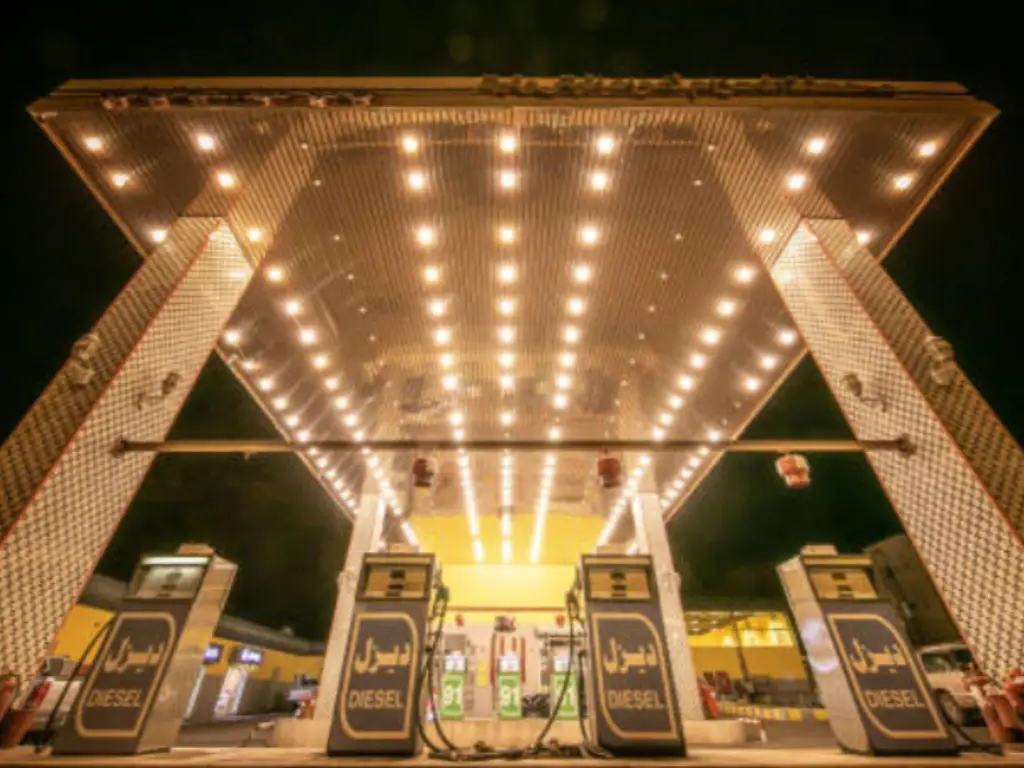
In the high-precision world of B2B lighting engineering, “brightness” is a deceptive metric. A station can be lumen-rich but visually dysfunctional if it fails to respect the biological and mechanical requirements of a high-speed refueling environment. To transition from a simple utility to a “commercial beacon,” the following parameters must be strictly audited and maintained.
- Glare Control (UGR < 19) and Driver Adaptation: High-output LEDs are effectively point-sources of extreme intensity. If left unshielded, they cause “Disability Glare”—a momentary loss of vision that is particularly dangerous for drivers transitioning from dark rural roads. Professional-grade canopy fixtures utilize deep-recessed LED chips and micro-prismatic diffusers to maintain a Unified Glare Rating (UGR) below 19. This ensures light is focused on the ground island, not the driver’s retina, smoothing the visual adaptation process and reducing the risk of onsite collisions.
- The Psychology of Color Temperature (4000K – 5700K): Color temperature (CCT) is a powerful driver of nighttime consumer behavior. While 3000K (warm white) is suitable for hospitality, it creates a sense of lethargy and “low security” in industrial settings. For fuel retail, 5000K “Daylight White” is the global benchmark. It triggers a psychological sense of alertness, cleanliness, and modernity. Data shows that stations utilizing 5000K-5700K lighting see significantly higher nighttime traffic from solo travelers and female drivers who prioritize high-visibility safety.
- Forensic Accuracy and CRI Standards: The Color Rendering Index (CRI) is a critical security parameter often overlooked by amateur buyers. High-quality 80+ CRI lighting ensures that Security Surveillance Systems can accurately distinguish vehicle colors and suspect clothing details. Furthermore, high CRI makes the vibrant colors of fuel branding and convenience store merchandise look more appealing, directly influencing impulse purchases at the storefront.
- IESNA Compliance and Uniformity: Adhering to IESNA RP-33-14 involves more than just hitting a 30 foot-candle (fc) target; it requires a “Uniformity Ratio” of 3:1. A station with “bright spots” and “black holes” is a liability nightmare. Constant, even light levels ensure that the transition between the pump island and the C-store is seamless, reducing the risk of slip-and-fall accidents and improving the overall perceived property value.
Step-by-Step Lighting Layout and Quantity Calculation
Designing a lighting layout for a gas station is a geometric puzzle where precision saves thousands in energy and maintenance. Professional contractors follow a systematic verification process: geometric spacing rules, mathematical estimation via the Lumen Method, and final 3D photometric simulation.
Spacing-to-Mounting Height Ratio for Uniformity
The relationship between the fixture’s mounting height (MH) and the distance between each unit (Spacing) determines the “flatness” of the light field. For standard 14–16 foot canopies, the industry follows the 1.5 to 2.0 S/MH Rule. If your canopy is 16 feet high, the distance between any two fixtures should not exceed 32 feet to maintain a ratio of 2.0. Exceeding this creates “Zebra Striping”—pools of light surrounded by dark bands. To achieve a premium, shadow-free environment, a 1.5 ratio is preferred, ensuring light beams overlap at the 3-foot “task plane” where the pump nozzle is operated.
The Lumen Method: A Practical Calculation Case Study
While software like DIALux provides the final word, the Lumen Method is the essential tool for initial budgeting and quantity verification. It allows the owner to verify the contractor’s “Bill of Materials” using fundamental physics.
Consider a standard 4-pump island canopy measuring 60ft × 40ft (2,400 sq. ft, approx. 223 m²). To achieve a target illumination (E) of 300 Lux (Premium Visibility), we select a high-performance 150W LED canopy light producing 22,500 Lumens (Φ). We apply a Light Loss Factor (LLF) of 0.8 to account for dirt and diode aging, and a Coefficient of Utilization (CU) of 0.7 for the efficiency of the light hitting the target island.
- The Math: (300 Lux × 223 m²) / (22,500 lm × 0.8 × 0.7) = 5.3 units per island area.
- Engineering Decision: For this standard 4-island layout, installing 12 fixtures (arranged in a 3×4 grid) ensures redundant overlapping coverage, perfect uniformity, and absolute visibility for the customer, even if one pump is blocked by a high-profile vehicle.
Extreme Conditions and Compliance: Avoiding Fatal Pitfalls
In the fuel retail industry, electrical failure isn’t just a maintenance issue—it’s a potential catastrophe. High-pressure wash systems, volatile vapors, and municipal ordinances create a complex compliance matrix that standard residential lighting simply cannot navigate.
Hazardous Locations and IIC Class Explosion-Proof Mandates
Safety is strictly governed by NEC Article 514. Gasoline vapors are heavier than air and collect in high-concentration “pockets” around the pump nozzle and vents. Lighting installed within these proximity zones must be certified for Class I, Division 1 or 2 locations. Furthermore, the IIC Class rating is the industry gold standard, certifying that the fixture’s housing can contain an internal explosion of gasoline vapors without igniting the external environment. True explosion-proof lighting features “Flame-path Engineering”—precisely machined joints that cool escaping gases from an internal failure before they can ignite the external atmosphere.
Combating Light Trespass and Municipal Fines
With increasing urban sprawl, many local councils have adopted aggressive “Light Trespass” laws. This prohibits light from “spilling” into neighboring residential windows. To be compliant, your site must achieve a Full Cut-off status. This is audited via the BUG Rating (Backlight, Uplight, Glare). Modern canopy lights must have a U0 (Zero Uplight) rating, ensuring photons hit the asphalt island and not the neighbor’s bedroom. Failure to meet these mandates often results in forced downtime and expensive retrospective shielding projects.
The Business Case: ROI, Energy Savings, and Maintenance
Traditional 400W Metal Halide fixtures represent a massive “energy leak,” consuming over 450W per unit while losing 40% of their brightness within the first year. Beyond high utility bills, the Maintenance Trap—involving $500+ daily Boom Lift rentals and lane closures for simple bulb swaps—corrodes site profitability. Transitioning to a zero-maintenance LED system is no longer an option, but a financial imperative to stabilize operational budgets and achieve a full ROI in under 18 months.
Realizing these savings requires a hardware partner capable of turning technical theory into long-term performance. WOSEN LED bridges this gap by providing industrial-grade hardware that prioritizes both site safety and maximized energy conversion. By integrating 150 lm/W chip technology and high-precision thermal management, our fixtures slash consumption by over 65% while delivering superior illuminance. Engineered for 24/7 high-vibration environments, our solutions carry IP66 protection and IIC Class explosion-proof certifications, ensuring your investment is shielded against extreme weather and hazardous gasoline vapors.
Our competitive edge extends beyond hardware to our extensive OEM and ODM capabilities, allowing us to tailor optical layouts to your specific site footprint for perfect uniformity. Operating under a strict “Quality First” philosophy, every unit is manufactured to meet the world’s most demanding safety mandates, including UL, DLC, and CE certifications. Whether executing a nationwide rollout or retrofitting a single flagship location, our team ensures your infrastructure functions as a robust, high-yielding asset that enhances your commercial presence for over a decade.
Conclusion: Upgrading to a Brighter, Safer, and Profitable Future
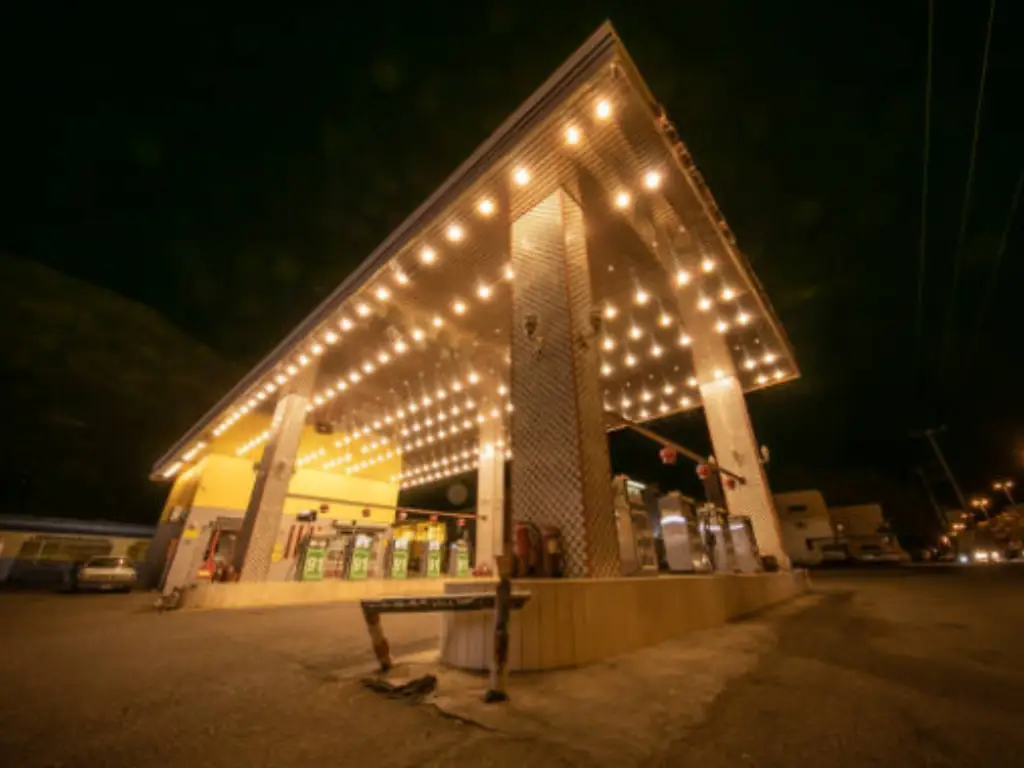
Professional gas station lighting is a synthesis of safety, compliance, and financial strategy. By prioritizing IIC-certified hardware and precise mathematical layouts, you protect your business from liability while creating a welcoming beacon for customers. In 2026, the right light is the ultimate competitive advantage for modern fuel retailers looking to stabilize costs and maximize site traffic.
Ready to Maximize Your ROI and Site Safety?
Stop losing money on inefficient legacy lighting and maintenance traps. Contact our engineering team today for a free 3D DIALux photometric layout and a custom LED retrofit quote tailored to your gas station’s exact footprint.
Get Your Custom Quote & Lighting Layout

 English
  Spanish
  French
  German
  Italian
  Arabic
  Russian
  Portuguese
  Dutch
Dutch  Indonesian
  Turkish
  Polish