
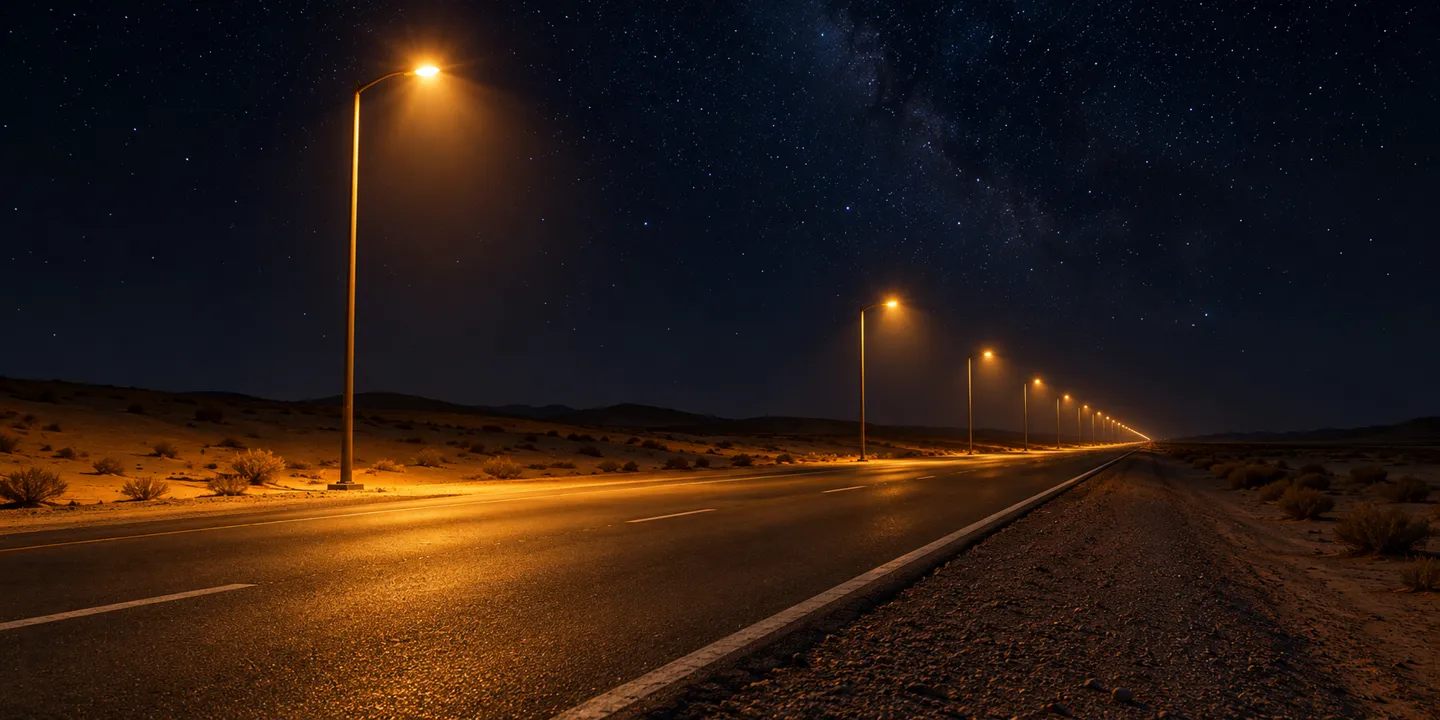
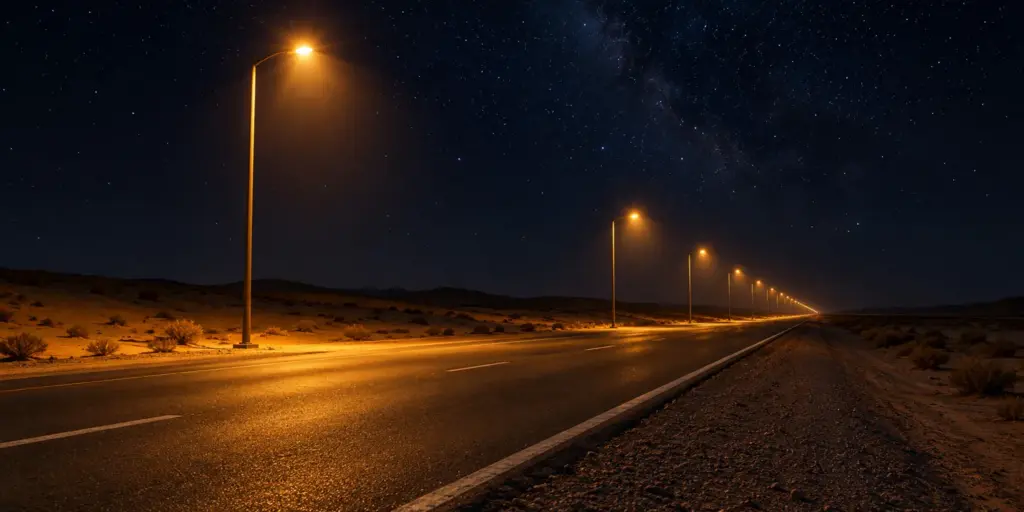
At two in the morning, a desert highway runs on amber light spaced 90 meters apart. A few kilometers away, a city collector road sits under cool white LED arrays wired to a photocell on each pole. Both are street lighting. They share almost nothing else: different lamps, different power routes, different optics, different failure modes.
That gap is why this category confuses buyers. “Types” can mean the lamp inside the head, the way the fixture is fed, or the shape of the beam it throws. Each meaning answers a different question for a different reader. A driver only needs to recognize the light. An installer needs to pick a power route. An EPC bidder needs to defend wattage, poles, and warranty clauses in front of a review board. This guide walks the full ladder: lamp by lamp first, then the power routes, and finally the parameters that belong in a purchase order rather than a wish list.
What “Types of Street Lighting” Actually Covers
One clarification first, because the term gets crossed with a neighbor. The red, green, and yellow signals at an intersection are traffic lights, a different product with a different supply chain. Street lighting here means the luminaires that light the road surface itself.
Past that, the word “types” hides three separate sorting systems, and most confusion comes from mixing them:
- By light source: the lamp technology that makes the light. This is the classic list, from incandescent and mercury vapor through sodium lamps to LED.
- By power route: where the energy comes from. Grid-tied, solar off-grid, and hybrid systems behave differently in ways that decide whether a project survives a rainy season.
- By beam shape and mounting: where the light lands. Distribution types I to V, pole spacing, and mounting style decide how many poles a road needs.
Every street lighting product answers all three questions at once. A fixture is one source, fed one way, throwing one beam pattern. Reading the category as a single flat list of lamps is where most articles stop, and it is exactly where the expensive mistakes start. The rest of this page takes the three layers in order, from the lamp inward to the system.
Street Light Source Types: From Discharge Lamps to LED
The historical arc is short to tell: flame, then filament, then gas discharge, then the LED chip. What matters today is not the full history but the status column, because three of these types are being regulated out of existence while one has taken over new installations.
Street light source types at a glance
| Type | Typical efficacy (lm/W) | Color rendering (CRI) | Typical rated life | Status in 2026 |
|---|---|---|---|---|
| Incandescent and halogen | 10-24 | about 100 | 1,000-4,000 h | retired from road use |
| Fluorescent (incl. CFL) | 35-100 | 60-80 | 10,000-20,000 h | phase-out scheduled |
| Mercury vapor | 25-60 | low | 16,000-24,000 h | phase-out scheduled |
| High pressure sodium (HPS) | 50-150 | about 20-25 | about 24,000 h | still common, fading |
| Low pressure sodium (LPS) | 80-180 | essentially 0 | 14,000-18,000 h | niche (observatory zones, heritage) |
| Metal halide | 65-115 | 65-90 | 15,000-20,000 h | legacy in sports and area lighting |
| LED (white) | 80-220 | 70+ | 50,000-100,000 h | the modern standard |
| Amber LED (PCA/NBA) | 60-150 | low | 50,000 h class | growing eco and dark-sky niche |
Source: published manufacturer comparisons (Enkonn Solar, 2024).
The table explains why the swap happened. A white LED head delivering 100 to 150 lm/W in a real fixture beats every discharge lamp on energy and maintenance at once. Its 50,000 to 100,000 hour rating outlasts them too (Enkonn Solar, 2024). The International Energy Agency now frames LED as the end state of the market, targeting 100% LED share of lighting sales by 2025 (IEA, 2022). For anyone writing a new specification, LED-first is now the baseline that every alternative has to argue against.
Discharge lamps are leaving on a schedule, not a trend. The Minamata Convention on Mercury phases out the manufacture, import, and export of fluorescent lamps for general lighting by 2027. Its exemption register also shows mercury vapor and fluorescent deadlines clustering between 2025 and 2030 by country (Minamata Convention, 2026). For a distributor, that turns “cheap fluorescent stock” into stranded inventory risk. For a project owner, it means mercury vapor heads still burning on older networks will soon have no lamp supply behind them. New tenders should simply exclude them.
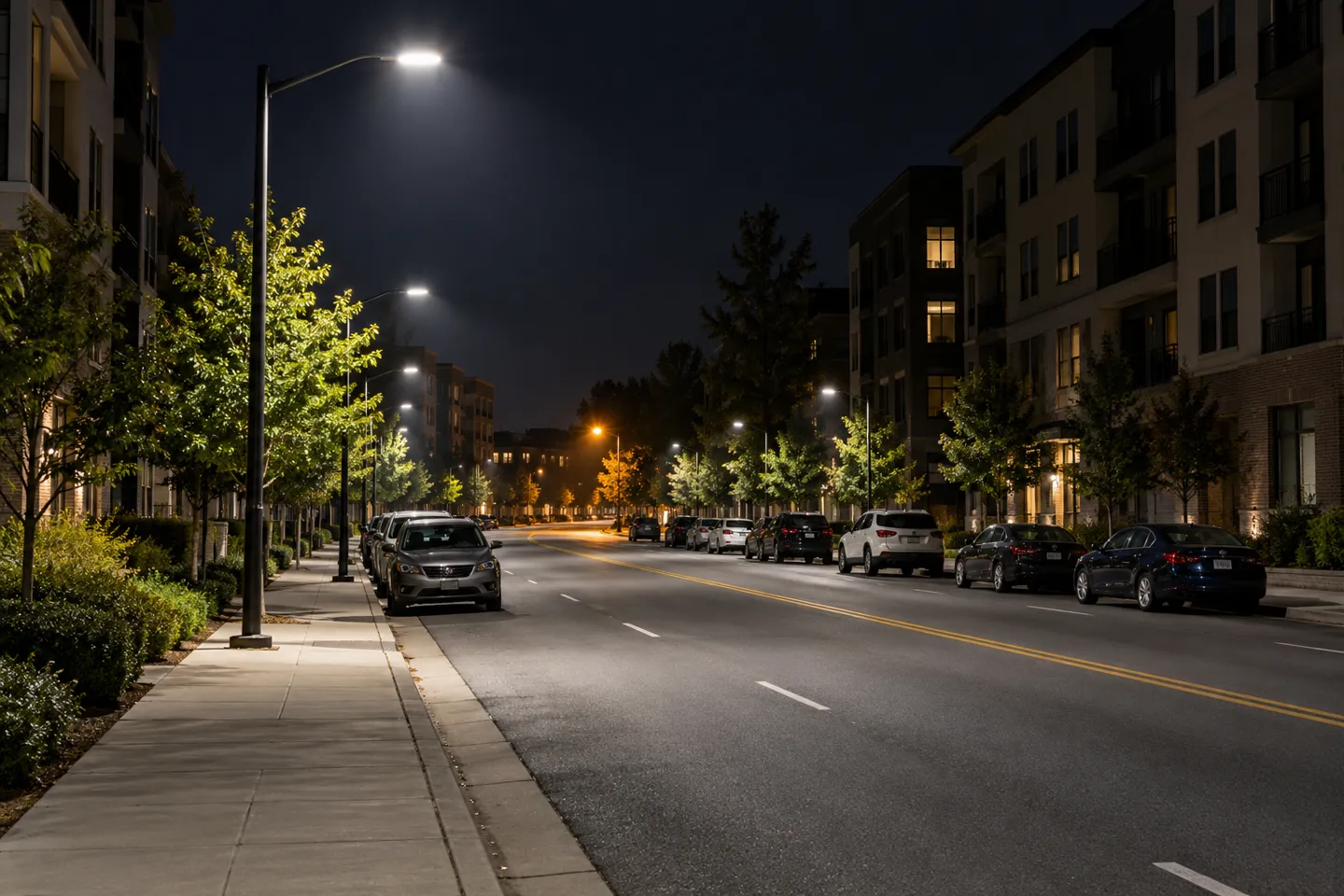
Higher efficacy did not end the argument about light quality. HPS renders color at a CRI of roughly 20 to 25, which is why everything under it looked monochrome amber, while LED heads render at 70 and above. But early LED conversions leaned on cool white 4000 K chips for maximum lumens per watt, and the blue-rich light drew medical and public pushback. The American Medical Association adopted guidance in 2016 urging communities to minimize blue-rich street lighting, advising color temperatures no higher than 3000 K (AMA, 2016). Cities that converted at 3000 K instead of 4000 K saw far less resident resistance. Amber LED variants now serve wildlife zones and dark-sky areas where even warm white is too intrusive. The lesson for a buyer is concrete: lock the CCT into the specification, because it is the parameter most likely to trigger a public fight after installation.
One historical curiosity still causes arguments online: low pressure sodium produces 80 to 180 lm/W, numbers some LED fixtures still cannot match. The catch is that LPS emits a single yellow line, so it renders color at effectively zero. It survives where color does not matter and astronomy does, and nowhere else. Efficacy without color rendering is a boundary case, not a benchmark.
Grid, Solar, or Hybrid: Choosing the Power Route
Every modern street light is an LED head, so the real fork in the market today is the power route. This choice dominates project cost and reliability more than any lamp specification, and each route has clear conditions where it wins and clear conditions where it fails.
Grid-tied LED: the default where the grid reaches
When reliable mains power already runs along the road, wiring LED heads to it is almost always the cheapest route across the full life of the asset. There is no battery to size or replace, dimming and remote control can ride on the same network, and the running cost is predictable. The numbers are blunt. New York State analysis figures put typical collector-road lighting at 6,400 dollars per mile per year for HPS, running 8.5 kW per mile. The same roads on LED at 5.4 kW per mile cost 4,000 dollars (Wikipedia, Street light, 2026, citing NYSERDA). The lamp swap alone trims roughly 37% off the bill. Grid-tied LED loses its edge only when the grid is absent, unreliable, or expensive to reach, which is exactly where the other two routes live.
Solar off-grid: when trenching is the project
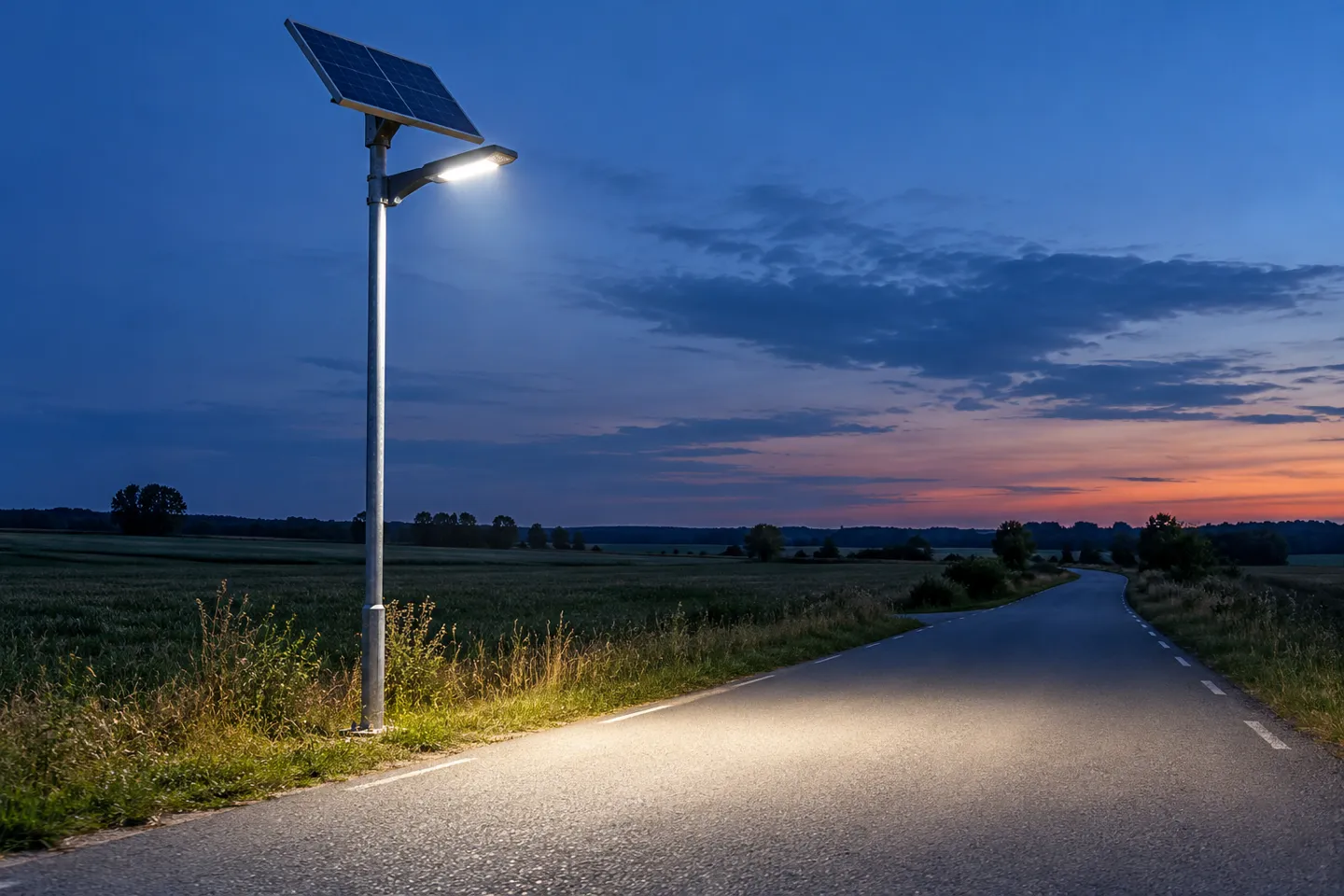
A solar street light is a small power plant on a pole: panel, battery, controller, and LED head sized as one system. It wins where the civil works dominate: long rural runs, new roads with no ducting, historic districts, and sites where extending the grid costs more than the lighting itself. It fails predictably in three conditions: high latitudes with short winter days, monsoon climates where the battery never fully recharges, and cold regions where capacity drops while demand stays fixed. Shading from trees or buildings starves the panel the same way.
The failure pattern behind most dead solar lamps is not the sun. Practitioners who design these systems for a living warn against the biggest-battery instinct. When the panel cannot fully recharge the bank each day, the battery lives at a low state of charge and ages early. Reliability comes from matching three numbers as a system, panel input, LED load and working hours, and autonomy days (Clodesun via LinkedIn, 2026). Ask a supplier for that math, the daily watt-hours in and out and the autonomy design in nights, before asking for a price per unit.
Hybrid: grid backup where outages are routine
Hybrid systems pair a solar array with a mains connection and switch to grid power when the battery runs low. They cost more up front than either pure route. They earn it on roads through regions where blackouts are weekly events. The light stays on through the outage, and the grid keeps the battery healthy through the cloudy stretch. Where a grid point exists but cannot be trusted, hybrid is the only route that removes both failure modes at once.
Route decision rule
Never size solar by battery capacity alone; size it by daily energy balance.
The direction of travel is easy to read. LED keeps taking the grid-tied market as the IEA target approaches, while solar and hybrid keep taking the roads that were never going to be wired profitably. For a supplier or a buyer, the practical consequence is the same: treat the power route as the first specification line, not an afterthought under the lamp datasheet.
Send us your road length, grid status, and site insolation, and WOSEN’s engineers will return the route choice with the sizing math that backs it.
Request Route SizingSpecifying the Light: Distribution Types and Verifiable Parameters
Route chosen, the next money decision is optical: where the light lands. Two roads with identical LED heads can need completely different pole counts because of one line in the datasheet.
Distribution types I to V
Lateral distribution types describe the footprint of the beam, matched to road width. Vertical distribution, written as short, medium, or long throw, matches the beam to pole spacing and mounting height. These codes come from the IES classification and map directly onto EN 13201 and ANSI/IES RP-8 design practice in their respective markets.
Type I
Paths and one-to-two-lane roads
Type II
About two lanes plus a sidewalk
Type III
Three or more lanes
Type IV
Wide in one direction: perimeter and area lighting
Type V
Round spread for large open areas
The economics are not subtle, and one published simulation puts a number on it. For the same pedestrian crossing, a conventional symmetric pattern needed a 30 W luminaire to meet the standard. An asymmetric Type II pattern met it with 20 W, a third less power for identical compliance (ZGSM, 2025).
Same crossing, two patterns
30 W
conventional symmetric
20 W
asymmetric Type II
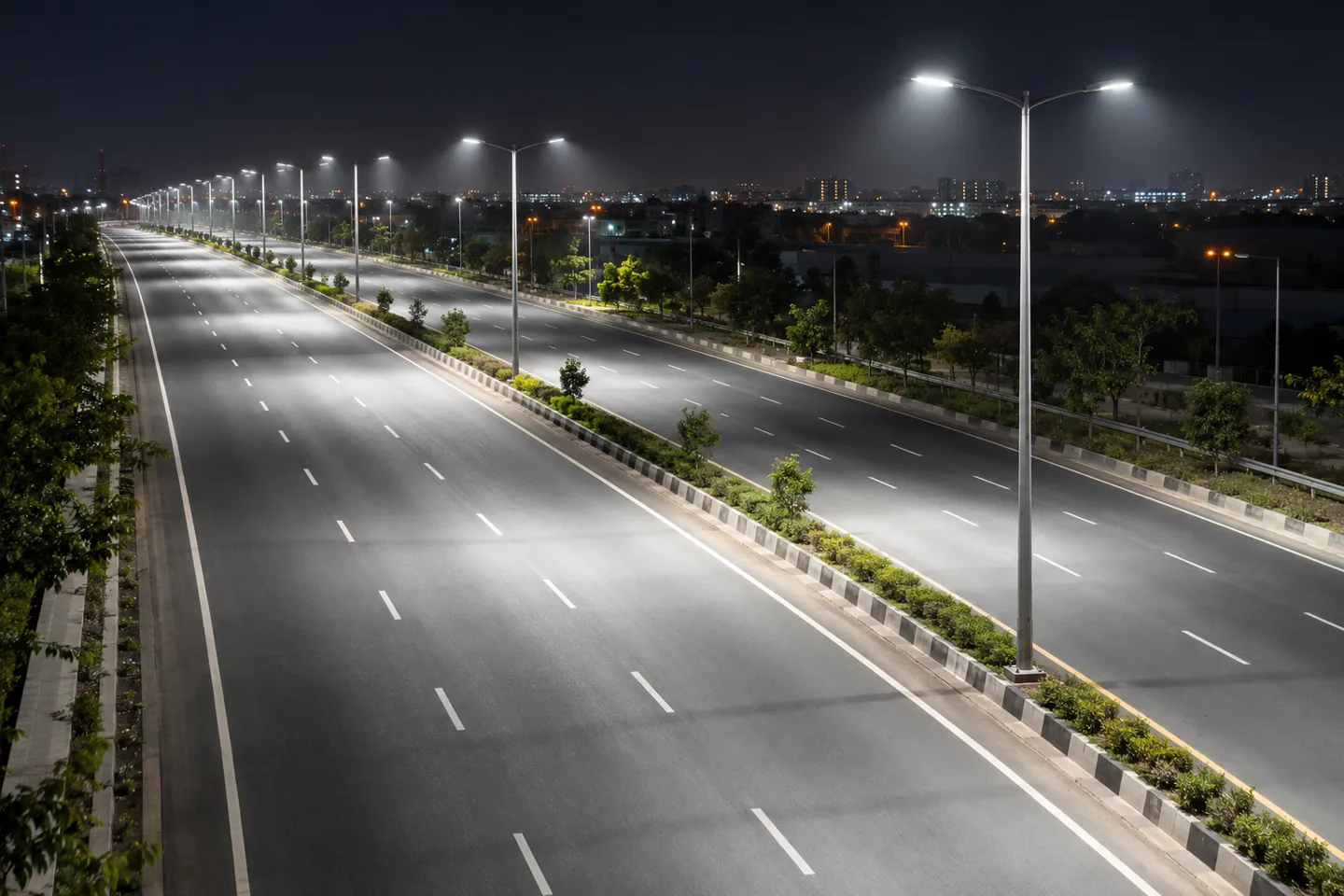
The same lever scales to whole networks. When the Flanders region retrofitted with wide-angle optics, it doubled pole spacing from 45 m to 90 m. Annual electricity spending on the 2,150 km retrofitted network fell to about 9 million euros (Wikipedia, Street light, 2026). Fewer poles means fewer foundations, fewer cables, and fewer maintenance visits for the next twenty years. Distribution type is the difference between a road that needs one lighting budget and a road that needs two.
Matching the pattern to the project
Route and road width together point at one pattern, and the matrix below makes the pairing explicit. The rightmost column is the part most specifications forget: the document to collect while the supplier still wants the order.
Selection matrix: project scenario to verification actions
| Project scenario | Recommended route | Distribution type | Boundary to watch | Verify before signing |
|---|---|---|---|---|
| Residential street, grid available | grid-tied LED | Type I-II, short-medium throw | glare into bedroom windows | CCT locked at 3000 K or below, photometric file matches pole layout |
| Urban collector or arterial | grid-tied LED with dimming | Type II-III, medium throw | wrong type inflates pole count | IES/LDT files, EN 13201 or RP-8 compliance statement |
| Highway or high-mast section | grid-tied LED | Type III-V long throw from high mounting | maintenance access at height | structural load rating, surge protection class |
| Rural road, no grid within reach | solar off-grid | Type I-II, autonomy prioritized | rainy season autonomy, panel shading | PV and battery sizing math, autonomy in nights, low-temp battery spec |
| Parking area or compound perimeter | solar or grid | Type IV-V | spill light onto neighbors | cutoff rating, IP/IK reports, warranty scope |
The parameter checklist that belongs in the order
Standards themselves are a boundary. EN 13201 governs European design, ANSI/IES RP-8 governs North American practice, and CIE 115 frames the underlying recommendations. A tender should cite the standard of its own market rather than mixing references. Beyond that, put the checklist in this order and make each line a document, not a promise:
- Efficacy and light quality: lumens per watt at the luminaire level, CCT in kelvin, CRI minimum.
- Protection: IP65 or IP66 against dust and water, an IK rating against impact for public poles, and an operating temperature range that covers the site.
- Electrical fit: the voltage version in writing, because 110 V and 220-240 V markets are not interchangeable, plus surge protection for unstable grids.
- Compliance: CE and RoHS as the floor, then the target market’s certificates, UL or ETL, SAA, ENEC or TUV, confirmed per shipment rather than assumed from a brochure.
- Guarantees: warranty in years and in scope, and for solar systems the autonomy design, not just the battery capacity figure.
- Proof files: photometric files in IES or LDT format so a designer can simulate the road before the first pole is ordered.
Controls belong on the same list. A photocell or astro timer is standard, but networked dimming cuts further energy and can add remote fault detection. Note the standby rule too: connected-luminaire standby power is now regulated, with EU rules holding it under 0.5 W (Wikipedia, Street light, 2026). Mounting and structure close out the map. Pole-top arms cover most roads, catenary suspension spans wide intersections without mid-road poles, and high masts serve interchanges. Area flood luminaires are the neighboring category when the job is a yard rather than a road.
How Street Lighting Fails in the Field
Field failures follow four repeatable patterns, and each has a document that catches it before shipment.
The first is the solar system that dies in the rainy season. The lamps work in month one, then grow dimmer each overcast week until they stop. The cause is almost always energy imbalance: a panel and battery pair that was never sized for the site’s worst month. The battery cycles at a low state of charge until its capacity collapses. The check that catches it is the supplier’s own math: daily energy in versus out, autonomy in nights, and battery performance at the site’s lowest temperature.
The second is the color backlash. A city converts at 4000 K for maximum photometric efficiency, and within months the complaints start: harsh light, sleep disruption, a night sky that no longer looks like night. The American Medical Association’s 3000 K guidance exists precisely because enough conversions went through this cycle (AMA, 2016). A CCT line in the contract costs nothing on order day and a retrofit program six months later.
The third is water and driver failure. Sealing gaskets, drain design, and driver grade decide whether a head survives its third monsoon, and these are invisible from a product photo. IP and IK test reports, the driver brand or grade in writing, and surge protection rated for the local grid are the paperwork equivalents of opening the fixture yourself.
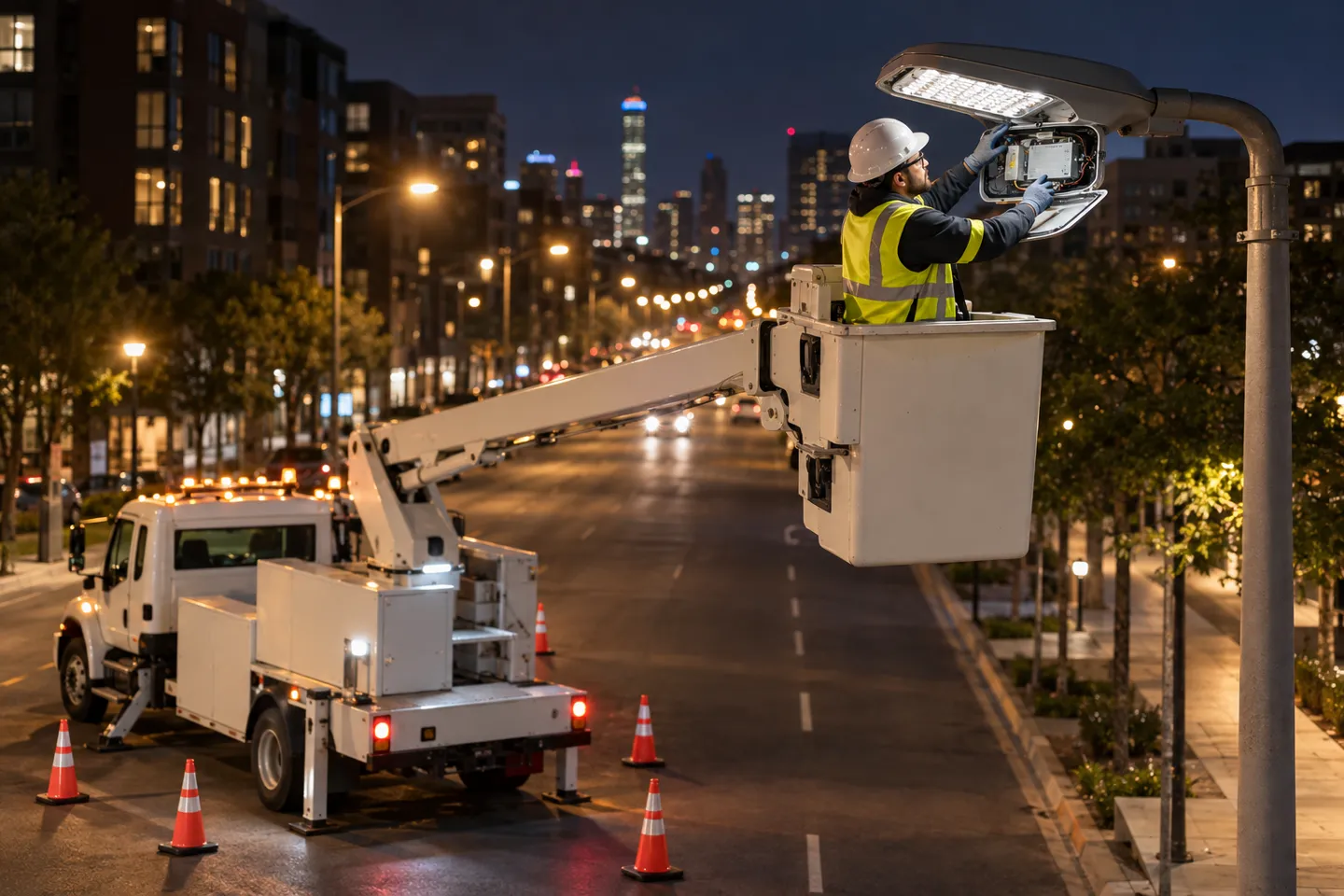
The fourth is the quietest: the lamp type that will have no spares. A network extended with mercury vapor or fluorescent heads today inherits a supply line the Minamata Convention is closing on a published schedule (Minamata Convention, 2026). The verification is a two-minute document check before the order.
Pre-shipment checklist
- Solar energy balance sheet with autonomy nights
- CCT written into the contract
- IP/IK test reports
- Driver grade and surge rating in writing
- Lamp type checked against phase-out lists
- Photometric files for the actual pole layout
What This Means for Tenders, Stock, and Product Lines
Read back through the previous sections and the commercial picture sorts itself into three moves.
For a tender, the specification should open with the route, the road geometry, and the distribution type, then attach the parameter checklist above as acceptance criteria. A document that opens with a model number instead has outsourced its engineering to whoever wrote the catalog. The 30 W versus 20 W crossing shows what that omission costs per pole, and the bill multiplies across every pole.
For stock planning, the two branches of the market deserve separate logic. Grid-tied LED in standard CCT and efficacy grades is the volume line, turning steadily as cities convert. Solar and hybrid stock is project stock, and it should be binned by the insolation and grid reliability of the destination market. A unit tuned for Sahel sun is mis-stocked for a monsoon coast. The difference is not the lamp; it is the panel and battery balance.
For supplier evaluation, the warranty line is the fastest read on production discipline. Warranty years track real differences inside the lamp: component grades, sealing process, and separate production standards. That is why a supplier can hold both budget lines and 5-year-class lines at once, and why the two should not be priced against each other. Ask what changes inside a lamp when the warranty doubles. A factory with an answer and test reports behind it is a different supplier from one with only a longer number.
For the tender
Route first, then distribution, then parameters as acceptance criteria
For the stock plan
Volume grid LED separate from project solar, binned by destination market climate
For the supplier check
Ask what the warranty tier changes inside the lamp; expect documents, not adjectives
Every layer of this category rewards the same habit: decide by system, verify by document. The lamp list is now the easy part; the route, the beam, and the paperwork behind the warranty are where projects and margins are actually won.
If you are mapping these types onto a procurement shortlist, WOSEN’s solar street light series cover the off-grid branch, with all six series listing a 5-year warranty.
Street Light Specifications You Can Defend
Send your road geometry, target standard, and power conditions; WOSEN returns route sizing, distribution picks, IES or LDT photometric files, and written warranty terms for your tender file.
Start a Spec ReviewReferences
- Minamata Convention on Mercury. “Exemptions: Approved Exemptions Pursuant to Article 6.” 2026. https://minamataconvention.org/en/parties/exemptions
- American Medical Association. “AMA Adopts Guidance to Reduce Harm from High Intensity Street Lights.” 2016. https://www.ama-assn.org/press-center/ama-press-releases/ama-adopts-guidance-reduce-harm-high-intensity-street-lights
- International Energy Agency. “Targeting 100% LED Lighting Sales by 2025.” 2022. https://www.iea.org/reports/targeting-100-led-lighting-sales-by-2025
- Wikipedia. “Street Light.” 2026. https://en.wikipedia.org/wiki/Street_light

 English
 Spanish
 French
 German
 Italian
 Arabic
 Russian
 Portuguese
 Dutch
 Indonesian
 Turkish
 Polish