
What Counts as High Bay: The Height Line That Keeps Moving
A warehouse aisle twelve feet wide. Racking stacked to twenty-eight feet. A ceiling that runs thirty feet at the ridge and drops to twenty-two over the loading docks. One building, three lighting problems. All of them land in the same fixture category: high bay.
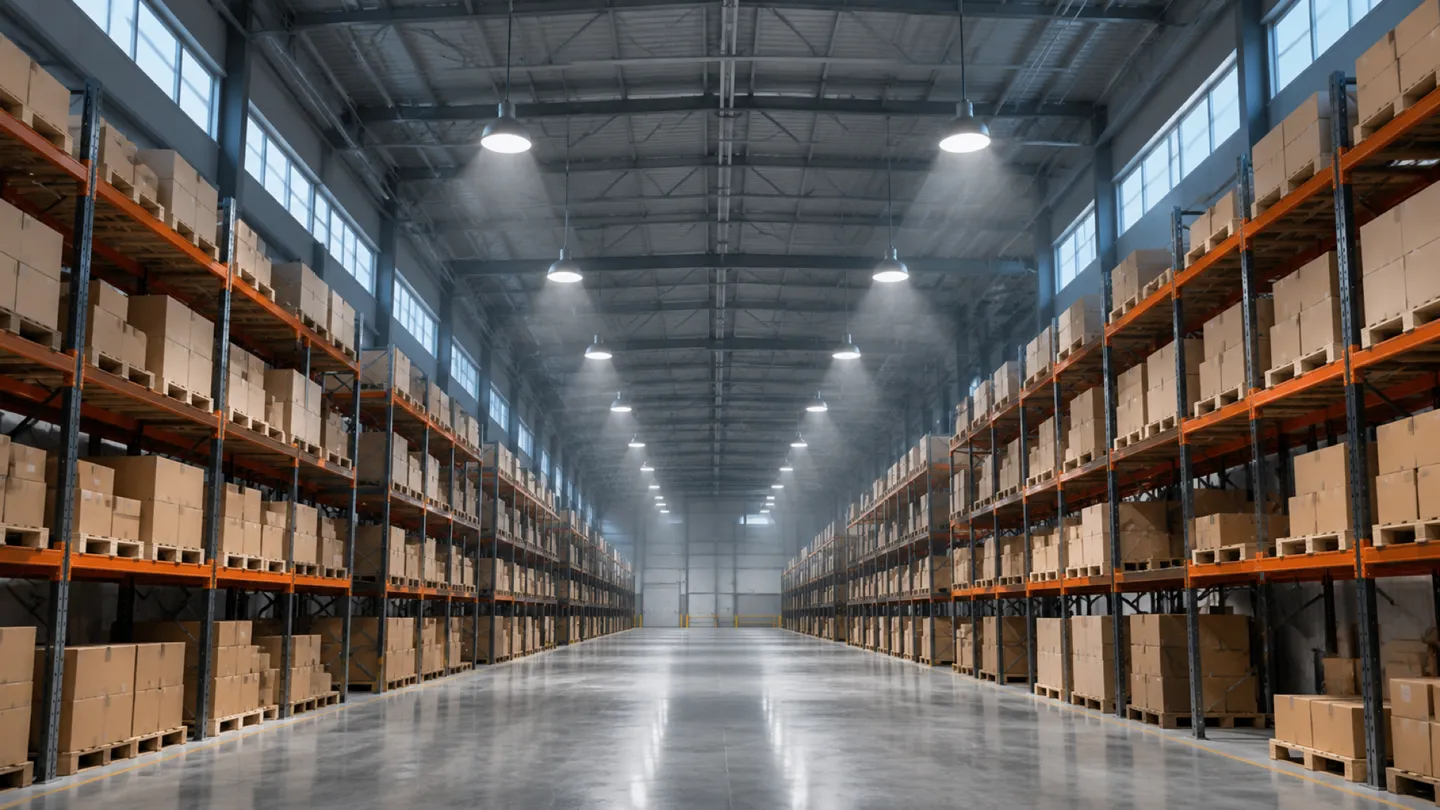
High bay fixtures exist because light behaves differently when it has to travel twenty feet or more before it lands. A beam that spreads comfortably at eight feet arrives at thirty feet as a dim wash. So high bays pack more lumens into a controlled beam, hang from chains, pendants, or hooks, and trade spread for reach. Low bay fixtures do the opposite job under the shorter ceilings.
Here is the part that confuses buyers: the trade disagrees about where “high bay” starts. One commercial lighting guide places high bay applications anywhere from 10 to over 25 feet, with some fixtures mounting above 30 (e-conolight). Another draws the line at 20 feet flat (Industrial Commercial Lighting, 2025). Both are serious trade publishers. Neither is wrong.
The line moves because the ceiling number is not really the input. The inputs are beam angle, mounting height, and the illuminance your task plane needs, which is what the IES standards library exists to specify (IES). A tight beam at 25 feet can land less usable light on the floor than a wider beam at 18, depending on what the task requires. Convert as needed: one footcandle equals about 10.76 lux (Industrial Commercial Lighting, 2025).
The working test, not a magic number
If the light has to throw roughly 20 feet or more and still deliver target illuminance at the floor or task plane, you are in high bay territory. Trade guides quote starting lines from 10-15 feet up to 20-25 feet and beyond. Low bay covers the shorter ceilings with wider beams.
Treat height as the entry condition, not the decision. Once you know this is high bay territory, the real choice begins: which body, which beam, and why. That is where the type names come from.
The Types: LED Forms and the Legacy Fixtures They Replaced
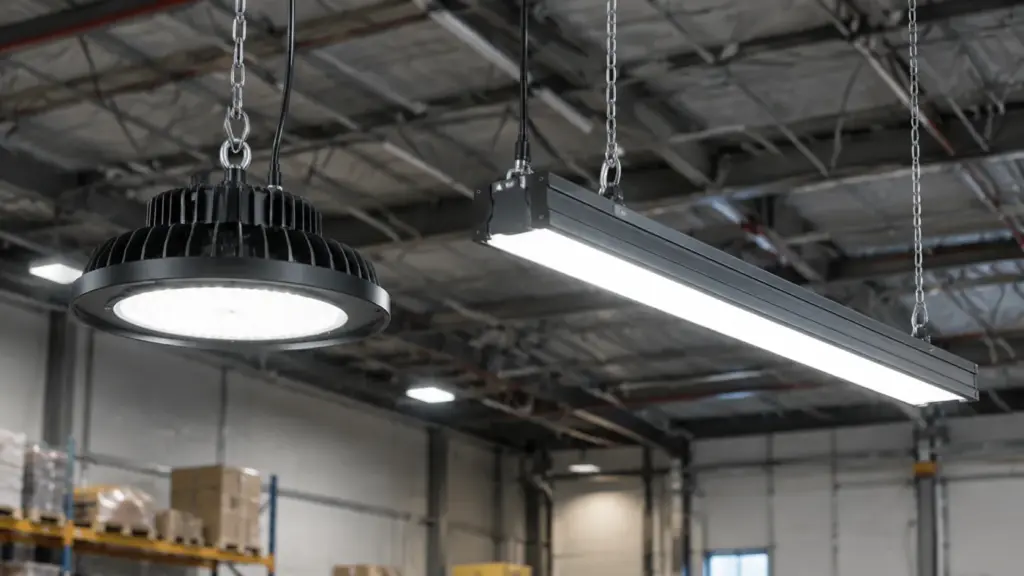
The market sorts high bays by body shape first. The three families are the round UFO form, the linear form, and a specialty tier covering low-profile, modular, and connected builds (SeekingLED, 2026). It sorts by light source second. LED stands against the legacy high-intensity discharge family: metal halide, high-pressure sodium, plus the fluorescent and induction units that held these ceilings for decades (LiteLume, 2021).
The shape differences are mechanical, not cosmetic. A UFO high bay stacks the driver over a round finned heatsink, with a reflector or lens setting the beam. Beams run most commonly 60/90/120 degrees, and most products land between 100 and 240 watts. The concentric output suits open floors. A linear high bay stretches the same electronics into an elongated body built for rectangular coverage, which is why aisle optics live on this form. The specialty tier solves problems the first two shapes cannot. It covers low-profile bodies for ceilings under roughly 18 feet, plus modular and waterproof builds for harsh or washdown zones. Emergency battery variants and networked fixtures that report failures and dim on schedules round it out.
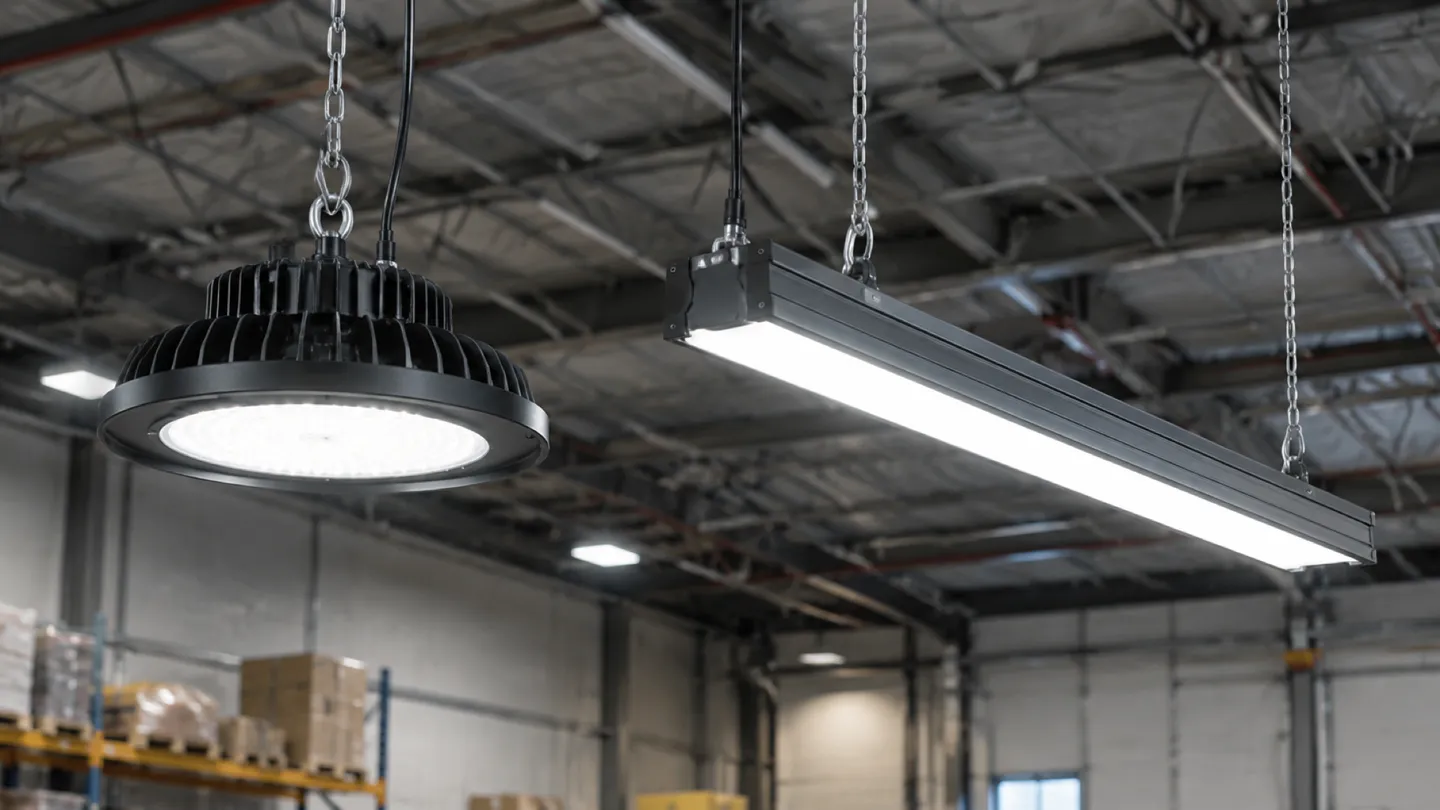
The legacy sources explain why the LED forms look the way they do. A metal halide high bay is an arc tube and a ballast: slow to warm up, losing output every year of service, and dumping much of its wattage as heat. High-pressure sodium adds an orange cast that distorts color in warehouses. Fluorescent and induction units handled the lower end. LEDs replaced them on the numbers. Commercial LED products commonly deliver 100-150 lumens per watt, well above metal halide’s effective output after ballast and fixture losses (e-conolight, 2026). Department of Energy roadmaps put LED efficacy on a path toward 250 lumens per watt (DOE, 2022).
High bay types at a glance
| Type | Structure | Light distribution | Typical homes |
|---|---|---|---|
| UFO (round) | Driver over finned round heatsink, reflector or lens | Concentric, 60/90/120 degrees | Open floors, gyms, big-box back rooms |
| Linear | Elongated body, aisle optics | Rectangular pattern matched to aisle width | Racking aisles, retail floors, low-bay retrofits |
| Specialty (low-profile, modular, emergency, networked) | Flat or segmented bodies, battery or control add-ons | Tuned per variant | Mezzanines, washdown and cold zones, managed facilities |
| Legacy: metal halide, HPS, fluorescent, induction | Arc tube or gas discharge plus ballast | Broad, aging, often yellow or slow to warm | Older plants awaiting upgrade |
One caveat belongs here: legacy is not dead. Lamp-for-lamp retrofit bulbs keep thousands of older high bays alive, and existing circuits and ballasts shape what a retrofit can accept. That constraint returns in the spec section, because it decides what you can install without rewiring.
Matching the Type to the Space
“UFO for open areas, linear for aisles” is the industry’s favorite shortcut, and it is true as far as it goes. It stops being enough the moment you stand inside a real building, because most real buildings are not one space. They are an open staging floor, a block of high racking, a low pick module, and a row of docks, all under one roof. The buyers who stay confused are the ones trying to make a single type cover all four zones.
Open Floors: The UFO’s Home Turf and Its Exceptions
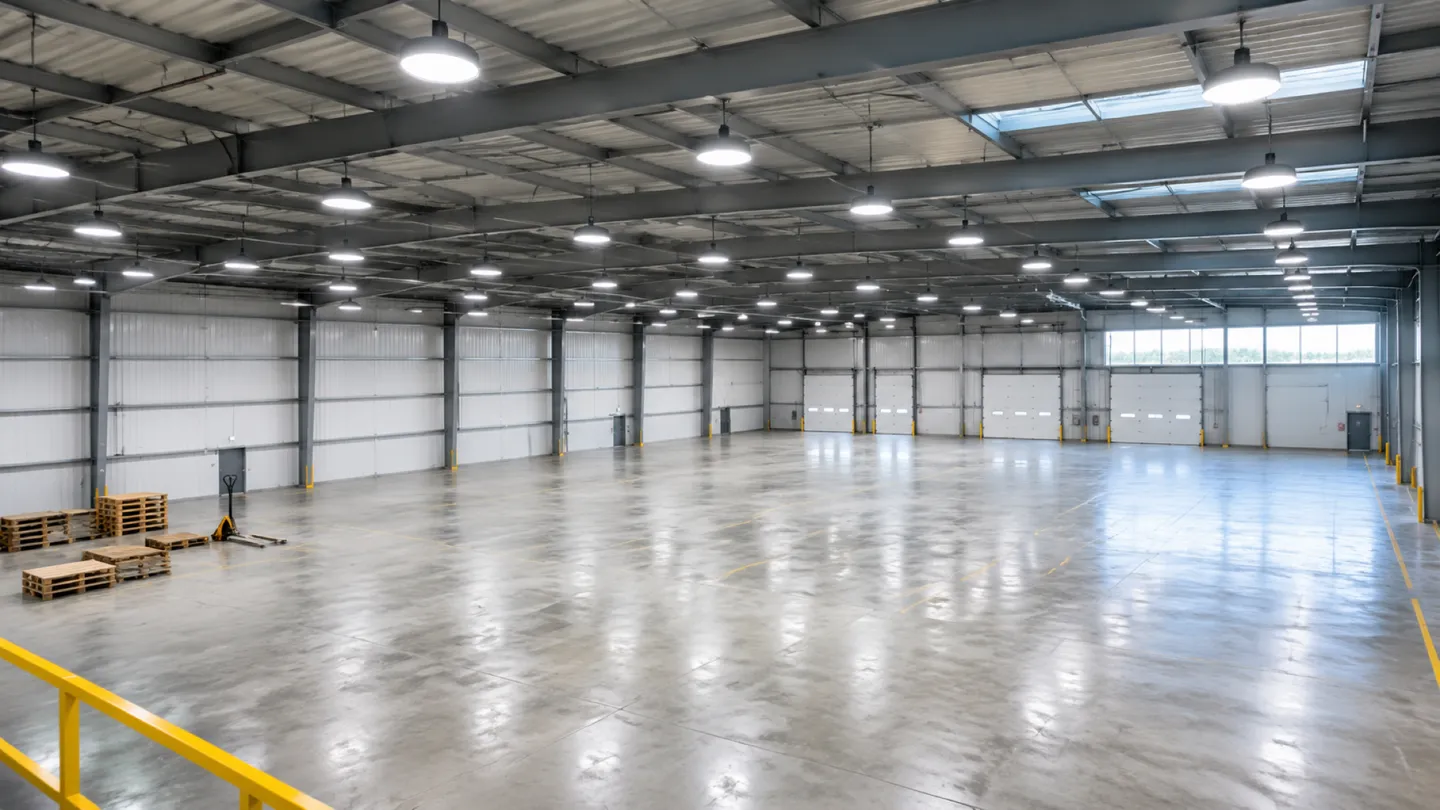
Over open floor, the UFO’s concentric beam and spacing math do exactly what the shape promises. Fixtures at 30 feet with 90 degree beams space themselves differently than the same watts with 120 degree beams. Uniformity comes from that spacing, not from the round body itself. The exceptions matter more than the rule. Watch glare-sensitive corners, office partitions, and any ceiling under about 15 feet. A wide-beam UFO mounted low turns into a glare source pointed at everyone’s sightline. Low ceilings want the low-profile tier, not a downsized UFO.
Aisle Racks: Where Linear Fixtures Earn Their Keep
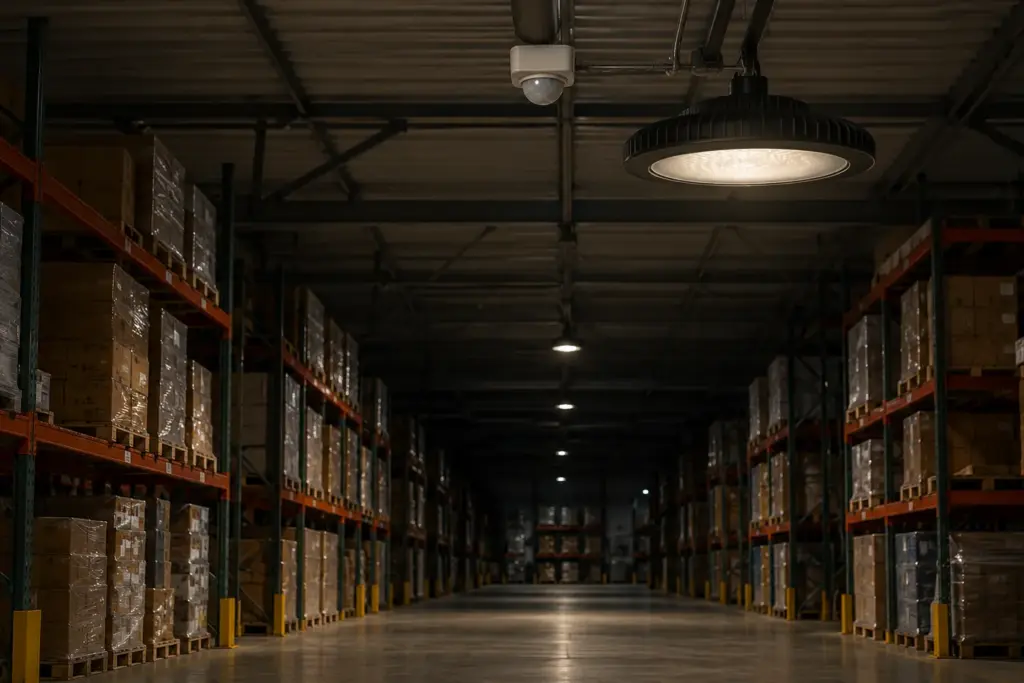
An aisle is a corridor, and the surfaces that matter are vertical: rack faces, labels, and the forklift driver’s path. Linear fixtures with aisle optics throw a rectangular pattern matched to the aisle width, which lights the rack face instead of the rack top. Swap in round wide-beam fixtures and you get the classic failure: bright aisle ceilings, readable tops, dim labels. Match the optic to the corridor: a 12-foot aisle pairs with a beam designed for roughly that width, and narrower pick aisles need narrower optics and closer spacing.

Mixed Layouts and the Low-Ceiling Trap
Most plants end up zoned: UFO over open staging, linear over the racking, low-profile under ducts and mezzanines, sealed builds at the docks. Mixing types by zone is not indecision, it is the correct answer, provided the transitions are managed so no zone hands the next one a glare step. The failure case runs in both directions. One type everywhere leaves dark spots or glare pockets. The reverse error shows up outside warehouses entirely. High bays mounted in residential garages and low shops deliver their designed punch at a distance the room does not have. The fixture is not defective; the mounting height never gave the beam room to work.
Boundary matrix: zone, fixture, and failure modes
| Zone | Fixture type that fits | Key specs to check | What failure looks like |
|---|---|---|---|
| Open floor over 20 ft | UFO, 90-120 degree optics | Spacing per beam angle, hang height | Tight beams at wide spacing: hotspots with dark mid-spans |
| Aisle racking | Linear with aisle optics | Beam matched to aisle width, vertical illuminance on rack faces | Round wide beams light rack tops, labels stay dim |
| Mixed zones | Zone-by-zone mix | Glare management at transitions | One type everywhere: glare pockets or coverage gaps |
| Ceilings under 15 ft, mezzanines | Low-profile specialty | Wide beam, moderated output | High bay mounted low: harsh glare and over-lighting |
| Docks, dust, cold rooms | IP65/IP66 sealed builds | Sealed drivers, impact rating, low-temp rating | Indoor-grade builds: condensation, driver failures, early deaths |
Read the matrix by row: find the zone you actually have, then check the failure column before anyone quotes a fixture. Docks and cold rooms deserve a second look. Moisture, dust, and low temperatures disqualify indoor-grade builds quickly. Mining installations push every one of these demands to the extreme (a mining high bay installation in the DRC).
Reading the Spec Sheet Without Getting Burned
Put two high bay spec sheets side by side and the fastest way to get burned is comparing wattages. Watts measure what a fixture draws, not what it delivers. A 150-watt fixture at 150 lumens per watt produces 22,500 lumens; a 150-watt fixture at 100 lumens per watt produces 15,000. Same wattage, half again the light. Compare lumens and efficacy instead. The LED efficacy band runs roughly 100-150 lumens per watt, with premium builds higher, and the DOE roadmap is still pushing it upward (DOE, 2022).
Comparing quotes right now? WOSEN answers with lumens, efficacy, and photometric files per SKU, not wattage alone.
Ask WOSEN for a QuoteIngress and impact ratings come next, and both get misread. IP65 and IP66 are both dust-tight; they differ in water jet severity, which matters at washdown docks and less in dry storage. IK ratings cover impact, and a fixture at 30 feet is above most forklift traffic but not above it all. For cold storage and unheated docks, check the operating temperature range and ask how the build handles condensation. An IP rating stops water that arrives from outside, not water that condenses inside.
Drivers and controls carry the rest of the sheet. Dimming is usually 0-10V; sensor-ready fixtures accept occupancy and daylight sensors without rewiring. On retrofit circuits, remember the legacy problem. An LED high bay cannot simply hang where a metal halide unit hung if the old ballast circuit is still in series. And circuit loading math changes when a 400-watt HID becomes a 150-watt LED with a different inrush profile. Total harmonic distortion and power factor belong on your acceptance list next to lumens.
Spec sheet checks before you compare prices
- Lumens and lm/W, not watts alone
- IP and IK ratings matched to the zone, not the catalog default
- Operating temperature range for cold or unheated spaces
- Driver spec: brand tier, THD, power factor, dimming protocol
- CCT and CRI against the task (color judgment tasks need CRI above the baseline)
- Photometric files (IES/LDT) available per SKU, not per family
- Warranty term stated in writing, with the reaction it triggers
Sourcing: Certifications, Warranty Tiers, and the Acceptance Checklist
Buying one fixture is a product decision. Buying a program of them is a supplier decision, and the order of questions matters: market first, warranty second, unit last.
Start With the Market: Certification Lines
The destination market picks the certificates before any model discussion. North America wants UL or ETL safety marks plus a DLC listing. The DLC listing is commercial infrastructure, not a badge: its Qualified Products Lists are required by nearly 700 utility and energy efficiency programs before a product can earn rebates (DLC). A fixture without the listing quietly locks its buyer out of that money. Europe runs on CE with EMC and RoHS; Australia and New Zealand want SAA. Certification is the entry gate, so it is the first question to any supplier, not the last.
Warranty Tiers Are Production Lines
Ask a factory what stands behind a 5-year warranty. The honest answer involves the bill of materials: branded drivers instead of budget ones, higher-grade LED bins, aluminum PCBs graded by copper content and thickness. A 2-year and a 5-year warranty can come off two different production lines in the same plant, which is exactly why you ask the question instead of reading the brochure.
Ask it exactly this way
Which driver brand ships on the 5-year build, and is that line run separately from the standard line?
A supplier who cannot answer is selling a sticker, not a term.
The same verification logic extends to failure handling. Ask what happens when a batch fails. Do samples come back for root-cause analysis? Does the supplier investigate local grid and voltage conditions? How does re-shipment after repair work? A supplier with a named process will describe it in one sentence; one without will describe goodwill.
The Acceptance Checklist
Before any purchase order, put the whole list on the table. The difference between a 12-hour and a 12-day answer is the difference between a project that holds its schedule and one that does not.
What to verify, in writing
What This Category Means for Your Line
For the brand owner or distributor assembling a high bay program rather than buying fixtures, the category reads differently. The type taxonomy itself is settled: every guide lists the same shapes and every catalog carries the same list. What is scarce is the matching discipline above and the habit of verifying what you buy. That scarcity is where a product line earns structure rather than price alone.
The UFO form is the volume SKU, and it will be judged on price because every catalog carries one. Differentiate it by certification line rather than by another photograph of the same round body. A DLC-listed, UL-marked build reaches the North American rebate channel that unlisted fixtures cannot. The linear and specialty forms carry margin, because aisle optics, emergency variants, and low-profile builds solve problems a catalog price cannot express. The verification checklist stops being procurement hygiene and becomes the product: it is what you can promise a project channel that a reseller of catalog goods cannot.
That is how our own line is built. WOSEN runs six high bay series across UFO and flat linear formats. The program behind them is what turns a catalog into a product line. Private molds come under three ownership models: client-owned, joint with regional exclusivity, or supplier-invested for anchor market partners. And optics are customizable from 15 to 120 degrees. That means a linear SKU can be tuned to the aisle widths your market actually sells (our customization program). The range spans cost-effective to high-output builds, all rated for 50,000-plus hours with IP65 sealing. Extended warranty options run in the 5-7 year band (the LED high bay range).
One boundary on all of this: the volume-plus-margin structure assumes you operate a channel or project pipeline. A pure reseller flipping catalog units should weight verification cost differently and let the certification line do the sorting. And in every case the order holds: certification line first, models second, because market entry cannot be retrofitted.
Whichever side of the purchase you sit on, the next step is the same. Walk the building zone by zone and write down the ceiling heights and aisle widths. Hand that sheet to whoever quotes next. A layout drawn from real dimensions will settle more arguments than any type chart.
Turn Your Zone Sheet into a Fixture List
Send WOSEN your ceiling heights, aisle widths, and destination market. You get back the certification line, optic options, and a quote for your channel.
Request a High Bay QuoteReferences
- DesignLights Consortium. “DesignLights Consortium Quick Facts.” n.d.https://designlights.org/fact-sheet/
- Illuminating Engineering Society. “Standards.” n.d.https://ies.org/standards/
- U.S. Department of Energy. “Solid-State Lighting R&D Opportunities.” 2022.https://www.energy.gov/sites/default/files/2022-02/2022-ssl-rd-opportunities.pdf

 English
 Spanish
 French
 German
 Italian
 Arabic
 Russian
 Portuguese
 Dutch
 Indonesian
 Turkish
 Polish