
In the push to upgrade aging municipal and commercial lighting, procurement teams are often presented with a false binary: buy cheap replacement bulbs or overspend on entirely new fixtures. Stripping away the superficial marketing noise, the real business logic of LED retrofits lies in the 15-year Total Cost of Ownership (TCO) and rigorous thermal management. This guide applies an engineering audit perspective to street light replacement. By dissecting the failure points of fan-cooled corn bulbs, the thermal constraints of legacy reflector housings, and the critical differences between generic and branded drivers, we provide an industry whistleblower’s framework. It is designed to help you bypass disposable quick-fixes and make bulletproof, data-driven sourcing decisions.
Types of Street Light Bulbs Being Replaced Today
If you are responsible for street lights that were installed more than a decade ago, you are almost certainly dealing with legacy technology — not LED. Knowing what is already in the fixtures shapes every decision that follows.
| Technology | Typical Wattage | Light Color | Current Status |
|---|---|---|---|
| High-Pressure Sodium (HPS) | 70W–1000W | Yellow-orange | Most common globally — 60%+ of street light inventory |
| Metal Halide (MH) | 100W–400W | White | City centers, sports areas, parking lots |
| Mercury Vapor (MV) | 100W–1000W | Blue-white | Largely phased out; remaining units approaching end-of-life |
Whichever type you are dealing with, the replacement path points to LED. But the method you choose — a simple bulb swap, an internal retrofit, or a full fixture replacement determines not just the upfront cost but the lighting quality, energy savings, and maintenance burden for the next decade. That is where the real decision lies.
LED Replacement Options: From Drop-In Bulbs to Full Fixtures
You have three ways to convert a street light to LED. The single question that separates them: how much of the existing fixture are you keeping?
Each method trades upfront savings against long-term performance. The right call depends on the condition of your existing housings and how long you plan to own the lights after the upgrade.
Drop-In LED Corn Bulbs: The Quickest, Cheapest Path
LED corn bulbs — named for their rows of LED chips arranged like kernels on a cob — are the simplest upgrade path. They screw directly into the existing E39 mogul socket, the standard base found in HPS and MH street light fixtures.
Installation is straightforward: bypass the old ballast, connect line voltage directly to the socket, and screw in the LED corn bulb. Most corn bulbs use Type B (ballast-bypass) wiring. One critical check before ordering: measure the inside of your fixture housing. Corn bulbs are physically larger than the HPS lamps they replace, and a bulb that does not fit with the cover closed is a wasted purchase.
Corn bulbs are the right call when the existing fixture housing is structurally sound, the budget is tight, and the project is smaller scale — a parking lot or a single commercial property. Expect 100–120 lumens per watt and a practical lifespan of 30,000–50,000 hours. The trade-off: light distribution is fixed by the old reflector and glass lens, which may have degraded significantly over years of UV exposure and weather.
LED Retrofit Kits: The Middle-Ground Upgrade
A retrofit kit replaces the internal components — LED light engine, driver, and optical lens — while keeping the original fixture housing. This preserves your investment in the pole, arm, and housing shell while upgrading everything that affects light output.
The advantage over a corn bulb comes from the optics. A dedicated LED lens array, designed for the specific housing geometry, throws light with far better uniformity and less waste than an omnidirectional corn bulb firing into a 20-year-old reflector. Degraded reflectors alone can rob 30–40% of the light your LED produces.
Retrofit kits make sense when the fixture body and mounting hardware are still solid but the internal optics and electrical components are past their useful life. Always verify the kit carries an NRTL listing (UL or ETL for North America) and an IP65 or higher rating for outdoor use.
Full LED Luminaire Replacement: The Performance-First Choice
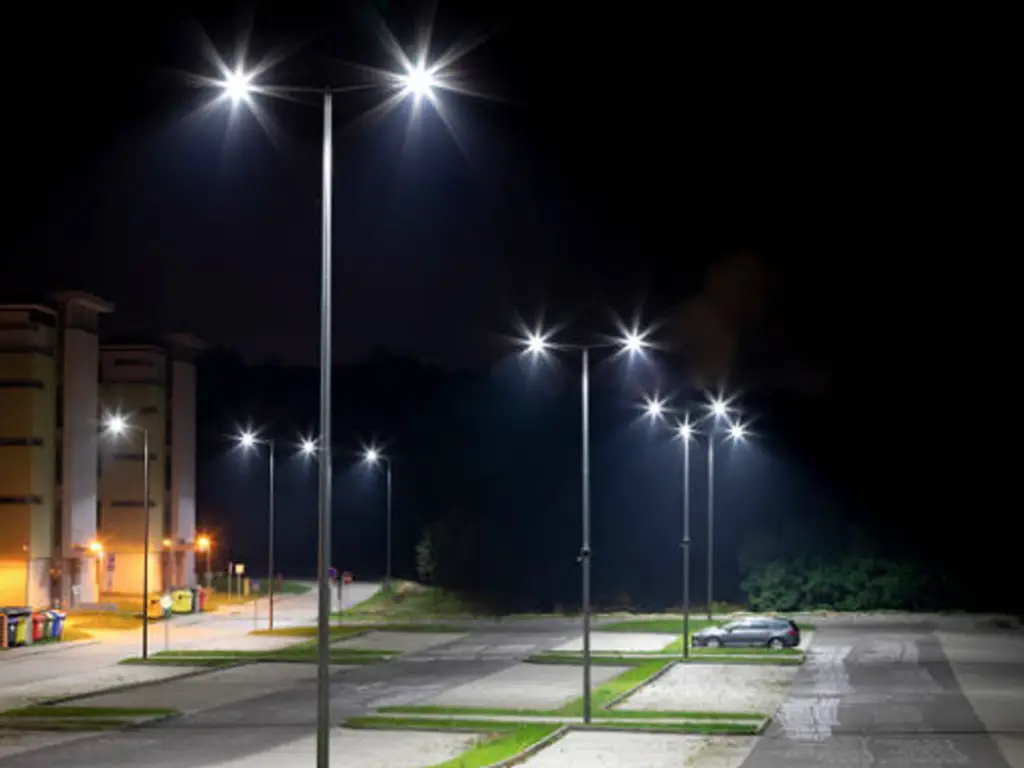
This is the benchmark. A complete LED luminaire integrates the LED light source, purpose-built optics, dedicated driver, and IP66-rated housing into a single engineered unit. Everything is designed to work together.
The optical performance difference is measurable: true IESNA Type II, III, IV, or V beam patterns that put light exactly where the roadway needs it, with none wasted above the horizon. Full luminaires deliver 130–150 lumens per watt — and the industry is pushing toward 170 lm/W by 2027. A typical 150W LED luminaire replaces a 250W HPS fixture while putting more usable light on the ground.
Full replacement is the right answer for new installations, for fixtures where the housing itself is corroded or structurally compromised, and for any project where smart controls (DALI, Zigbee, or LoRaWAN dimming and remote monitoring) are part of the specification. Budget roughly $240–$350 per luminaire at project scale.
Choosing the Right Replacement Method: A Quick Decision Framework
If the three options leave you unsure which direction fits your situation, this table cuts through the uncertainty.
| Decision Dimension | Corn Bulb | Retrofit Kit | Full Fixture |
|---|---|---|---|
| Existing Housing Condition | Good — no rust, straight mounting | Fair — reflector aged, glass hazy | Poor — corroded, bent, or water-damaged |
| Budget Constraint | Tight, under $100 per unit | Moderate | Capital project with lifecycle budget |
| Project Scale | Single-digit to dozens | Dozens to low hundreds | Hundreds to thousands |
| Climate Severity | Mild, inland | Humid or coastal | Extreme — salt spray, storms, or sub-zero winters |
| Smart Controls Needed? | No | Optional (add-on) | Yes — integrated from day one |
| Compliance Bar | Basic | Regional certification needed | Strict — DLC Premium, utility rebates required |
If you checked mostly the left column, corn bulbs will serve you. The middle column points to retrofit kits. If you are leaning right, a full luminaire replacement is not just the best performance choice — it is likely the cheapest option over the life of the installation.
Knowing which method to pick is step one. Step two is harder: once you have chosen a path, how do you tell a quality product from one that will fail in three years?
What Separates a Quality LED Street Light Replacement from a Disposable One
Price tells you almost nothing about street light quality. A $50 corn bulb and a $350 luminaire both use LEDs. The difference is in components that are invisible to the naked eye — and those components determine whether the light lasts five years or fifteen.
One signal matters more than price: component transparency. A manufacturer that willingly tells you which chip brand, which driver capacitors, and which test standards they use is sending a signal of confidence. A manufacturer that says “high-quality chips” without naming them is hiding something.
LED Chips and Drivers: The Two Components That Determine Lifespan
The LED chips themselves are not the weak point. Brand-name emitters from CREE, Osram, Philips Lumileds, Nichia, or Samsung are LM-80 tested and typically maintain 70% of their initial output (L70) beyond 50,000 hours. Unbranded chips can dip below the L70 threshold in 15,000–20,000 hours — a threefold difference in usable life.
The real failure point in most budget LED street lights is the driver, specifically the electrolytic capacitors inside it. Under the Arrhenius law of chemical reaction rates, every 10°C increase in operating temperature halves a capacitor’s lifespan. A driver built with Japanese-brand capacitors (Nichicon, Rubycon, United Chemi-Con) rated for 105°C continuous duty will outlast a generic 85°C unit by a factor of four or more. Philips, Meanwell, and Inventronics are the driver brands most consistently specified in professionally engineered street lighting.
This is where supplier transparency becomes a practical buying tool. Reputable manufacturers who build to international project standards publicly disclose their component sources — specifying CREE or Osram emitters paired with Meanwell or Philips drivers — and validate them through in-house testing laboratories built to CNAS standards, with 50 or more validation tests covering waterproofing, salt spray from 48 to 1,000 hours, 24-hour aging, constant temperature and humidity cycling, and surge protection.
LED Chips
- CREE · Osram · Philips Lumileds · Nichia · Samsung
- LM-80 tested · L70 ≥ 50,000 hrs
- Avoid unbranded chips (L70 < 20K hrs)
Drivers
- Philips · Meanwell · Inventronics
- Japanese capacitors (Nichicon, Rubycon)
- 105°C rating ≥ 4× lifespan vs 85°C
Certifications and Testing: Your Insurance Against Fake Specs
Certifications are a street light’s safety rating. Different markets demand different credentials:
- North America: UL or ETL for electrical safety. DLC Premium listing for utility rebates — without it, your project may lose 20–40% of its funding.
- Europe: CE marking plus ENEC for higher-tier quality assurance.
- Australia / New Zealand: SAA approval.
- Global baseline: RoHS compliance and ISO 9001 for manufacturing quality management.
Beyond safety marks, demand photometric test reports. LM-79 measures the complete luminaire’s actual output — not the chip manufacturer’s theoretical spec. LM-80 tests the LED chips’ lumen maintenance over time. TM-21 projections use LM-80 data to estimate the luminaire’s L70 life. A supplier who cannot produce these three reports on request has not done the testing — or has done it and does not like the results.
Thermal Management and Physical Protection: The Hidden Determinants of Reliability
Street lights live outdoors 24/7, facing heat, cold, rain, dust, salt, and the occasional lightning strike. The products that survive are the ones designed for it.
Passive cooling wins. A die-cast aluminum heatsink — ADC12 alloy is the industry standard, with thermal conductivity around 96 W/m·K — dissipates heat without moving parts. Fan-cooled corn bulbs are a false economy: the fan motor typically fails at 15,000–20,000 hours, well before the LEDs themselves dim, and dust or insects accelerate the timeline.
For physical protection, IP66 is the outdoor minimum for full luminaires — it means the housing withstands powerful water jets and is fully dust-tight. IP65, common on retrofit kits, protects against water spray but not pressurized jets. In coastal environments where salt corrosion is the primary failure mode, demand salt spray test certification of 500 hours or more. Surge protection of at least 10 kV is essential in lightning-prone regions.
A real-world example: a coastal city in Southeast Asia installed 2,000 budget LED street lights in 2019. Within three years, over 40% had failed — fan motors seized by salt and dust, drivers fried by surge events, and housings corroded through. The replacement program cost more than the original installation. Specification-level fixes — passive cooling, IP66, 10 kV surge protection, and 500-hour salt spray rating — would have prevented nearly all of those failures.
Fan-Cooled Corn Bulbs: A False Economy
In 2019, a coastal Southeast Asian city installed 2,000 budget fan-cooled LED street lights. Within 3 years, 40%+ failed — fan motors seized by salt and dust, drivers fried by surge events. Passive cooling, IP66, and 10 kV surge protection would have prevented nearly all failures.
The Real Cost of Street Light Replacement: TCO Over 15 Years
The price tag on the box is the smallest part of a street light’s true cost. Over a 15-year ownership period, energy and maintenance dominate the equation.
Upfront Costs Compared: Corn Bulb vs Retrofit Kit vs Full Fixture
At the point of purchase, the price gap is real:
| Method | Product Cost per Unit | Installation Labor | Total Upfront (per unit) |
|---|---|---|---|
| Corn Bulb | $30–$80 | Low (screw-in) | $80–$150 |
| Retrofit Kit | $100–$200 | Medium (wiring work) | $200–$350 |
| Full Fixture | $240–$350 | Medium-High (mounting + wiring) | $350–$550 |
If you stop calculating here, corn bulbs win every time. That calculation ignores the next 15 years.
Beyond the Price Tag: Energy, Maintenance, and Warranty Over 15 Years
Street lights run roughly 4,380 hours per year — 12 hours a day, every day. At $0.12 per kWh, a 100-watt difference between two fixtures costs $52.56 per light per year in electricity alone. Over 15 years, that single fixture burns through $788 in extra energy. In a project with 500 lights, the inefficient choice adds nearly $400,000 to the electric bill.
Then add maintenance. Replacing a failed street light on a public road involves a bucket truck, traffic control, and a qualified electrician — typically $200–$500 per visit, even for a quick bulb swap. A corn bulb with a 3-year warranty replaced twice over 15 years at $350 per truck roll costs $700 in maintenance alone. A full luminaire with a 7-year warranty may need one replacement in the same period.
The TCO math inverts the upfront cost story: the full luminaire, despite its higher purchase price, costs less to own over the asset’s lifetime. Municipalities that cut corners on specification to save Capex almost always pay more in Opex — and often end up re-bidding the same project within a decade.
Warranty terms themselves carry a hidden cost signal. A 5-to-7-year warranty that covers one-way shipping, customs duties on replacements, and on-site technical support when necessary signals a manufacturer that expects their product to outlast the warranty period. A 2-year warranty that covers “product only” signals the opposite.
Where to Source Quality LED Street Light Replacements
You have the knowledge to choose the right method and identify quality. The last step is knowing where to buy.
For small projects — a few dozen lights — a local electrical distributor with technical support staff is the safest route. You pay a margin but gain someone to call when a specification question comes up during installation.
For larger projects and for buyers who want direct pricing, sourcing from the manufacturer makes more sense. The key distinction is not “domestic vs. imported” — it is “verified vs. unverified.” A factory audit, whether in person or via live video walkthrough, answers more questions than any product catalog.
Your verification checklist should include: ISO 9001 certification, publicly stated LED chip and driver brands, an on-site testing laboratory, willingness to provide LM-79 photometric reports for the exact model you are buying, and a warranty of at least five years with documented international service procedures.
For projects requiring compliance across multiple markets, look for manufacturers whose certification portfolio already covers the regions where you operate. A supplier holding UL, CE, TUV, ENEC, SAA, and RoHS certifications has already navigated the compliance requirements you need.
Whether you are upgrading a single parking lot or converting an entire city’s street lighting inventory, the selection principle stays the same: trace your components, verify your test reports, and measure cost over the full lifecycle — not just the purchase order.
Get Street Light Specifications & Certification Documents
Discuss your project with a product engineer. 12-hour response, 5–7 year warranty, samples available for qualified projects.
Request SpecificationsReferences
- DesignLights Consortium. “Qualified Products List.” https://www.designlights.org/
- DVRPC. “Regional Streetlight Procurement Program.” https://frontend.dvrpc.org/rslpp/
- IESNA. “Outdoor Lighting Standards.” https://www.ies.org/
- Nichicon Corporation. “Aluminum Electrolytic Capacitor Technical Notes.” https://www.nichicon.com/

 English
  Spanish
  French
  German
  Italian
  Arabic
  Russian
  Portuguese
  Dutch
Dutch  Indonesian
  Turkish
  Polish