
True perimeter defense is never achieved by simply bolting the highest-wattage floodlight you can find above your garage. An elite outdoor security lighting system is a meticulously engineered optical defense network designed to eliminate dangerous blind spots, deter intruders through psychological pressure, and work in seamless synergy with your smart camera systems. In this comprehensive guide, we move beyond amateur retail advice to explore the commercial-grade science of illumination, strategic fixture placement, and the critical installation tactics required to protect your property without sacrificing its architectural aesthetics or infuriating your neighbors.
The Science of Illumination: Lumens, Kelvins, and Glare Control
Before selecting physical fixtures or planning electrical routing, you must first master the foundational physics of light. The most common vulnerability in both residential and commercial security design stems from a fundamental misunderstanding of how the human eye and digital camera sensors process artificial illumination in extreme darkness.
The Lumen Illusion: Why Brighter Isn’t Always Safer
In the security lighting industry, there is a dangerous and pervasive misconception that astronomical lumen counts automatically equate to maximum safety. A lumen is a standard unit measuring the total quantity of visible light emitted by a source. However, unleashing a massive, uncontrolled blast of 6,000+ lumens into a localized area of your backyard can actually compromise your security infrastructure. To understand exactly why, we must examine human ocular biology.
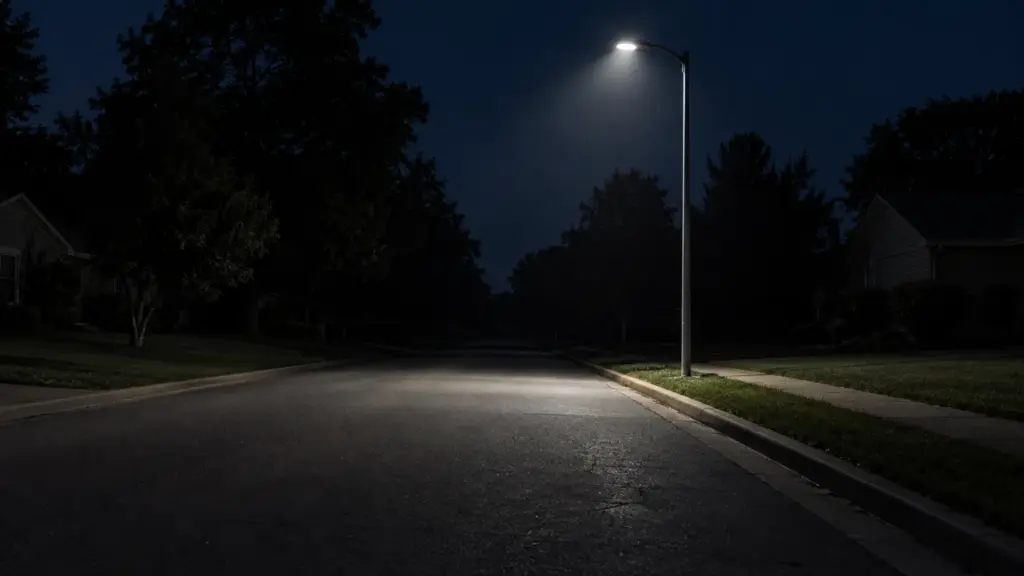
When you look out into your yard at night, your eyes have naturally adapted to the low-light environment. If a hyper-bright floodlight is suddenly triggered, it creates a severe optical phenomenon known as Disability Glare. Your pupils violently and involuntarily constrict to protect your retinas from the intense optical radiation. While the immediate area directly under the light fixture becomes painfully visible, everything outside that intensely illuminated circle instantly becomes an impenetrable, pitch-black abyss. By over-illuminating one specific zone, you inadvertently create deeper shadows around the perimeter, providing the perfect, invisible hiding spot for an intruder.
According to the standards published by the Illuminating Engineering Society (IES), effective outdoor security lighting relies on uniformity rather than sheer intensity. The IES strongly warns against “Light Trespass”—poorly aimed, excessively bright fixtures that spill light beyond property lines, blinding pedestrians and creating high-contrast shadows that aid criminal concealment.
Effective perimeter deterrence relies on calculated, evenly distributed light pools that allow your eyes—and your cameras—to scan the entire property without experiencing blinding contrast ratios. It is always better to have four strategically placed 1,000-lumen fixtures casting an even wash of light than a single 4,000-lumen fixture creating a blinding hotspot.
Decoding Kelvins (CCT): The Secret to Perfect Camera Footage
While lumens dictate the sheer volume of light, the Correlated Color Temperature (CCT), measured in Kelvins (K), dictates the precise color appearance of that light. Property owners frequently make the catastrophic mistake of purchasing 2700K (warm white/yellow) landscape lights for security purposes, or going to the opposite extreme with 6500K (harsh blue-white) industrial lights.
For a robust security apparatus, the optimal CCT strictly resides in the 4000K to 5000K (Neutral to Cool White) range. This specific spectrum is scientifically matched to the performance parameters of modern CMOS surveillance sensors. When ambient light drops, security cameras rely on your outdoor fixtures to maintain their full-color night vision capabilities. If you utilize a warm 2700K light, the yellowish hue heavily distorts visual data. A suspect’s dark blue hoodie might register as black, and a green getaway vehicle might appear dark grey. By maintaining a crisp 4000K-5000K baseline, you ensure maximum visual acuity, perfect color rendering for suspect identification, and a clean aesthetic.
Arsenal Selection: The Complete Outdoor Security Catalog
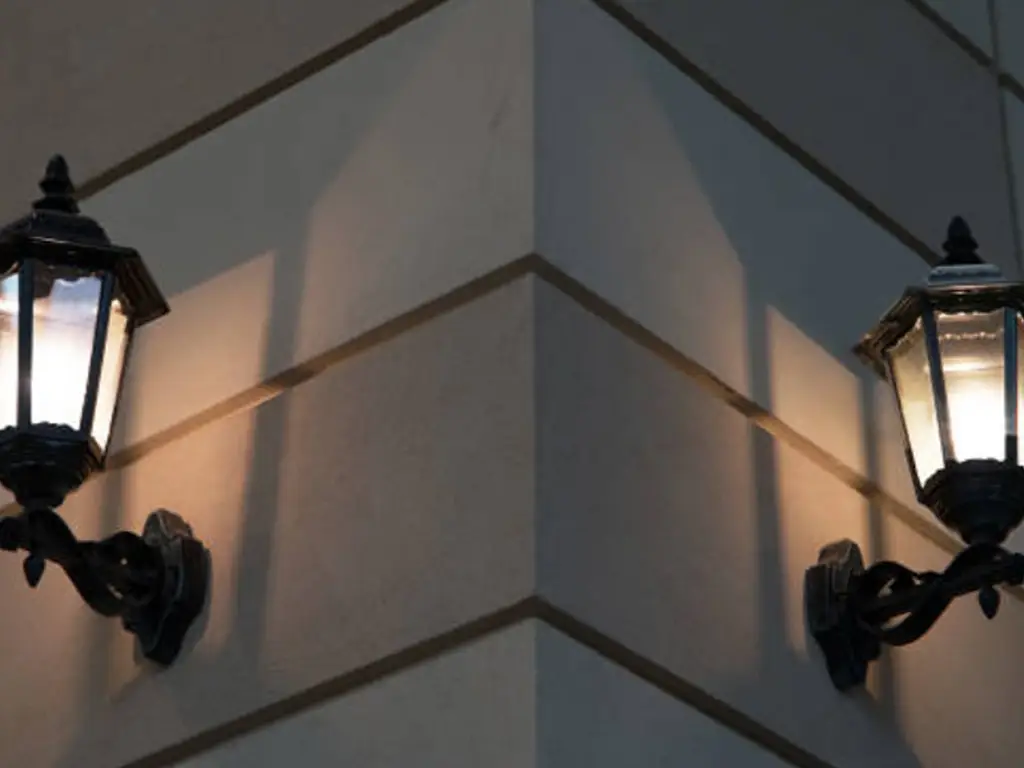
A commercial-grade defense perimeter never relies on a single type of light; it utilizes a layered arsenal of specific fixtures, each engineered with distinct optical geometries and triggering mechanisms to fulfill unique tactical roles.
Active vs. Passive Deterrence (Triggers & Sensors)
Your lighting system is only as intelligent as the sensors controlling it. Security fixtures are divided into passive environmental illumination and active, event-driven deterrence:
- Dusk-to-Dawn (Photocell Sensors): Relying on ambient light sensors, they automatically ignite at sunset and extinguish at sunrise. They provide constant, passive deterrence, signaling to potential intruders that the property is occupied and actively monitored.
- Motion-Activated (PIR – Passive Infrared): PIR sensors detect rapid changes in infrared radiation (body heat) moving across a grid. The sudden ignition of a high-lumen light creates a severe “startle effect,” stripping the intruder of their psychological safety net.
The Law of Lateral Sensitivity: Because of how internal fresnel lenses are segmented, PIR sensors are incredibly sensitive to objects crossing horizontally across their field of vision, but notoriously sluggish to targets walking in a straight, direct line toward them. You must install motion sensors at a strategic 90-degree angle to the anticipated path of intrusion to guarantee instantaneous activation.
Floodlights, Spotlights, and Architectural Wash Lights
The shape of the light beam is just as critical as its intensity. Understanding various lighting distribution types allows you to tailor the light to the specific geometry of your architecture. Identifying your required lighting distribution ensures there is no wasted energy and zero light pollution.
- Wide-Angle Floodlights (120°+ Beam Spread): Designed for brute-force illumination over vast areas like multi-car driveways and expansive backyards. They utilize multifaceted reflectors to cast a wide, overlapping net of light.
- Targeted Spotlights (Under 45° Beam Spread): These project a tightly focused, high-intensity beam over longer distances without scattering light sideways. These are the mandatory choice for penetrating deep into narrow, high-risk corridors like side alleys.
- Architectural Wash Lights: These cast a soft, even gradient of light across vertical surfaces, eliminating the micro-shadows created by architectural bump-outs, ensuring there is no dark recess for a trespasser to exploit.
Strategic Placement Blueprint: Mapping the High-Risk Zones
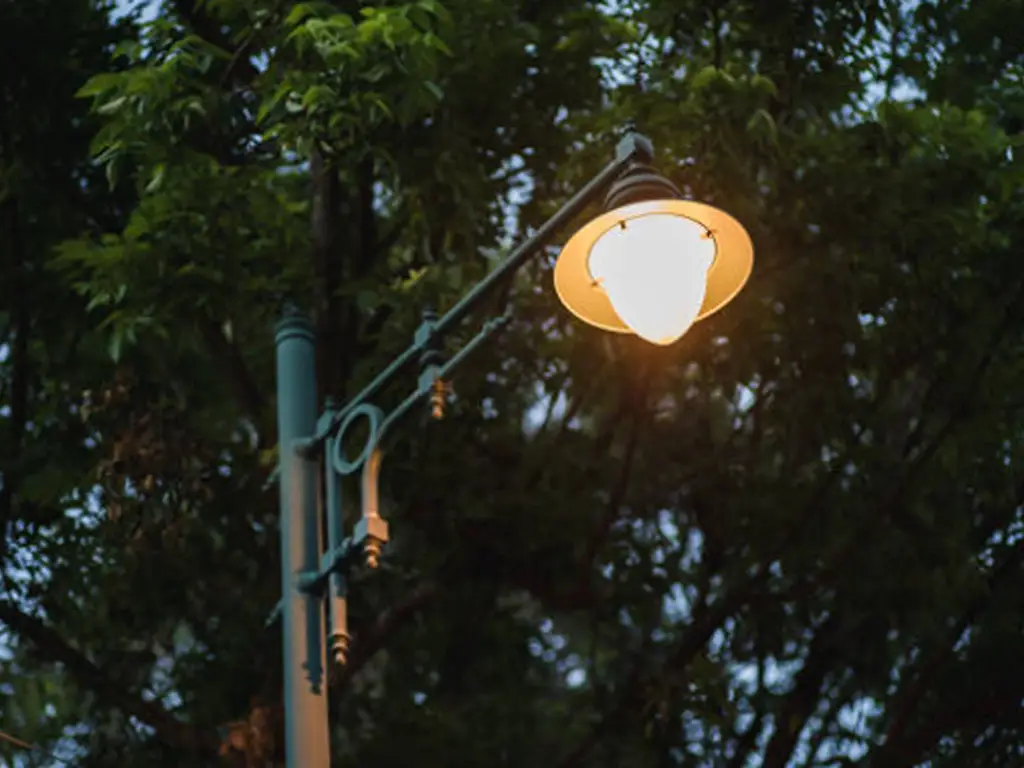
Possessing the right commercial-grade equipment is entirely useless if it is deployed blindly. You must physically map your property’s vulnerabilities and assign precise lumen parameters and fixture types to each unique threat vector.
The 360° Perimeter Matrix (Location, Fixture, and Lumens)
In architectural lighting design, coupling the raw lumen output with the correct installation height is an absolute necessity. A 2,000-lumen light mounted at 8 feet will create a blinding hotspot, whereas the same fixture at 15 feet provides a smooth wash of illumination. Utilize the following matrix to audit your layout.
| High-Risk Zones | Recommended Fixture | Optimal Lumens & Height | Blind Spot Warning |
|---|---|---|---|
| Pathways, Steps & Low Perimeters | Bollard Lights / Shielded Path Lights | 100 – 300 Lumens (Height: 1 to 3 feet) |
Avoid unshielded upward glare that blinds pedestrians. Ensure no dark gaps exist between light pools. |
| Side Alleys & Narrow Blind Spots | Directional PIR Spotlights | 700 – 1,000 Lumens (Height: 8 to 10 feet) |
Mounting wide floodlights here wastes energy by illuminating neighbor’s walls. Narrow beams must slice straight down. |
| Entry Doors, Porches & Patios | Dusk-to-Dawn + Soft Wash Lights | 500 – 800 Lumens (Height: 7 to 9 feet) |
Over-illuminating this specific zone will completely blind your video doorbell’s sensor. |
| Wide Driveways & Deep Backyards | Twin-Head Active Floodlights | 1,500 – 2,500 Lumens (Height: 9 to 12 feet) |
Beware of intense light trespass. Fixtures must be angled downward at a minimum 45-degree pitch. |
Layered Landscape Integration (Aesthetics Meets Security)
One of the greatest objections to robust security lighting is the fear that a residence will end up looking like a militarized compound. The brilliant integration of layered landscape lighting bridges the gap between high-end aesthetics and covert perimeter defense. The most devastatingly effective tactic in this crossover realm is Silhouetting.
To execute this flawlessly, you must strictly adhere to a specific geometric placement rule: You must conceal the fixture entirely between the shrubbery and the exterior wall, aiming the beam strictly away from the observer and directly onto the wall surface behind it to create a true backlighting effect. If you mistakenly place the light in front of the shrub facing the street, you will merely illuminate the foliage and cause severe light trespass.
When placed correctly behind the landscaping, you create a luminous backdrop on your exterior walls. If a prowler attempts to use your perimeter bushes for concealment and steps into that narrow gap, the hidden uplight instantly catches their body, casting a massive, unmistakable black silhouette against your home’s bright exterior wall. This serves as a highly effective, passive visual alarm.
Commercial-Grade LED vs. Retail Traps: The Reliability Factor
You can execute a flawless perimeter blueprint, but if the hardware you deploy fundamentally lacks engineering integrity, your defense grid will collapse when you need it most. The outdoor lighting market is heavily saturated with suspiciously cheap, plastic-housed fixtures that look impressive on the retail shelf but harbor fatal engineering flaws.
The Hidden Costs of Cheap Outdoor Lighting
The two greatest enemies of an outdoor security light are internal thermal degradation and external moisture penetration. Cheap LEDs lack proper heat sinks. Because LED diodes generate immense localized heat, failing to bleed off this thermal energy causes the internal components to bake themselves to death.
According to the U.S. Department of Energy (DOE) lighting standards, thermal management is the single most critical factor in LED longevity. Poor heat dissipation leads to rapid lumen depreciation, where a light can lose up to 40% of its brightness within the first year of operation.
Simultaneously, cheap rubber gaskets expand and contract wildly during seasonal temperature shifts, drawing microscopic water vapor into the housing until a heavy rainstorm finally shorts out the motherboard.
The Pro Buyer’s 3-Point Spec Checklist
To avoid these catastrophic failures, you must begin auditing fixtures like a commercial procurement officer. There are three non-negotiable physical parameters you must demand:
- Demand Die-Cast Aluminum Housings: Flatly reject polycarbonate plastic. Pure die-cast aluminum acts as a highly efficient thermal conductor. Paired with aerodynamic cooling fins, it aggressively pulls heat away from the LED chips, preventing thermal throttling.
- Enforce a 130+ LM/W Optical Baseline: Low-tier lights consume massive amounts of electricity for mediocre brightness. A high efficacy rating (Lumens per Watt) proves the manufacturer is using top-tier SMD diodes and precision optics, delivering blinding, fog-penetrating power while suppressing energy bills.
- Require True IP65/IP66 Industrial Sealing: Do not trust standard “weatherproof” marketing jargon. Demand certified IP65 or IP66 industrial sealing standards, which utilize multi-layered silicone gaskets to guarantee survival against driving rain, freezing snow, and corrosive salt air.
It is only after establishing this rigorous baseline that you can truly evaluate a fixture. Seasoned security contractors bypass retail stores entirely and seek out commercial-grade manufacturers that natively engineer these industrial standards into their products. For example, WOSEN LED is one of the few brands that strictly adheres to these demanding engineering specifications. By utilizing heavy-duty die-cast aluminum housings with thermal fins, integrating premium SMD chips for a staggering 130+ lumens per watt, and enforcing rigorous IP65/IP66 silicone sealing, they provide the exact commercial reliability required to guarantee a 50,000-hour lifespan and keep a perimeter impenetrable.
Advanced Installation Tactics: Avoiding Critical Failures
The final phase involves the physical execution of the installation. A perfectly manufactured commercial light is utterly useless if it can be easily neutralized by a criminal, or if its placement inadvertently cripples your video surveillance network.
Anti-Tamper Geometry (Height & Wiring)
If criminals can easily reach your security hardware, they will dismantle it. The lowest edge of your primary security fixtures must be mounted at a strict minimum height of 9 feet (approximately 2.7 meters). This elevation keeps the fixture completely out of the physical reach of an average-height adult, even if they attempt to swing a blunt instrument.
Exposed electrical wire running along a brick wall is an open invitation for wire cutters. All outdoor security wiring must be meticulously hidden internally through walls, tucked securely into architectural soffits (eaves), or encased within rigid, heavy-duty metal conduit pipes.
Beating the IR Washout (Camera Synergy)
This is where the vast majority of DIY installations suffer a catastrophic failure. The Absolute Warning: You must never install a high-lumen floodlight directly next to your security camera. If a beam originates from the exact same vantage point as the camera lens, it illuminates every single dust particle, raindrop, and snowflake suspended in the air immediately in front of the lens.
This triggers a severe optical phenomenon known as Near-field Backscatter. The intense light violently reflects straight back into the camera’s image sensor, creating an impenetrable white wall of glare (the “spider-web effect”) that completely blinds the surveillance system.
To achieve perfect optical synergy, the light fixture and the security camera must be separated by a physical distance of at least 5 to 8 feet (1.5 to 2.4 meters). The light source must be mounted at a lower elevation than the camera, projecting its beam downward and away from the lens. Ensure that the outer edge of the light beam never slices upward into the camera’s Field of View (FOV).
Conclusion: Finalizing Your Perimeter Defense
Securing your property is an interconnected engineering process, not a simple hardware purchase. By respecting the intricate science of lumens and glare control, deploying the correct lighting distribution types to map your high-risk zones, and mastering the physical spacing required to protect your camera networks, you establish an uncompromising perimeter defense system that neutralizes threats long before they reach your front door.
Ready to Upgrade to Commercial-Grade Security?
Don’t compromise your perimeter with unreliable retail lighting. Connect with our engineering team today to design a flawless, high-efficacy defense system tailored to your property’s exact vulnerabilities.
Contact WOSEN Experts Now

 English
  Spanish
  French
  German
  Italian
  Arabic
  Russian
  Portuguese
  Dutch
Dutch  Indonesian
  Turkish
  Polish