
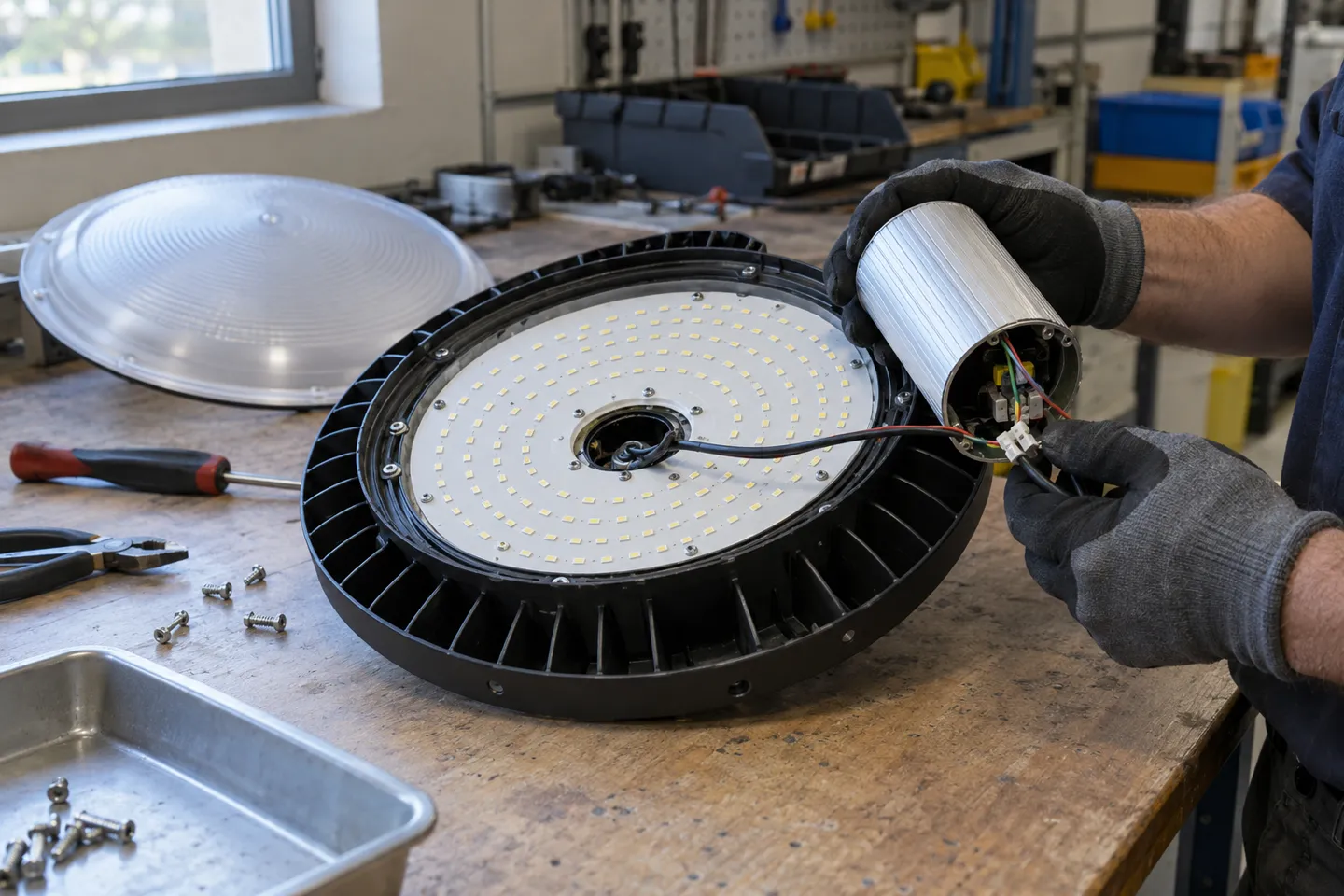
Three UFO high bays over the loading line went dark in the same week. The maintenance tech pulls the first one down, opens it up, and finds the LED board clean and intact. The fault sits on a palm-sized circuit board bolted to the housing: the driver. That scene repeats in warehouses and plants of every size. It is why industrial lighting maintenance looks different in the LED era than it did in the lamp-swap decades.

What Industrial Lighting Maintenance Actually Covers Now
The task list itself has not changed much. Clean the optics and the heat sink surfaces. Walk the floor and inspect, and check electrical connections and control devices. Deal with failed fixtures quickly instead of leaving dark spots over work areas.
What changed is the rhythm. HID fixtures got opened on a relamping calendar, so they also got cleaned on one. LED fixtures rarely get that visit because nothing burns out on schedule. The Illuminating Engineering Society flagged the consequence: LED luminaires accumulate more dirt over their long life precisely because they are cleaned less often (Illuminating Engineering Society, 2017). Luminaire dirt depreciation can become a significant loss factor at end of life. Maintenance shifts from replacing lamps on a timer to two separate jobs: keeping the output you paid for, and responding to electronic failures.
Set the frequency by environment, not by a calendar month. A foundry, a woodshop, and a clean assembly area do not share a cleaning schedule, and the difference between them is dust load. Safety stays simple and non-negotiable. De-energize and verify before touching anything. Respect the rules for work at height, and treat 277V and 480V circuits as the hazard they are.
Industrial lighting maintenance task list
What Actually Fails Inside an LED High Bay
The batch-failure pattern
Chips almost never die.
Batch failures in industrial LED fixtures overwhelmingly trace to the driver and the wiring, not the chips.
That is not a slogan. The U.S. Department of Energy’s LED Systems Reliability Consortium states it plainly. Electronics failures in the driver, or degradation of optical components, often occur long before LED lumen depreciation causes failures (U.S. DOE / LED Systems Reliability Consortium, 2017). Rating a whole luminaire by its LED source alone is misleading. The chip is usually the last part to quit, so reading a dead fixture correctly means knowing which part actually failed.
Four Ways an LED High Bay Actually Fails
A dead fixture, one that produces nothing, points first to power input and then to the driver. Before ordering parts, confirm the circuit actually delivers voltage. A tripped breaker or a miswired replacement gets misdiagnosed as a bad fixture surprisingly often.
Flickering and random restarts usually trace back to the driver. Loose wiring can do it. So can an incompatible dimmer or control. So can a dirty power supply that hits the driver with surges it was never built to absorb.
Dark patches, where part of the fixture lights and part does not, implicate the chip board or its solder joints. True chip package failures do happen, but they are the rare case, not the common one.
Slow, even dimming is the one presentation where the chips are legitimately involved. LED packages depreciate gradually. The industry defines useful life as the point where output falls to 70 percent of its initial value, the L70 point (U.S. DOE / LED Systems Reliability Consortium, 2017). Clean the optics and measure again before you condemn the board, because dirt steals output too.
Symptom to component, first move
| Symptom | Most likely component | First move |
|---|---|---|
| Dead, no output | Power supply, then driver | Verify circuit voltage before ordering parts. |
| Flicker, random restarts | Driver, controls incompatibility, surges | Check dimmer compatibility and supply quality. |
| Dark patches | Chip board, solder joints | Confirm pattern is static, then board. |
| Slow even dimming | Lumen depreciation or dirt | Clean optics, measure illuminance, then judge. |
The Driver: Why It Dies First
Driver electronics follow the ordinary rules of electronics reliability, and the weak link inside them is well known. Electrolytic capacitors are typically the most sensitive components. Reliability practice puts it bluntly: for every 10 degrees Celsius increase in operating temperature, capacitor life is roughly cut in half (B. Schneider, DELTA / FORCE Technology, Nordic Test Forum, 2017). A driver bolted into the hot zone of a UFO high bay, close to the board it feeds, lives a shorter life than the same part on a cool wall.
Field data agrees with the physics. In a Danish field study covering eight large municipalities and four energy suppliers, an average of more than 4 percent of street-lighting luminaires failed annually. 80 percent of those failures were related to the electronic drivers. The same presenter documented one project where nearly half of several thousand lamps failed within three to four years of installation (B. Schneider, DELTA / FORCE Technology, Nordic Test Forum, 2017). Warehouses see the same pattern in their own way. One facility reported 15 of 40 corded high bays failing within a couple of months, with the batch dying right around the end of the warranty period (r/Lighting, 2025). The comment section recognized that timing instantly.
Two lessons follow. First, the rated life printed on the chip tells you almost nothing about the service life of the fixture, because the system lives as long as its shortest-lived part. Second, when a batch starts failing just past its warranty, that is not bad luck. It is a cohort of drivers reaching the end of their thermal and electrical tolerance at the same time. That should change how you buy the replacements.
Diagnose in This Order Before Ordering Parts
Start with the supply. Confirm the input voltage the fixture is receiving, because industrial buildings accumulate legacy circuits. A fixture expecting one voltage will misbehave or refuse to start on another. One electrician replacing high bays found an older wing of the building wired at 240V while the rest ran 120V, exactly the trap a two-minute check avoids (r/AskElectricians, 2023).
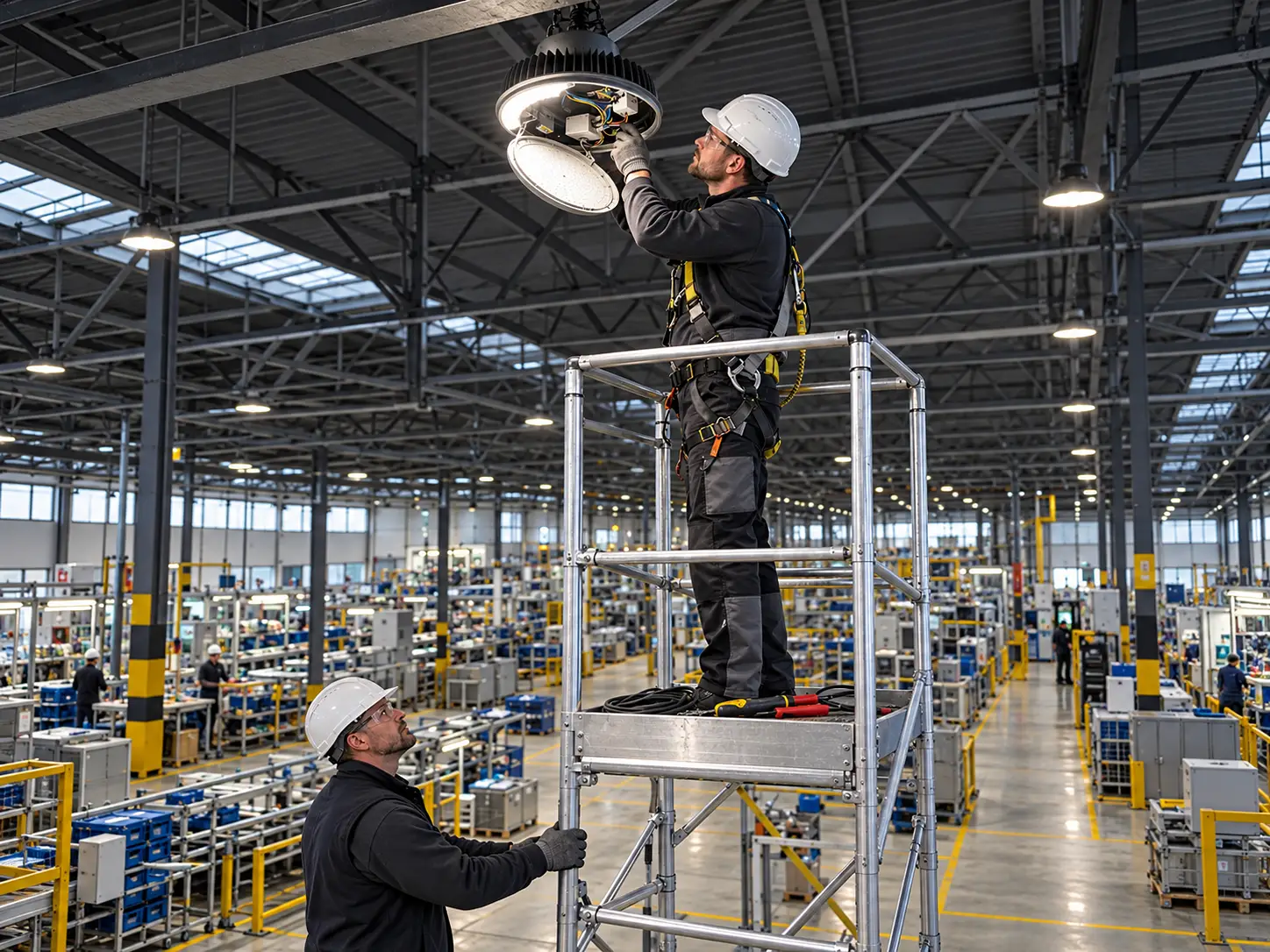
Second, read the failure distribution. One fixture dead among forty is an individual part failing. Five dead in the same row, or a batch crossing its warranty anniversary together, is a common cause. That means a driver series, a voltage problem, or an environmental stress shared by the whole group. The distribution tells you whether you are fixing a fixture or managing a cohort.
Third, swap the driver before the board. It is the cheaper part, it is the likelier culprit, and a known-good driver turns an ambiguous fixture into a clear diagnosis in minutes.
Fourth, judge the board last and only after cleaning. Measure illuminance over the work area after the optics are clean. If output is still short of what the task requires, you are looking at lumen depreciation, and the decision changes from repair to replacement.
Diagnose in this order before ordering parts
Confirm supply voltage
Verify the circuit delivers power before ordering parts.
Read the failure distribution
One dead fixture is a part; a batch is a common cause.
Swap the driver first
The cheaper, likelier culprit turns ambiguity into a diagnosis.
Judge the board last
Clean the optics, measure illuminance, then decide.
Why the Same Fixture Ages Differently Facility to Facility
Five stresses decide how fast the same model ages. Dust settles on optics and insulates heat sinks, and it is the most common. Ambient heat works directly on driver electronics, whose life curve bends sharply with temperature. Moisture finds its way through tired seals and gaskets. Vibration loosens connectors and solder joints near machinery. Unstable voltage and surges attack every electronic part at once, and they explain clusters of failures that track with the grid rather than with the fixtures.
Cleaning deserves an honest job description. The IES-led study with the Virginia Tech Transportation Institute put recoverable numbers on dirt (Illuminating Engineering Society, 2017). Annual light loss from dirt depreciation ran from about 1 percent to 3.8 percent per year, depending on the optic design. Cleaning recovered that loss. A dry rag or plain water proved ineffective, while a 70 percent isopropyl alcohol wipe or mild detergent worked. Cleaning restores light output. It does not reset driver aging. A fixture in a dust-heavy plant needs cleaning more often than its catalog cousin, but no cleaning schedule will add a year to a driver running hot.
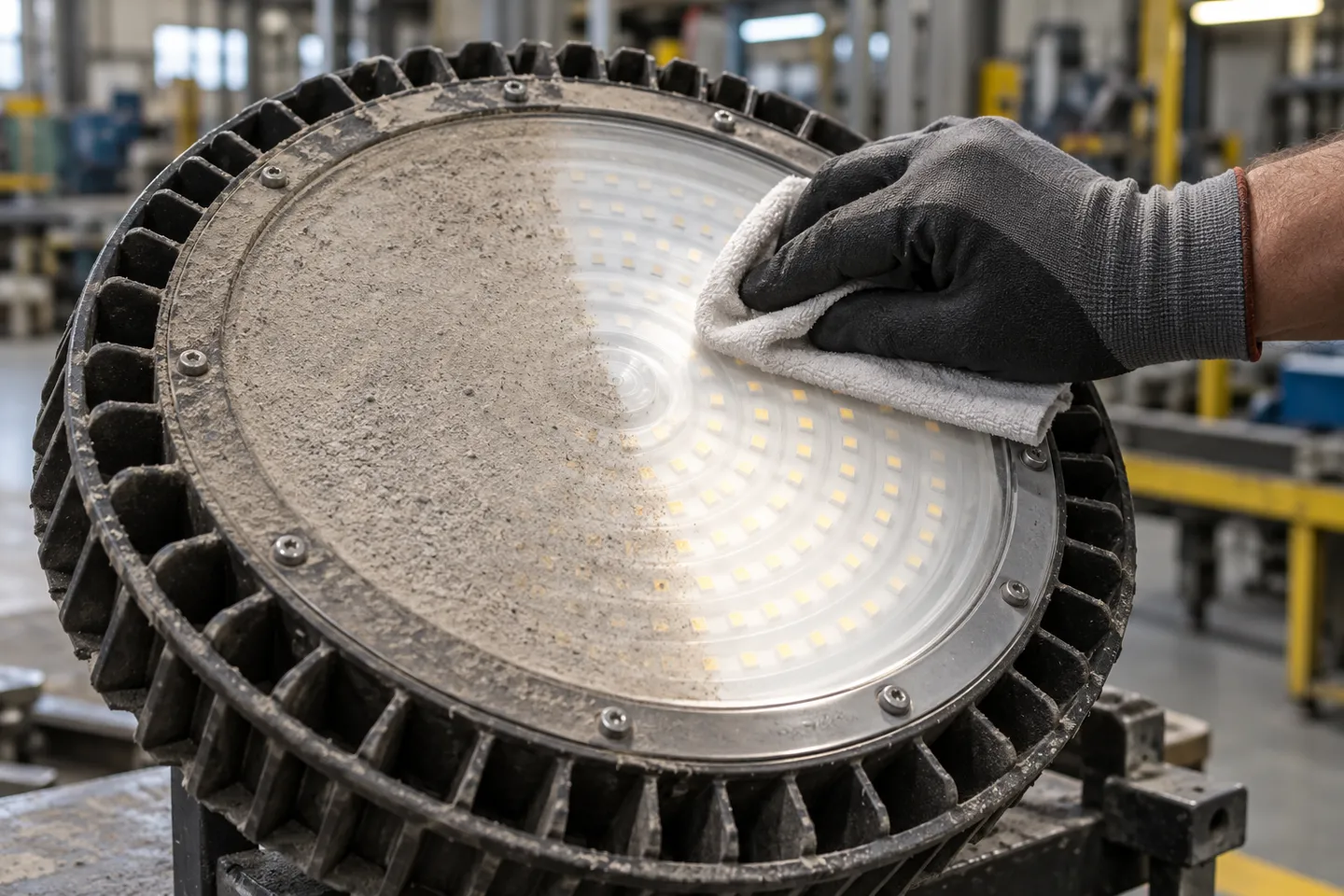
This is also where the contradictory cleaning advice on the internet comes from. Recommendations ranging from monthly to annual all sound authoritative because each is right for a different dust load. Set your interval by measuring illuminance and watching how fast it drifts, not by copying another facility’s schedule. Judging by eye fails because vision adapts: a bay can lose a meaningful share of its output before anyone on the floor notices.
If your bays run hot, dusty, or on legacy voltage, WOSEN matches IP sealing, driver brand, and warranty to those exact conditions.
Match fixtures to my facilityRepair, Replace, or Group-Relamp: The Maintenance Decision
Read the Failure Pattern Before You Spend
The pattern decides the playbook before any math does. Isolated failures spread across years are normal attrition, and they only need a repair response. A rising rate, where the same batch starts reporting failures closer and closer together, opens a decision window. That window is the moment to run the numbers below, because once a cohort of drivers passes its tolerance, the next failure is a matter of when, not whether.
The Three Accounts: Repair Math, Replacement Math, Risk Math
Repair math is bigger than the part price. A replacement driver may cost less than a lunch. But getting a lift to it, an electrician up and down, and a production line waiting underneath can make the labor the dominant line item. Multiply that by the number of failures you expect, not the number you have already had.
The replacement account starts with the fixture price and immediately collects offsets. New fixtures run at higher efficacy, so the energy line shrinks, and the warranty clock resets to zero. A fixture bought today carries a fresh multi-year warranty. A fixture repaired today carries whatever its remaining cohort life is.
Risk math is the one spreadsheets miss. When failures are a cohort phenomenon, each repair is a down payment on the next service call. The repaired fixture works. Its nine siblings with the same hours and the same driver series are still counting down. This is the account that tips a facility from repair-by-repair into group relamping.
When Group Relamping Wins, and the Boundary Matrix
Group relamping used to mean changing lamps before they burned out. In the LED era the trigger is different, because chips do not fail on schedule. A group replacement wins when three things line up: a failure rate that is ramping rather than flat, fixtures past mid-life, and a real efficacy gain in current replacements. Any one alone is usually not enough. The combination is the case.
Failure pattern to response, with boundaries
| Situation | Response | Fits when | Switch to the next option when |
|---|---|---|---|
| Single failures inside warranty | Warranty claim or swap per manufacturer terms | Fixture is within its warranty window | Claim frequency rises, pointing to a batch issue. |
| Scattered driver deaths out of warranty | Replace drivers or individual fixtures | Failure rate is flat, parts available | Rate climbs, or replacement parts are unavailable. |
| Ramp-up with mid-life fixtures | Group relamp the batch | Ramping rate plus age past mid-life plus a real efficacy gain | Only isolated failures remain across the fleet. |
| Dimming without deaths | Clean, then measure illuminance | Output recovers after cleaning | Illuminance still short after cleaning, depreciation beyond spec. |
One execution note belongs on every work order: confirm voltage and dimming compatibility against the actual circuits before installation, in writing. The 240V wing that surprised the electrician above is a cheap surprise in a small building and an expensive one across a distribution center.
What to Specify When Buying Replacement Fixtures
A specification is how this round’s failures buy you a quieter next round. Every line below exists because its absence caused a failure mode described earlier. Every line also carries a confirmation action, because verbal assurances do not survive the gap between quotation and container.
Replacement fixture specification checklist
| Specification | Why it matters | Confirm in writing |
|---|---|---|
| Driver serviceability and brand upgrade path | Drivers dominate failure statistics, a replaceable or brand-upgradeable driver cuts next-round cost and lead time | Ask which driver ships as default, what upgrade brands cost, and whether the driver is an independently replaceable part. |
| Input voltage range | Legacy circuits at 240V or 277V kill or idle mismatched fixtures | State your circuit voltage and require the fixture’s voltage version on the quotation. |
| IP and IK rating with operating temperature range | Dust, moisture, impact and heat are the aging accelerators from earlier | Match IP65-class sealing, impact rating and the temperature range to your environment. |
| Lumen maintenance, not just initial lumens | Output fades gradually, and the task needs lumens at year five, not year zero | Ask for the L70-based rated life and the test standard behind it. |
| Warranty tier and coverage | Multi-year warranties track driver cohort risk | Match the warranty years to the project horizon and confirm what the warranty covers, whole fixture or parts. |
| Certification for the target market | Shipments stall without market-specific certification | Require the certificate names and confirm they apply to the exact model numbers quoted. |
When budget forces a ranking, rank by failure cost rather than by brochure order. Driver serviceability and confirmed voltage come first, because they decide whether the next failure is a maintenance task or a procurement project. Protection matched to your environment comes second. Warranty comes third, efficacy fourth, and the cosmetic options last. Trading away driver specification to save on the unit price transfers the cost to the next maintenance cycle, which is exactly the account that was already overdrawn.
The Business Read for Contractors and Distributors
Read everything above once more as a buyer, and the purchase changes shape. A facility buying maintenance or replacements is not buying initial lumens. It is buying the absence of the next batch failure. The 80 percent driver share in the field study, the capacitors halving their life per ten degrees, and the warranty-edge timing of batch failures all point the same way. The specification items that look like fine print are the ones that decide the total cost.
So the position is straightforward. On replacement and retrofit projects, weight the spec toward four items: a replaceable or upgradeable driver, voltage confirmed in writing, environment-matched protection, and a warranty aligned to the project’s life. Compare efficacy after those are settled, not before. For distributors and wholesalers the same logic lands in the warehouse. Serviceable fixtures and a shelf of common drivers change after-sales economics. Warranty tiers chosen per project avoid sitting inside the just-past-warranty complaint window with your customer.
WOSEN builds its LED high bay line around exactly these service points. Drivers can be upgraded to Meanwell, Inventronics or Philips brands, with price and MOQ moving with the brand choice. Housings carry IP65/IP66 sealing with an IK06 impact rating, and the rated operating range spans -20°C to 50°C. Series pages list a 5-year warranty, CE and RoHS come standard, and UL, ETL, SAA, ENEC or TUV are available on request for your market. Voltage versions are confirmed in writing at inquiry, and we answer overseas inquiries within 12 hours. The full LED high bay series is online.
Build your next high bay order around the driver
Send your target market, environment, and circuit voltage, and get a quotation with the driver brand, sealing, warranty, and certification stated in writing.
References
- U.S. Department of Energy / NGLIA LED Systems Reliability Consortium. “LED Luminaire Reliability: Impact of Color Shift.” 2017. https://www.energy.gov/sites/prod/files/2017/04/f34/lsrc_colorshift_apr2017.pdf
- B. Schneider, DELTA / FORCE Technology. “Electronic Drivers for LEDs: Why Are Many Failing?” Nordic Test Forum 2017. https://nordictestforum.org/files/slides17/NTF17_s7.1.pdf
- Illuminating Engineering Society. “Study Confirms the Need to Keep LEDs Clean” (IES RES-1-16, Virginia Tech Transportation Institute). 2017. https://ies.org/lda/study-confirms-the-need-to-keep-leds-clean-2/
- r/Lighting. “Commercial High Bay Lights Failure.” Reddit, 2025. https://www.reddit.com/r/Lighting/comments/1i11wo0/commercial_high_bay_lights_failure/
- r/AskElectricians. “240v High Bay Lighting.” Reddit, 2023. https://www.reddit.com/r/AskElectricians/comments/17lmck5/240v_high_bay_lighting/


 English
 Spanish
 French
 German
 Italian
 Arabic
 Russian
 Portuguese
 Dutch
 Indonesian
 Turkish
 Polish