
“How tall is a street light” is one of the most searched questions about outdoor lighting. The answer is not a single number. Street light heights span from roughly 8 feet for a garden path bollard to 150 feet for a high-mast highway installation — and where your project lands on that spectrum changes everything about what you need to buy.
Here is what most guides leave out: knowing the height is only the first step. The question that separates a smart procurement decision from an expensive mistake is what that height demands from the manufacturer who builds the fixture.
This article covers both. First, the height ranges every project planner needs. Then the engineering and manufacturing quality factors that determine whether a light installed at that height will still be working five years later.
Standard Street Light Heights: From Park Paths to Highways
Street light heights are not arbitrary. Each range serves a specific application, dictated by road width, traffic speed, and how much ground a single fixture needs to cover. The table below gives you the quick reference.
| Application | Typical Height (ft) | Typical Height (m) |
|---|---|---|
| Parks, pathways & sidewalks | 8–15 ft | 2.4–4.6 m |
| Residential streets & rural roads | 12–20 ft | 3–6 m |
| Urban roads & commercial zones | 20–30 ft | 6–9 m |
| Highways & major arterials | 30–50 ft | 9–15 m |
| High-mast & industrial facilities | 50+ ft | 15+ m |
The numbers alone do not tell the full story. Each tier exists for a reason, and those reasons matter when you are specifying fixtures for a real project.
Parks, Pathways & Sidewalks (8–15 ft / 2.4–4.6 m)
This is the shortest tier, designed for pedestrian-scale environments. The goal is not maximum coverage. It is creating a comfortable, human-scale light environment that stays contained to the walking surface rather than spilling into nearby homes or green spaces.
Fixtures at this height are typically decorative post-top designs or low-level bollard lights. A 30–60W LED delivers the 5–20 lux that pedestrian areas require under IESNA guidelines. Note: bollard lights — those waist-high cylinders along walkways — top out around 2–4 feet. They are pathway markers with very different optical characteristics, not street lights.
If you have ever walked through a neighborhood park at dusk, the lights lining the path were likely 12–15 feet tall, about one and a half stories. That height keeps the light on the walking surface without broadcasting into the surrounding trees or houses.
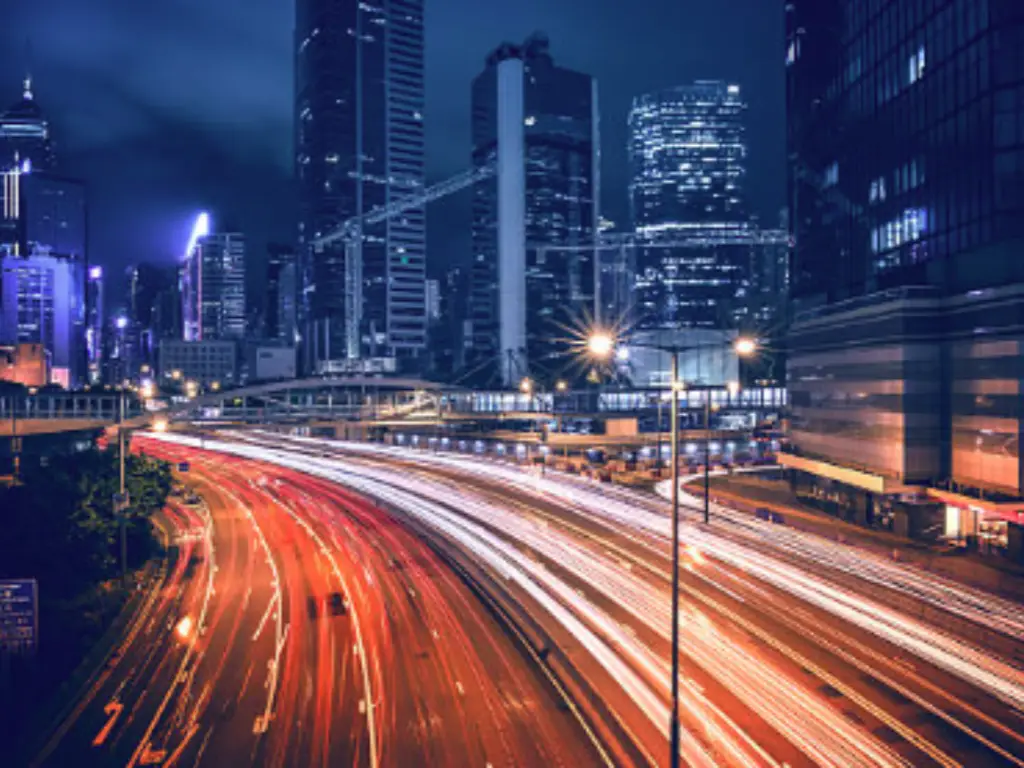
Residential Streets & Rural Roads (12–20 ft / 3–6 m)
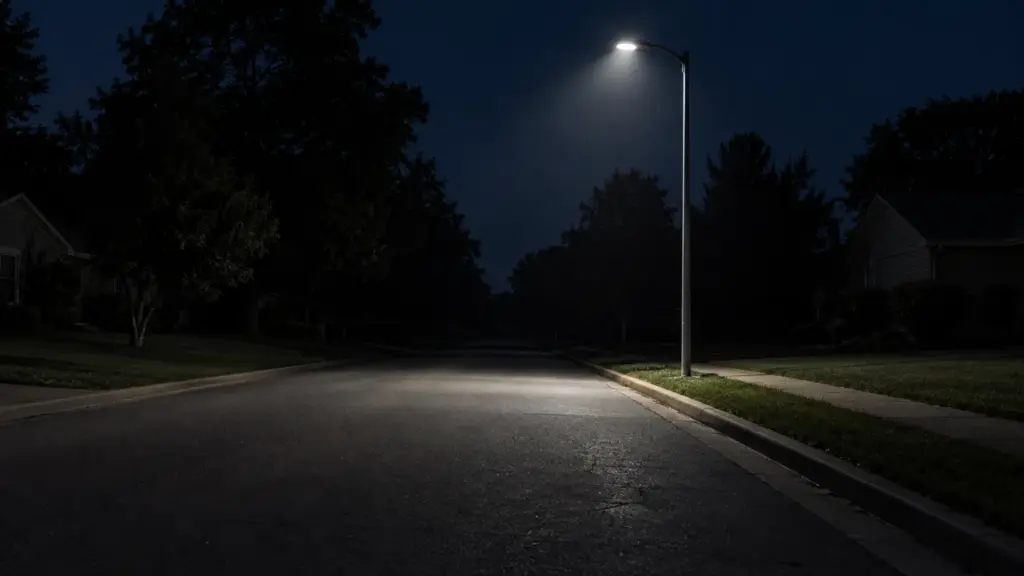
These are the street lights most people see every day — the ones lining subdivision roads and two-lane rural routes. At 12–20 feet, the pole is tall enough to cast light across a two-lane road, but short enough to keep glare out of bedroom windows.
This height range presents a specific engineering trade-off: go too tall and residents complain about light trespass. Go too short and the poles need tighter spacing, which drives up the total installation cost. The sweet spot for a typical residential street is a 15–18 ft pole with 60–100W LED luminaires, spaced 90–150 feet apart.
The spacing formula to remember: pole spacing ≈ 2.5 to 3 times the mounting height. A 5-meter (16 ft) pole gets spaced every 12.5 to 15 meters (40–50 ft). This ratio keeps the light distribution even, with no dark gaps between poles.
Urban Roads & Commercial Zones (20–30 ft / 6–9 m)
This is the workhorse height range — the one that appears most often in municipal tenders and brand-buyer specification sheets. City avenues, commercial district streets, shopping center parking lots, and office park ring roads all fall into this category.
At 20–30 feet, you get broad, even coverage across multiple lanes without the heavy structural engineering that highway poles demand. A 100–150W LED luminaire at this height can illuminate a four-lane arterial road to the 6–12 lux average specified by IESNA RP-8 for collector roads, with a uniformity ratio of at least 0.33.
Project planners often overlook a practical advantage of this range: maintenance. A 25-foot pole can be serviced with a standard bucket truck — the kind most municipal maintenance crews already own. Cross into the 40-foot-plus range, and you need specialized hydraulic lifts. Maintenance costs jump significantly.
For reference: the street lights along a typical downtown commercial district stand roughly 25 feet tall — about two SUVs stacked bumper to bumper. The pole base at this height is wide enough that an adult cannot wrap both arms around it.
Highways & Major Arterials (30–50 ft / 9–15 m)
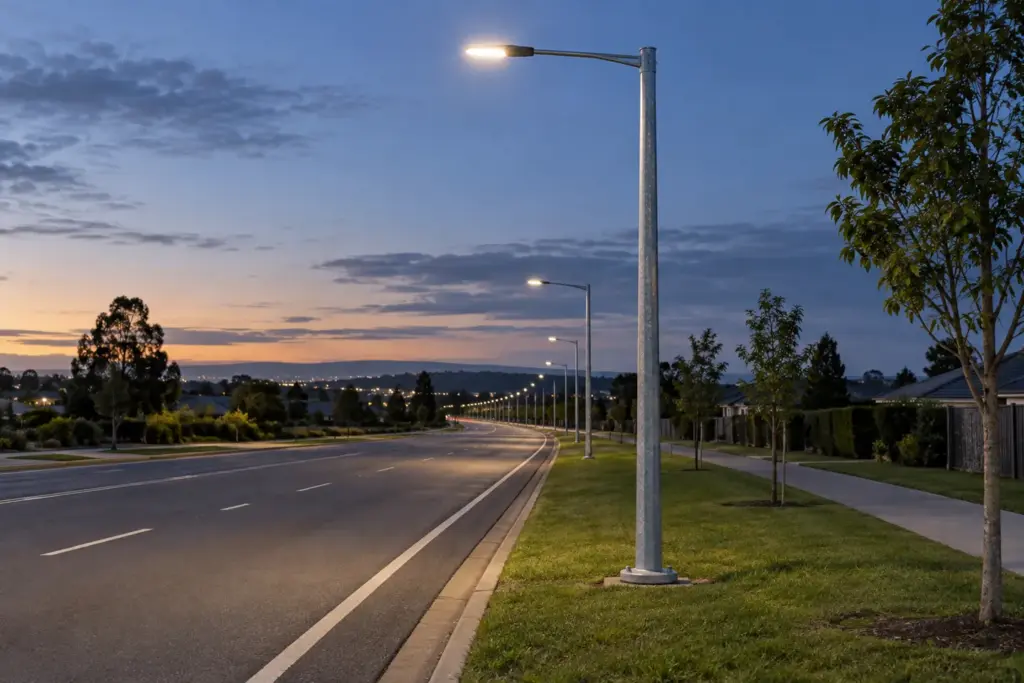
At highway speeds, everything changes. Drivers need longer visibility distances, wider coverage across multiple lanes, and zero dark-adaptation gaps between poles. A 30–50 ft mounting height delivers all three. That is why the U.S. Federal Highway Administration classifies 9–15 meters as the standard range for conventional roadway lighting.
At this tier, structural engineering becomes non-negotiable. A 40-foot pole in an open highway median faces wind loads roughly 1.3 times stronger at the top than at ground level. The bending moment at the base grows with the square of the height. That means pole wall thickness — typically 3–5 mm for steel poles in this range — and the EPA (Effective Projected Area) rating of the luminaire must both match the local wind speed data from ASCE 7.
LED wattage for this tier runs 150–300W, with pole spacing typically 150–250 feet. The luminaires almost always use IES Type II or Type III distribution patterns. Type II handles straight road segments with a wide, narrow beam thrown forward and to the sides along the road. Type III covers intersections and wider coverage areas.

High-Mast & Industrial Facilities (50+ ft / 15+ m)
High-mast lighting is a different species entirely. These are the 80–180 ft (25–55 m) giants at airport aprons, container ports, major highway interchanges, and large industrial yards. The FHWA classifies them separately from conventional roadway lighting for good reason — they are engineered as complete systems, not individual poles.
A high-mast installation typically mounts a ring of 4 to 12 luminaires, each 400–1000W LED, on a lowering platform at the top. Maintenance means lowering the entire ring to ground level with an integrated winch system. No bucket truck reaches 120 feet. The lowering mechanism itself becomes a critical reliability component — and one of the first things experienced project engineers inspect when evaluating a high-mast supplier.
Road Width, Spacing, and Wattage: The Three Numbers That Determine Pole Height
Ask a lighting engineer how they pick a pole height. They will not start with a catalog. They start with three numbers: how wide is the road, how far apart can the poles be, and how much light does each fixture produce. These three variables lock together. Change one, and the other two must follow.
Road Width: The 1:1 Rule of Thumb
The simplest design rule in roadway lighting: for single-side mounting, pole height should approximately equal road width. Lighting a 10-meter-wide road from one side? You need at least a 10-meter pole. This ensures the light reaches the far curb without an extreme tilt angle that would create glare for drivers.
The rule softens with more poles. Staggered mounting (alternating sides) drops the height-to-width ratio to 0.5–0.7. Opposite mounting (poles facing each other across the road) can go as low as 0.5. A wide boulevard with poles on both sides can use shorter poles than a narrow road lit from only one side.
A concrete example: a four-lane urban road, 12 meters wide. Single-side mounting needs a 10–12 meter pole. Staggered mounting can use 7–8 meter poles on alternating sides. More poles in the staggered layout, but each one is cheaper — the procurement decision becomes a trade-off between pole count and pole height.
The cantilever arm has its own rule: arm length should not exceed one-quarter of the mounting height. A 10-meter pole gets at most a 2.5-meter arm.
Pole Spacing: The 2.5–3× Formula for Uniform Coverage
Nothing ruins a street lighting installation faster than wrong spacing. Too far apart and you get the “zebra effect” — alternating bright and dark bands across the road surface that strain drivers’ eyes and create hiding spots for pedestrians. Too close and you waste money on unnecessary poles and energy.
The industry rule of thumb — spacing should be 2.5 to 3 times the mounting height — comes directly from photometric physics. A luminaire at 8 meters casts a usable light pool roughly 20–24 meters in diameter at ground level. For even coverage, the pools from adjacent poles must overlap by about 20–30%. At a 3:1 ratio, the edges just touch. At 2.5:1, they overlap comfortably.
The inverse square law adds another constraint: double the mounting height, and the light intensity at ground level drops to one-quarter. Taller poles need either more powerful luminaires or tighter spacing. The cost impact of either choice ripples through the entire project budget.
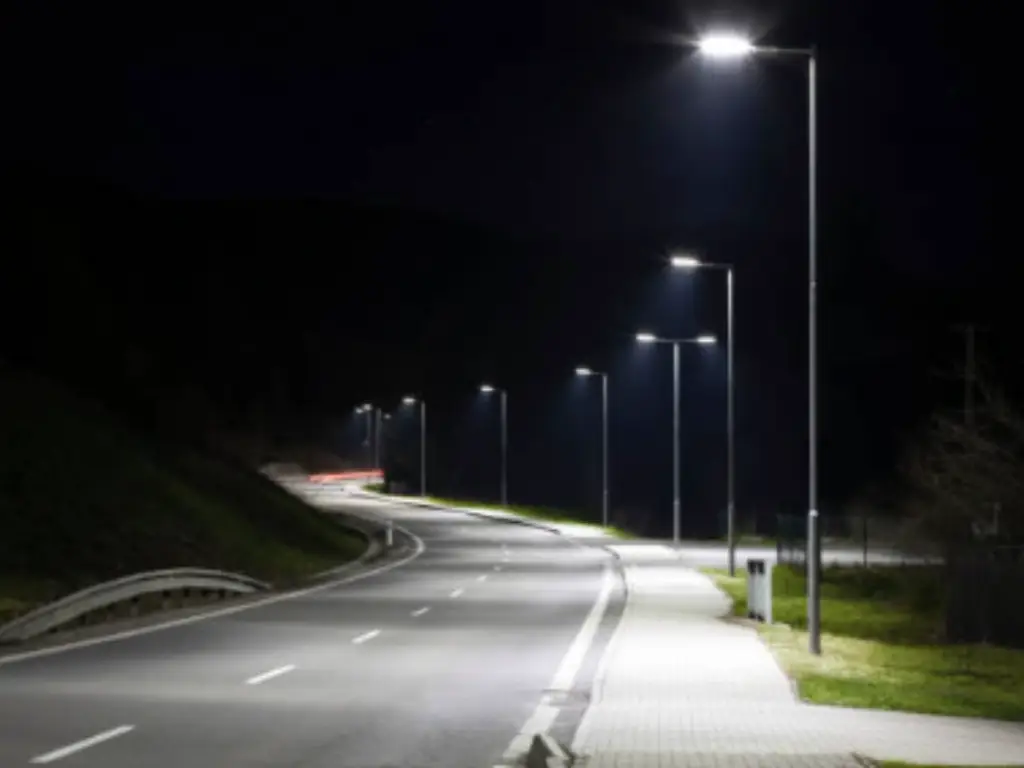
Wattage & Lumen Output: Matching Power to Height
The table below is a practical reference for matching LED wattage to mounting height. These are starting points. A proper photometric design using DIALux or AGi32 software will fine-tune the specification for the specific road geometry.
| Mounting Height | Recommended LED Wattage | Typical Lumen Output |
|---|---|---|
| 3–5 m (10–16 ft) | 30–60W | 3,900–7,800 lm |
| 5–7 m (16–23 ft) | 60–100W | 7,800–13,000 lm |
| 7–10 m (23–33 ft) | 100–150W | 13,000–19,500 lm |
| 10–12 m (33–39 ft) | 150–200W | 19,500–26,000 lm |
| 12–15 m (39–50 ft) | 200–300W | 26,000–39,000 lm |
| 15+ m (50+ ft) | 300–1000W+ | 39,000+ lm |
One number on this table deserves extra attention: lumens per watt (lm/W). This is the efficiency metric that separates commodity-grade street lights from performance-grade ones. A quality LED street light delivers 130–160 lm/W. A budget fixture manages 100–120 lm/W. At 150W, that 30 lm/W gap means 4,500 lumens of difference — enough to visibly change how bright a residential street looks at night. When comparing supplier quotes, asking for the lm/W figure, not just the wattage, is one of the fastest ways to filter out underperforming products.
Wattage tolerance matters just as much. The IEC standard allows ±10% variance. A “100W” light could be 90W or 110W and still pass. Better manufacturers hold themselves to ±5%, and their batch-level testing reports prove it. At ±5% on a 100W fixture, actual power draw stays between 95W and 105W — tight enough that the designed illumination level stays predictable across every unit in the shipment.
Street Light Height Standards: FHWA, EN 13201, and IESNA at a Glance
If you are sourcing street lights for a project, the height you choose is not entirely up to you. Each region has its own lighting standard. They all address mounting height. They do it differently.
| Standard | Region | Scope | Key Height Reference |
|---|---|---|---|
| IESNA RP-8-22 | US / North America | Roadway lighting design & performance | Conventional: 9–15 m; High-mast: 25–55 m |
| FHWA Lighting Handbook | US Federal | Highway lighting requirements | 30–50 ft conventional; 80–180 ft high-mast |
| EN 13201 | EU / Europe | Road lighting — 5 parts covering performance, design, calculation, measurement | Height derived from road class (ME/CE/S series) |
| AS/NZS 1158 | Australia / NZ | Road & public space lighting | Category V (traffic) vs Category P (pedestrian) determine mounting height ranges |
| CJJ 45-2015 | China | Urban road lighting design standard | Performance-based; mounting height derived from road classification |
Before you finalize a pole height specification, confirm which standard governs the project location. A height that meets IESNA RP-8 for a U.S. arterial road may not satisfy EN 13201 for a European distributor’s catalog. If your supplier cannot tell you which standard their recommended height is based on, treat that as a red flag.
Ron Gibbons, Director of the Center for Infrastructure-Based Safety Systems at Virginia Tech Transportation Institute, has published extensive field research showing that mounting height directly affects not just illumination uniformity but also drivers’ object detection distance — a safety variable no height table captures on its own.
What a Height Table Will Not Tell You: Manufacturing Quality Across Height Tiers
A height table tells you how tall the pole should be. It does not tell you that a street light mounted at 10 meters faces fundamentally different manufacturing demands than one mounted at 5 meters. Higher mounting point, stronger wind loads, harder maintenance access, and less forgiveness for any quality shortcut.
The difference between a street light that lasts seven years and one that fails in two is rarely visible on a specification sheet. It lives in the aluminum grade, the seal design, and the component sourcing decisions made on the factory floor.
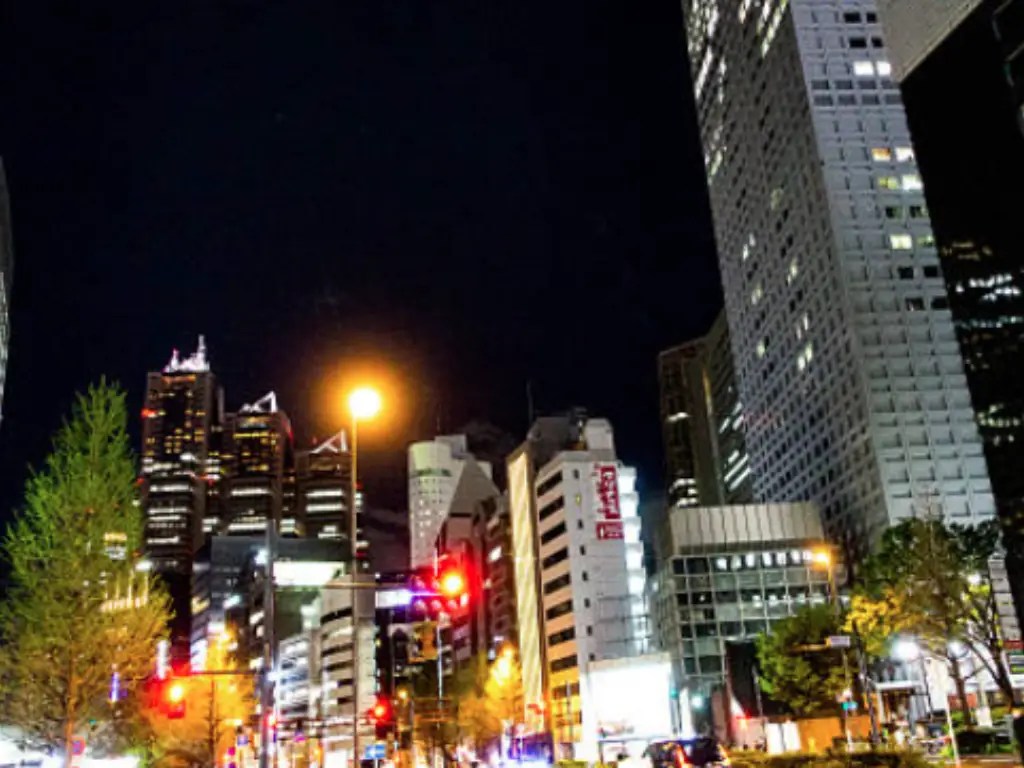
Housing Integrity: Why Die-Casting Quality Matters More as Height Increases
The aluminum housing of a street light is not a cosmetic shell. It is the primary structural element that bears wind load, sheds heat from the LED array, and protects internal electronics from rain, dust, and salt. As mounting height increases, every one of these demands intensifies.
Most quality street light housings use ADC12 aluminum alloy — an aluminum-silicon-copper formulation (9.6–12% silicon, 1.5–3.5% copper) that flows well in high-pressure die casting and delivers good strength-to-weight ratios. But ADC12 is a specification range, not a guarantee. The actual purity of the aluminum ingot, the casting pressure, and the post-casting machining all affect the final housing integrity. Budget production runs at 200–300 tons. Premium production uses 400–500 tons of pressure.
A high-pressure horizontal die-casting machine at 400–500 tons produces a denser casting with fewer internal gas pores than a 200–300 ton machine running faster cycles. Fewer pores mean better structural strength, better heat conduction from the LED board to the housing surface, and less risk of micro-cracks that let moisture in over years of thermal cycling.
How do you verify this without visiting the factory? Ask for the salt-spray test report. ASTM B117 salt-spray testing runs a continuous corrosive mist over the housing until corrosion appears. Standard-grade housings pass 500 hours. Better ones pass 1,000 hours. Top-grade housings — the kind specified for coastal installations and 10-meter-plus highway poles — pass 2,000 hours. The test duration is printed on the report. If a manufacturer hesitates to share it, they likely cannot.
IP Ratings and Weatherproofing: Getting Waterproofing Wrong at Height Is Expensive
An IP65 rating means the fixture is “dust-tight and protected against water jets.” IP66 means “dust-tight and protected against powerful water jets.” The difference between those two definitions: a 6.3 mm nozzle spraying 12.5 liters per minute, versus a 12.5 mm nozzle spraying 100 liters per minute. On a 10-meter pole in a coastal city, wind-driven rain hits the housing at pressures closer to the IP66 test condition.
The waterproof seal is a rubber gasket compressed between the housing and the lens frame. Three variables determine whether water stays out for two years or ten: the gasket material (silicone for high-temperature stability, EPDM for general use), the cross-section geometry (D-profile, O-profile, or custom-extruded), and the compression uniformity around the entire perimeter.
In regions where winter temperatures drop below -20°C, standard gaskets become brittle and lose compression. Frost-rated gaskets use specialized silicone formulations that hold elasticity at low temperatures. A small material upgrade that prevents the number-one failure mode in cold-climate street light installations.
The IK rating — impact resistance — is often overlooked in height discussions but becomes critical for higher-mounted fixtures. A luminaire at 6 meters might never face a physical impact. One at 10 meters, exposed to wind-thrown debris and occasional maintenance mishaps, benefits from IK08 (5 joules) or IK10 (20 joules) rated glass lenses. Tempered glass at IK10 absorbs a 5 kg mass dropped from 40 cm without cracking — the kind of real-world robustness that prevents an entire fixture from going offline because of a stray branch in a storm.
Component Selection: LED Chips, Drivers, and What Determines Real-World Service Life
The components inside the housing decide whether the light still performs at 90% brightness after five years — or flickers, dims, and needs an expensive replacement that costs more in labor than the fixture itself.
LED Chips. The gap between a CREE, OSRAM, or PHILIPS LED chip and an unbranded alternative is quantifiable. The LM80 test report measures lumen maintenance over time. A top-tier chip delivers L90 at 6,000 hours — meaning it still produces 90% of its initial output after 6,000 hours of continuous operation — and projects to L70 at 50,000–100,000 hours. A budget chip reaches L70 at 25,000 hours, losing 30% of its brightness in roughly three years of nighttime operation.
Drivers. The LED driver is the component most likely to fail first — specifically, the electrolytic capacitors inside it. On a summer night, internal driver temperatures inside a hot luminaire housing can exceed 85°C. Standard electrolytic capacitors rated for 5,000 hours at 105°C degrade rapidly under thermal cycling. Premium drivers from PHILIPS, Meanwell, or Inventronics use long-life capacitor formulations or film-capacitor alternatives that extend driver life to match the LED array — 50,000 hours or more. That is the difference between a 2-year warranty product and a 5-to-7-year warranty product.
Aluminum substrate (MCPCB). The aluminum-core PCB carries heat away from the LED chips into the housing. The critical variable is the copper layer thickness: 18 μm standard, 35 μm enhanced. The thicker copper cuts the thermal resistance between the LED junction and the housing by roughly 50%. That directly lowers LED operating temperature and slows lumen depreciation.
The total-cost equation. Here is the math experienced project buyers already know. Replacing a failed street light on a 10-meter pole requires a bucket truck, a two-person crew, traffic control, and roughly half a day of labor. The cost can easily exceed $500 per replacement — often more than the fixture itself. A light that costs 30% less upfront but fails in year three costs significantly more over five years than a light that cost more initially but runs without intervention the entire time. Warranty duration, and the manufacturing standards that back it, matters far more than the price-per-unit on the quote.
Quality-focused manufacturers address this by running separate production lines for different warranty tiers: one line for 2-year products using cost-optimized components, and a separate line for 5-to-7-year products using premium chips and drivers with documented batch-level traceability. This prevents the standard drift that happens when both tiers share a production line. Leading manufacturers operate distinct production lines per warranty tier and publish transparent material selection standards for street light components — specifying which LED chip brands, driver models, and aluminum grades correspond to each warranty level. This gives the buyer verifiable criteria to audit before placing an order, rather than taking warranty claims on faith. If you are evaluating suppliers, requesting component specification sheets with batch-level test data is a fast way to separate manufacturers who can back their warranty from those who cannot.
From Specification to Supplier: What to Verify Before You Source
You now know the height your project needs, the factors that determine it, the standards that govern it, and the manufacturing quality markers that separate a durable fixture from a future headache. The last step: turning that knowledge into a supplier evaluation.
Here are six questions to ask any street light manufacturer before placing an order. Each targets a specific quality indicator that a height table alone cannot reveal.
- “What aluminum grade do you use for the housing, and can you provide batch-level spectrometer reports?” — Verifies ADC12 purity. A manufacturer who cannot produce per-batch material certification is either not testing or not confident in their supplier’s consistency.
- “What is your salt-spray test duration for fixtures at this mounting height, and can you share a recent test report?” — Reveals real corrosion resistance. Look for 1,000 hours minimum; 2,000 hours for coastal or high-humidity installations.
- “Which LED chip and driver brands do you use for your 5-year warranty products versus your 2-year products?” — Separates tiered-quality manufacturers from one-spec-fits-all operations. If the answer is “same for both,” ask how they achieve the longer warranty with identical components.
- “Do you run separate production lines for different warranty tiers?” — A “yes” with details about how they prevent cross-contamination between lines signals serious process control. A “no” or a vague answer signals that warranty duration is a marketing claim, not an engineering commitment.
- “Can you provide a DIALux simulation for my specific road width and pole spacing?” — Tests whether the manufacturer has in-house application engineering capability or is just a product vendor. A proper simulation includes illuminance maps, uniformity ratios, and glare ratings — not just a wattage recommendation.
- “What does your warranty actually cover — parts only, or parts plus one-way freight and duties?” — The strongest after-sales commitments include freight coverage. It means the manufacturer is confident enough in their product to bet on low failure rates.
Buying street lights is not about comparing heights. It is about comparing what happens at that height five years later — in wind, rain, salt, and heat — when the only thing standing between a working road and a dark one is the quality of the aluminum, the seal, and the components inside the housing.
References
- Federal Highway Administration. “FHWA Lighting Handbook.” U.S. Department of Transportation. https://highways.dot.gov/safety/other/visibility/fhwa-lighting-handbook-august-2012
- Illuminating Engineering Society. “ANSI/IES RP-8-22: Recommended Practice for Design and Maintenance of Roadway and Parking Facility Lighting.” 2022. https://www.ies.org/wp-content/uploads/2023/04/RP-8-22-comprimido_compressed.pdf
- European Committee for Standardization. “EN 13201: Road Lighting.” Parts 1–5. https://www.cencenelec.eu/news-events/news/2026/brief-news/2026-09-23-week-of-sport/
- Standards Australia and Standards New Zealand. “AS/NZS 1158: Lighting for Roads and Public Spaces.” https://www.standards.org.au/
- ASTM International. “ASTM B117-26: Standard Practice for Operating Salt Spray (Fog) Apparatus.” https://store.astm.org/b0117-26.html

 English
  Spanish
  French
  German
  Italian
  Arabic
  Russian
  Portuguese
  Dutch
Dutch  Indonesian
  Turkish
  Polish