
Welcome to the definitive engineering guide for basketball court lighting. Upgrading a gymnasium or constructing a professional outdoor sports complex requires mastering precision optics, strict structural safety assessments, and calculating long-term financial viability. This comprehensive breakdown navigates you through every critical phase—from international FIBA standards and wind load physics to the True Cost of Ownership (TCO) models that drive commercial purchasing decisions. Let us engineer a lighting system that performs flawlessly and generates a measurable return on investment.
The Tipping Point: The Physical and Financial Failures of Metal Halide
For decades, High-Intensity Discharge (HID) and Metal Halide lamps were the undisputed standard for sports arenas. However, the physical limitations of these legacy systems present severe, ongoing operational liabilities for modern facility managers and electrical contractors.
Consider the catastrophic scenario of a packed high school championship game operating under legacy Metal Halide fixtures. A sudden, momentary power grid fluctuation causes the lights to drop out. Due to the physical nature of HID arc tubes, the lamps cannot simply be turned back on. They require a mandatory 15 to 30-minute cooling and restrike period before the internal gases can re-ignite. This delay is not merely an inconvenience; in a commercial setting, it results in interrupted television broadcasts, outraged corporate sponsors, and potential mass ticket refund demands. In stark contrast, modern LED technology features solid-state instant-on and instant-restrike capabilities, immediately restoring full 100% illumination the absolute second power returns to the facility.
Furthermore, legacy lighting suffers from aggressive and unavoidable lumen depreciation. A standard Metal Halide lamp can lose up to 30% of its initial light output within the first 10,000 hours of operation. A basketball court that passes local municipal lighting inspections on opening day may fail to meet minimum legal safety standards by year two, resulting in a dim, yellowed, and uneven playing surface. High-quality LED fixtures fundamentally eliminate this rapid optical degradation. By utilizing advanced thermal management systems, premium LEDs offer an L70 lifespan of up to 100,000 hours. This ensures the court remains brilliantly illuminated and safety-compliant for over a decade without a single bulb replacement, completely altering the financial trajectory of the facility.
The Rulebook: FIBA Standards, TV Broadcasts, and Lumen Requirements
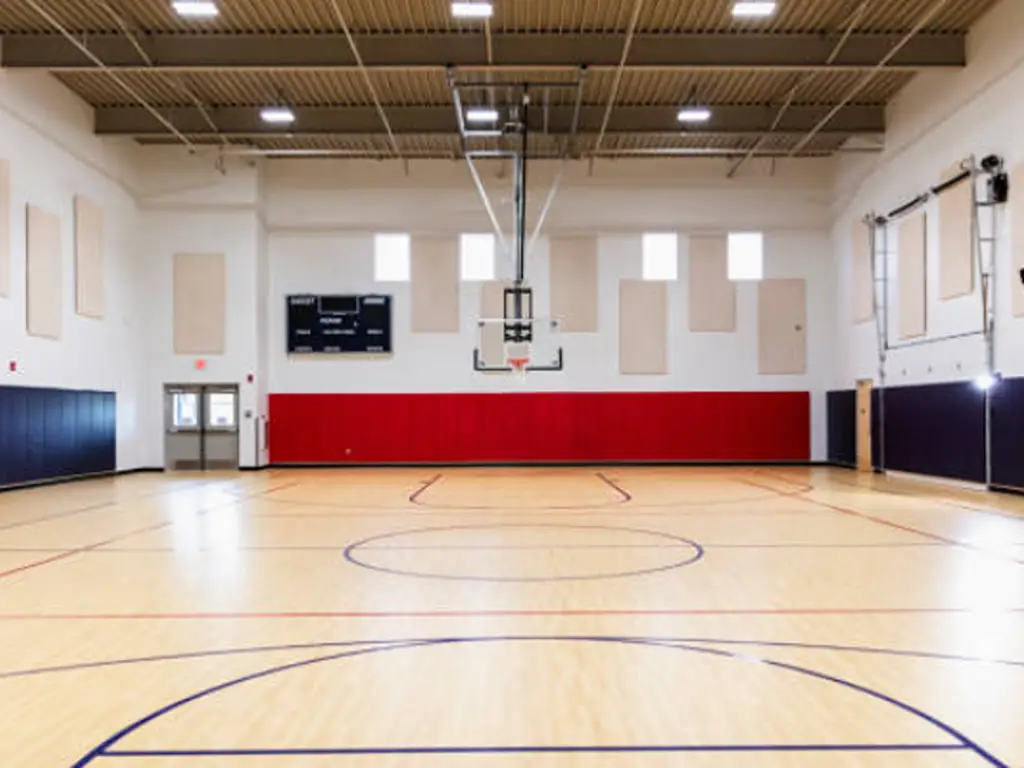
Before purchasing any hardware, contractors must understand the exact photometrics required by international and regional governing bodies. Relying on guesswork or outdated rules of thumb inevitably leads to failed inspections, poor playing conditions, or massive budget overruns caused by significantly over-illuminating a space. According to the authoritative FIBA Guide to Basketball Facilities and the EN 12193 European Standard for Sports Lighting, court illumination is divided into distinct tiers.
Decoding FIBA Classes and Television Broadcast Parameters
It is a common engineering mistake to treat all courts equally. The lighting standards change drastically based on the speed of the game and whether or not the event will be recorded by professional camera crews.
- Class III (Recreational & Training – 200 Lux): This is the baseline for high school physical education, community parks, and amateur practice. The primary metric here is Horizontal Illuminance (Eh)—ensuring the floor itself is bright enough for players to safely see the ball, teammates, and the boundary lines.
- Class II (Regional & Club Competition – 500 Lux): Used for medium-level regional tournaments. The faster gameplay demands better visual acuity and a much tighter uniformity ratio (U0 > 0.6) across the entire court surface to prevent dark patches.
- Class I (National & International Non-Televised – 750 Lux): This is the elite standard for top-tier national league matches that are played in front of large crowds but do not have professional television broadcast requirements.
- Televised Broadcast Levels (1000 to 2000+ Lux): The moment a game is televised, horizontal floor lux is no longer sufficient. The engineering focus abruptly shifts to Vertical Illuminance (Ev). Cameras require light to strike the players’ bodies and faces evenly from multiple angles to prevent them from appearing as dark silhouettes against the bright floor. Furthermore, televised events mandate a Color Rendering Index (CRI) of > 90 to accurately reproduce team jersey colors, and the LED drivers must deliver Flicker-Free performance (≤ 1% flicker rate) to prevent violent water-ripple effects on 4K 240-fps slow-motion replay cameras.
The Lumens vs. Lux Conversion Matrix
A frequent error made by amateur contractors is confusing Lux (the actual measured light arriving at the floor) with Lumens (the raw light energy leaving the fixture). Converting one to the other requires advanced photometric modeling. To prevent costly engineering errors, the following quick-reference matrix is built upon strict, real-world physical constraints. Parameters: These calculations strictly assume a standard 10-meter (32-foot) pole height, utilizing highly efficient 60°/90° NEMA asymmetric optics, mapped onto a standard 420-square-meter full playing surface, factoring in a Maintenance Factor (MF) of 0.8 to account for dirt and minor LED aging.
| Target Standard | Average Target (Lux) | Estimated Total Lumens | Typical LED Configuration |
|---|---|---|---|
| Class III (Recreational) | 200 Lux | Approx. 175,000 lm | 4 x 300W LED fixtures |
| Class II (Regional) | 500 Lux | Approx. 437,500 lm | 6 x 500W LED fixtures |
| Class I (National) | 750 Lux | Approx. 656,000 lm | 8 x 600W LED fixtures |
| TV Broadcast (HD/4K) | 1500+ Lux (Vertical) | 1,300,000 – 1,800,000+ lm | 12 to 16 x 800W-1000W Broadcast LEDs |
How to Execute This Matrix in the Field
This table is your primary quoting tool, but it must be used correctly to yield accurate results. Here is how a professional contractor utilizes this matrix:
First, identify the client’s strict regulatory requirement—do not over-promise a TV-broadcast level system for a high school that only needs Class II regional compliance, as this will needlessly inflate the bid and lose the job. Second, locate the required Total Lumens in the matrix based on that target Class. Finally, divide that total lumen number by the exact lumen output of your chosen LED fixture model. For example, if your chosen 500W fixture outputs 75,000 lumens, and the project requires 437,500 lumens for Class II, you divide 437,500 by 75,000 to realize you need precisely 5.8 fixtures—which means you must quote the client for a standard 6-pole, 6-fixture layout.
The Engineering Transition: Now that the photometric math is solved, we reach a critical engineering fork in the road. You have successfully completed the “paper calculation,” but light is ultimately a physical phenomenon. Emitting 500,000 lumens inside an enclosed, air-conditioned gymnasium requires a vastly different delivery strategy than emitting those same lumens on a windy, rain-soaked municipal park court. Indoor environments must battle highly reflective hardwood floors and the physical impact of flying basketballs. Conversely, outdoor environments must survive hurricane-force winds tearing at structural poles and neighborhood associations threatening lawsuits over light pollution. Therefore, once your target lumens are locked in, we must split our hardware selection and layout topologies into two distinct environmental pathways.
Indoor Arena Masterclass: Fixture Selection and Structural Topologies
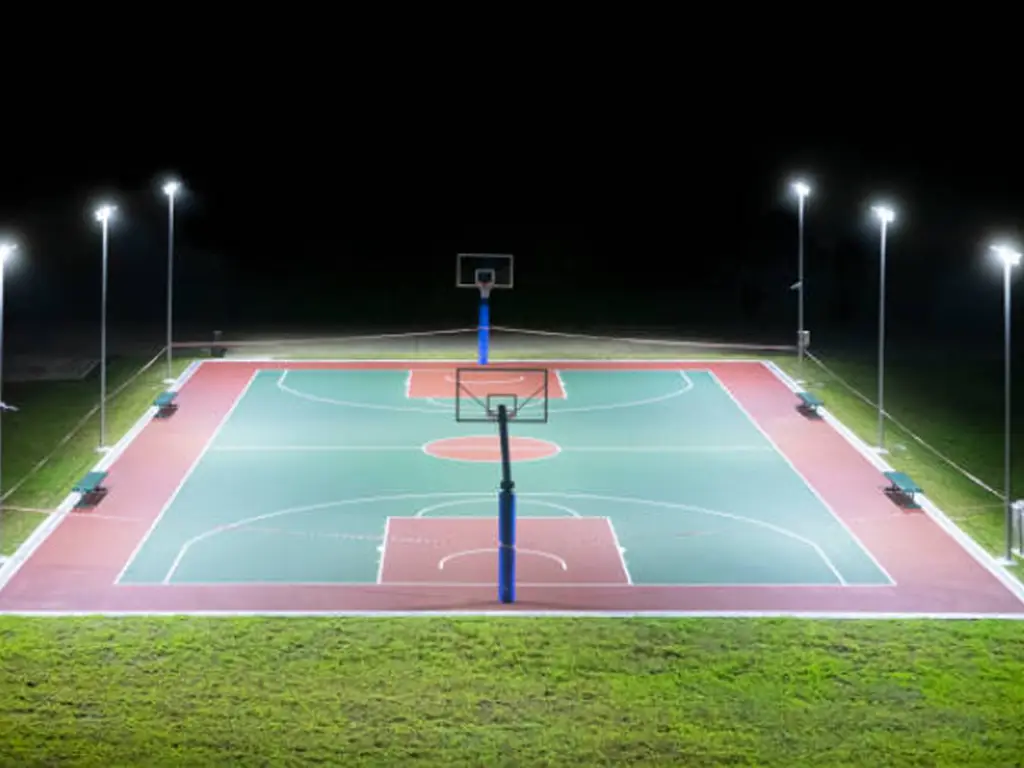
Indoor sports lighting design strictly prohibits the use of free-standing poles. Instead, engineers must intelligently utilize the existing ceiling architecture, structural catwalks, and steel beams to mount fixtures while heavily mitigating the severe glare created by highly polished indoor hardwood surfaces.
Hardware Defenses: Anti-glare and Impact Resistance
- Unified Glare Rating (UGR ≤ 22): Standard office spaces require a UGR of under 19, but high-ceiling sports arenas operate on a different scale, demanding a UGR of 22 or lower for athletic safety. When a point guard sprints down the court and looks vertically up toward the hoop for a rebound, staring directly into an unshielded, high-intensity LED diode will cause immediate flash blindness. Professional indoor fixtures utilize deep-recessed diodes, frosted polycarbonate diffusers, and specialized internal baffles to soften the light and completely eliminate direct eye contact with the raw light source.
- Impact Resistance (IK10 Standard): The physical hazards of an indoor gymnasium are immense. Stray basketballs, volleyballs, and occasionally athletic equipment frequently impact the ceiling at high velocities. An IK10 mechanical impact protection rating is non-negotiable. This standard guarantees that the luminaire’s heavy-duty housing and lens can survive the direct drop of a 5-kilogram steel mass from a height of 400mm. Without IK10 certification, a shattered glass lens could rain sharp debris down onto the court, causing severe lacerations to athletes and triggering massive liability lawsuits against the contractor.
Indoor Arena Layouts: Symmetrical Grid Arrays vs. Catwalks
Because there are no poles, contractors must choose how to mount the lighting to the roof structure based entirely on the facility’s budget and long-term maintenance capabilities.
- Symmetrical Grid Arrays (High Bay Suspensions): This is the most common layout for high schools and local community centers. LED UFO High Bays or linear LED fixtures are suspended directly above the playing surface in 3 or 4 longitudinal rows spanning the length of the court. This direct top-down lighting provides excellent, highly efficient horizontal illumination and is generally the most cost-effective to install initially. However, maintaining these lights requires bringing heavy mechanical scissor lifts onto the delicate hardwood court, which requires special protective flooring covers to prevent crushing the wood.
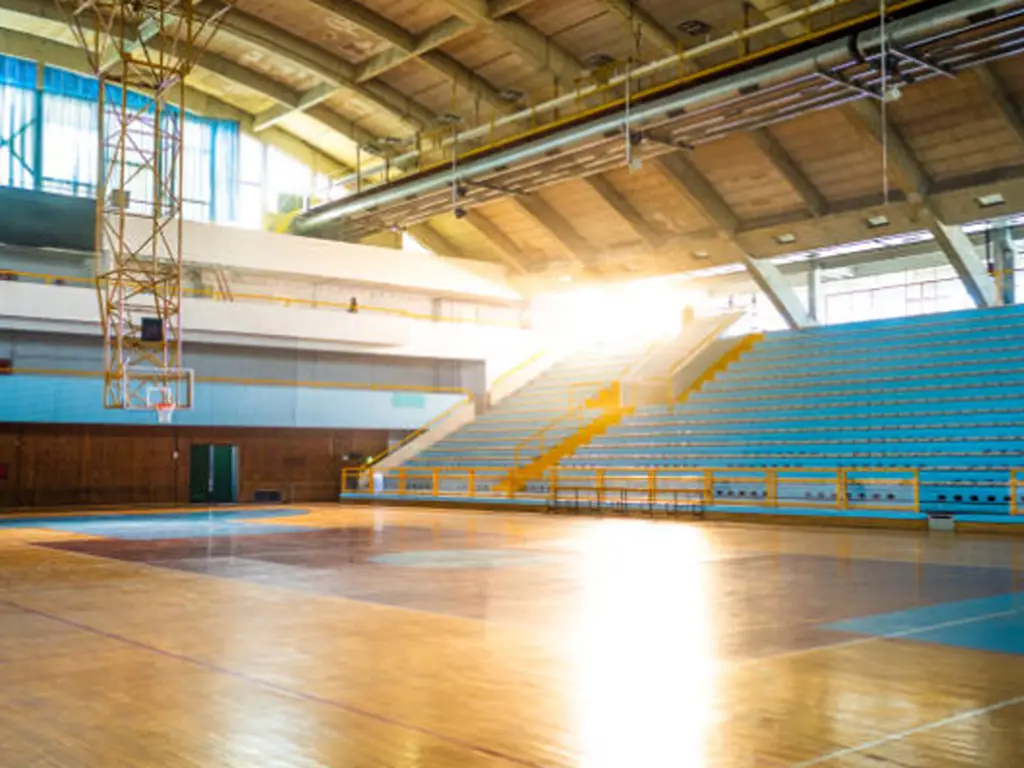
- Catwalk and Perimeter Mounts: This is the gold standard for collegiate and professional indoor arenas. Fixtures are mounted high up on the perimeter walls or along structural maintenance catwalks spanning the outer sides of the court. The lights are tilted inward toward the center of the court using specialized asymmetrical lenses. This completely removes the light source from the players’ direct vertical line of sight, vastly reducing glare. More importantly, facility technicians can safely replace wiring or clean lenses by simply walking along the catwalk, completely avoiding the need to drive heavy lifts onto the playing floor.
Outdoor Court Engineering: Poles, EPA, and Light Pollution
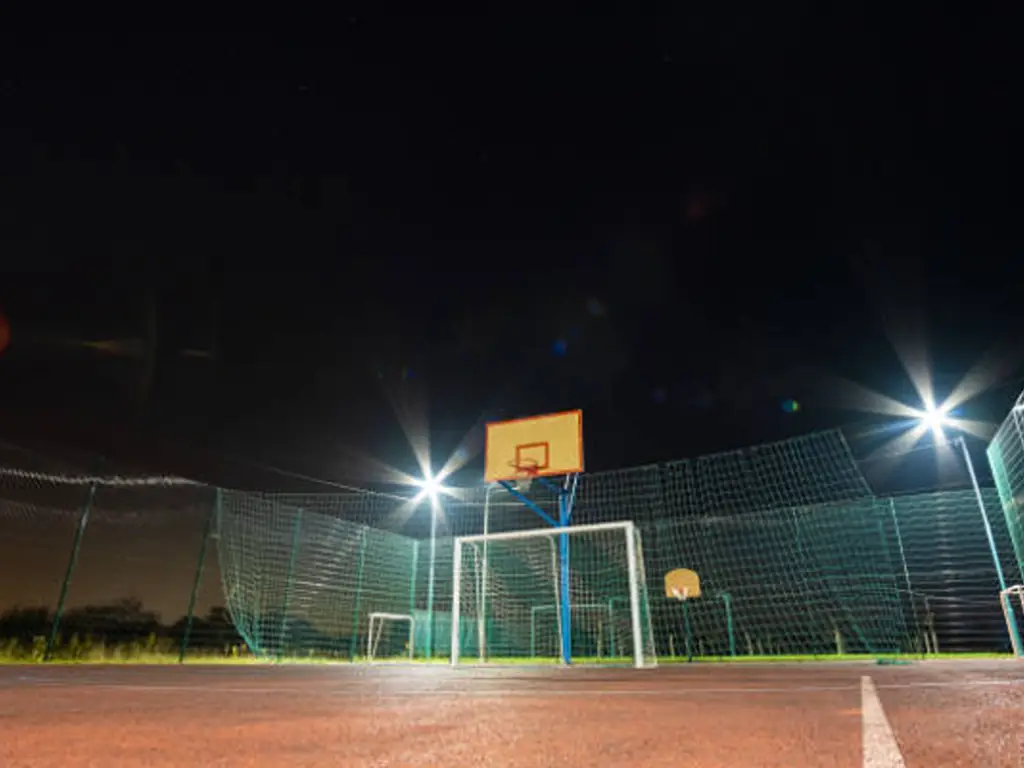
Engineering an outdoor facility introduces volatile variables that indoor arenas never face. Outdoor lighting is a relentless battle against corrosive weather, structural aerodynamics, and strict municipal zoning laws regarding environmental light trespass.
Weatherproof Hardware: IP66 and Salt Spray Tests
A standard IP65 waterproofing rating is insufficient for professional outdoor sports lighting that will face decades of exposure. High-end fixtures must carry a minimum IP66 rating, ensuring the optical chambers are entirely sealed against high-pressure water jets and microscopic dust infiltration during severe storms. Furthermore, if the court is located in a coastal region or subjected to heavy winter road salts, the luminaire housing must pass the rigorous 1000-Hour Salt Spray Test (ASTM B117). This involves treating the housing with a marine-grade anti-corrosion powder coating that prevents the aluminum heat sinks from oxidizing, blistering, and crumbling in harsh, saline environments.
Outdoor Placement Strategies: 2, 4, 6, and 8-Pole Configurations
Determining the quantity and placement of lighting poles dictates the shadow profile of the athletes on the court. Regardless of the pole count chosen, strict player safety regulations mandate that all poles must be set back a minimum of 1 to 1.5 meters from the boundary lines to prevent high-speed physical collisions.
- 2-Pole Configuration: The baseline solution for backyard half-courts. Poles are positioned near the baseline corners or slightly offset, pushing light inward toward the hoop.
- 4-Pole Configuration: The standard for recreational community full-courts. Poles are placed near the four corners of the court. While highly economical, this setup can create a slight shadowing dip in the direct center of the court where the four light beams overlap at their furthest and weakest points.
- 6-Pole Configuration: The municipal and high school golden rule. By adding two additional poles precisely at the mid-court line, engineers completely eliminate the “center court dip,” ensuring phenomenal uniformity and shadow-free running paths for the athletes.
- 8-Pole Configuration: Reserved for elite professional and broadcast arenas. This setup surrounds the court with overlapping photometric arcs from all sides, eliminating all dead zones and providing flawless vertical illumination for camera crews.
The Hidden Engineering Killer: EPA and Wind Load Assessments
When retrofitting legacy outdoor courts, many contractors mistakenly believe they can simply unbolt the old Metal Halide boxes and attach new LED fixtures to the existing 40-foot poles. This assumption can be structurally fatal. It all comes down to EPA (Effective Projected Area).
Think of an elevated luminaire as a physical sail catching the wind. Modern LED fixtures require extensive, heavy aluminum heat sinks to dissipate thermal loads, meaning they often have a larger surface area and heavier mass than legacy bulbs. The EPA represents the aerodynamic drag the fixture creates during high winds. If the combined EPA and weight of the new LED fixtures exceed the structural wind load rating of the old pole—especially in hurricane-prone AASHTO 150-mph wind zones—the leveraged force will snap the steel pole in half. A rigorous engineering audit must evaluate the local wind zone ratings against the new fixture’s EPA. If the mathematics fail, the entire pole infrastructure must be immediately replaced to prevent catastrophic accidents.
Eradicating Spill Light: The Engineering of Neighborhood Harmony
Perhaps the most common reason outdoor community courts face legal action, forced curfews, or total municipal shutdowns is light pollution. When a city installs powerful symmetrical floodlights, the light naturally scatters outward in a 360-degree halo, blinding passing drivers and illuminating the bedrooms of adjacent residential neighborhoods.
Professional contractors neutralize this threat using Asymmetric Optics and external Spill Visors. Instead of blasting light symmetrically in all directions, an asymmetric NEMA Type 3 or Type 4 PC lens acts as an optical scalpel. It bends and throws the light sharply forward, surgically dropping it onto the playing surface while creating a hard, defined cut-off line directly behind the pole. By combining these advanced lenses with external glare shields, engineers can strictly contain light trespass, ensuring that just 3 meters outside the facility’s chain-link fence, the spill light drops to an environmentally compliant 0.5 to 2 footcandles. This Dark-Sky compliant engineering saves municipalities from debilitating neighborhood lawsuits and preserves local nocturnal ecosystems.
True Cost of Ownership (TCO): A Data-Driven Financial Breakdown
When presenting a proposal to a school board, commercial developer, or municipal procurement officer, focusing solely on the initial hardware price is a guaranteed way to lose the bid. Commercial decision-makers evaluate investments based on a 5-year True Cost of Ownership (TCO) model. You must prove the financial superiority of the system by analyzing the sum of initial capital, ongoing energy consumption, and the historically exorbitant maintenance fees associated with legacy lighting.
5-Year Financial Impact Sandbox
Let us calculate a realistic, data-driven 5-year TCO comparison for a standard 6-pole municipal court upgrade. We will compare an existing system of six 1000W Metal Halide fixtures against a modern retrofit using six 400W LED fixtures. Assume the court lights run for 5 hours a night, 365 days a year (totaling 1,825 hours annually), with a commercial electricity rate of $0.15 per kilowatt-hour.
- The Baseline – Metal Halide Energy Costs: A 1000W Metal Halide actually draws about 1100W when accounting for the ballast draw. Six fixtures at 1.1kW equals 6.6kW of total draw. Running for 1,825 hours results in 12,045 kWh consumed annually. At $0.15/kWh, the annual electricity bill is roughly $1,806. Over 5 years, this totals $9,030 in energy alone.
- The Baseline – Metal Halide Maintenance: Metal Halides require frequent bulb and ballast replacements. Renting a commercial boom lift costs roughly $500 per day, plus the hourly rate of a licensed high-voltage electrician and the parts. Two maintenance visits a year can easily cost $1,500. Over 5 years, this equates to a staggering $7,500 in maintenance.
- The Upgrade – LED Energy Costs: Six 400W LED fixtures draw exactly 2.4kW. Running for 1,825 hours results in 4,380 kWh consumed annually. At $0.15/kWh, the annual electricity bill drops to just $657. Over 5 years, the energy cost is only $3,285.
- The Upgrade – LED Maintenance: Premium LEDs require absolutely zero bulb replacements or ballast changes for 100,000 hours. The 5-year maintenance cost is $0.
In this standard scenario, maintaining the legacy Metal Halide system costs the municipality over $16,530 over five years. The LED upgrade costs merely $3,285 to operate—generating over $13,000 in pure savings, which rapidly pays for the initial capital cost of the LED fixtures themselves within the first 18 to 24 months.
At Wosen, we actively engineer solutions to compress this TCO timeline. Rather than sourcing generic public molds, we utilize in-house die-casting facilities to produce thickened aluminum heat sinks, guaranteeing superior thermal management and a strictly maintenance-free 100,000-hour lifespan. Simultaneously, our proprietary high-transmittance asymmetric NEMA PC lenses surgically direct 95% of the lumen output exactly where it is needed, eliminating optical waste. By combining these two manufacturing advantages, we consistently empower contractors to achieve strict FIBA compliance while reducing their total fixture purchasing quantity by up to 20%, structurally slashing both upfront procurement costs and long-term energy overhead.
Conclusion
Mastering basketball court lighting goes far beyond basic wattage. By adhering to strict photometric standards, choosing precise hardware defenses for indoor impacts or outdoor wind loads, and engineering for absolute light containment, you guarantee a world-class sporting environment. Protecting your investment requires calculating the true long-term operational costs to prove undeniable ROI.
Ready to Engineer Your Court?
Stop guessing with standard bulbs. Gather your facility dimensions, pole heights, and target lux standards, and initiate your custom DIALux simulation today to visualize the exact performance of your future court.
Get Your Custom Lighting Audit

 English
  Spanish
  French
  German
  Italian
  Arabic
  Russian
  Portuguese
  Dutch
Dutch  Indonesian
  Turkish
  Polish