
Introduction: The Strategic Importance of Jobsite Illumination
Site illumination in the 2026 building industry has been transformed into a rudimentary utility to a highly contested financial variable. Adequate lighting is no longer an issue of safety to the project stakeholders, but a threat to the bottom line. Poor visibility results in costly recordable accidents, a costly delay in projects associated with night failures, and the huge cost of operation in keeping old light systems.
This manual goes beyond simple compliance to the real pain areas of the contemporary contractors that are to minimize liability, cut overhead energy, and the hidden costs of equipment failures. Considering proper lighting and LED technology as a strategic weapon and not an accidental by-product, companies can turn their places of employment into high-stake, high-precision 24/7 profit centers.
Compliance: Navigating OSHA Lighting Standards
OSHA 1926.56 presents the minimum standard that must be adhered to by any project lead to ensure sufficient lighting. The interpretation of these legal provisions helps to avoid the closure of the sites and provide a minimum level of human safety.
Required Illumination Levels by Construction Zones
OSHA quantifies intensity in Foot-candles (fc) depending on the type of risk and the level of accuracy of a zone. General construction areas should have at least 5 fc to allow easy movement, whereas indoor corridors and warehouses are to have the same level of 5 fc to ensure that the transitional hazards are observable. In cases of high-stake workplaces like general shops or high-level assembly places, insufficient lighting significantly increases the demand to 10 fc or beyond to avoid occurrence of error and injuries when carrying out intricate mechanical or electrical work.
Safety Protocols and Equipment Guarding
Brightness is only one of the regulatory compliance, which also touches on the physical integrity of the lighting system. OSHA stipulates that every single fitting, including temporary construction lights, should be physically covered to ensure that they will not be broken, as this can lead to electricity that is unsafe. Moreover, enclosements should have sufficient emergency backup light to allow their exit in case of power failure to avoid blackout panic in the workplace.
Project managers should use a combination of intensive on-site area lighting and portable solutions, which are specific to the needs of such a mix. Not only will the choices of the appropriate fixture to the particular exercise make it OSHA compliant, but it will also save considerable overhead of energy and time to implement, promoting energy efficiency.
Equipment Selection: Key Categories of Jobsite Lighting
LED Flood Lights
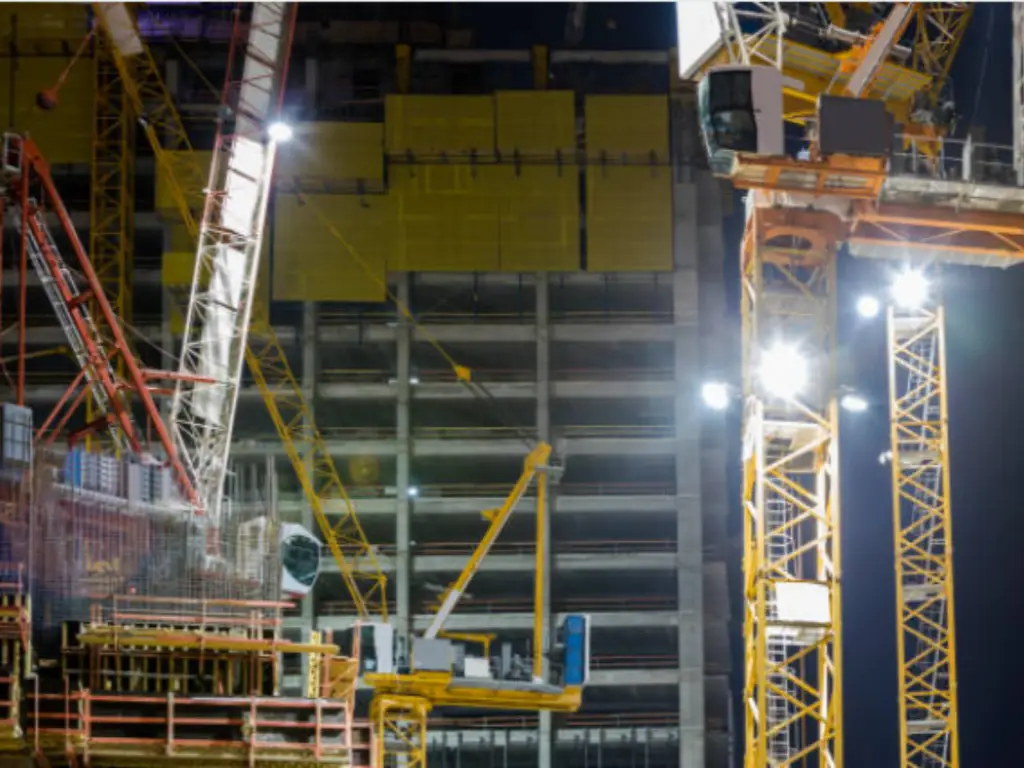
The LED Flood Light forms the basis of the general purpose all-purpose tool of wide area light. These fixtures are designed with high luminous flux and flexibility in beam angle making them stronger to cover vast large-scale open pits, foundation work, and high-security perimeter. Recent industrial floodlights, including halogen bulbs, have mounting brackets that can be adjusted and have a modular design, which is why they can be mounted on scaffolding, crane, or temporary poles. Their resistant properties to vibrations of heavy machinery are attributed to their strong-state construction thus they would always perform well in areas where the normal metal halide lamps would fail.
Mobile Light Towers
Mobile light towers, equipped with a light pole, are used in the construction of highways and in creating large excavations, designed to be used in large, dynamic areas outdoors and providing unmatched speed in deployment. These units have telescopic masts with the ability to reach up to 30 feet in the air which use high-mast illumination that illuminates acres of land at one location. With the change to LED-driven towers, this type has changed forever; as opposed to traditional diesel-guzzlers, LED towers have instant-on (no warming time) and can in many cases operate across multiple shifts on one tank or a small battery pack, which reduces the carbon footprint of the project dramatically and reduces fuel expenditures.
Temporary LED String Lights
The LED string lights, which are needed as part of the interior fit-out and finishing stage, will offer uninterrupted, linear lighting in the interior corridors, staircases, and tunnels. In comparison with the classical “caged” incandescent strings, the new LED models are much more efficient in energy consumption and they have polycarbonate housing, which is high-impact and which excludes the possibility of breaking glass. These lights can be planned to be designed to be connected in a daisy chain to stationary items, so that hundreds of feet of lighting can be driven over one outlet. This makes sure that transitional spaces are navigable and in line with the 5 fc requirement of OSHA even in the most complicated building layout designs.
Balloon Lights
Balloon lights are used in the industry when high visual accuracy is necessary and there is no danger of blinding glare. These lights contain a clear, inflatable fabric cover to spread this type of light over 360 degrees of radius, thus providing a shadow-free environment which resembles natural daylight. This is important in the night road paving where terrible glare produced by ordinary floodlights may jeopardize the safety of workers and road users. They are also favored because of their soft and uniform light by mechanical and electrical tasks in which workers need to look upwards or work with reflective substances.
High Mast Lights
Designed to be semi permanently fixed in large staging setups or other major infrastructure centers, high mast lights offer centralised high output lighting at high levels. Through complex optics used to manage the light spill these fixtures can light up large square sections with fewer units and thus the total number of fixtures decreases, especially when compared to machines or equipment with small headlights, and the installation of electrical distribution lines at the site becomes easier. High mast LEDs are also specially designed to be durable in the long term with high-grade thermal management to maintain maximum lumen output through months of 24-hour operation.
| Equipment Type | Core Characteristics | Primary Applications |
| LED Flood Lights | High intensity, wide beam angle, versatile mounting, providing broad and bright light coverage. | Open work zones, foundation pits, perimeter security. |
| Mobile Light Towers | High-mast height, heavy-duty, rapid deployment. | Highway construction, large-scale excavation. |
| Temporary String Lights | Linear, lightweight, continuous daisy-chain. | Indoor hallways, stairwells, tunnels. |
| Balloon Lights | 360° diffused light, zero-glare, shadow-free. | Precision mechanical work, road paving. |
| High Mast Lights | Centralized high-output, permanent/semi-permanent. | Major infrastructure hubs, staging areas. |
Financial Justification: ROI Analysis of Modern LED Systems
High-end LED systems are an investment of high-end that is a mathematical move depending on Total Cost of Ownership (TCO). Although the cost of buying the first unit might be comparatively high to the old HID lamps, savings in operations can break even within a short time, especially for outdoor use.
Calculating the Total Cost of Ownership (TCO)
LEDs consume less energy, have a longer lifecycle, and last longer compared to conventional lighting, especially when using led work lights.
| Cost Component | Traditional HID Lighting | Modern LED Systems | Potential Savings |
| Energy Usage | High (e.g., 1000W per lamp) | Low (e.g., 300W per lamp) | ~70% Reduction |
| Lifespan | 10,000 – 15,000 Hours | 50,000+ Hours | 5x Longer Life |
| Maintenance Labor | Frequent bulb/ballast changes | Near-Zero maintenance | Significant Labor Savings |
| Durability | Fragile glass/filaments | Solid-state/Shock resistant | Reduced breakage costs |
Maximizing Returns through Energy Incentives and Rebates
In addition to operational savings and reduced operational costs, intelligent financial planning uses the incentives provided externally to cover up the initial capital expenditure. Utility companies and local jurisdictions in North America and Europe are giving large rebates on equipment that is registered on the DesignLights Consortium (DLC) list. These schemes are usually in two types: Prescriptive Rebates which give fixed “per-fixture” cash back, and Custom Rebates which are given on the basis of the total kilowatt-hours (kWh) saved. With the right form of high efficiency LED systems that can be classified as tier-one in the energy certification programs, contractors have the potential to recoup 20 percent to 50 percent of the investment in the hardware in less than six months. Also, the latest tax laws in most jurisdictions permit accelerated depreciation of energy efficient assets, which increase the bottom-line profitability of the project even in the first year.
Manufacturing Excellence: Engineering Standards for Industrial LEDs
Excellent performance in the workplace is no accident, but the culmination of strict engineering measures to make high-quality raw materials into durability of operations in the long term.
Thermal Management and Optical Precision
Durability of a lamp in the tough construction and warehousing conditions is determined by the accuracy of its production for specific tasks. This stability is initiated with superior thermal control whereby effective cooling designs can reduce the chip junction temperature to prevent the depreciation of lumens. The system, in combination with accuracy lenses guiding all of the lumen in the locations of greatest need, attains a performance that is truly out of this world in comparison with standard lighting. These systems have tough aluminum housings and safety glass to resist the physical blows that would occur on the job sites.
Electrical Reliability and Global Compliance
The construction sites exist on a cruel paradox: they require the highest safety standards such as IEC 61000 and OSHA, whereas equipment has to deal with the dirty power grids, torrential rain, and brutal physical collision of the machinery such as jackhammers. This environmental stress tends to cause the most painful aspect of the industry—premature failure of the fixtures and unsafe dark areas that nullify compliance.
To bridge this gap, the engineering must transition from standard consumer grade to industrial-heavyweight. WOSEN can overcome these field realities through the use of high-purity ADC12 aluminum in the housing, which is actually designed with IK10 impact resistance rating. This is the ultimate level of protection where the fixing is assured, the mechanical shocks and accidental impacts that are friendly to heavy-duty areas are experienced. This hardened goods with an IP65/IP66 seal is completely operational between -40°C to 50°C with integrated active surge protection shielding sensitive electronics against massive voltage breaks. It provides a stable margin of ±5% lumen guaranteeing that your Photometric Study would translate into a safe, reliable and OSHA certified work station.
Precision Layout Planning: Engineering for Maximum Coverage
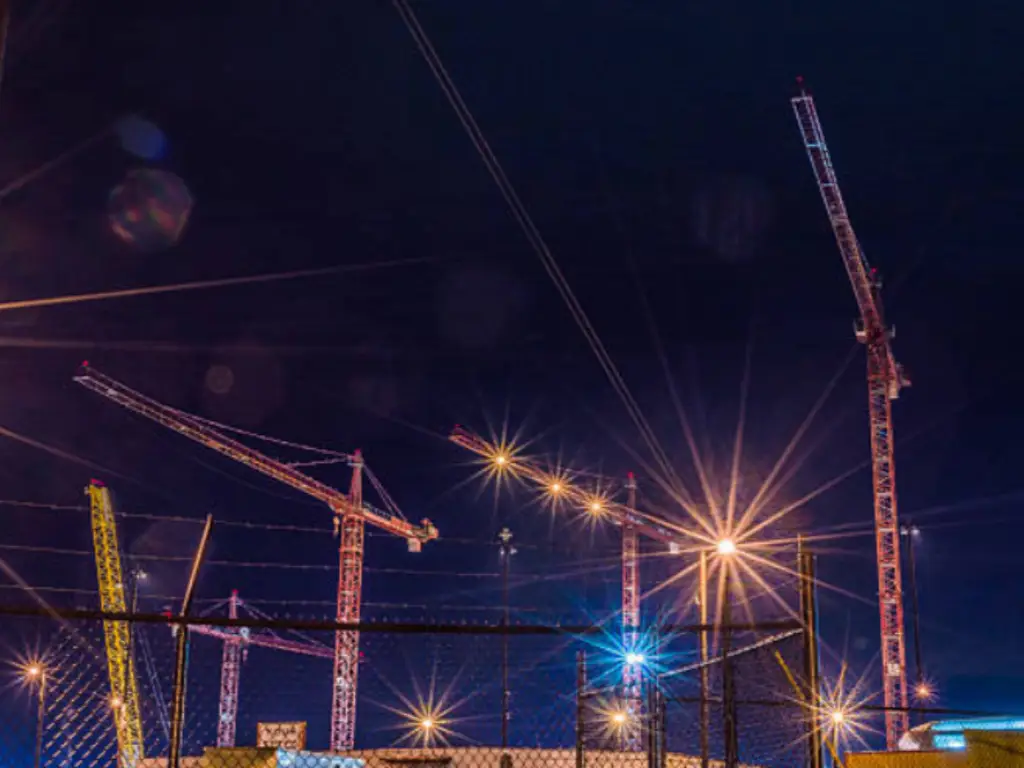
Achieving good lighting layout with tall lights is a matter of engineering efficiency and not necessarily increasing the number of lamps. The professional approach starts with a Photometric Study, which is a computer-based simulation showing the intensity of the light over the topography of the whole site.
With the entry of specific technical requirements, such as the beam angle and the ±5% stable lumen output of the fixtures, the engineers are in a position of determining the exact mounting height and the compact size tilt angle to be used in order to overcome dangerous dark spots and unnecessary glare. This evidence-based practice would also enable much greater distance between units without affecting the foot-candle provisions of OSHA.
An example would be the use of high-intensity fixtures having better optical control to have a site that used 50 lamps traditionally only use 40 of those lamps to obtain the same even lighting. This 20% savings in the number of fixtures produces a compounding saving effect: it will reduce the initial purchase or rental price, the amount of electrical connection and poles needed, and the overall amount of power consumed by on-site generators. Finally, precision layout planning, will change lighting into a cost of guesswork to a calculated engineering solution which is the safest at minimum operational footprint.
The Innovation Shift: Leveraging Smart Tech for Automation
The switch towards Smart Lighting resolves the age-old industry sore of manual management of the sites by converting illumination into a data-driven asset. The IoT-integrated floodlights allow the project managers to remotely access the complete systems through smartphones or management systems, allowing the management to have a finer control of the electrical grid. They have superior photocells and motion sensors that can automatically regulate the intensity depending on the ambient light or the activity of the worker to ensure maximum saving of energy without the need to be controlled by man.
Moreover, accuracy in scheduling is done to make sure that work areas are only lightened on working shifts and the diagnostics are integrated to give real-time information on the health of the hardware. The predictive maintenance will ensure that crews can see failures that might pose safety risk even before it becomes one, thereby saving on power and preventing the occurrence of unforeseen blackouts in the process of undertaking the most important night operations.
Conclusion: Securing Profitability Through Proper Illumination
Construction site lighting is a complex equation of the legal rules, human being and engineering safety. The low bid systems of disposable lighting can be discarded and the high performance LED systems implemented by firms to realize their profitability. A more productive site would be a safer site. The project managers must review their current lights plans or consult with industrial professionals to obtain a custom photometric plan that will result in the highest level of safety and minimum spending.

 English
  Spanish
  French
  German
  Italian
  Arabic
  Russian
  Portuguese
  Dutch
Dutch  Indonesian
  Turkish
  Polish