
What Is a High Bay Light?
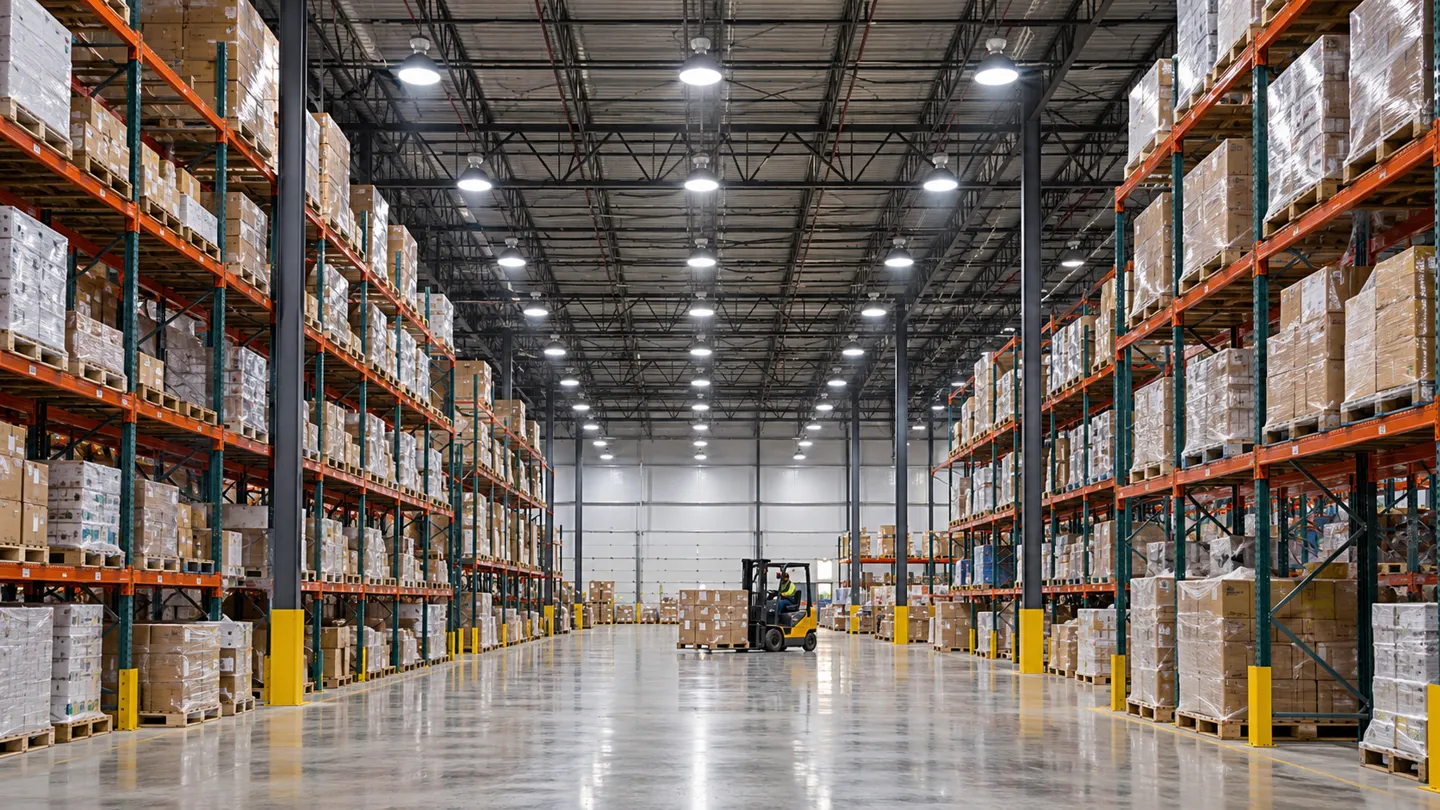
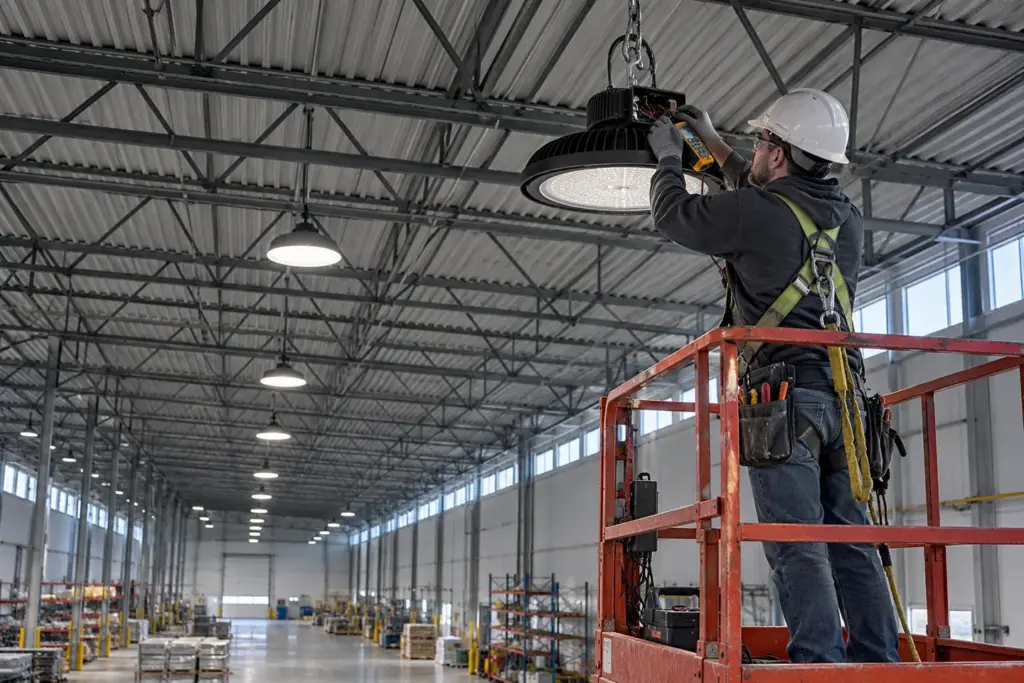
Six meters up, a round fixture bolts to a steel truss and pushes 20,000 lumens straight down onto a picking floor. Nobody services that thing with a stepladder from the hardware store. It exists because ordinary ceiling lights give up at that height: the beam spreads, fades, and dies somewhere around the racking instead of reaching the work.
That is the short answer to what a high bay light is: a luminaire engineered for high ceilings, typically 20 to 45 feet (6 to 14 meters) above the floor (LiteLume, n.d.). Two things separate it from a shop light. It throws hard: output commonly runs from 10,000 to 50,000 lumens per fixture. And it aims: instead of one soft 120-degree wash, high bays use defined beam angles, usually 60, 90, or 120 degrees, matched to how far the light has to travel.
The category also has a history worth knowing in one sentence. Older buildings still remember the metal halide and high-pressure sodium era, when these fixtures needed minutes to warm up and relamping was a scheduled event. LED versions changed the math: the US Department of Energy puts LED efficacy at up to 150 lumens per watt or more in specialized designs (U.S. Department of Energy, 2026), which is why the same fixture positions that once held 400-watt HID lamps now hold LED units drawing a fraction of that.
There is one more thing to know before you shop: “high bay” names a job, not a shape. The label covers several very different fixtures, and picking the wrong one is the first way people waste money.
Types of High Bay Lights and Where Each One Belongs
Walk a lighting trade show and you will meet three body types, and each one is a mechanical answer before it is a look.
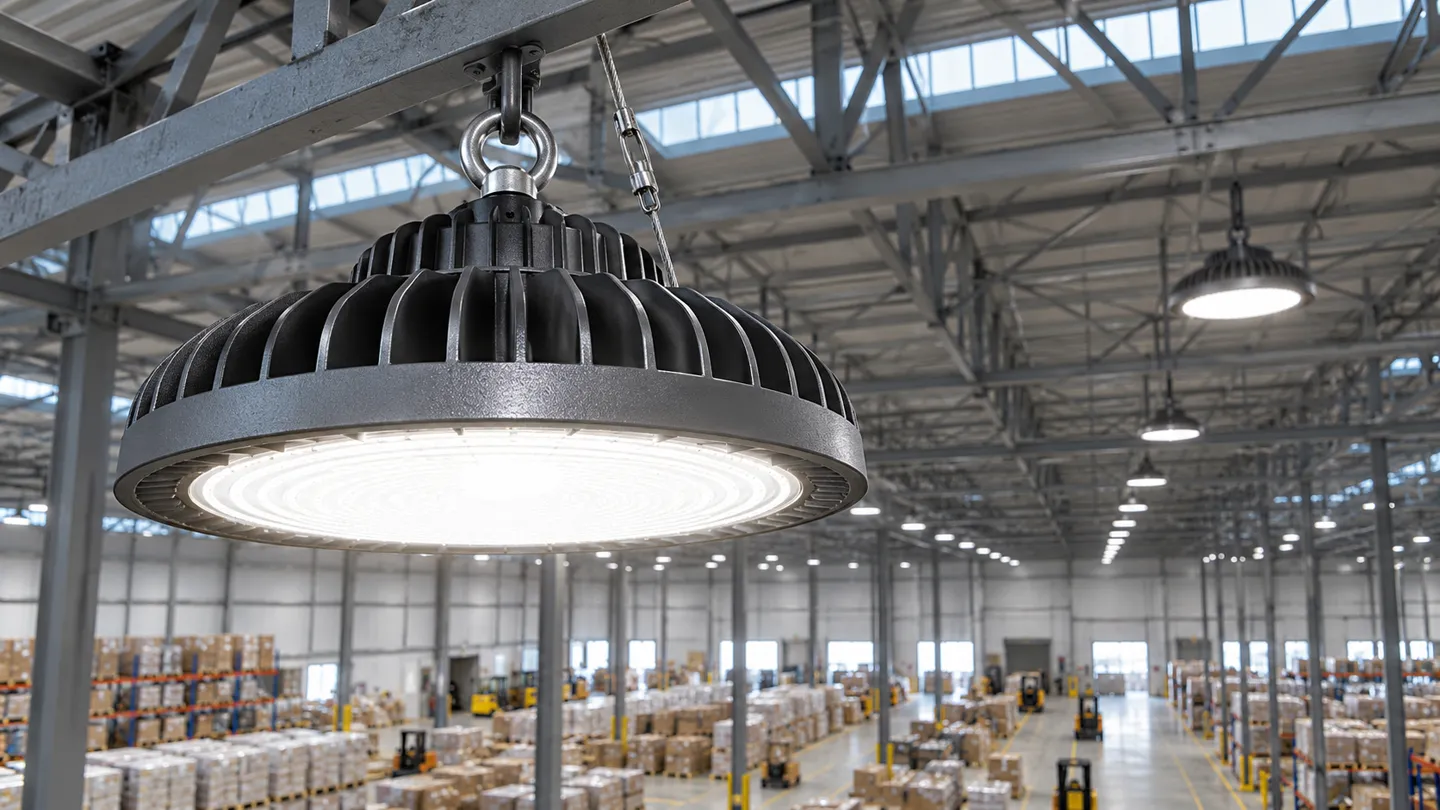
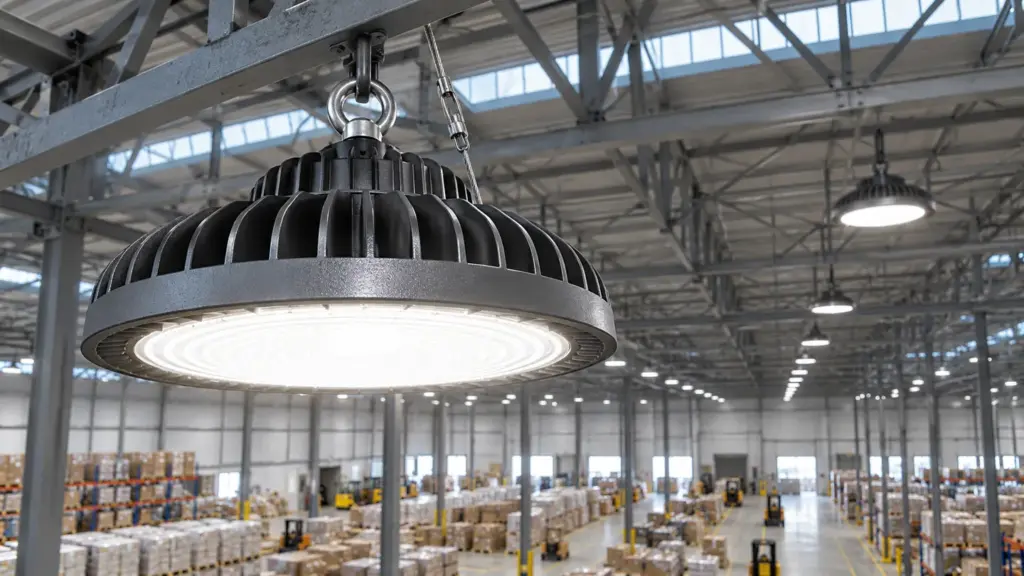
The UFO fixture is the round, finned drum that dominates the category today. ⭐ The fins are heat sinks: LEDs live or die by junction temperature, and the sealed round body sheds heat while resisting dust and bumps. That is why UFOs became the default in open floor areas and rough industrial spaces.
The linear high bay is the long, slim body built for racking. Aisle layouts need even light along the full run of shelving, and a line source delivers that spread more naturally than a round point source. Linear fixtures are a mainstream form across the market, so if your supplier list does not include them, you will meet them at someone else’s.
The traditional rectangular housing with a reflector dome is the oldest shape, and it still earns its keep. In retrofits and lower mounts, the reflector widens the beam and keeps glare out of people’s eyes. Niche variants exist beyond these three, including architectural models for retail-grade spaces, but they are refinements, not a fourth category.
| Form | What it does mechanically | Where it fits |
|---|---|---|
| UFO (round, finned) ⭐ | Finned body sinks heat; sealed against dust and impact | Open floor areas, factories, gyms |
| Linear | Line source spreads light evenly along a run | Racking aisles, long narrow buildings |
| Traditional + dome | Reflector widens beam and cuts glare at lower mounts | Retrofits, halls with lower ceilings |
All of them hang from the same hardware: hooks, chains, or brackets off the building structure. And all of them show up in the same places: warehouses, plants, gymnasiums, big-box retail floors, aircraft hangars, and exhibition halls.
Shape, though, is the easy question. The question that separates a working layout from an expensive mistake is height.
High Bay vs Low Bay: Where the Height Boundary Actually Sits
Most guides frame “high bay vs low bay” as a matchup. It is really one question: how far does the light drop, and what does the beam need to do on the way down?
Why the published numbers disagree
Retail guides put high bays at 20 to 45 feet and low bays below that (LiteLume, n.d.). Electricians who actually hang fixtures push the floor lower: on trade forums you will read that high bays start making sense around 15 feet with the right beam. Manufacturer spec sheets convert to roughly 19.7 feet as the metric floor. So you get three numbers, 15, 20, and 19.7, and no ruling.
Here is the workable reading. Above 20 feet, a high bay is the tool. Below 15 feet, it is the wrong tool. The 15-to-20-foot band is contested territory, and the decision there is not a slogan, it is a beam angle and an output number, which the next section turns into a rule.
What misalignment costs
Hang a 120-degree UFO pushing 20,000 lumens in a 12-foot garage and three things happen at once. The source sits at eye level, so everyone works inside the glare. The floor gets far more light than any task needs. And you paid for lumens that die in the walls instead of the workbench.
Run it the other way and it fails quieter: a wide, soft low bay at 30 feet sheds light that fades to a rumor before it reaches the floor. The room looks switched on and the work surfaces still fail a lux check.
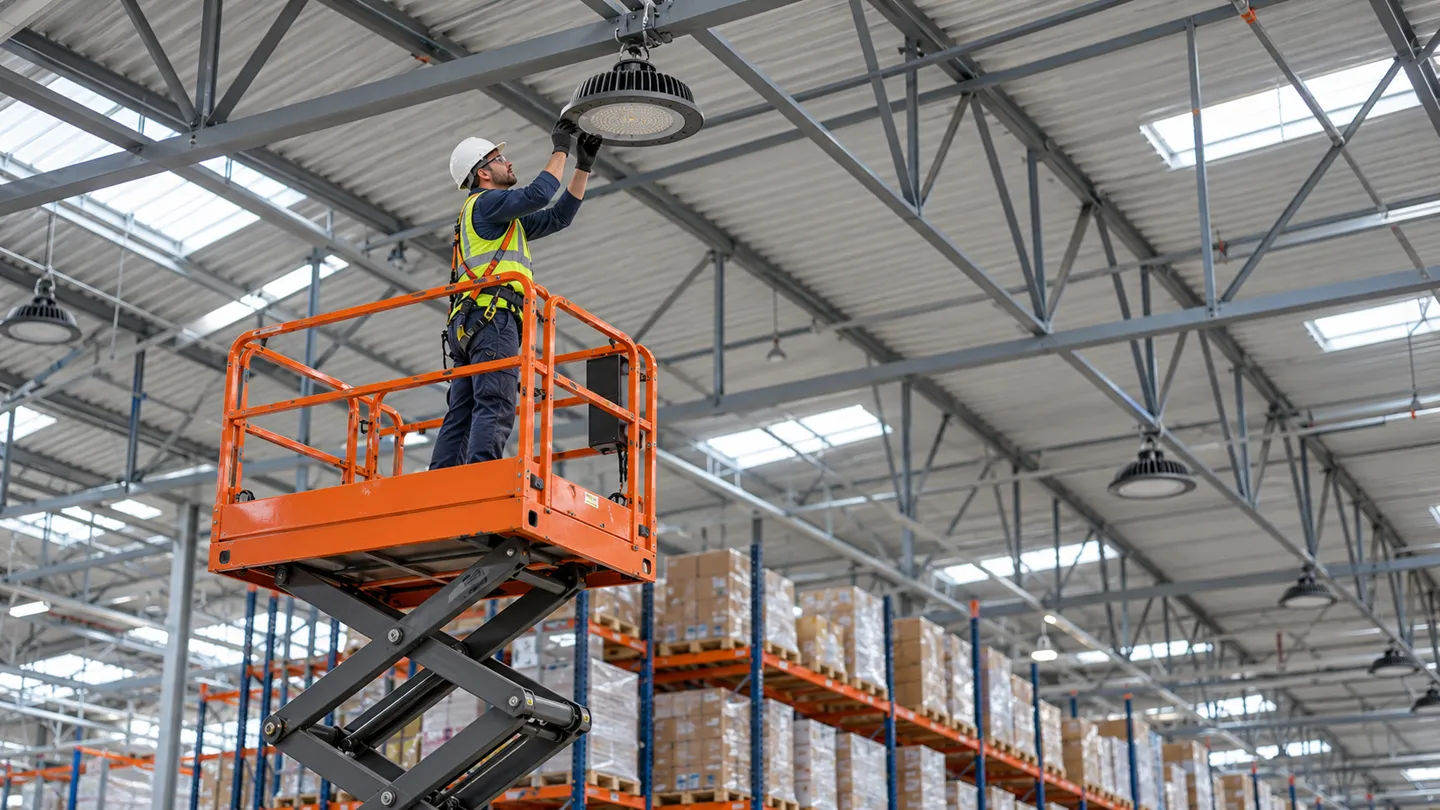
The fix is a measurement habit, not a product choice. Measure clear height, floor to the lowest obstruction, not architectural ceiling height, because sprinkler pipes and trusses eat mounting height before the fixture ever hangs.
The boundary, laid out
| Your space | Clear height | What fits | Check before ordering | If you get it wrong |
|---|---|---|---|---|
| Home garage, small workshop | Under 12 ft | Low bays or plain shop lights | Glare at bench height, lux on the task | High bay: glare, overlit floor, wasted watts |
| Small warehouse, retail floor | 12 to 20 ft | Contested band: 90-degree high bay at moderate output, or a low bay | Beam angle against the actual drop | Overlit floor or dark corners, money spent either way |
| Standard warehouse | 20 to 30 ft | UFO high bay, 90 to 120 degrees | Fixture spacing against a lux target | Dark pools between fixtures |
| Tall bay, hangar, gymnasium | 30 to 45 ft | High-output UFO, 60 to 90 degrees | Aiming plan and a lux calculation | Light never lands where people work |
| Outdoor yards and facades | Any | Flood lights, not high bays | IP rating and beam spread | Wrong tool entirely: high bays are indoor fixtures |
The contested-band rule
At 15 to 20 feet, choose a high bay only if you can specify a 90-degree beam or narrower at moderate output. Otherwise, a low bay lights the same floor for less.
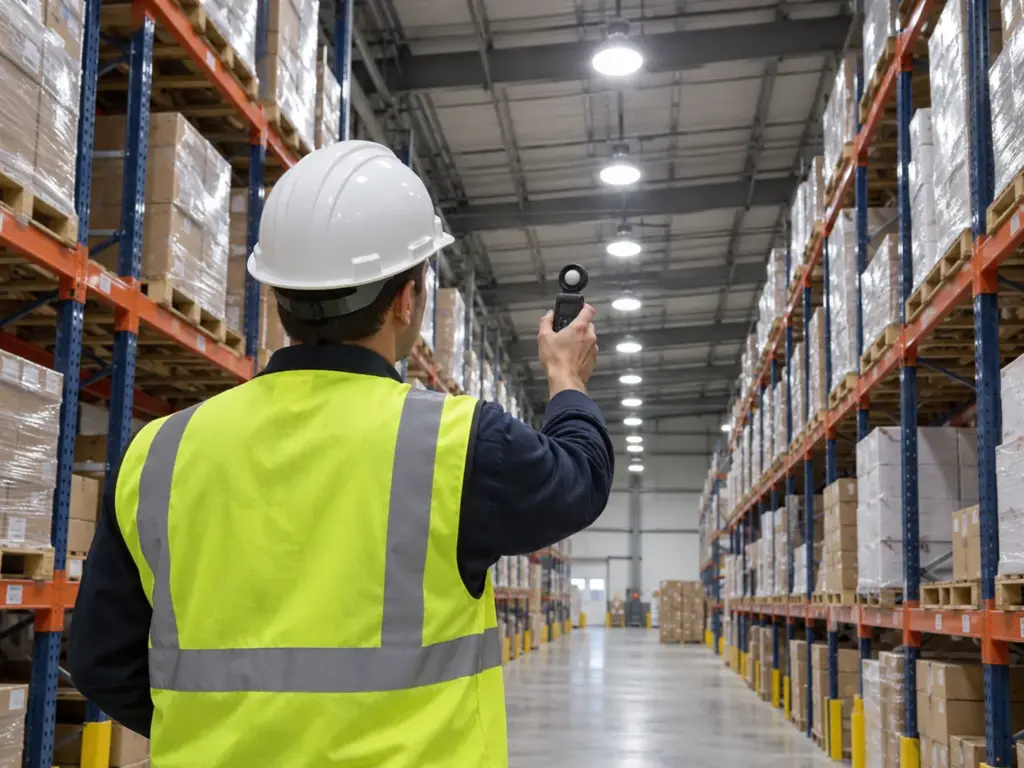
Whichever side you land on, the target is the same kind of number: general storage runs around 10 to 30 foot-candles, loading docks 30 to 50, and fine detail work 50 to 100, per the IES recommendations compiled by PacLights (PacLights, n.d.).
With height settled, the next decisions all live on a piece of paper you send to suppliers.
Taking this spec sheet to suppliers: WOSEN answers high bay RFQs line by line, certificate numbers included.
Have WOSEN Review Your SpecHow to Choose a High Bay Light: From Room Dimensions to a Spec Sheet
Specifying in the right order saves rework: space first, light second, electrical third, compliance last.
Step 1: Set the lumen target from the space, not the wattage
The lumen method is one multiplication. Floor area times your foot-candle target gives the delivered light the room needs. A 10,000 square foot storage floor at a 20 foot-candle target needs about 200,000 delivered lumens. Fixture output then tells you the count. At 20,000 lumens per fixture, that is ten on paper, and twelve to fifteen once you account for spacing losses and lumen maintenance. Wattage is a consequence of those choices, not a starting point, which is why ordering “by watts” is the habit to unlearn.
Spacing closes the layout. Even coverage for storage needs a regular grid; task areas such as pack benches and QC stations deserve their own fixtures aimed at the 50-to-100-foot-candle work the IES guide assigns them.
Step 2: Pick the efficacy tier and write the driver down
The market currently sells three live efficacy tiers: around 120 lumens per watt in budget and sealed emergency builds, around 150 in the mainstream, and 160 to 180 in flagship models. These are meaningful gaps, not marketing decimals. The same 20,000-lumen fixture draws about 133 watts at 150 lm/W and about 167 watts at 120 lm/W. Across 100 fixtures burning 12 hours a day, that 34-watt gap is roughly 15,000 kilowatt-hours a year, which is why the Department of Energy’s “150 or more” benchmark is worth taking seriously (U.S. Department of Energy, 2026).
Efficacy tiers on the live market
Budget and sealed emergency builds
The mainstream tier and the DOE benchmark
Flagship class, 160 to 180; wins the energy math
Then write the driver into the purchase order, because the driver is where these fixtures actually die; the failure section below shows the case files. Three lines belong in writing. First, the driver brand: it must be specifiable or upgradeable, and upgrade paths to brands such as Meanwell, Inventronics, or Philips exist across the market. Second, dimming compatibility, stated in writing, with 0-10V as the common protocol. A dimming circuit paired with a non-dimmable fixture is a documented way to cook a fleet. Third, power output tolerance in the acceptance criteria: the loose industry norm is plus or minus 10 percent, and tighter manufacturers commit to 5.
Step 3: Environment and market compliance
Dust and washdown call for IP65 or IP66. Unheated buildings call for a rated operating range that includes the winter floor, and minus 20 to 50 degrees Celsius is the span to expect on honest spec sheets. Color temperature settles at 4000K for general work and 5000K where the ceiling is high, with 2700K to 6500K available across the market. Color rendering of 70+ is the baseline, and 80+ earns its premium at inspection and assembly benches.
Certification is a destination question, not a bonus round. CE and RoHS form the baseline for Europe, UL or ETL opens North America, SAA covers Australia, and ENEC or TUV matters in the German-speaking EU. The North American marks are the ones that move schedules. Requesting them typically adds weeks to production and carries minimum-order conditions. So the certification list belongs in the first conversation, not the last email.
The checklist is the take-home:
The RFQ spec sheet checklist
- Clear height measured (floor to lowest obstruction)
- Foot-candle target set by area type
- Fixture lumens and count calculated
- Efficacy tier chosen (120/150/180 lm/W class)
- Driver brand clause written (specifiable or upgradeable)
- Dimming compatibility stated in writing
- Power tolerance acceptance set (±10% norm, ±5% tight)
- IP rating and operating temperature range confirmed
- CCT and CRI matched to tasks
- Certification list fixed per destination market
- MOQ and lead time confirmed including certification adders
A spec sheet built this way survives contact with suppliers. What it cannot predict is what happens after the fixtures hang, which is where most of the real-world stories start.
Why High Bay Lights Fail: Reading the Warranty Before It Fails
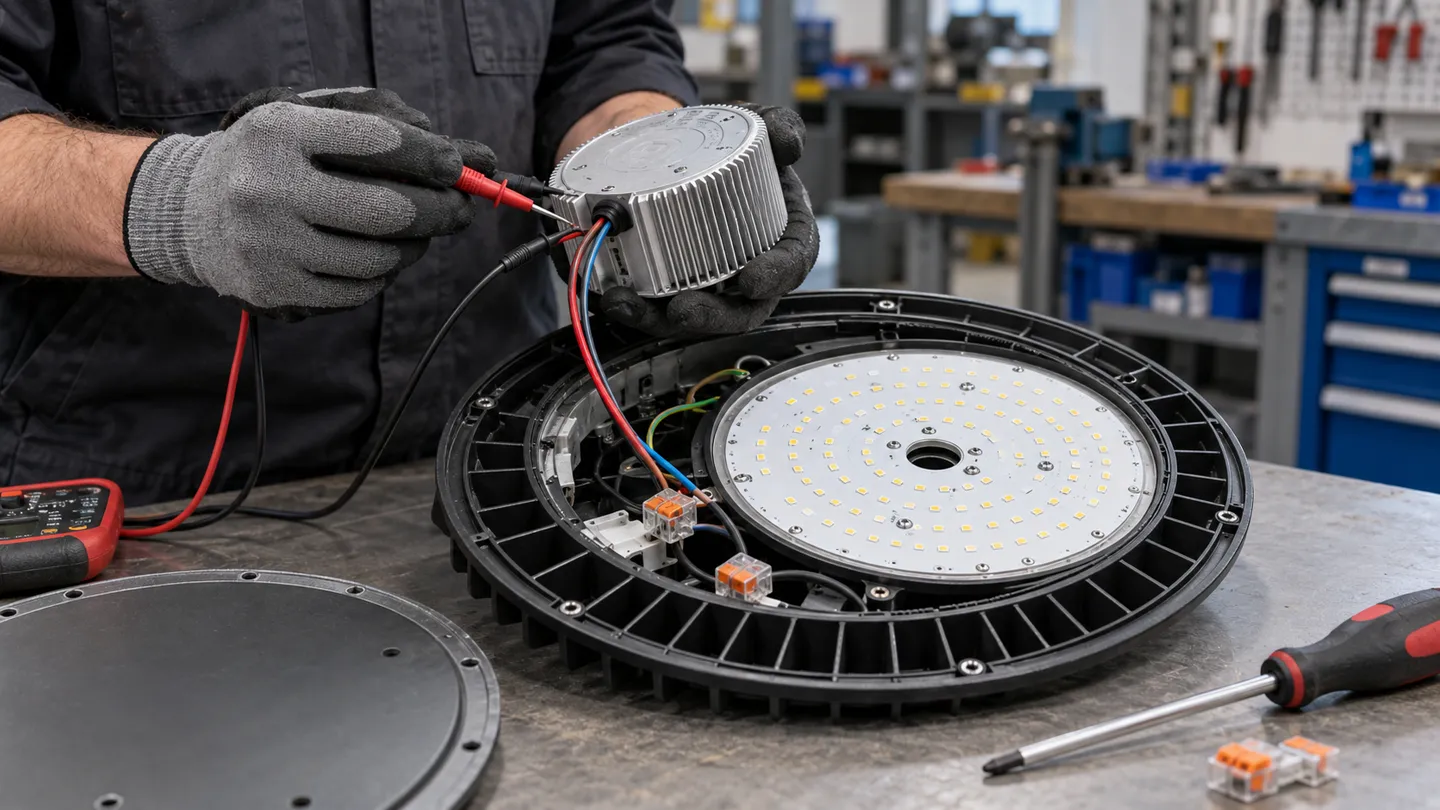
Drivers die first, and the UFO form has a specific relationship with that fact. In a round high bay, the driver sits close to the LED board. Board heat soaks into the driver’s electrolytic capacitors for the fixture’s whole life. As they age, the capacitors lose their ability to regulate, and the fixture flickers before it goes dark. Failure analyses of high bay LED lights list driver faults, overheating, and unstable supply voltage as the leading causes (LED Drivers Australia, 2023).
Controls kill fixtures more quietly. A facilities manager described 40 high bays rated “driverless, 100,000 hours” that began failing within months, 15 of them dead, and found “nondim” printed on boards that had been installed on dimmed circuits (Reddit r/Lighting, 2025).
Field report, r/Lighting, 2025
“Driverless, 100,000 hours.”
Within months, 15 of the 40 fixtures were dead.
Electrical environment takes out fleets, not fixtures. An electrical contractor reported a warehouse service center where 11 of 18 high bay drivers died overnight and the surge protector was scorched. The measured supply voltage sat at a normal 277 volts, which pointed the investigation toward surge and loose-neutral behavior rather than the utility (Mike Holt Forums, 2020). And budget panels fail in their own signature way: one buyer counted three of six fixtures with entire dead LED rows (Garage Journal, 2023).
Rated hours are a lab projection. The warranty term, the driver behind it, and the company standing behind both are the parts you can actually enforce. A 100,000-hour claim printed next to a 1-year warranty is a 1-year product.
Read warranties the way the failures teach. Rated hours describe a projection under controlled conditions. Warranty years describe what someone will do when reality disagrees, and the two numbers routinely tell different stories. A dark fixture can be a dead driver, a loose connection, or water in the housing, and each has a different test. Diagnose before you replace, and record which failure mode your building produces. That pattern is your real procurement data.
How to Qualify a High Bay Light Supplier
Certifications come first, and they come as documents, not logos. Ask for the certificate number and validity for each market you ship to. CE and RoHS form the European baseline, UL or ETL covers North America, SAA covers Australia, and ENEC or TUV matters where the destination requires them. A supplier who cannot produce the paper does not hold the mark.
Components come second. Ask which LED brands ship as standard and which are available on request. Ask whether the driver brand can be specified or upgraded, and at what minimum order quantity. Those answers decide whether your spec sheet survives past the first quotation.
Warranty terms deserve the same line-item treatment as price. Four clauses matter: the years of coverage, the response clock for claims, who pays freight and customs on warranty replacements, and the standard a repair must meet before reshipment. Twelve-hour-class response windows and repair-to-spec commitments exist in this market. The difference between suppliers is whether those are written or merely said.
Commercial terms close the list: minimum order quantity, sample policy, lead time including any certification adders, and the failure analysis procedure. Paid samples are normal at this unit value, and returning a defect ratio for teardown is a reasonable, telling request.
Anniversary counts and factory-square-meter claims are background. The verifiable parameters above are the decision, and a supplier who engages with them line by line has already passed a meaningful test.
The supplier qualification checklist
- Certificate numbers and validity per market
- LED brand standard vs on-request
- Driver brand specifiable or upgradeable, with MOQ
- Warranty years, response clock, freight and customs responsibility, repair standard
- MOQ, sample policy, lead time including certification
- Failure analysis procedure in writing
What the High Bay Market Teaches Distributors About Stocking
The same facts read differently from the distributor’s side of the counter, where they become a shelf plan. Your inventory is a portfolio of height bands, control requirements, and warranty classes. The failure data tells you where the returns come from.
| Line | Height band | Control | Warranty class | Why it earns shelf space |
|---|---|---|---|---|
| Commodity UFO, mid efficacy | 20 to 30 ft | Fixed output | 2-year class | Price-driven volume, fast turns |
| Workhorse UFO, 150 lm/W class | 20 to 35 ft | Dimmable (0-10V) | 3-to-5-year class | The bulk of project demand |
| Flagship high efficacy, 180 lm/W class | 25 to 45 ft | Dimmable, driver upgrade path | 5-year class | Spec projects, energy-driven retrofits |
| Sealed emergency / moisture-proof builds | Harsh and humid sites | Emergency pack | 5-year class | The corners competitors avoid |
The stocking stance follows from the failure record, not from catalog bravado. Drivers and control compatibility are the first failure point. They are also the first return source. That is the argument for tilting inventory toward dimmable fixtures with upgradeable drivers, and away from sealed bargain panels with epoxy-hidden electronics. Certification belongs in the plan as a market adder. North America-bound stock carries certification lead time that a Europe-bound container does not, so delivery promises should differ by market from day one.
Keep the two warranty classes in separate lanes. A 2-year commodity line and a 5-year project line are different businesses. They serve different customers with different price sensitivities and different after-sales mechanics. Mixing their standards on one shelf produces quotes nobody can honor.
WOSEN stocks its own shelves on exactly this logic: a flagship series at 180 lm/W, 150 lm/W-class workhorses, and sealed emergency and moisture-proof builds for the harsh corners. All are dimmable, with driver upgrade paths to Meanwell, Inventronics, or Philips, under a 5-year warranty across the high bay series, at a 100-piece minimum order (our high bay lineup). We would rather compete on the spec sheet and the warranty terms than on the biggest number on the box, because that is the comparison our customers’ customers can actually check.
Get High Bays That Survive the Spec Sheet
UFO high bays at 120 to 180 lm/W, dimmable as standard, upgradeable drivers, 5-year warranty across the series, 100-piece MOQ. Send your requirements for a line-item quote.
Request a High Bay QuoteReferences
- U.S. Department of Energy. “LED Basics.” Solid-State Lighting. Accessed 2026.https://www.energy.gov/cmei/ssl/led-basics
- Mike Holt Forums. “Multiple High Bay LED Failures.” 2020.https://forums.mikeholt.com/threads/multiple-high-bay-led-failures.2557616/
- Reddit r/Lighting. “Commercial High Bay Lights Failure.” 2025.https://www.reddit.com/r/Lighting/comments/1i11wo0/commercial_high_bay_lights_failure/
- Garage Journal. “LED High Bay Panels Failing: What’s Proven Reliable?” 2023.https://www.garagejournal.com/forum/threads/led-high-bay-panels-failing-whats-proven-reliable.518215/
- LED Drivers Australia. “Reasons for Failure of High Bay LED Lights.” 2023.https://www.led-drivers.com.au/blog/reasons-failure-high-bay-led-lights

 English
 Spanish
 French
 German
 Italian
 Arabic
 Russian
 Portuguese
 Dutch
 Indonesian
 Turkish
 Polish