
Municipal engineering is the branch of civil engineering that plans, builds and maintains the infrastructure a city runs on. Roads, water supply, sewerage, drainage, street lighting and waste collection all fall under it. Where general civil engineering covers any built structure, municipal engineering scopes itself to publicly owned assets, funded by public budgets and judged by public complaints.
The distinction matters less in textbooks than in practice. A private developer who builds a road answers to a landlord. A municipal engineer who builds one answers to every driver, cyclist and shopkeeper on it, usually for decades after the ribbon is cut.
That is also why municipal engineering decisions age slowly and punish late. A streetlight specified today will burn every night for twenty years. A drainage gradient set slightly wrong will resurface as flooded intersections in the first serious storm, long after the contractor has moved to the next site.
Among all the subsystems a municipality owns, one generates more complaints calls, budget lines and supplier disputes than any other: street lighting.
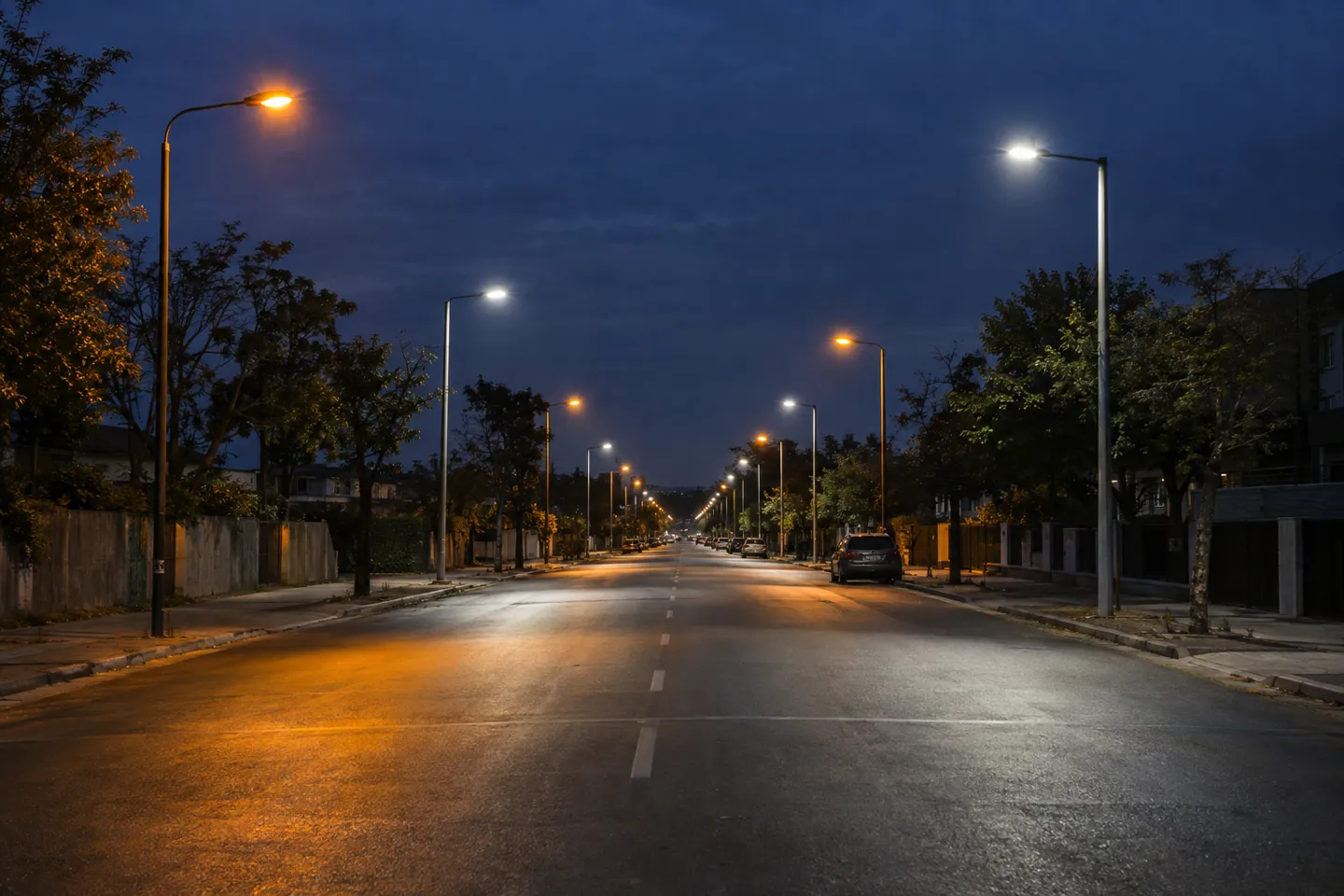
What Municipal Engineering Covers: The Subsystem Map
Most city engineering departments organize their work into five asset groups. Each has its own design rules, maintenance cycle and procurement logic, and each fails in public when it fails at all.
The five asset groups
- Roadways and bridges: carriageways, intersections, footpaths and small structures
- Water supply: treatment plants, pumping stations, distribution mains
- Sewerage and drainage: collection networks, stormwater systems, outfalls
- Street lighting: road lanterns, poles, feeder cables and control cabinets
- Sanitation and public space: waste collection routes, landfills, parks and streetscape
Take one example from each end of the visibility spectrum. A water main is buried and silent; residents notice it only when the tap runs dry. A road lantern is overhead and lit for twelve hours a night; residents notice it the first evening it goes dark. The manhole cover on the corner, the bus shelter light, the park path luminaire, all of these sit in the same budget chapter and arrive through the same tender process.
Street lighting sits at the top of the complaint list for a simple reason. It is the subsystem the public checks every single night. It is also the subsystem where equipment suppliers change most often between projects, which is exactly where the expensive mistakes happen.
Grid or Solar: The First Fork in Municipal Road Lighting
Before any discussion of luminaire brands or brightness classes, a road lighting project faces one fork that decides its cost structure, its failure modes and its installation schedule. That fork is the power source. Grid-connected and solar street lights are not interchangeable products with different plugs. They are two different project models, and the wrong choice cannot be fixed with a better luminaire.
When Grid Power Wins
A grid-connected LED street light is a lamp head, a feeder cable, a trench, and a control cabinet. The luminaire itself is usually the cheapest line in the budget; the civil works dominate. That is precisely why grid lights win wherever cable routes and a stable electrical supply already exist. The wire is already in the ground, and adding a tap costs a fraction of a new circuit.
The economics changed when cities started swapping high-pressure sodium for LED. Field retrofit programs consistently measure savings of 55 to 60 percent against comparable HPS fixtures (Street Lighting Retrofit Implementation Guide, Texas Energy Partnership, 2017). Multi-stage dimming widens the range: one peer-reviewed analysis puts quality-LED savings at 31 to 60 percent depending on dimming strategy (A. Djuretic, Energy, 2018). Los Angeles projected 40 percent savings for its citywide retrofit and ended up above 63 percent (EESI, 2013).
What the retrofit numbers actually say
55–60%
field savings replacing HPS with LED
Texas Energy Partnership, 2017
31–60%
quality LED, by dimming strategy
Energy, 2018
63%
Los Angeles delivered, vs 40% projected
EESI, 2013
Current-generation LED road lanterns make those numbers routine. Series on the market today deliver 130 to 220 lumens per watt, IP65/IP66 protection and 50,000-hour design lives, with dimming profiles that cut power further in the low-traffic hours.
When Solar Wins
A solar street light is a lamp, a panel, a battery and a controller on one pole. No trench, no feeder cable, no electricity bill, and no exposure to grid outages. For roads where the nearest cable is two kilometers away, or where digging permits take a year, the solar model removes the most expensive and slowest part of the project entirely.
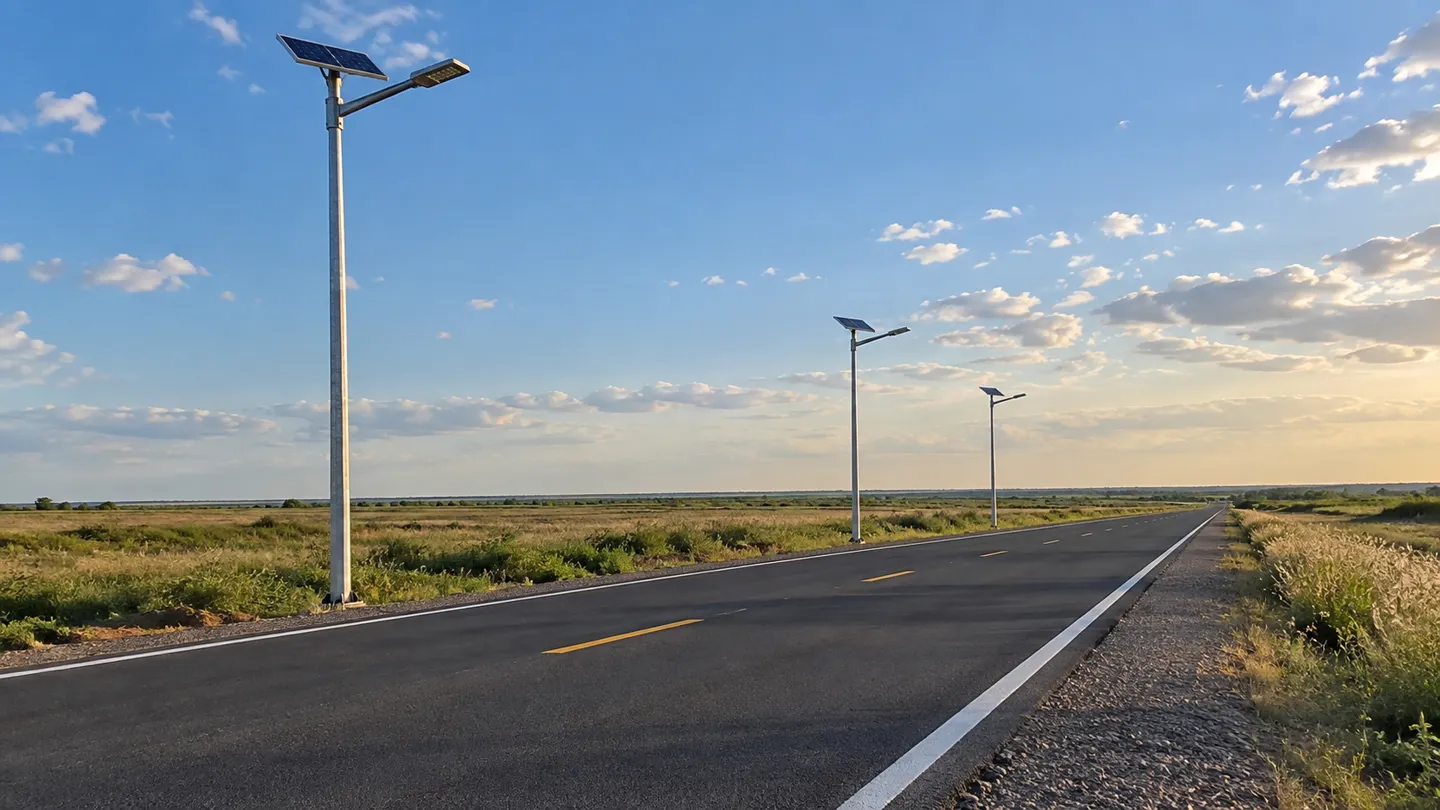
The design variable that decides whether solar works is autonomy: how many sunless nights the battery can carry. Manufacturer spec sheets typically size battery banks for 3 to 5 days of autonomy at full or scheduled brightness (Leapole solar pole comparison, 2025), and motion-sensor dimming stretches that reserve through late-night hours.
| Dimension | Grid-Connected LED | Solar Street Light |
|---|---|---|
| Upfront cost driver | Trenching, cabling, control cabinet | Panel, battery, larger luminaire body |
| Running cost | Monthly electricity bill | Effectively zero |
| Installation speed | Weeks to months with civil works | Days, no excavation |
| Dominant failure mode | Driver and surge damage from the grid | Battery aging, autonomy shortfall |
| Best fit | Existing cable routes, stable grid | Remote roads, weak or absent grid |
The boundary is weather and latitude, not brand. A site with more consecutive overcast days than the battery autonomy will dim or go dark regardless of how good the luminaire is. Before committing to solar, pull the local record for longest cloudy stretch and winter day length, then size autonomy against that number rather than against a catalog average. High-latitude winters and heavy tree canopy are the two cases where solar regularly disappoints.
What Fails, When, and Who Pays: Lifecycle Truths of Street Lighting
A street light rated for 50,000 hours rarely dies of old age. Field studies attribute more than 70 percent of LED luminaire failures to the driver circuit, and only about 7 percent to the LEDs themselves (IEA 4E SSL Annex, LRC lifetime literature review, 2021; S. Sagala, TU Eindhoven, 2020).
The 50,000-hour rating describes the LEDs
The part that actually fails first is almost always the driver, and the grid that feeds it.
70%+
of luminaire failures trace to the driver circuit
~7%
trace to the LEDs themselves
50,000 h
the rated life printed on the datasheet
Failure attribution: IEA 4E SSL Annex / LRC lifetime literature review, 2021; Sagala, TU Eindhoven, 2020.
Four Ways Street Lights Actually Die
First, the driver gives out. Drivers fail from heat, moisture ingress and above all voltage surges arriving down the feeder line. Capacitors and switching components degrade silently for years, then a lightning season finishes them off. On grids with frequent surges, this single mechanism accounts for most early deaths.
Second, the LEDs dim instead of dying. Lumen degradation is a heat story: a housing that cannot move heat away from the junction ages the chips years ahead of schedule. Aluminum alloy purity and the copper thickness of the metal-core PCB do the thermal work here. Datasheet-level differences, such as PCB copper in the 18-micrometer class, show up as very different light output in year five.
Third, water gets in. IP65 and IP66 labels are test conditions, not guarantees. The difference between a sealed luminaire and a weeping one is gasket material, gasket compression and the discipline of the sealing process in the factory. None of that is visible in a product photo.
Fourth, the hardware corrodes. Coastal and high-salinity sites eat standard fasteners and thin coatings within a few seasons. Salt-fog test hours on the housing finish and the screw material grade predict this failure long before it happens on the pole.
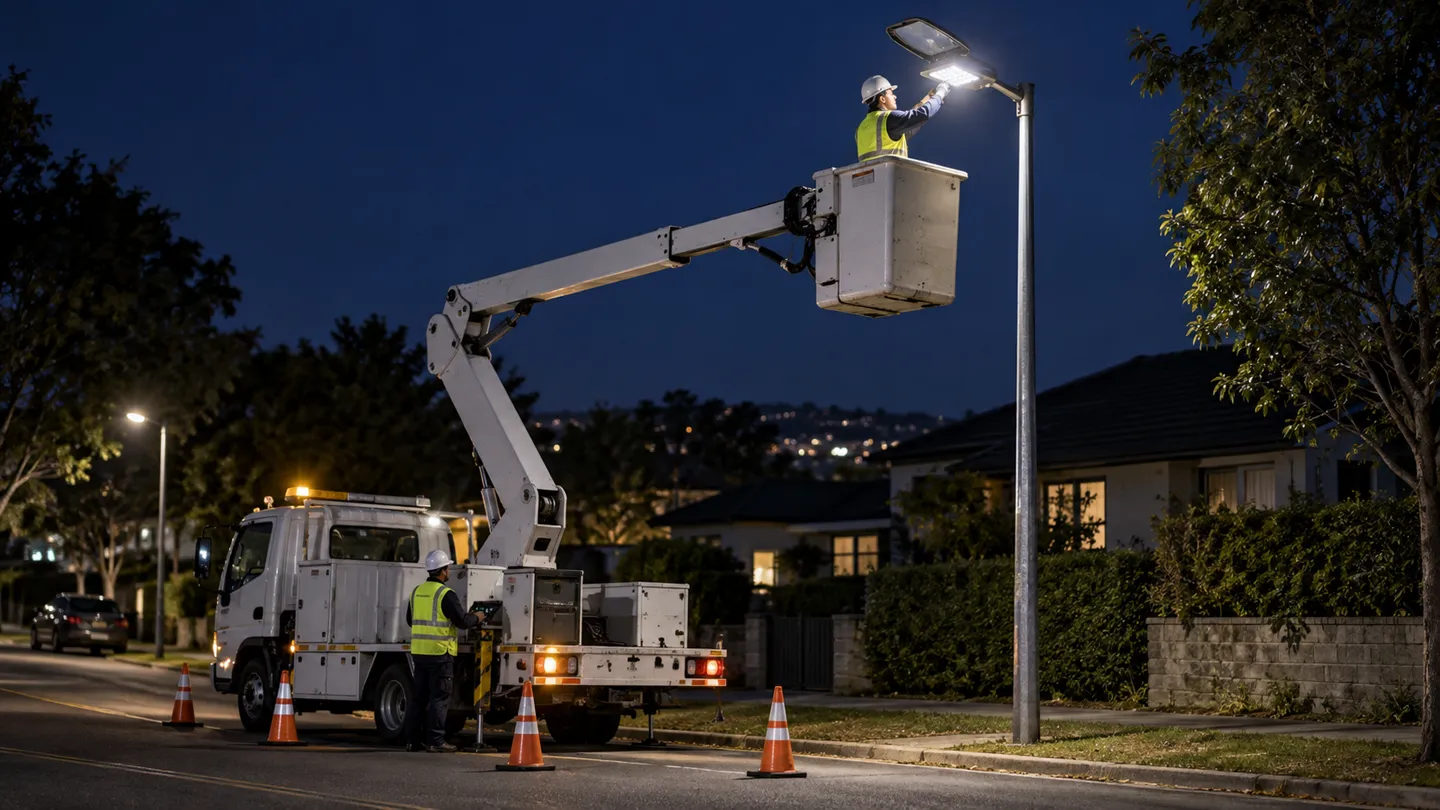
Here is who pays for each of these. Suppliers tier their products deliberately. Commodity lines are built to a two-year warranty standard; engineering lines to a five-to-seven-year standard. The component grades differ, and at serious factories the two run on physically separate production lines so the standards never blur. The two-year units are cheaper, and they pass acceptance. The expensive part arrives in year three, when drivers start failing and the warranty has already expired. On most municipal contracts, that cost lands on the maintenance budget of the contractor or the city, not on whoever sold the cheapest lantern.
Two build standards pass the same acceptance test
Commodity line
2 yr
- Warranty ceiling: two years
- Built to a price, tuned to pass acceptance
- Month-30 failures land on the maintenance budget
Engineering line
5–7 yr
- Warranty ceiling: five to seven years
- Separate component grades and production lines
- Failures return for analysis and repair-to-compliance
Where Each Design Breaks: The Environment Matrix
The failure modes above do not distribute evenly. Climate and grid quality decide which one visits a given road first, and the same luminaire can be a decade-long performer in one region and a maintenance nightmare in another.
Street Lighting Environment Matrix
| Environment | Safer specification choice | Where it breaks | Confirm before ordering |
|---|---|---|---|
| Coastal, salt fog | Marine-grade coating, SUS304 fasteners, verified salt-spray hours | Standard coatings pit within seasons | Salt-spray test hours on housing and fasteners |
| Desert, heat and dust | High-purity ADC12 housing, sealed optics, IP66 | Heat accelerates driver aging, dust clogs heat sinks | Thermal design, IP test reports, gasket material |
| Cold winters | Anti-freeze gaskets, low-temperature-rated battery (solar) | Seals harden, battery capacity drops | Low-temperature test data, gasket compound |
| Unstable grid, frequent surges | Surge protection to IEC 61000-4-5, robust driver grade | Surge season kills drivers after warranty | Surge rating on driver datasheet, warranty term |
| No grid, remote | Solar with autonomy sized to local overcast record | Autonomy shorter than longest cloudy stretch | Local weather record vs. stated autonomy days |
Read the matrix as a checklist of confirmable actions, not as marketing categories. Every cell on the right is something a supplier can prove with a test report or a datasheet value, and every one of them is cheaper to verify before the purchase order than after the third maintenance season.
Reading a Municipal Tender Like a Supplier
Everything above reads differently from the buying side of the table. The unit price in a tender covers manufacturing and delivery, and nothing else. If a driver batch starts failing in month thirty, the cost of pole rentals, replacement lanterns and night crews belongs to whoever holds the maintenance obligation. No discount percentage covers that.
Experienced municipal buyers therefore verify a different list than price and catalog pages. Certification certificates matched to the destination market, UL and ETL for North America, CE and ENEC for Europe, SAA for Australia, with ISO 9001 underneath. Production depth: whether the factory casts its own housings, assembles its own boards, and controls the sealing process in-house, or bolts together purchased parts. Test capability: IP, salt spray and aging laboratories that generate the reports instead of forwarding someone else’s. Warranty execution: what happens to a failed unit, who pays freight, and whether the failure gets analyzed or just swapped.
Supplier Verification Checklist for Municipal Tenders
| Verification item | What to ask for | Red flag |
|---|---|---|
| Certifications | Certificate numbers matched to destination market (UL/ETL, CE/ENEC, SAA, ISO 9001) | Copies without numbers, or certs for the wrong market |
| Production depth | Die-casting, SMT and assembly under one roof | Assembly-only shop purchasing finished housings |
| Test capability | In-house IP, salt-spray and aging labs; sample reports | Forwards third-party PDFs on request only |
| Warranty terms | Written repair-to-compliance process, response deadline, failure-analysis commitment | “Replacement parts by negotiation” language |
| Delivery record | Live and completed municipal projects with dates and quantities | Catalog projects without locations or years |
A workable sequence for the evaluation itself runs in five steps.
The five-step evaluation
- 1Shortlist by certification match to the destination market
- 2Audit production depth, die-casting to assembly
- 3Pull sample test reports for IP, salt spray and aging
- 4Write warranty-execution clauses into the contract
- 5Verify live municipal projects, not catalog photos
The underlying logic is simple and slightly uncomfortable. A tender scored only on unit price systematically selects the supplier least able to fund a warranty claim. Scoring on lifecycle cost and warranty execution does the opposite: it moves the failure risk to whoever is actually equipped to carry it. The five-to-seven-year engineering lines cost more per unit because the component grades, testing depth and after-sales machinery behind them are real, and that difference is where the maintenance budget goes to sleep.
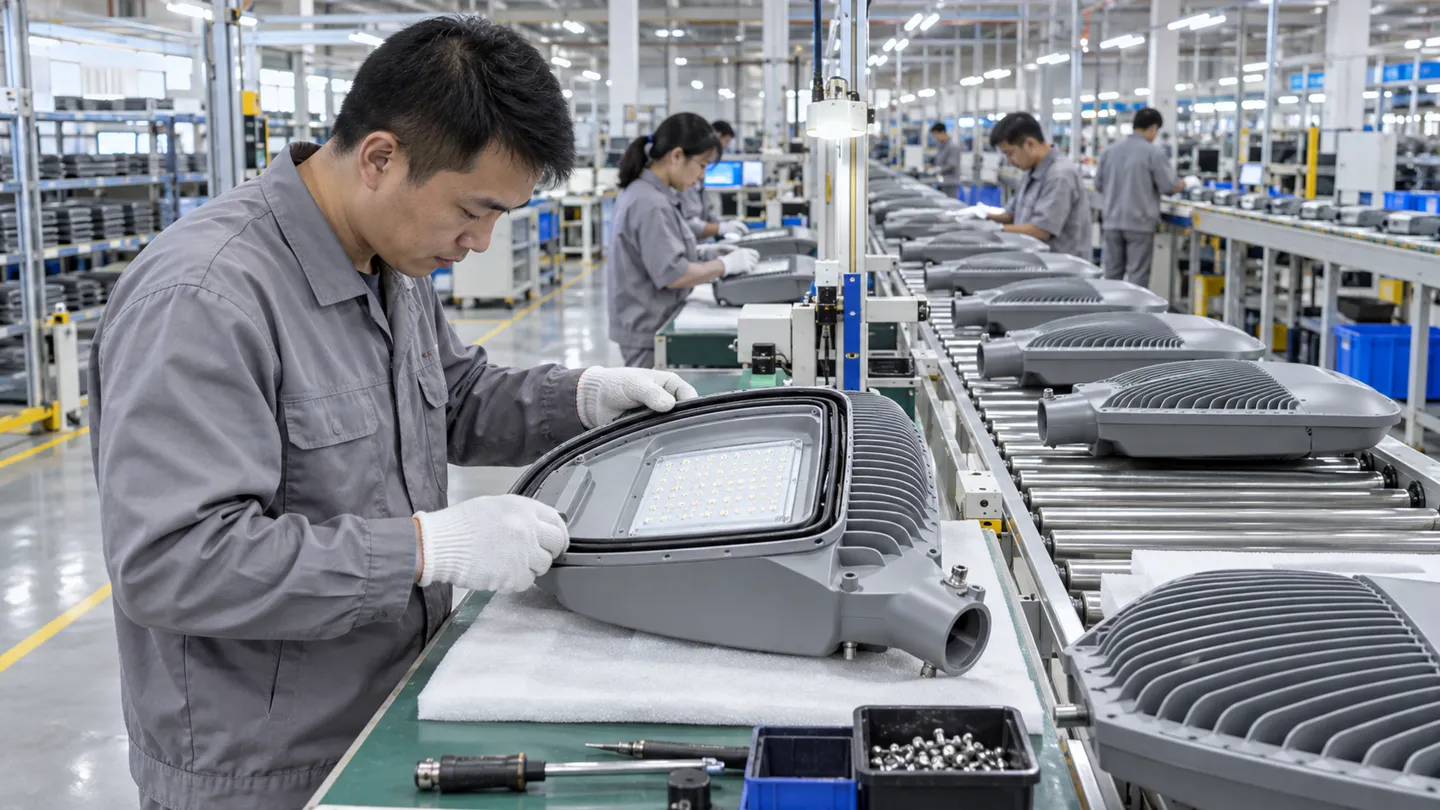
That is the standard we hold ourselves to at WOSEN. Our street-light series run 130 to 220 lm/W with IP65/IP66 protection and five-to-seven-year warranties on engineering-grade lines. Warranty claims are answered within 12 hours. Failed units come back to our CNAS-standard laboratories for root-cause analysis and repair-to-compliance before they ship again. You can check our certification portfolio (WOSEN Patents & Certificates) against your tender list before you shortlist anyone.
Spec street lighting that survives year three
WOSEN engineering-grade LED road lanterns — 130 to 220 lm/W, IP65/IP66, five-to-seven-year warranties, 12-hour claim response, CNAS-standard failure analysis.
Request a municipal quoteReferences
- Texas Energy Partnership / EEP. “Street Lighting Retrofit Implementation Guide.” 2017. https://eepartnership.org/wp-content/uploads/2017/09/Final-Combined-Streetlighting.pdf
- Djuretic, A. “Actual energy savings when replacing high-pressure sodium street lighting with LEDs.” Energy, 2018. https://www.sciencedirect.com/science/article/abs/pii/S0360544218310235
- Environmental and Energy Study Institute (EESI). “L.A. Goes LED.” 2013. https://www.eesi.org/articles/view/l.a.-goes-led
- IEA 4E Solid-State Lighting Annex / Lighting Research Centre. “Literature Summary of Lifetime Testing of Light Emitting Diodes and LED Drivers.” 2021. https://www.iea-4e.org/wp-content/uploads/publications/2021/06/SSL-Annex-Lifetime-Literature-Review-Report-by-the-LRC_final.pdf
- Sagala, S. “Failure Analysis of LED Luminaires.” TU Eindhoven, 2020. https://research.tue.nl/files/174889746/Sagala_S..pdf
- Leapole. “Best Solar Lights with Poles Compared.” 2025. https://www.leappole.com/blog/best-solar-lights-with-poles-compared-for-2025/
- WOSEN. “Patents & Certificates.” https://www.wosenled.com/patents-certificates/
- WOSEN. “LED Street Lights.” https://www.wosenled.com/outdoor-lights/led-street-lights/
- WOSEN. Homepage. https://www.wosenled.com/

 English
  Spanish
  French
  German
  Italian
  Arabic
  Russian
  Portuguese
  Dutch
Dutch  Indonesian
  Turkish
  Polish