
For B2B procurement managers and architectural lighting designers, choosing between COB (Chip on Board) and SMD (Surface Mounted Device) LED technologies is no longer just a matter of comparing upfront unit prices. It is a complex engineering and financial decision that dictates long-term thermal reliability, optical precision, and the Total Cost of Ownership (TCO) for large-scale projects. This comprehensive guide bypasses superficial marketing jargon to deeply analyze the underlying packaging physics, core performance metrics, and strict application domains of both technologies, equipping you with the ultimate matrix to make foolproof, ROI-driven decisions.
The Technical Blueprint: SMD vs. COB LED Packaging Explained
To truly understand why a specific LED fails in the field or underperforms in a commercial setting, we must look under the microscope at the foundational packaging architecture. The structural differences between SMD and COB dictate their heat dissipation capabilities, physical fragility, and light distribution patterns.
SMD (Surface Mounted Device): The Legacy Standard
Surface Mounted Device (SMD) technology has been the undisputed workhorse of the LED lighting industry for decades. Recognizable by their numerical naming conventions—such as 2835 (2.8mm x 3.5mm) or 5050 (5.0mm x 5.0mm)—these LEDs feature a discrete, compartmentalized structure.
In a standard SMD package, the LED die (the actual light-emitting chip) is glued into a metallic lead frame bracket. The critical electrical connection is established using microscopic gold or copper wires (a process known as wire-bonding), and the entire assembly is then encapsulated in a phosphor-infused epoxy or silicone resin. This finished, independent diode is then surface-mounted onto a Printed Circuit Board (PCB).
- The Core Vulnerability: While the technology is highly mature, the wire-bonding process represents a significant physical and thermal bottleneck. The microscopic gold wires are highly susceptible to thermal expansion and contraction. In environments with severe temperature fluctuations, these wires can easily snap, leading to the dreaded “dead light” phenomenon.
- The Volume Advantage: Because each SMD diode is independently manufactured and tested before being placed on the PCB, the yield rate (the percentage of functional products off the assembly line) is exceptionally high. This makes SMD technology incredibly cost-effective to produce at a massive scale.
COB (Chip on Board): The High-Density Revolution
COB technology eliminates the restrictive “middleman” of the traditional SMD package. Instead of placing the LED die into an individual bracket and wiring it up, COB technology directly mounts multiple bare LED chips directly onto the substrate (the PCB) in a dense array. The entire array is then covered with a single, continuous layer of phosphor gel.
However, it is crucial for B2B buyers to understand that not all COB LEDs are created equal. There is a distinct technical divide that separates high-end commercial grade from cheap residential grade:
- Wire-Bonded COB (The Budget Option): Lower-end COB products still utilize microscopic wires to connect the bare chips on the board. While the light is seamless, the physical fragility of the wires remains, meaning the risk of failure is still present.
- Flip-Chip COB (The Premium Standard): True high-end COB technology utilizes a “Flip-Chip” design. The LED chips are flipped upside down, and their electrical pads are directly soldered to the PCB substrate without any wire bonding whatsoever. This completely eliminates the risk of wire breakage and massively accelerates heat transfer.
By abandoning the traditional lead frame and wire-bonding approach, Flip-Chip COB achieves unprecedented chip density. While an SMD strip might house 120 LEDs per meter, a COB strip can easily pack 480 to 840 chips per meter, transforming discrete points of light into a flawless, continuous ribbon of illumination.

Head-to-Head Clash: Core Performance Metrics Analyzed
When engineering a lighting solution for commercial spaces, subjective opinions must give way to objective physics. How do these two technologies actually stack up against each other in rigorous laboratory testing and real-world conditions?
Luminous Efficacy & Light Quality (Spotty vs. Seamless)
The visual output characteristics of COB and SMD dictate their suitability for different architectural finishes. Here is a breakdown of their optical performance metrics:
| Performance Metric | SMD Performance | COB Performance |
|---|---|---|
| Beam Angle | Typically restricted to 120°. The structural bracket walls block wider light emission. | Can easily reach 180°. The frameless, flat-glue encapsulation allows unrestricted light spread. |
| Visual Continuity (Dotting) | High dotting effect. Visible dark spaces exist between individual diodes. | Completely dot-free. Continuous phosphor coating ensures seamless, uninterrupted light. |
| Color Consistency (SDCM) | Prone to color shift across large batches due to individual binning discrepancies. | Superior consistency. High-end COB can achieve SDCM < 3, ensuring perfect color uniformity. |
The practical implication of these metrics is most evident when illuminating highly reflective surfaces. If you install standard SMD strip lights inside an aluminum profile next to a polished marble floor or a glossy tiled wall, you will suffer from the “zebra effect”—ugly, distinct points of light reflecting on the surface. COB technology, with its seamless encapsulation, operates like a pure “light sword,” delivering a perfectly smooth wash of light regardless of the reflection material.
Thermal Management & Reliability (The Heat Sink Paradox)
Thermal management is the ultimate predictor of an LED’s lifespan. The U.S. Department of Energy (DOE) consistently reports that elevated Junction Temperatures (Tj) are the primary catalyst for severe lumen depreciation and premature failure in solid-state lighting.
This brings us to a critical engineering paradox that traps many inexperienced procurement managers. On paper, a Flip-Chip COB possesses a vastly superior thermal resistance rating (typically around 2-6 °C/W) compared to a standard SMD (which can range from 10-20 °C/W). This is because the COB chip transfers heat directly to the PCB without the bottleneck of a lead frame.
The Paradox: Because COB transfers heat so efficiently and concentrates so much power into a tiny, high-density area, it creates a massive thermal load on the PCB. If you pair a high-wattage COB module with a cheap, thin, low-weight aluminum extrusion (Heat Sink), the heat has nowhere to go. The heat will immediately back up into the chip, causing the Junction Temperature (Tj) to skyrocket. Consequently, a poorly heatsinked COB will actually burn out and suffer catastrophic failure much faster than an SMD in the exact same condition.
Therefore, evaluating COB technology requires evaluating the entire thermal system, not just the chip. Buyers must demand LM-80 test reports and verify that the manufacturer has engineered adequate aluminum mass to handle the aggressive heat dissipation of COB arrays.

Application Matrix: Where to Deploy Which Technology?
Before issuing a purchase order, you must align your underlying optical requirements with the correct physical technology. There is no absolute winner between COB and SMD—only the optimal tool for the specific job. Use the matrix below to lock in the correct technology for your specific commercial scenario.
| Core Optical Need | Specific Applications | Recommended | Technical Rationale |
|---|---|---|---|
| Ultimate Visual Continuity (Continuous, dot-free illumination) |
Hotel cove lighting, high-end cabinet strips, minimalist architectural lines. | COB | Continuous phosphor encapsulation eliminates the physical gaps that cause the “zebra” dotting effect on reflective surfaces. |
| Extreme Precision Optics (Sharp, punchy center beam without multi-shadows) |
Museum track lighting, jewelry display spotlights, high-end hotel downlights. | COB | Acts as a dense “Point Source,” allowing TIR lenses/reflectors to shape a crisp 15°/24° beam without optical artifacts. |
| Maximum Hygiene & Durability (Flat surface, easy to wipe, no dust traps) |
Cleanrooms, hospital operating theaters, food processing facilities. | COB | The single flat layer of encapsulation removes the microscopic gaps around brackets found in SMDs, making it totally dust-proof. |
| Maximized TCO for Area Coverage (Lighting massive spaces on a strict budget) |
Outdoor parking lots, street lighting, massive logistics warehouses. | SMD | Extremely mature supply chain ensures the lowest cost per lumen for massive high-wattage arrays where micro-aesthetics don’t matter. |
| Dynamic Chromatic Control (Independent channel mixing for RGB/RGBW) |
LED billboards, stage lighting, dynamic building facades. | SMD | Discrete packaging allows for exact pixel-level control and superior color blending over large visual canvases. |
| Harsh Industrial Reliability (High ambient temps, need for separated thermal loads) |
Heavy industrial High-Bay lighting, mining operations. | SMD | Spacing out the diodes distributes the thermal load across a larger PCB area, reducing the risk of localized thermal runaway. |
Linear & Seamless Diffusion (The “Continuous Line” Domain)
Whenever an architectural design demands “light without seeing the fixture,” COB is the absolute sovereign. In applications like flexible neon strips, under-cabinet lighting, and shallow aluminum extrusions where the diffuser sits extremely close to the light source, SMD strips will inevitably show distinct dots of light. COB technology, utilizing its high-density chip placement and continuous phosphor coating, guarantees a perfectly smooth, uniform wash of light. This is particularly vital for luxury retail and hospitality projects where visual perfection is non-negotiable.
Point-Source & Precision Optics (The “Directional Beam” Domain)
For applications demanding high-precision secondary optics, the physics heavily favor COB. Because a COB module packs immense lumen output into a tiny circular Light Emitting Surface (LES), it acts as a true “Point Source” of light. When you place a Total Internal Reflection (TIR) lens or a parabolic reflector over a point source, you can easily control the light, focusing it into a sharp 15°, 24°, or 36° beam angle. The edge of the beam will be incredibly crisp. Conversely, attempting to use a cluster of separate SMD diodes as a directional spotlight creates a “Surface Source.” When light from multiple distinct angles hits the lens, it results in severe optical cross-talk, producing blurred edges and highly undesirable multi-shadow effects on the illuminated object.
Discrete Arrays & Chromatic Diversity (The “Multi-Channel & Flood” Domain)
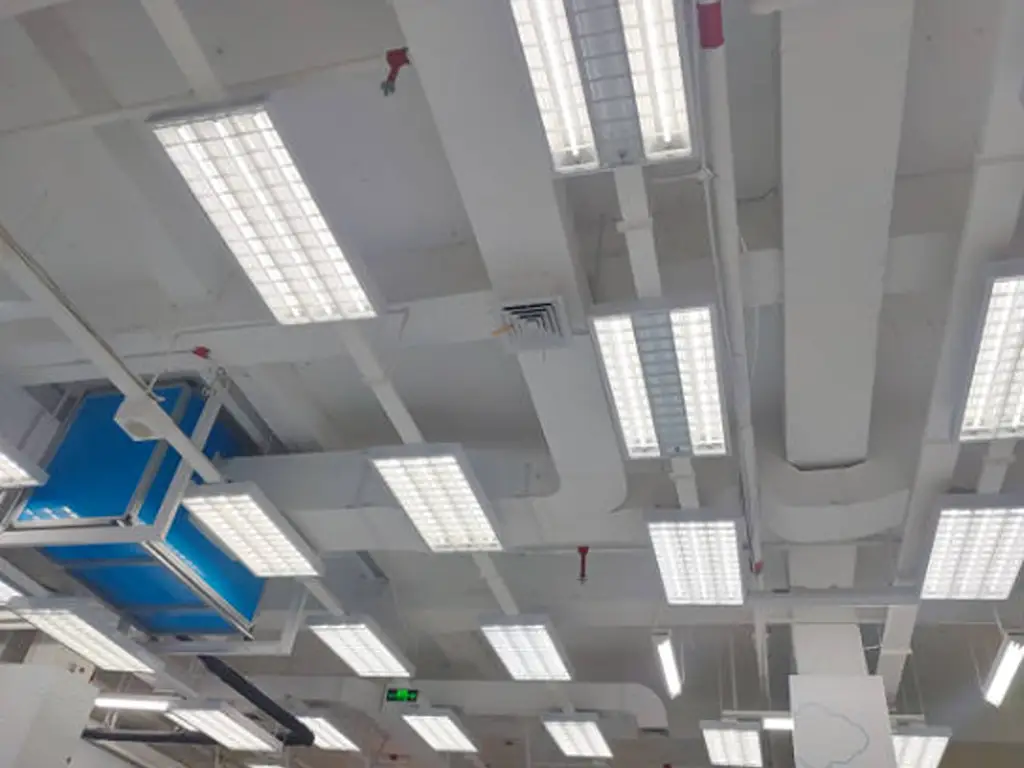
Despite COB’s advances, SMD maintains an unbreakable monopoly in two critical areas: digital displays and massive industrial floodlighting. In the realm of Digital Signage and RGB/RGBW lighting, the independent nature of SMD packages allows engineers to place microscopic Red, Green, and Blue diodes into discrete, addressable packages. This allows for pixel-perfect dynamic color mixing necessary for outdoor displays and stage lighting. Furthermore, when tasked with illuminating a 100,000-square-foot warehouse, the sheer scale of the PCB means that the high-density aesthetic of COB is irrelevant. An array of widely spaced SMD 3030 or 5050 chips spreads the thermal load evenly across a massive heat sink, offering exceptional reliability and the lowest possible upfront cost per lumen.
The TCO Trap: Calculating the True Cost of Ownership
In B2B lighting procurement, focusing solely on the initial invoice is a guaranteed formula for financial disaster. The True Cost of Ownership (TCO) encompasses upfront Capital Expenditure (CapEx), ongoing energy consumption (OpEx), maintenance labor, and the hidden costs of yield rate fluctuations. To make an informed decision, procurement teams must run the full mathematical model over a multi-year horizon.
Upfront Procurement vs. Hidden Operations Costs
Imagine a commercial project requiring 1,000 meters of linear lighting operating 12 hours a day, 365 days a year. A low-grade SMD strip might cost $3.00 per meter ($3,000 total), while a premium Flip-Chip COB strip might cost $5.00 per meter ($5,000 total). At first glance, the SMD saves $2,000. However, the true math lies in efficacy and maintenance.
- Energy Efficiency ROI: A high-end COB strip can deliver the required lux levels while consuming 2 watts less per meter than its SMD counterpart due to superior luminous efficacy. Over a 5-year period (approx. 21,900 operating hours), those 2 watts per meter translate to a massive 43,800 kWh of energy saved. At an average commercial rate of $0.12 per kWh, the COB strip saves $5,256 in electricity alone—more than wiping out the initial price difference.
- Labor and Replacement Traps: If 10% of the wire-bonded SMD strips fail due to thermal stress in year three, the cost of dispatching electricians with scaffolding to replace the strips in a commercial ceiling will instantly eclipse any initial material savings.
- Lead Time and Yield Costs: The SMD supply chain is vastly robust, guaranteeing rapid delivery for standard items. Custom COB solutions from unverified factories often face severe yield rate drops, causing shipment delays that can breach your overarching construction contracts.
The Vendor Verification Checklist (Avoiding Supply Chain Disasters)
To avoid catastrophic thermal runaway and delayed shipments, B2B buyers must rigorously audit their suppliers, demanding official LM-80/TM-21 depreciation reports and evaluating the factory’s underlying engineering infrastructure. Navigating these complex supply chain pitfalls requires partnering with a manufacturer that possesses deep vertical integration.
For instance, established source factories like WOSEN LED demonstrate how comprehensive quality control mitigates these risks. Operating from a 30,000-square-meter facility with three decades of manufacturing heritage, WOSEN maintains a strict closed-loop production system governed by ISO9001 standards. Rather than assembling generic external parts, they conduct extreme internal thermodynamic testing to independently develop aluminum extrusions perfectly matched to handle high-density COB thermal loads. This source-factory direct model ensures precise lead times, exceptional thermal reliability, and a streamlined supply chain—effectively cutting out middleman markups while drastically reducing your long-term Total Cost of Ownership.
Conclusion: Making the Right B2B Decision
The debate between COB and SMD LEDs is not about determining a universal victor, but rather executing precise optical engineering for specific commercial needs. If your project demands absolutely seamless linear illumination, pristine aesthetic continuity, or ultra-precise, artifact-free directional spotting via TIR lenses, Flip-Chip COB technology is the unequivocal choice. Conversely, for projects involving dynamic RGB pixel control or massive industrial floodlighting where budget is critical, the discrete architecture of SMD technology remains unbeaten. Prioritize your physical project requirements over upfront unit costs to secure both visual integrity and long-term profitability.
Ready to Optimize Your LED Procurement?
Ensure maximum ROI, flawless optical precision, and zero supply chain headaches for your next commercial project. Connect with our engineering team for a customized TCO analysis and professional product selection.
Contact Our Engineering Experts

 English
  Spanish
  French
  German
  Italian
  Arabic
  Russian
  Portuguese
  Dutch
Dutch  Indonesian
  Turkish
  Polish