
A warehouse floor rarely asks one thing from its lighting. Over the open stretch between receiving doors, fixtures need to throw an even circle across staging lanes. Down the racking, light that lands on the floor is waste; shelf faces need it. Every fixture also hangs where a lift rental, a production schedule, and a warranty all meet at once.
That is why the buying order matters more than the brand shortlist most lists start with. Match the fixture to the building first. Then turn “best” into numbers you can write into a spec sheet. Then learn where LED high bays actually fail, because most of the failure stories are predictable. Then pick a channel, verify what arrives, and lock the right terms into the order. Run that chain in order and the expensive mistakes, the ones that surface after the warranty expires, mostly disappear from your project.
Fit the Fixture to the Building First
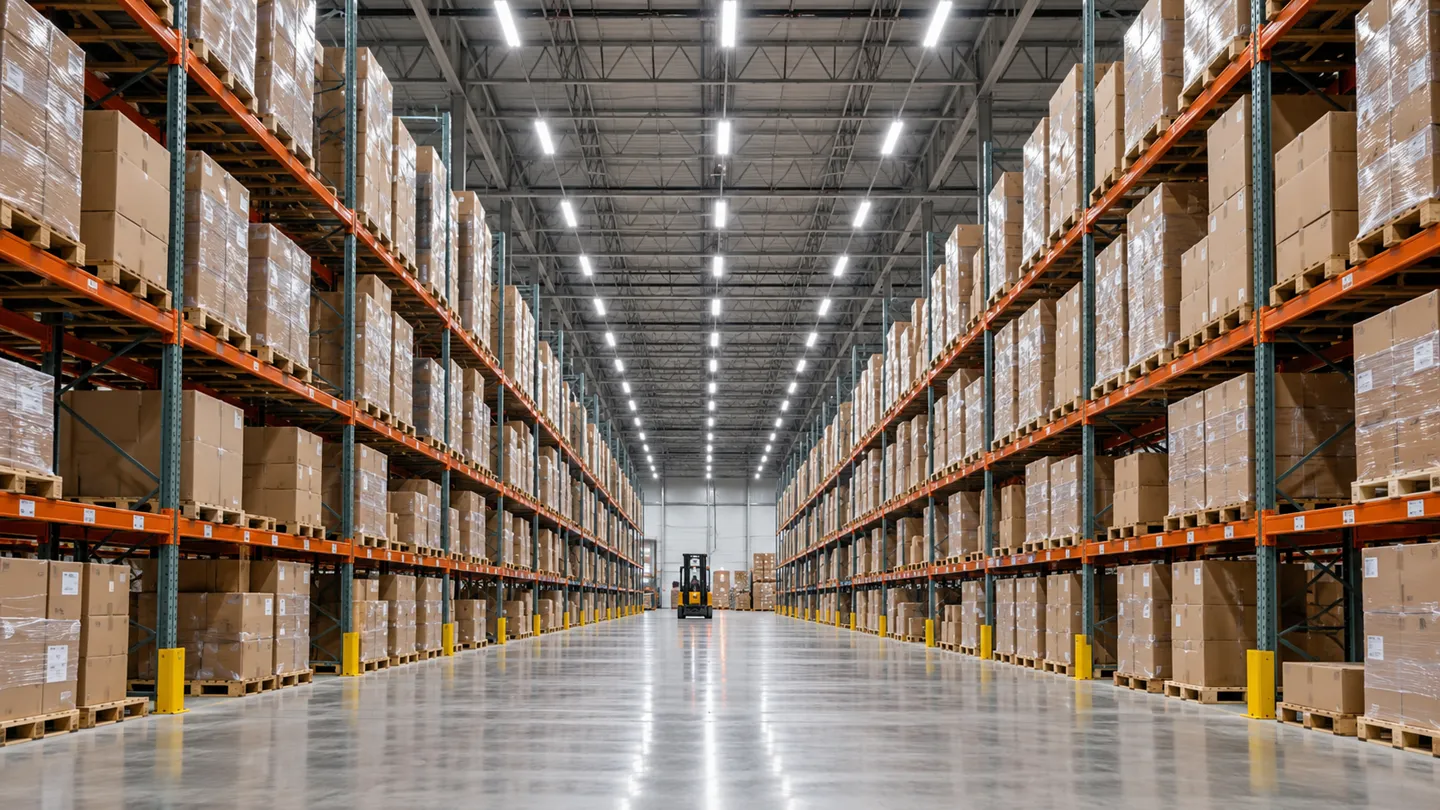
Start with one measurement: mounting height. The industry draws the line at about 20 feet. Under it, low bay fixtures spread a softer, wider pool of light, because a bare high-output fixture at head height is glare you pay for. Over it, high bays put concentrated output to work from a distance. Treat the rated mounting height on the spec sheet as the truth, not the product name. Naming is genuinely inconsistent across the industry: the same fixture gets sold as a high bay by one brand and a low bay by another.
Within the high bay family, shape decides where light goes. Four fixture types cover nearly every warehouse floor:
Four Fixture Types and Where They Belong
| Fixture | Beam shape | Rated height | Natural home |
|---|---|---|---|
| Linear high bay | Rectangular, throws light along its length | 20 ft and above | Racking aisles, production runs |
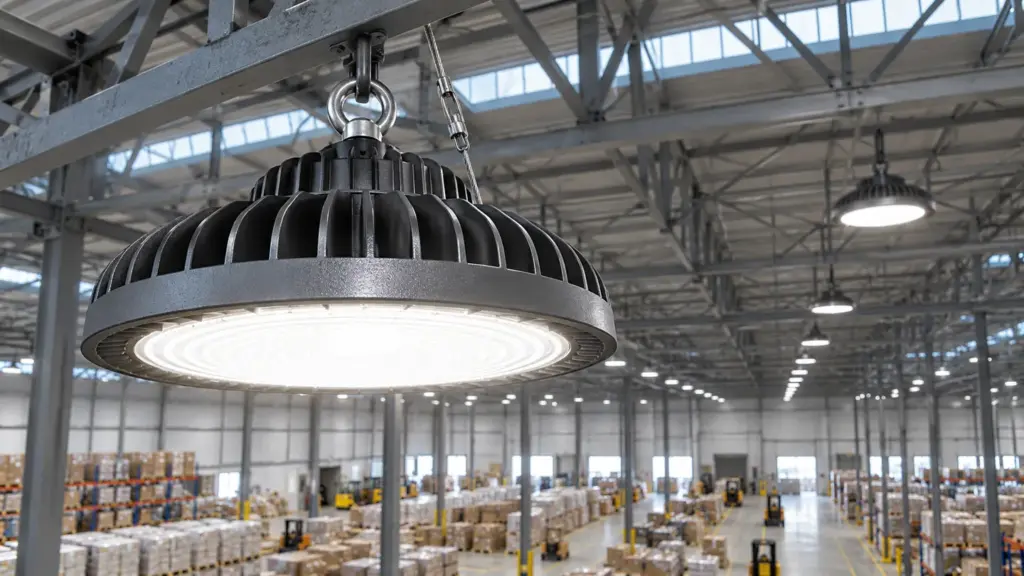
| UFO high bay | Round, symmetrical, about 120 degrees | 20 ft and above | Open floor, staging, wide unobstructed areas |
| Low bay | Wide, diffused, softer output | Under 20 ft | Mezzanines, workshops, small storage rooms |
| Strip | Broad, even, line-shaped | Any height | Pick and pack benches, corridors, task supplement |
Two of them carry most warehouse floors. Linear high bays throw light in a rectangle along their own length, which is why racking aisles are their natural home: the output lands on shelf faces instead of the floor. UFO high bays throw a symmetrical circle, usually around 120 degrees, which suits open floor, staging areas, and anywhere with nothing to block the beam. Most buildings larger than a garage end up using both, plus strip fixtures over pick and pack benches where labels get read all day.
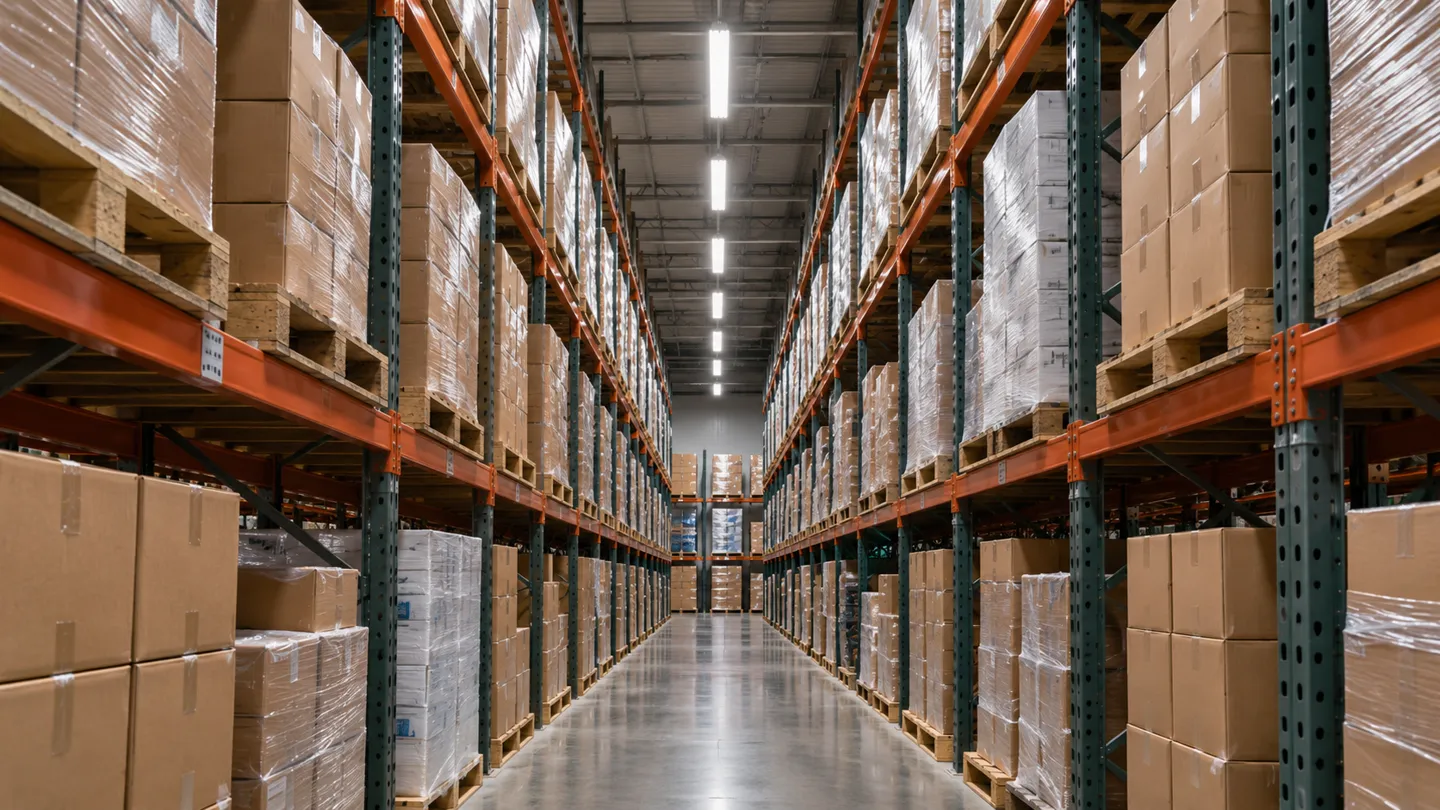
The case for swapping fluorescent or HID for LED is settled at this point. Commercial LED fixtures commonly carry 50,000 to 100,000 hour ratings (Warehouse Lighting, n.d.). They start instantly at temperatures where fluorescent tubes struggle. They also pair cleanly with occupancy sensors, because there is no warm-up penalty. Two boundaries belong in the same breath. A strip fixture is a task light, not a warehouse main light. And a high bay mounted under 20 feet buys glare and wasted lumens in equal measure.
Starting points by mounting height. Source: Warehouse Lighting, n.d.
Treat those bands as starting points. The next section turns them into a method.
The Numbers That Decide “Best”
Three calculation systems circulate for warehouse brightness, and they contradict each other often enough to cause real arguments. Lumens per square foot is the bluntest: guides quote 20 to 50 lumens per square foot for warehouses, which works as a rough sanity check on a quote and little else, because it ignores mounting height entirely. Footcandle targets describe light actually arriving at the floor. IES-based ranges put general storage around 10 to 30 footcandles and specify active picking and processing areas closer to 30 to 50 (PACLights, n.d.). The lumen bands from the previous section translate a chosen target into fixture counts.
The working order among the three: pick a footcandle target for each zone, let a photometric layout convert it into fixture count and placement, and use lumens per square foot only to sanity-check the result. A quote that jumps straight from square footage to a fixture count has skipped the step where errors hide.
Efficacy, measured in lumens per watt, separates the field cleanly.
Commercial high bay lines commonly spec between 100 and 180 lm/W across their series. Source: Reddit r/led, 2025
Each step up cuts energy draw for the same light, which is why rebate programs set efficacy floors.
Color temperature is a two-question decision. 5000K reads as crisp and suits detail work and tall aisles; 4000K is easier to sit under for a full shift. The rule that actually matters is consistency: one temperature across the whole floor, because mixed 4000K and 5000K zones make a well-lit building look unplanned.
Uniformity is the number most quotes omit, and it is where “brighter” stops working. A rack aisle with hot bright spots and dark gaps fails in practice even when its average hits target. Trade guidance keeps the average-to-minimum ratio in rack areas at or below 3:1 (ECM Web, 2004), and commercial layouts commonly target 3:1 to 4:1 (Crown Lighting Group, 2026). More fixtures aimed well beat fewer fixtures aimed hard.
The Numbers to Put in a Warehouse Lighting Spec
| Spec item | Working value | How to use it |
|---|---|---|
| Target illuminance | 10-30 fc storage, 30-50 fc picking | Set per zone by activity, verify with a layout |
| Efficacy | 150+ lm/W is efficient, 200 is top end | State a floor in the quote, reject below it |
| Color temperature | 4000K or 5000K, one across the floor | Pick by task, enforce consistency |
| Uniformity | Avg-to-min 3:1 or better in rack areas | Require it in the photometric report |
Put together, “best” resolves into a short list a buyer can enforce: footcandle target by zone, an efficacy floor, one color temperature, a uniformity ratio, and a photometric layout that predicts all four. None of those numbers is a brand name, which is exactly why they belong in the quote before brands do.
Why Warehouse LED Lights Fail Early (and in Batches)
The most expensive warehouse lighting failure is not a dead fixture. It is a batch of them, and the pattern is common enough that maintenance forums document it in detail.
Working high bays before and after a single weekend, with no warning at all.
A single failed fixture is a maintenance ticket. A failed batch is a lift rental, a stopped shift, and a harder conversation with the building’s owner. The three patterns below account for most batch failure stories told on electrician forums.
The driver usually dies first
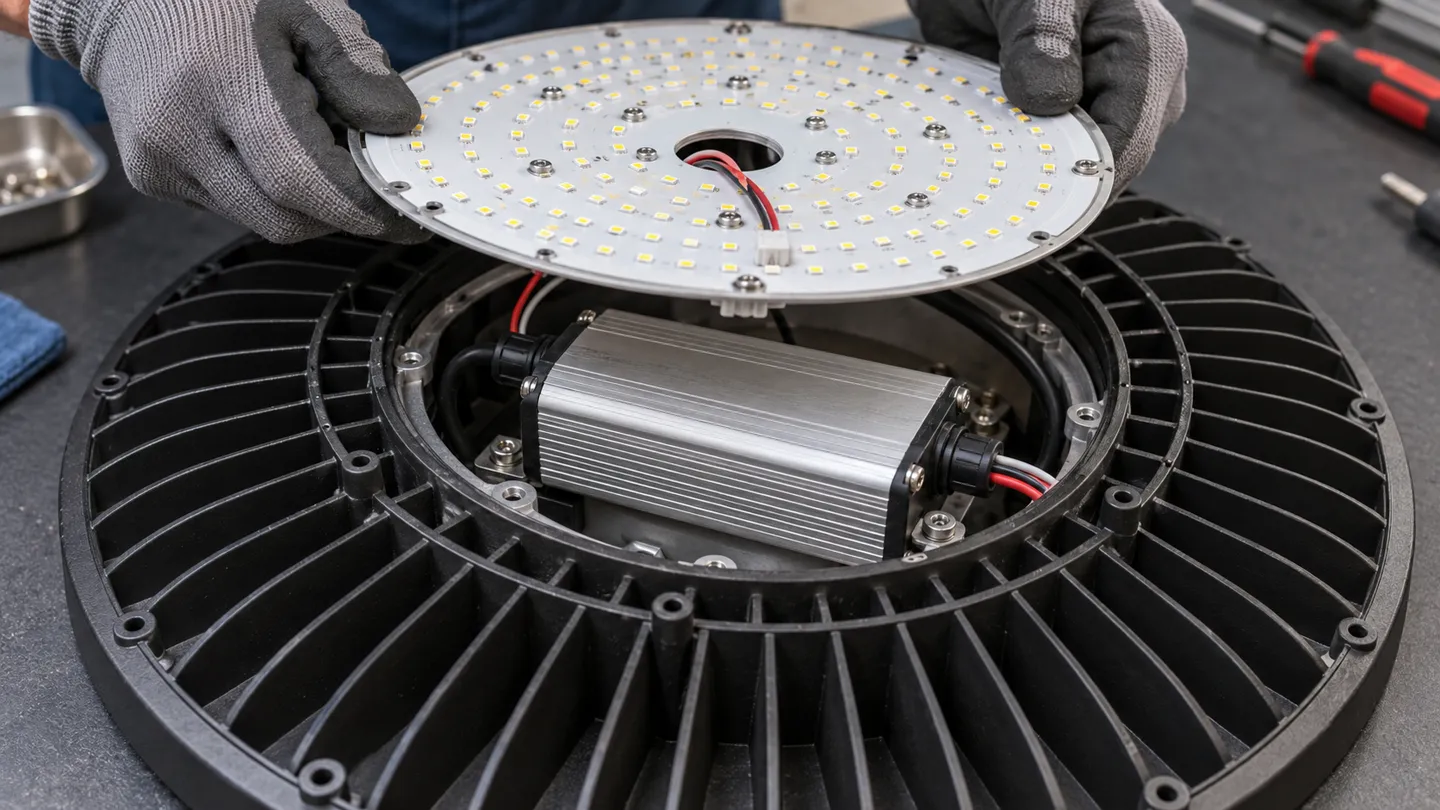
LED boards rarely quit first. The driver, the power supply that converts mains voltage to what the board needs, is the first component to fail, and in UFO-style fixtures it sits directly behind the board, absorbing its heat for its entire life. Electrolytic capacitors inside the driver dry out on a schedule set by that heat, and the schedule has a way of landing just past the warranty. Facility owners who opened failed fixtures after years of service found the pattern familiar enough to name it: the lights “made the warranty period” (Reddit r/Lighting, 2025). Driver tier is therefore a reliability decision, not a line item. Driverless designs, unbranded drivers, and branded units sit at visibly different points on the failure curve, and the price gap between them is small next to one lift-and-replace campaign.
Power quality kills in batches
The weekend die-off above has a suspected mechanism that electricians see repeatedly: a loose neutral conductor on a 277-volt circuit lets voltage drift upward, and overvoltage cooks drivers and sensor power blocks across a whole branch at once. Transients do the same work in an instant. A surge event can take out a batch of healthy fixtures in one night, which is why manufacturers sell surge protection in tiers, with a 3kA/6kV rating standard and a 5kA/10kV rating available for higher-risk sites (Mike Holt Forums, 2020). If the building shares a transformer with welders, crushers, or an unreliable utility feed, the surge tier belongs in the specification, in writing, before the order.
When the spec sheet and the box disagree
A 40-fixture installation tells the third version of the story. The spec sheet promised dimmable operation with a 5-year warranty, and 15 fixtures failed within a few months. The circuit board inside the failed units was marked non-dim, and the fixtures flickered whenever the dimmer moved off full output (Reddit r/Lighting, 2025). Somewhere between the catalog and the pallet, the wrong variant shipped. The defense is unglamorous: open one carton before installing anything, read the driver label, and check the dimming marking against the order. The same discipline catches machining defects, like the hanging threads one electrician reported unusable out of the box, one unit in a batch, returned rather than hung (Reddit r/electricians, 2025).
Warehouse LED Failure Modes and Where to Intercept Them
| Failure mode | Field symptom | Root side | Intercept at |
|---|---|---|---|
| Driver thermal failure | Units die just past warranty, rest of lamp intact | Product design | Specify driver tier and brand in the quote |
| Grid overvoltage and surge | Whole branch or batch dies overnight, blackened vents | Facility power | Confirm surge tier, check neutral bonds on aged circuits |
| Spec mismatch | Flicker on dimming, wrong markings inside the unit | Order chain | Open-carton check: driver label against purchase order |
| Receiving defects | Bad threads, missing gaskets, dents on arrival | Manufacturing QC | Spot-check machining before anything hangs |
| Lumen misdiagnosis | “Dim” fixtures that are dirty or yellowed | Maintenance | Clean and inspect lenses before replacing units |
Not every dim warehouse is a failure story. Before condemning LED boards, clean the lenses and check for yellowed diffusers; both mimic lumen depreciation at a fraction of the diagnosis cost. In cold storage, verify the fixture’s rated ambient temperature against the actual room, because an unventilated ceiling pocket runs far hotter than the floor beneath it, and heat is the enemy named above.
Where to Buy Warehouse Lighting: Three Channels
Retail and e-commerce channels, from big-box electrical aisles to online marketplaces, solve the small end of the market. For one to ten fixtures in a garage or a storage room, they are fast, returns are simple, and the brands stocked there, Keystone and Lithonia among them, show up repeatedly in electrician recommendations for exactly this duty (Reddit r/electricians, 2025). What the retail channel cannot supply is terms: no photometric layout, no batch failure procedure, no credit schedule.
Electrical distributors and supply houses carry the commercial and industrial tier. Their counter price per fixture runs above an online listing, and the difference buys real services: a layout run from your floor plan, project pricing, credit terms, and a human who answers when a batch misbehaves. Contractor advice on procurement forums converges on this channel for anything project-sized, in the blunt words one electrician gave a warehouse buyer: bring the layout to a supply house instead of picking fixtures online and hoping they work out (Reddit r/electrical, 2025).
Manufacturer-direct and ODM channels open at volume, typically around the hundred-unit mark. This is where fixtures get built to a specification instead of picked from a catalog: driver brand options, surge tiers, certification packages for the destination market, private-label production. It is also where the industry’s open secret lives. The same fixture frequently sells under several labels, and installers note this casually when they recognize a listing under a different name (Reddit r/led, 2025). Recognition cuts both ways. A brand name on the box proves less than the parameters on the datasheet, and a buyer who specifies parameters can compare a catalog brand and a factory quote on equal terms.
The channel decision follows order size, not loyalty. Single digits: retail. Dozens to a few hundred with a layout attached: distributor. Hundreds and up, or anything carrying your own label: manufacturer. For North American projects, add one check regardless of channel, because rebate eligibility runs through the DesignLights Consortium’s qualified products list, which nearly 700 utility and efficiency programs require for rebates (DesignLights Consortium, n.d.).
Verify Before You Sign
Purchase orders in this industry run on trust and get audited by reality. Three verification passes, in order, keep the audit short.
Get the photometric layout before the quote
A layout costs nothing and prevents the most expensive class of mistake, which is buying the right fixture in the wrong places. The inputs are ordinary: ceiling height, racking positions and heights, floor and wall reflectance, and a footcandle target per zone. Free software such as DIALUX runs the calculation (DIALUX, n.d.), supply houses run it as a counter service, and manufacturers with engineering staff run it from a set of project drawings. Judge the output by what it predicts: fixture count, mounting positions, expected average footcandles, and the uniformity ratio per zone. A supplier who answers a layout request with “trust us, it will be bright” has told you something useful. One boundary: the layout is only as good as its inputs. Measure the racking rather than estimating it, because a two-foot error in rack height moves the shelf-face numbers more than a fixture upgrade would.
Run receiving checks before anything hangs
The carton is where spec mismatches and machining defects get caught for free. Four checks take under an hour on a sample of cartons:
Receiving checks
- 1Driver label: brand and model match the purchase order, dimming marking matches the dimmable requirement.
- 2Machining: hanging threads cut cleanly, hook hardware seats properly, gasket sits in its channel.
- 3Power-on test: sample units age for a few hours and dim through the full range without flicker.
- 4Documents: datasheet, certification marks, and warranty terms on file.
A single unit that fails a workmanship check is a return. A single unit that fails the spec check is a batch inspection, because the wrong variant ships in dozens, not ones.

Confirm the light after installation
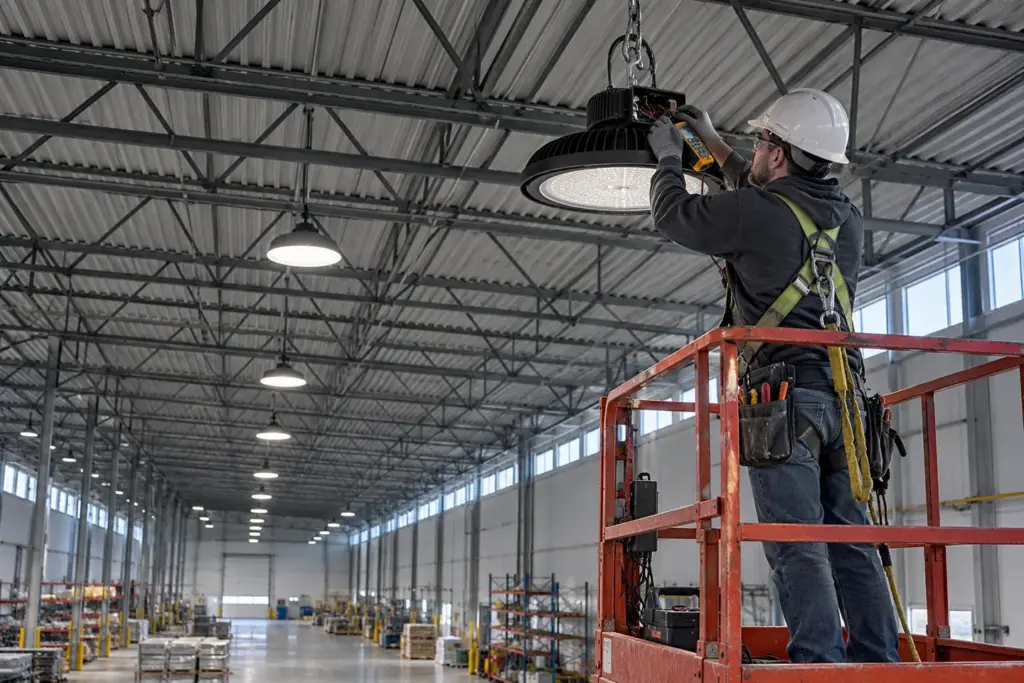
The layout made promises; the floor keeps or breaks them. Spot-measure a few positions with a basic meter and compare against the predicted averages, then walk the racks looking for dark gaps rather than reading numbers. Where levels disappoint, check the boring causes first: accumulated dust on lenses, a yellowed diffuser, or supply voltage off spec. Those three explain most “the LEDs are failing” calls that turn out to be housekeeping.
WOSEN ships with the acceptance numbers already in writing: photometric predictions, driver spec sheets, and photographed container loading, standard on every volume order.
What Volume Buyers Should Lock in Writing
Read back through the failure stories and a cost structure appears. The 40-fixture batch that lost 15 units, the weekend that took 11 fixtures down: neither failure was caused by a price that was too high. Batch failure cost lands on the buyer as lift rentals, stopped shifts, reinstallation labor, and a harder conversation with the building’s owner, while the price spread between a careful fixture and a cheap one is a rounding error on the project total. Contractors pricing this work already know where the money sits: material selection and markup decide whether an installation job makes money or eats it, which is why installer threads argue markup percentages with more heat than hourly rates (Reddit r/electricians, 2025).
The direction of the market raises the stakes quietly. The U.S. Department of Energy anticipates the majority of lighting installations will use LED technology by 2035, with savings from the transition projected to top 569 TWh annually (U.S. Department of Energy, 2025). Suppliers with the engineering discipline to stand behind warranty terms are consolidating their positions while the rest compete on price alone, so the shortlist a buyer assembles this year is cheaper to assemble than the one needed three years from now.
Three documents turn that reasoning into procurement. They fit on one page and belong in every volume inquiry:
Volume inquiry checklist
- 1Driver and surge specification sheet: driver brand, stock or upgrade options, surge protection tier, in writing.
- 2Batch failure procedure: sample-return ratio, root-cause study against local grid voltage, design fix, repair-to-compliance re-shipment with freight terms.
- 3Photometric layout and acceptance numbers: predicted footcandles and uniformity per zone, attached to the order.
A supplier who produces all three has answered the questions this article raised. A supplier who produces none has answered them too.
At WOSEN, those three documents are standard attachments on volume inquiries for our high bay light line rather than special requests. Driver spec sheets name the stock driver and the upgrade path to Meanwell, Inventronics, or Philips units where quantity supports it. Series pages list a 5-year warranty. The batch failure procedure runs the way the failure section described: failed samples returned by ratio, studied against local grid voltage, redesigned, and re-shipped to compliance, with overseas inquiries answered inside 12 hours. Orders start at MOQ 100 pieces and run 35 to 40 days with ERP-visible progress. Container loading is photographed at four stages, as on the mining high bay project in the Democratic Republic of Congo. The high bay light line covers warehouse, workshop, and industrial duty at 100 to 180 lm/W with IP65 to IP66 housings rated IK06.
If you want terms that match the layout, WOSEN runs free photometric simulations from your project drawings, with beam angle options at 15, 30, 45, 60, 90, and 120 degrees.
Get a Photometric Layout for Your Warehouse
Send your floor drawings and target footcandles. WOSEN returns fixture counts, driver and surge specifications, and MOQ-100 volume pricing, with overseas inquiries answered inside 12 hours.
Request a Free LayoutReferences
- U.S. Department of Energy. “LED Lighting.” Energy Saver, 2025.https://www.energy.gov/energysaver/led-lighting
- EC&M. “Designing Lighting for a Warehouse.” 2004.https://www.ecmweb.com/content/article/20890573/designing-lighting-for-a-warehouse
- Mike Holt Forums. “Multiple High Bay LED Failures.” 2020.https://forums.mikeholt.com/threads/multiple-high-bay-led-failures.2557616/
- Reddit r/Lighting. “Commercial High Bay Lights Failure.” 2025.https://www.reddit.com/r/Lighting/comments/1i11wo0/commercial_high_bay_lights_failure/
- Reddit r/electricians. “Bidding High Bay Lights?” 2025.https://www.reddit.com/r/electricians/comments/1immgul/bidding_high_bay_lights/
- Reddit r/led. “Thoughts on These LED High Bay Lights? Need Them for Warehouse.” 2025.https://www.reddit.com/r/led/comments/1jew9rz/thoughts_on_these_led_high_bay_lights_need_them/
- Reddit r/electricians. “Best LED High Bay Lights for a Shop with 20ft Ceilings?” 2025.https://www.reddit.com/r/electricians/comments/1j8tjpp/best_led_high_bay_lights_for_a_shop_with_20ft/
- Reddit r/electrical. “Best LED High Bay Lights for Commercial Spaces?” 2025.https://www.reddit.com/r/electrical/comments/1je58th/best_led_high_bay_lights_for_commercial_spaces/
- DesignLights Consortium. “DLC Quick Facts.” n.d.https://designlights.org/fact-sheet/
- DIALux. “Lighting Design Software.” n.d.https://www.dialux.com/en-GB/


 English
 Spanish
 French
 German
 Italian
 Arabic
 Russian
 Portuguese
 Dutch
 Indonesian
 Turkish
 Polish