
A streetlight goes up, the retrofit finishes, and within weeks the calls start. The bedroom is lit at midnight, the road ahead looks hazier than before, and the new lamp is somehow worse than the one it replaced. If that loop sounds familiar, this page is for you. It starts at the window and ends in the tender document, because the same physics that annoys a resident is what a buyer needs to control on paper.
What Street Light Glare Actually Is
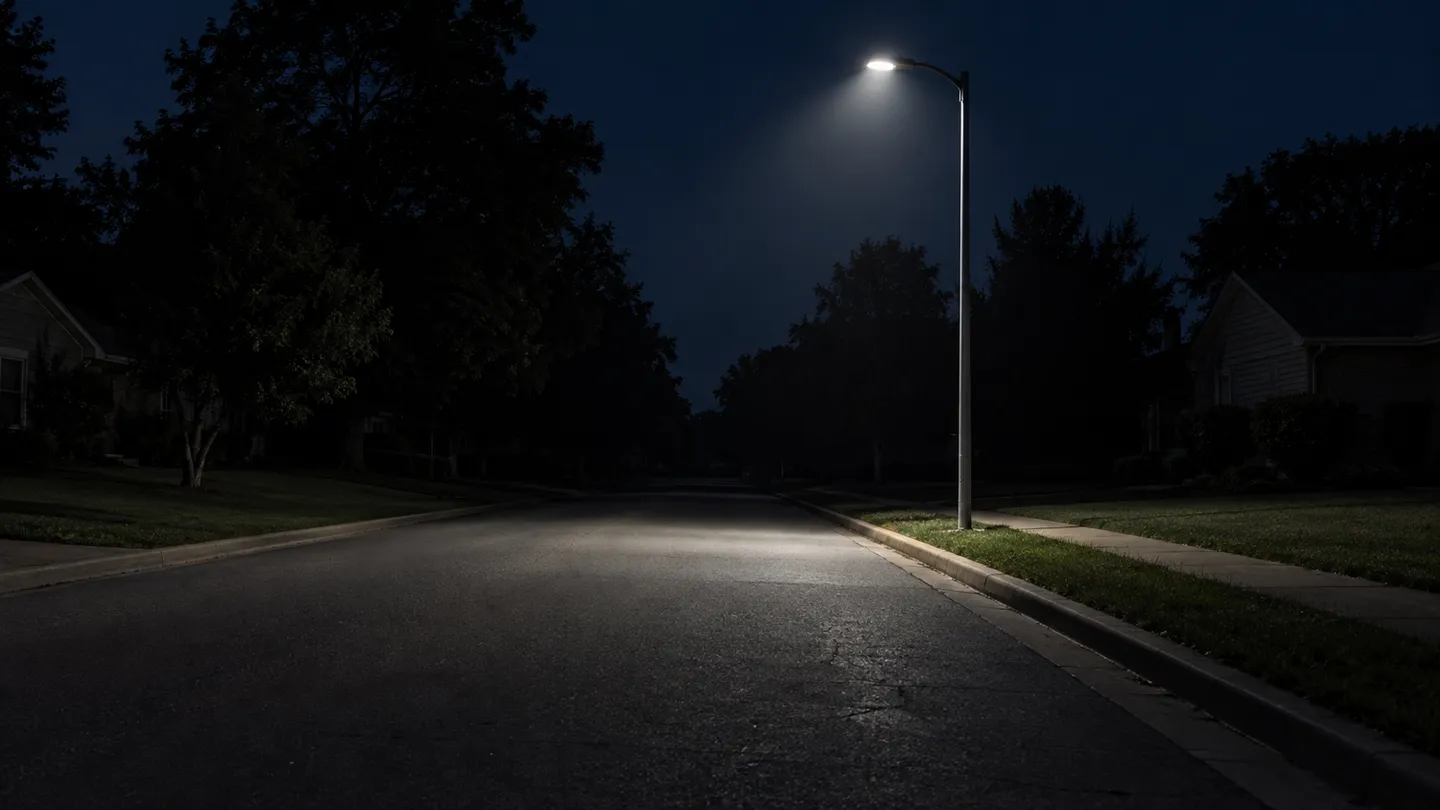
Glare from a street lamp is light arriving at your eye, straight from the source or bounced off a surface. It is intense enough to annoy you, or to lower what you can actually see. And it is not a property of the lamp alone. It depends on where the lamp sits, where it points, and where you are standing.
Three degrees matter, and they call for different responses. Discomfort glare is the irritating kind: the light bothers you but you can still see. Disability glare is the serious one. A bright source in your field of view scatters light inside the eye and washes out the scene. That is why a pedestrian walking under a glaring lamp can be harder to spot, not easier. The third degree, momentary blinding, speaks for itself.
One more thing worth settling early. If your complaint is a washed-out blob in phone photos of the street, that is lens flare, a camera problem with its own fixes. This article is about the light itself, and about who can do what about it.
City engineers openly acknowledge the baseline: glare observed from outside the illuminated area is “expected in a city street light environment” (Portland Bureau of Transportation, n.d.). Expected does not mean untreatable. But it does mean the useful question is not “why is there glare” but “why does this lamp glare more than that one.”
Why LED Street Lights Glare: Lumens Aren’t the Whole Story
LED retrofits changed the numbers that matter. A typical LED street light lists a long life, high efficacy, and a wide choice of color temperatures. The series pages of one manufacturer’s grid-tied line, for instance, run from 100 to 220 lumens per watt and 2700–6500 K (manufacturer series pages, 2026). Housing ratings run IP65 to IP66. None of those numbers predicts whether residents will hate the result. Three mechanisms do.
A Small Bright Source Outshines a Large Dim One
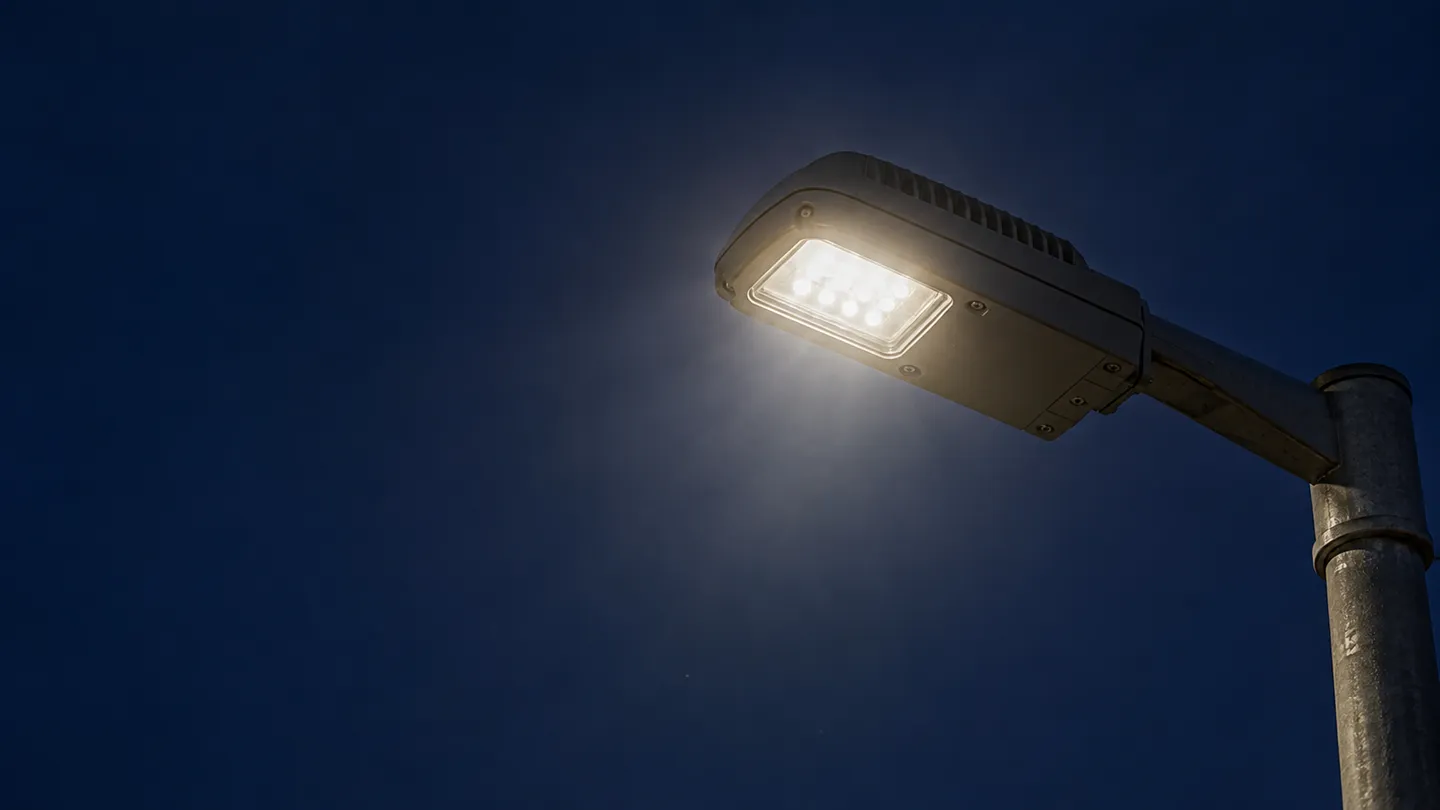
What stings the eye is luminance, the concentration of light in a given area, not the lumen total. An LED array pushes a road’s worth of lumens through a few square centimeters of emitting surface, so the source itself can read as a brilliant point even when the road below is properly lit. Older diffuse lamps spread the same output over a much larger glowing envelope. Advocacy groups documented early LED street lights that left diodes effectively bare to the eye, the worst case of this pattern (Soft Lights Foundation, n.d.). Two lamps with identical lumen ratings can therefore sit at opposite ends of the perceived-harshness scale.
Where the Light Points Beats How Much There Is
The second mechanism is distribution. A well-designed road optic keeps light inside the carriageway with a hard cutoff; a poor one spills it backward, upward, and into upstairs windows. Installation geometry compounds the design: a fixture tilted “for extra reach” turns a road lamp into a floodlight aimed at the opposite facade. Backlight deserves special attention, because the light thrown behind the pole is invisible to the crew on the lift and very visible from a bedroom across the street.
The Blue in White: Useful, But a Proxy
Color temperature is the mechanism most quoted and most misused. The American Medical Association recommended in 2016 that outdoor lighting, street lighting especially, stay at 3000 K or below (AMA CSAPH Rep. 2-A-16, 2016). Its report notes that 3000 K light still carries about 21% of its emission in the blue-appearing part of the spectrum. That shift reduces discomfort and disability glare compared with 4000 K, and it costs only about 3% in efficiency. The lighting research community pushed back. A peer-reviewed response argued that the AMA’s CCT-first recommendation was its most harmful error (Houser et al., LEUKOS, 2017). CCT, the critique runs, is a crude stand-in for the spectral and design factors that actually produce glare. Both things are true. Warmer sources help. Warmer sources alone do not fix bad optics.
The core judgment
Glare is a control failure, not a brightness failure. The lamp lost control of where its light goes; the lumen count is usually innocent.
That judgment has a practical order attached. To judge a lamp, look first at where the light exits and how large the emitting surface is, and only then at the spectrum. Buying a 2700 K lamp with a bare-diode optic and a forward tilt will not end a complaints cycle; it will just make the complaints warmer in tone.
Fixing Street Light Glare: What Works, What’s Banned, Who to Call
Once a lamp is installed, the menu has three lines: block, manage, replace. Which line applies depends on who you are and where the lamp stands.
Blocking splits in two. Inside the property, curtains and window film are the honest short-term answer, and dark-sky guidance suggests raising the fixture-level options with the neighbor or owner at the same time (DarkSky International, n.d.). Shield it, redirect it, reduce it, or put it on a motion sensor. At the fixture itself, a shield or house-side plate blocks the light heading toward a specific property. Note what a shield does not do: it does not dim or lower the lamp’s output (LED Light Expert, 2025).
Managing means the request process, and it is more standard than most residents expect. Photograph the problem and the fixture, identify the owner (the city or the utility), submit the request, and await an assessment. Portland runs exactly this flow by email and phone; some utilities run shield programs through the municipality, as a Florida city’s shield-and-replacement request program shows. Australian councils apply glare shields to qualifying streetlights to cut spill toward homes (Sunshine Coast Council, 2026).
Now the part the marketing pages leave out. The city that runs one of the oldest shield programs states plainly that shields “may reduce glare, though that is not the primary goal” (Portland Bureau of Transportation, n.d.). It refuses them in two positions: at intersections and corners, where backlight is doing useful work lighting the cross street, and on the street side of a light. There, a shield would shrink the illuminated roadway. A shield is a patch on one sightline, not a cure for the optic.
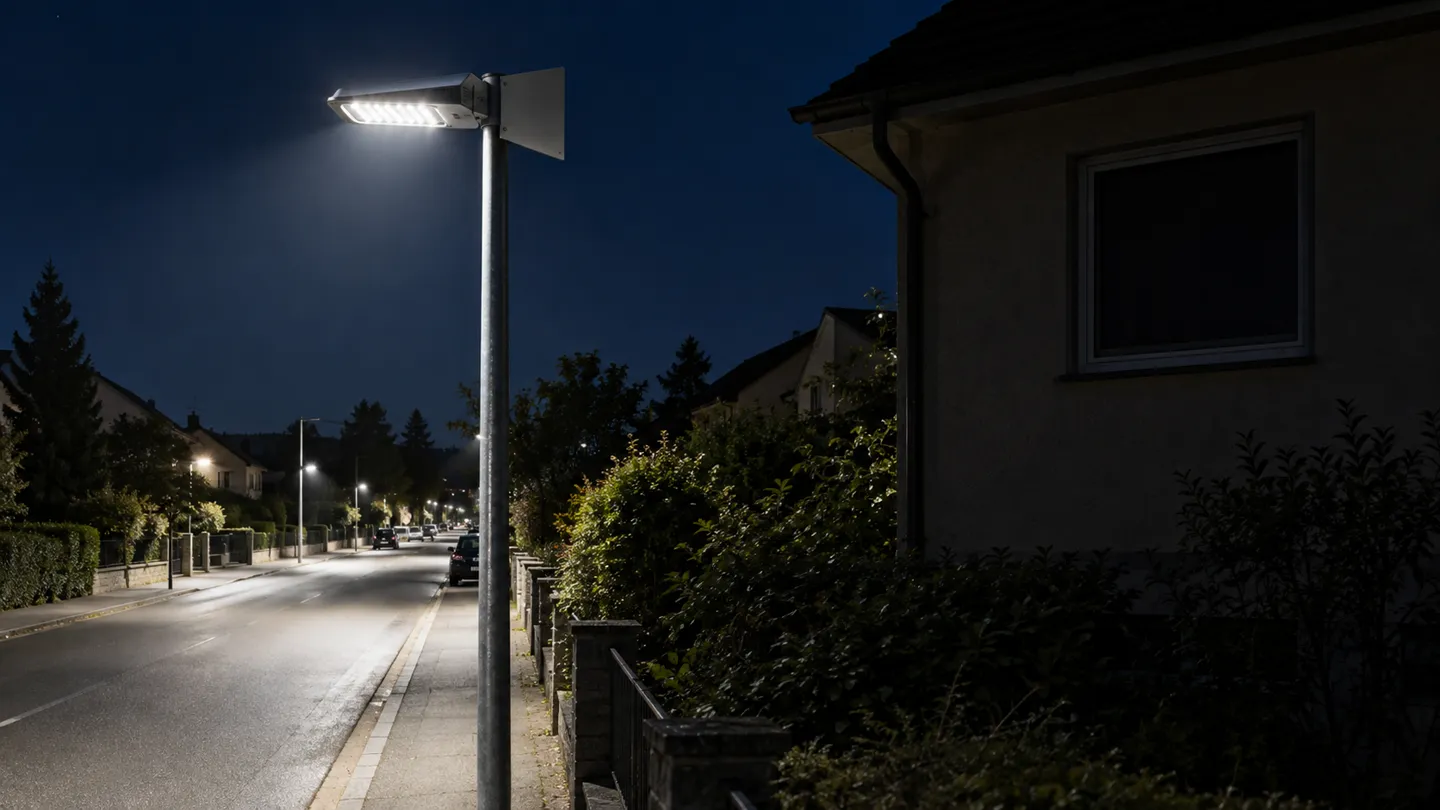
Replacing is the only line that fixes the fixture itself: a different optic, a full-cutoff distribution, or simply a lamp chosen with the emission direction in mind.
Glare measures compared: what works, what’s banned
| Measure | Who uses it | Works for | Fails or banned where | Verifiable action first |
|---|---|---|---|---|
| Window film / curtains | Resident | Immediate relief indoors | Street-side visibility unchanged | Check tenancy/glazing rules before applying |
| Aftermarket shield / house-side plate | Resident by request, crew installs | One specific sightline | Intersections & corners, street side of the lamp | Confirm fixture model and owner before requesting |
| Tilt / aim adjustment | Maintenance crew | Quick, low cost | Can create new trespass downstream | Re-check facing properties after adjustment |
| Swap to full-cutoff optic | City / project budget | The optic itself, permanently | Cost and lead time | Request photometric files before award |
| Formal complaint / shield request | Resident to owner | Creates an official record | Outcome not guaranteed | Photos + fixture number in the first message |
One trend belongs in every buyer’s calendar rather than a resident’s: glare is becoming a code matter. California’s energy code requires luminaires of 6,200 lumens or more to meet Backlight-Uplight-Glare requirements (Energy Code Ace, Title 24 Part 6 §5.106.8, 2019), European road classes carry explicit glare limits, and dark-sky certifications keep spreading. The complaint form is being replaced by the compliance sheet.
Measuring Glare: TI, BUG Ratings and the CCT Trap
If you design roadway lighting or sign off on it, “too bright” has to become a number on a sheet. Three numbers do that work, and they answer different questions.
Disability Glare Gets a Number: TI
Disability glare is measured as veiling luminance: the veil of scattered light a bright source lays over the retina. Its number is threshold increment (TI), the percentage increase in contrast an object needs to stay visible with the glare present (LEOTEK, n.d.). EN 13201-2 caps TI per road class for motorized traffic: 10% for classes M1 and M2, 15% for M3 through M5, 20% for M6 (POLAB, 2026). One warning travels with the number: TI is only comparable within the same standard edition, observer geometry, and road model. Change any of those and two TI figures stop talking to each other (LEOTEK, n.d.).
The Environmental Side: BUG
Where TI protects the road user, the BUG rating protects everything around the road. Backlight, Uplight, and Glare zones are each graded, with the system described in US federal guidance and enforced through rating limits rather than simulation (FHWA, n.d.). A luminaire’s BUG grade comes from its photometric file, which is why the file, not the brochure, is the deliverable that matters. One boundary note keeps the systems separate: area and sports lighting use the GR glare rating instead, so do not carry TI across to a stadium job.
CCT: A Useful Proxy, a Poor Proof
The CCT debate from the mechanism section lands differently once contracts appear. The AMA position (3000 K or below, with shielding) and the research critique (CCT is not a glare metric) resolve into one drafting rule. CCT enters the specification as a range, never as the only glare clause. A lamp can be 2700 K and still glare; a 4000 K lamp with a tight optic can beat it on TI.
Four glare metrics and where each one belongs
| Metric | What it covers | Who verifies it | Where it appears |
|---|---|---|---|
| TI (threshold increment) | Driver’s visual performance on the road | Designer’s simulation per EN 13201 | Road class sheets, design report |
| BUG rating | Light thrown behind, above, toward observers | Manufacturer’s photometric file, checked by reviewer | Title 24 / LEED compliance sheets |
| CCT | Spectrum, as a proxy | Meter reading at acceptance | Spec sheet line, as a range |
| GR | Observer glare in area/sports lighting | Sports lighting calculation | Floodlight and stadium specs |
Writing Glare Into the Spec — and Checking It on Arrival
Everything above compresses into three steps a buyer can put in an RFQ this week.
Step one: write the clauses numerically. Cap each BUG zone, set the TI limit by road class, and define CCT as a range. For residential streets, 2700–3000 K is the defensible default given the AMA position. Require zero uplight where dark-sky compliance applies, and list shield or house-side options as a deliverable, not a favor. Step two: check the goods against the paper. Photometric files in IES or LDT format come with the shipment, your designer re-runs TI and BUG in your own software and geometry, and nameplates get spot-checked against the file. Step three: file everything. The photometric file and the check records go into the warranty dossier, which is where they will be sitting when the first complaint letter arrives.
Example glare clauses for a street light RFQ
| Spec line | Example wording | Source of the number |
|---|---|---|
| Glare zones | BUG ≤ B2 / U0 / G2 | IES TM-15 file per luminaire |
| Disability glare | TI ≤ 10% (road class M1–M2 basis) | EN 13201-2 class table |
| Color temperature | 2700–3000 K for residential sections | AMA 2016 position, as a range only |
| Uplight | Zero uplight where dark-sky applies | Project dark-sky commitment |
| Shield option | House-side shield available on same housing | Supplier product data |
The failure mode to design against is quiet: the file in the shipment does not match the lamp on the pole. If that pair is never reconciled, every clause above is decorative. One third-party photometric spot test on a random sample closes the loop.
How to Vet a Street Light Supplier for Glare Control
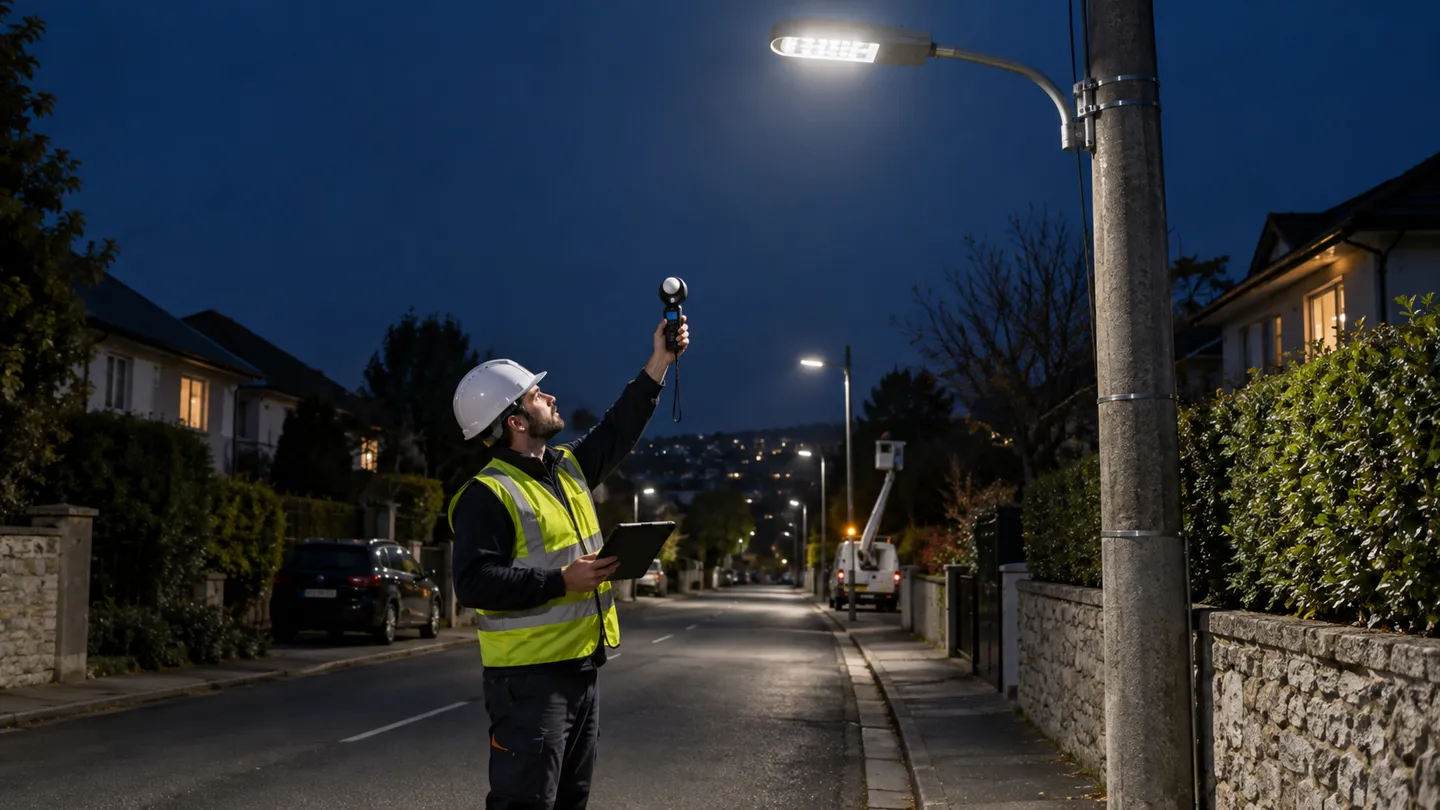
Quotations rarely fail on price. They fail later, when the glare clauses meet the supplier’s actual capabilities, so the vetting questions are worth settling before the bid, not after delivery.
The supplier who can carry glare clauses will do five things without being chased. They provide photometric files as standard and run simulations for your road cross-sections, not just for their demo road. They offer shields or house-side plates on the same housing, so a complaint six months later does not turn into a change order. They quote several cutoff and optics options rather than one distribution. They state certifications for your market and warranty terms per series, in writing. And they name road projects you can actually verify.
Supplier glare-capability check
- photometric files (IES/LDT) standard with offer
- project-specific simulation offered
- shield/HSS option on same housing
- multiple cutoff/optics options
- certifications for target market
- warranty per series in writing
- verifiable road references
When Retrofits Go Wrong: Davis’s 1,400-Light Lesson
Davis, California, ran the experiment for everyone. In 2014 the city’s LED conversion reached 1,400 installed lamps before complaints about brightness, glare, and color put the program on hold. The city staff review pinned the reaction on two things: 4,000 K color temperature and perceived excess brightness. By October, the decision was to replace the 650 residential-area lamps and all remaining fixtures with a warmer unit, around 1,800 lumens at 2,700 K (Smart Outdoor Lighting Alliance, n.d.). Residents had been asked to rank the candidate lamps directly, which is how the city found out (KCRA 3, 2014). The dark-sky community’s autopsy was blunter: “The first fault is glare” (DarkSky International, 2015).
Davis, CA 2014: the retrofit that paid twice
1,400
lamps installed before the hold
4,000 K
CCT named a primary cause
650
residential lamps plus all remaining fixtures replaced
2,700 K
replacement spec, about 1,800 lm
When complaints land on an already-retrofitted network, order of operations decides whether you pay once or twice. Triage the complaint into a glare type first. Re-check the as-built photometry against the file second. Then escalate through shields and dimming, partial swaps, and only at the end batch replacement. Seattle’s 2018 retrofit complaints show the pattern in reverse (r/SeattleWA, 2018). Residents compared notes on lamps that read “too bright and too blue,” while the practical talk moved straight to house-side shields. Skipping the photometry step and swapping lamps first means paying for the same complaint twice.
The institutional lesson costs the least if it is adopted first: pilot, then let residents rank the lamps. Davis eventually did exactly that, and it is the cheapest insurance a retrofit budget can buy.
Spec the Glare Out Before the First Lamp Goes Up
WOSEN supplies photometric files, cutoff options and shield-ready housings for street light projects — send your road classes and get a glare-ready proposal.
Request a Glare-Ready QuoteGlare as Procurement Risk: The Business Read
Read back through the chain, the business meaning is uncomfortable and useful. Glare is a control failure, so a project without glare clauses in its contract has not avoided the risk, only scheduled it for after acceptance. The tools to control it are numeric and mature: TI caps by road class, BUG zone limits, CCT as a bounded range, photometric files as a deliverable. And the cost of skipping them has a receipt attached: 1,400 lamps installed, 650 of them swapped, one city’s retrofit budget spent twice on the same poles.
So the stance here is simple. Treat glare control as procurement risk control. Put the numbers in the RFQ, reconcile file and lamp at acceptance, and weight suppliers by whether they can actually carry those clauses, shields and simulations included. When two quotes tie on price, the one that can hold the glare spec is the cheaper lamp.
Brand-side readers get the same advice pointed the other way. As codes harden glare limits into compliance sheets, a street light line that ships with the right files, warm-end options, and shield support stops being a spec detail and becomes the reason a tender lists you.
If you are assembling a tender and want a second catalog to compare glare-related options against, WOSEN publishes its street light range online, including custom optics angles from 15° to 120° (custom optics options).
Get Glare-Ready Street Lights for Your Next Tender
Photometric files, BUG/TI data, 2700 K warm options and house-side shield support — direct from the WOSEN factory.
Request Glare Specs & PricingReferences
- American Medical Association. “Human and Environmental Effects of Light Emitting Diode (LED) Community Lighting,” CSAPH Rep. 2-A-16. 2016. https://policysearch.ama-assn.org/councilreports/downloadreport?uri=/councilreports/a16_csaph2.pdf
- Houser, K. et al. “The AMA’s Misguided Report on Human and Environmental Effects of LED Community Lighting.” LEUKOS. 2017. https://www.tandfonline.com/doi/full/10.1080/15502724.2016.1247566
- Smart Outdoor Lighting Alliance. “Davis, CA LED Streetlight Retrofit.” n.d. https://volt.org/lessons-learned-davis-ca-led-streetlight-retrofit
- KCRA 3. “Davis asks residents to rank new LED street lights.” 2014. https://www.kcra.com/article/davis-asks-residents-to-rank-new-led-street-lights-1/6416154
- DarkSky International. “City’s LED Retrofit Shows Need For Careful Lighting Choices.” 2015. https://darksky.org/news/citys-led-retrofit-shows-need-for-careful-lighting-choices
- Portland Bureau of Transportation. “Streetlight shield.” n.d. https://www.portland.gov/transportation/traffic-operations/streetlight-shield
- Sunshine Coast Council. “Shading streetlights.” 2026. https://www.sunshinecoast.qld.gov.au/living-and-community/roads-and-transport/road-safety/streetlights
- DarkSky International. “My neighbor’s lighting: What can I do?” n.d. https://darksky.org/resources/what-is-light-pollution/light-pollution-solutions/lighting/my-neighbors-lighting
- LED Light Expert. “Blocking Glare from Street Lights: Light Shield Installation Guide.” 2025. https://www.ledlightexpert.com/blocking-glare-from-street-lights-light-shield-installation-guide
- Energy Code Ace. “Section 6.4 Mandatory Requirements, Title 24 Part 6.” 2019. https://energycodeace.com/site/custom/public/reference-ace-2019/Documents/64mandatoryrequirements.htm
- POLAB. “EN 13201 — The Road Lighting Standard’s Classes and Requirements.” 2026. https://www.polab.se/en/knowledge/en-13201-road-lighting-standard.html
- LEOTEK. “Veiling Luminance and Threshold Increment: Measuring Disability Glare on Roads.” n.d. https://leotek.com/veiling-luminance-and-threshold-increment-measuring-disability-glare-on-roads
- FHWA. “Appendix A. Roadway Lighting Details, Roadway Visibility Research Needs Assessment.” n.d. https://highways.dot.gov/safety/other/visibility/roadway-visibility-research-needs-assessment/appendix-roadway-lighting
- Soft Lights Foundation. “Chapter 16 – Streetlights.” n.d. https://www.softlights.org/chapter-16-streetlights/
- r/SeattleWA. “Neighbors complain: New street lights too bright & too blue.” 2018. https://www.reddit.com/r/SeattleWA/comments/8b8lqv/neighbors_complain_new_street_lights_too_bright/
- WOSEN. “Model 15 Series Adjustable Outdoor LED Street Lights.” 2026. https://www.wosenled.com/portfolio/model-15-series-adjustable-outdoor-led-street-lights/
- WOSEN. “Customization.” n.d. https://www.wosenled.com/customization/
- WOSEN. Homepage. n.d. https://www.wosenled.com/

 English
  Spanish
  French
  German
  Italian
  Arabic
  Russian
  Portuguese
  Dutch
Dutch  Indonesian
  Turkish
  Polish