
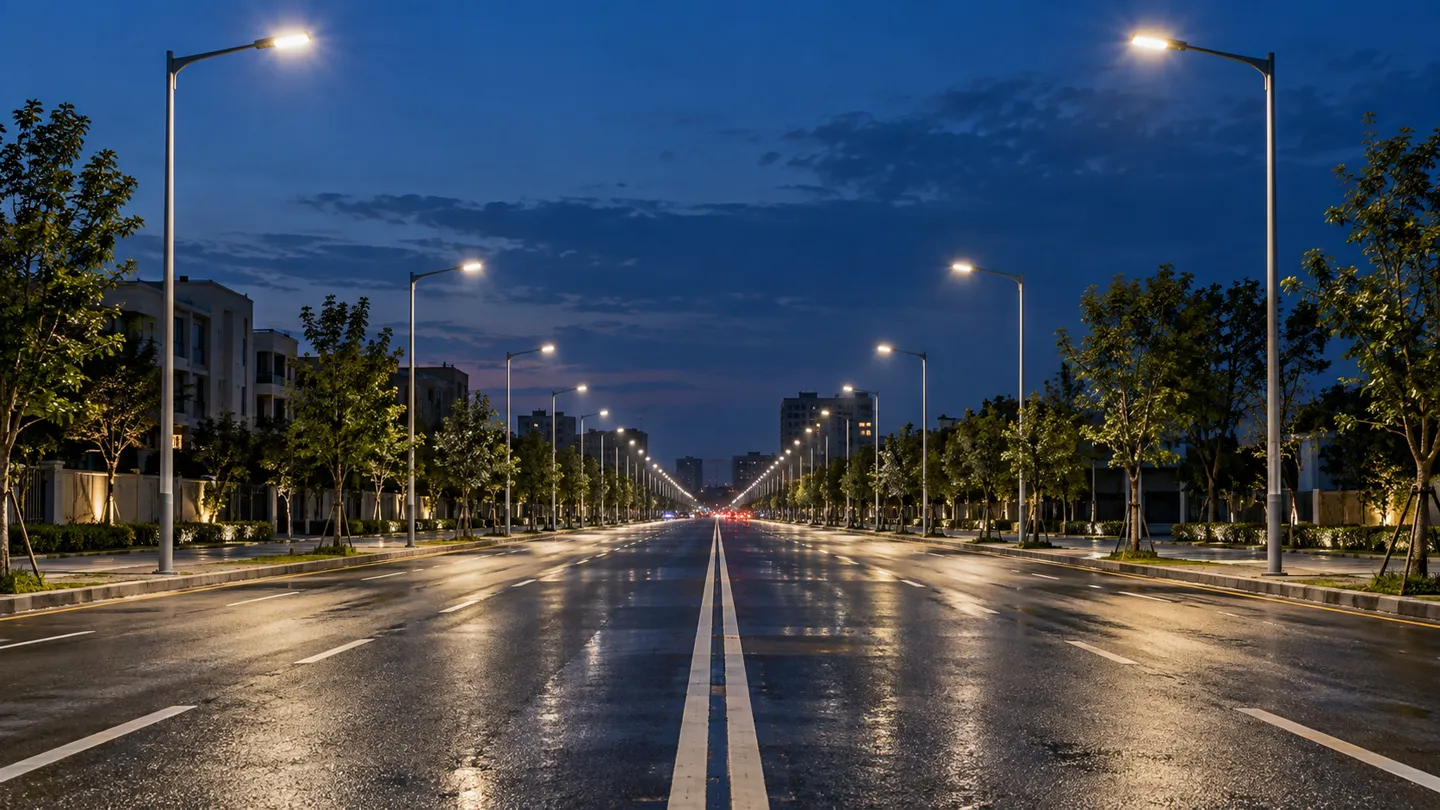
The catalog says an LED street light lasts 50,000 hours. The field says something else. Los Angeles keeps about 220,000 streetlights in service, and its crews repaired nearly 38,000 of them in a single year (City of Los Angeles DPW, n.d.). That is one fixture in six, touched every year, in a system that already converted most corridors to LED.
If you manage a lighting fleet, bid on its maintenance, or sign off its purchases, that gap between the datasheet and the street is where your budget lives. This guide covers what street lighting maintenance actually involves and how often each task should happen. It walks through when a program beats reactive repairs, and how to diagnose failures and decide repair versus replace. It ends with what to demand from a supplier before the pole goes up. It is written for the people who own the outcome: property and facility managers, public works teams, and the contractors who bid on both.
Reality check
A 50,000-hour rating is a lab number, not a maintenance plan.
220,000
streetlights in service in Los Angeles
~38,000
of them repaired in a single year
99%
lights-working target the city publishes
1 in 6
fixtures touched every year, LED or not
What Street Lighting Maintenance Actually Covers
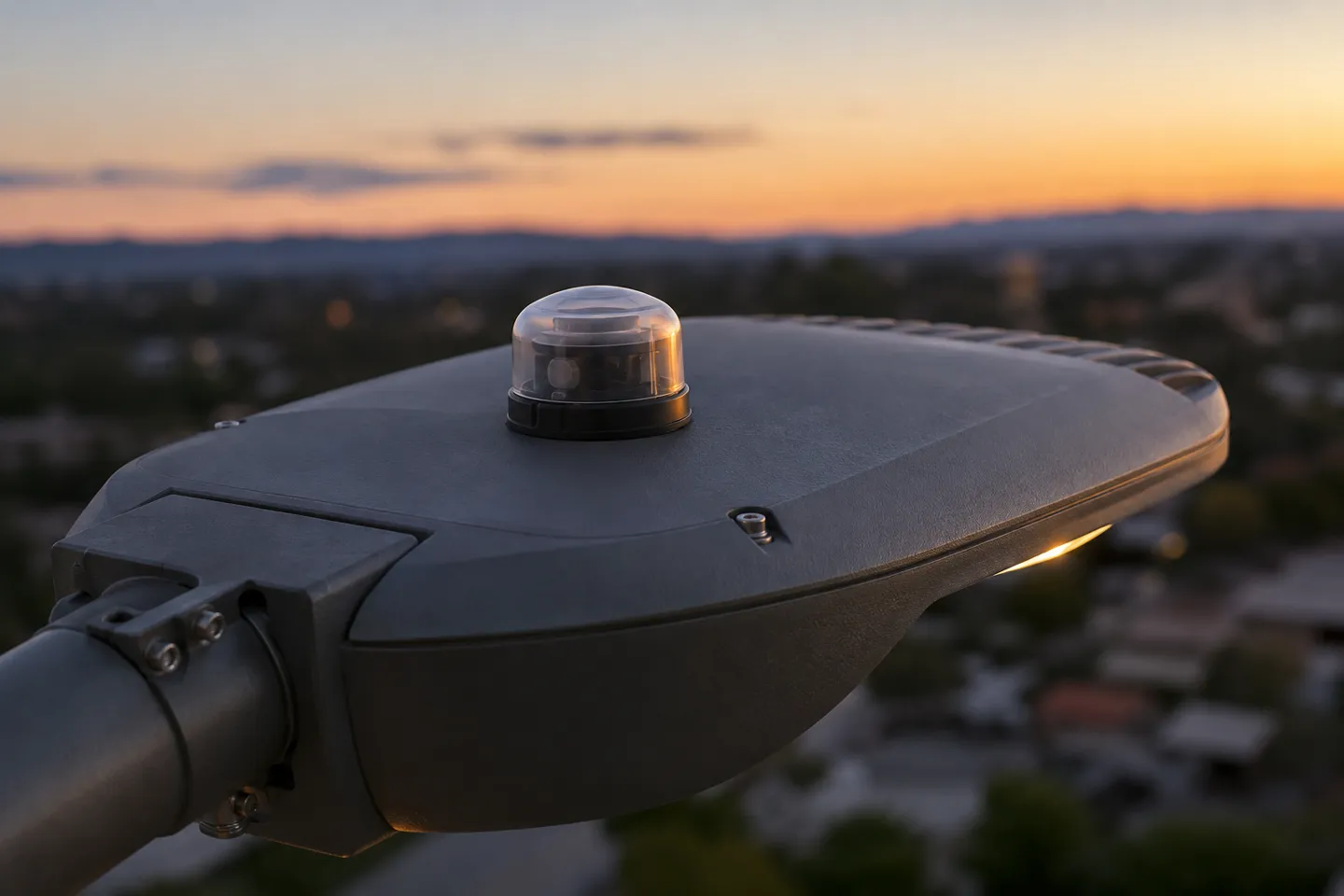
Street lights fail in four predictable ways. The lamp or LED module and its driver stop working. The circuitry upstream of the fixture trips, corrodes, or gets cut. The pole itself is hit, corroded, or climbed for its copper. And the controls, photocells above all, stop switching the light at dusk and dawn. Every maintenance task you will ever schedule exists to catch one of these four early.
Who fixes what depends on who owns the light. In some metro areas the utility owns the streetlights and the city leases them, with maintenance folded into the lease. Elsewhere the city owns the fleet and runs its own crews or hires contractors. On private roads, campuses, and HOA streets, the owner maintains everything. The pole tag and the utility bill settle the question in about a minute. Once you know the owner, the reporting path is usually a 311 line or a hotline. Response commitments vary sharply. In New York, contractors must reach true emergencies, like a fallen pole, within four hours (NYC DOT, n.d.). Note what that SLA actually promises: a response, not a repair.
Underneath the ownership question sit two engines of maintenance. The first is reactive: a resident reports a dark light, a crew rolls. The second is scheduled: inspections and cleanings happen on a calendar, whether or not anyone complained. A fleet of a dozen private lot lights can live on the first engine. Public networks cannot, and the reasons are economic rather than technical.
Street Lighting Maintenance Tasks and How Often to Do Them
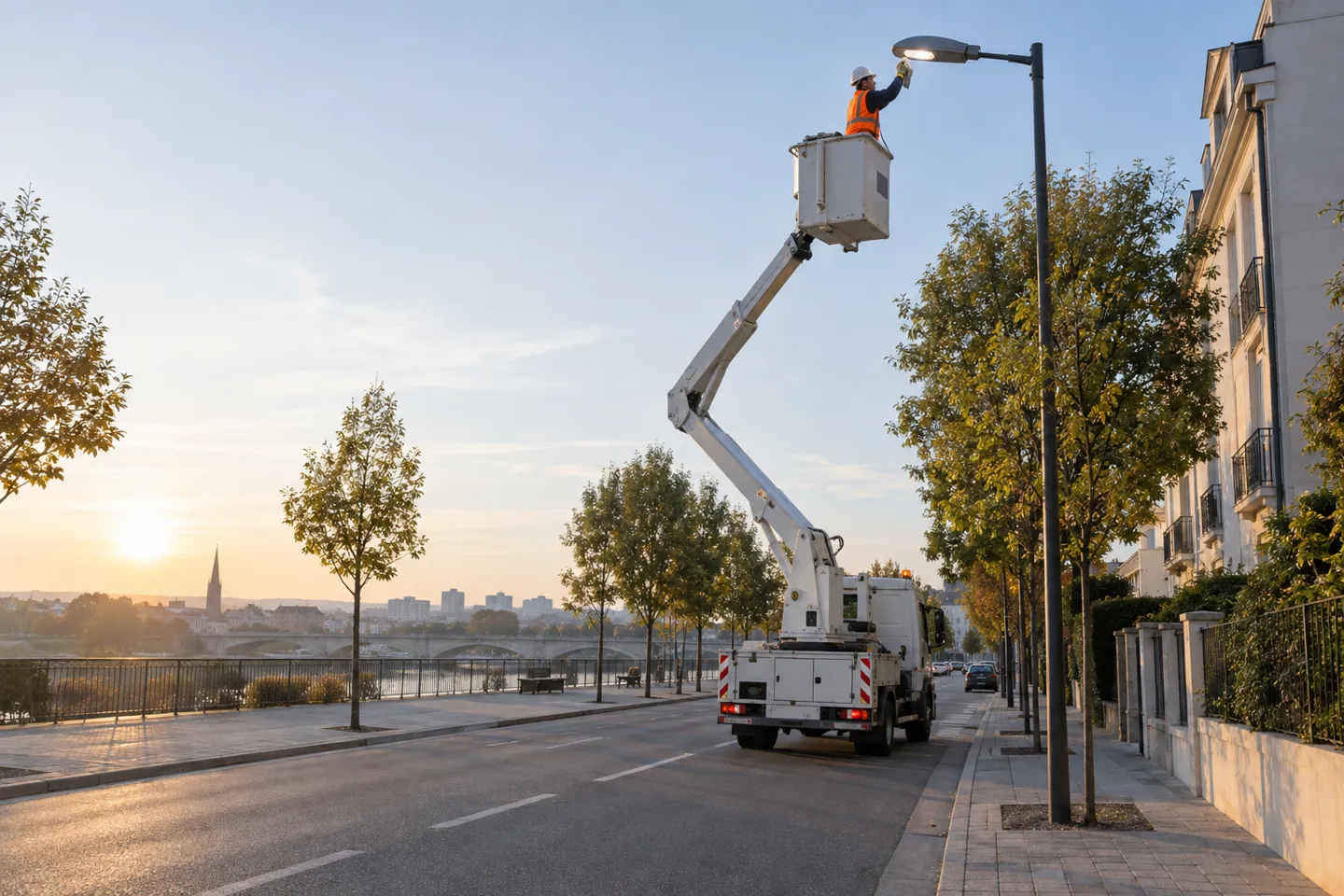
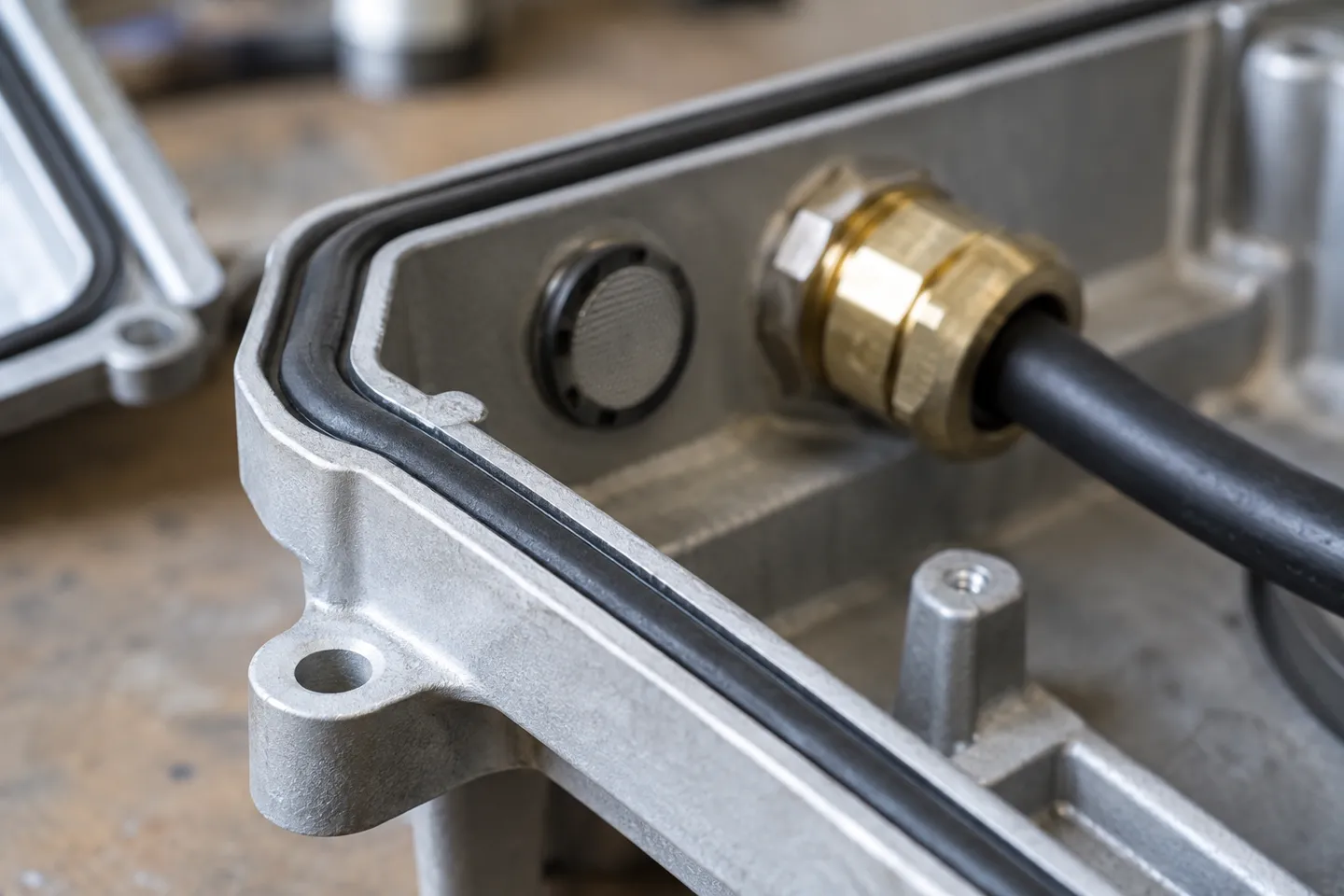
The task list makes sense only when each task is tied to the failure it prevents. Cleaning the lens restores lumens lost to grime. Replacing the driver or a module brings a dead or flickering head back. Checking gaskets, cable glands, and the breathing vent stops the slow moisture ingress that kills electronics a year after installation. Torquing fasteners and touching up corrosion protects the pole and the housing. Cutting vegetation restores the light distribution the optics were designed for. Testing the photocell catches the light that burns all day or never comes on. In the HPS era this list centered on lamp changes; in the LED era it centers on drivers, seals, and controls, because those are now the parts that actually wear.
How often? Run-to-fail is defensible below roughly a few dozen fixtures. Above that, a 12-month inspection cycle is the sensible baseline, tightening to 6 months on coastal, desert, or high-grime corridors and on sections with a history of complaints (OxMaint, 2026). One practical method replaces guesswork with measurement. Each year, measure illuminance at fixed points under a sample of lights; when readings drop more than 20%, high-pressure clean the lens and re-measure before touching the electronics (ZGSM, n.d.). That single threshold keeps cleaning on a condition basis instead of a calendar and catches real degradation early.
Two technology notes keep the list current. First, there is no lamp to unscrew in an LED fleet; the driver and the surge module are the wear parts, and your spares shelf should say so. Second, off-grid solar street lights run a different clock. The battery is the consumable, sized in charge cycles, so replacement is a scheduled event years before the LED fades. Panel cleaning is a lumen task like lens cleaning.
Street light maintenance checklist
- Clean lens or cover, inside and out
- Re-measure illuminance against the annual baseline
- Inspect gaskets, glands, and vent for cracks or blocking
- Check for water ingress, fogging, corrosion inside the head
- Verify photocell switching at dusk
- Inspect cable, connections, and earthing
- Torque fasteners, check pole for impact and rust
- Confirm the fixture still matches its design light distribution
- Log every action against the asset’s location and install date
A checklist keeps the lights on. What it does not do is tell you what the work should cost, or which failures a purchase order could have prevented. That needs a program.
From Reactive Repairs to a Maintenance Program
Complaint-driven maintenance feels free and is not. One city running 850 traffic signals and 12,000 streetlights spent $420,000 a year on reactive repairs, premium part shipping, and manual paperwork. It rebuilt its program, and the spending was the reason (OxMaint, 2026). The lesson generalizes. Past a few hundred assets, not knowing your fleet’s locations, ages, and warranty windows costs more than tracking them.
The Four Pieces Every Program Needs
Piece one is an asset registry: every pole mapped, with its install date, model, driver type, and warranty window attached. This one dataset feeds everything else. Piece two is the inspection schedule, built on the task list and the 6- or 12-month cadence from the previous section. Piece three is response tiering. A fallen pole or exposed wiring is a four-hour emergency; a single dark light is a routine ticket. The SLA for each should be written down, as New York does with its four-hour emergency commitment (NYC DOT, n.d.). Piece four is a KPI. The 99%-lit target Los Angeles publishes is the industry’s reference point (City of Los Angeles DPW, n.d.). Measure it by complaint closure, night patrol, or remote monitoring; whatever the method, publish the number and manage to it.
What the Program Actually Saves
The energy savings of LED conversion are familiar: on the 12,000-fixture example above, roughly $40 per fixture per year, some $480,000 annually. The maintenance savings are quieter but real. When crews stop hunting for fixtures and warranty windows, dark-light response drops from an average of 11 days to under 90 minutes, and route-optimized dispatch cuts truck rolls (OxMaint, 2026). None of that requires exotic hardware. It requires the registry, the schedule, and the discipline to log work against assets.
What one program changed (12,000-fixture city)
$420K
per year of reactive spend before the program rebuild
~$40
per fixture per year in LED energy savings
90 min
dark-light response, down from an average of 11 days
15%
of in-warranty claims recovered once install dates were tracked
Warranty Recovery: The Money Most Fleets Leave Behind
Here is the piece almost nobody collects. Without install-date records, roughly 15% of in-warranty claims simply go unfiled. One lighting authority recovered $31,000 in LED warranty claims in its first year of tracking, and a mid-sized municipality another $28,000, money that was already owed to them (OxMaint, 2026). Recovery needs three habits: record the install date of every fixture, retain the failed part until the claim closes, and track each warranty window against its expiry. It matters more in an LED fleet than an HPS one. What fails now is mostly electronics: drivers, surge modules, seals. That is exactly the content carrying multi-year warranties. The trend line is clear: as lamps stopped failing, warranty management quietly became part of maintenance, and the fleets that treat it as revenue recover it.
There is a boundary here worth stating. A program does not have to start big. A registry, an annual inspection, and a claim log are the minimum viable program, and they cost labor rather than capital. Remote monitoring earns its place only where fixture density and response penalties justify it; run that math before buying dashboards.
Diagnosing Street Light Failures: Repair or Replace?
A dark or misbehaving light is a question, and the answer follows a pattern. Dead light: supply first, then driver, then module. Flickering: driver capacitors, loose terminations, or grid voltage swings. Dimming across the whole head: lumen depreciation or a lens that needs cleaning. Intermittent operation: a photocell triggering falsely or oxidized contacts. Visible fogging or corrosion inside the optic: water got in, and everything downstream is suspect until proven dry.
Field diagnosis: symptom to action
| Symptom | Most likely cause | First field action |
|---|---|---|
| Dead, no light | Supply failure or driver breakdown | Check supply and fuse, then test driver, record the failed part |
| Flickering | Driver capacitors, loose connections, voltage swings | Reseat terminations, test on stabilized supply, replace driver if it persists |
| Whole head dim | Lens soiling or module lumen depreciation | Clean and re-measure; if still >20% below baseline, plan source replacement |
| Intermittent on/off | Photocell false triggering or oxidized contact | Swap photocell, inspect terminations |
| Fogging or corrosion inside | Sealing failure, water ingress | De-energize, dry, insulation-test, replace gaskets and vent |
Work in a fixed order: supply before fixture, external before opening the head, and record before touching. The recording is not bureaucracy. The photo, the date, and the retained part are exactly what a warranty claim is made of, which is why diagnosis belongs to the program, not just the crew.
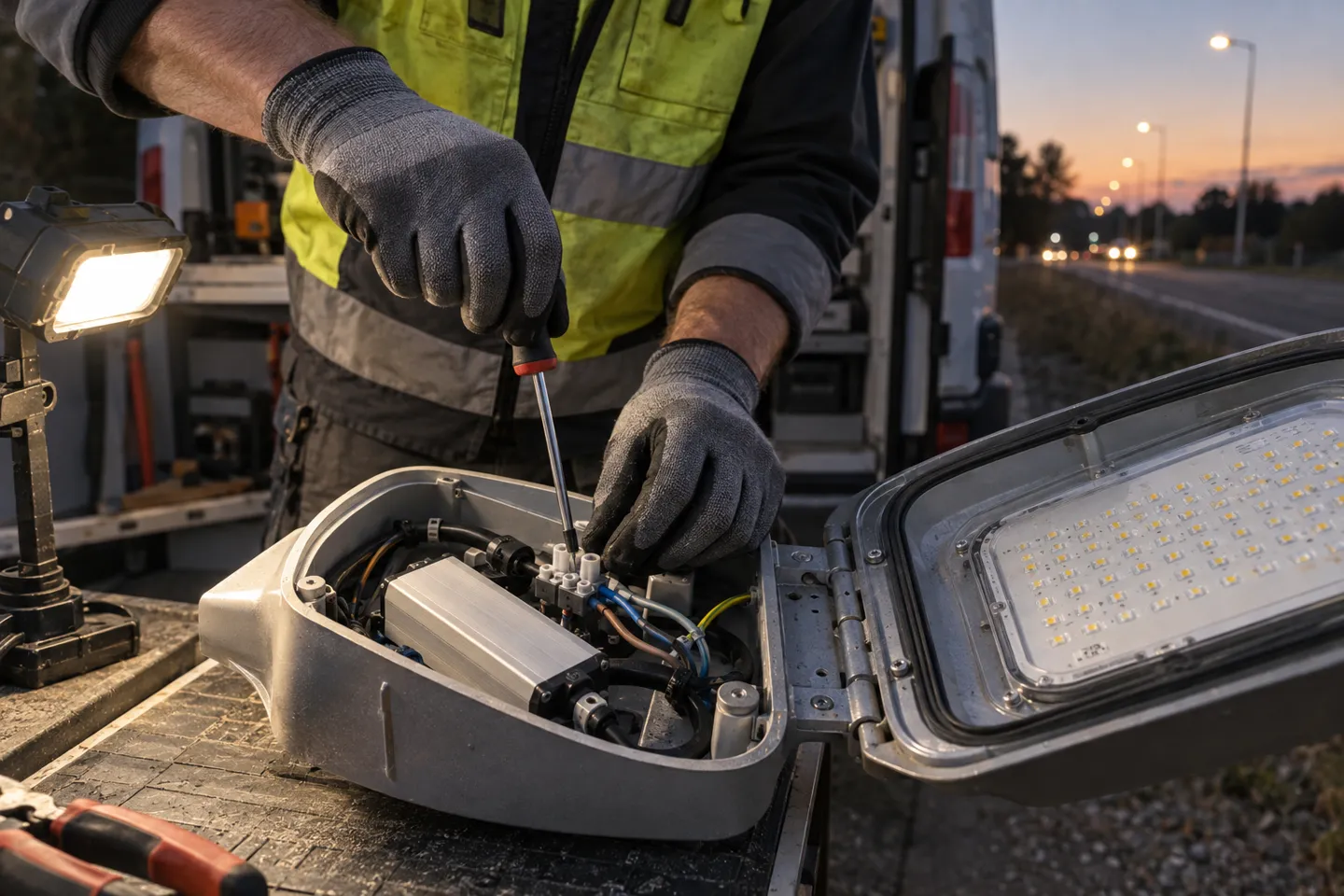
Repair versus replace has thresholds. A head measuring more than 20% below its baseline gets a cleaning first and a re-measurement second; only then does the light source or driver come into question. A driver that fails out of warranty in an older-generation fixture is usually a replace-the-unit decision. Parts plus a second truck roll cost more than a new head with a fresh warranty. And a model that fails in batches gets reported as a batch defect, not repaired unit by unit. There the vendor conversation is about a design or component fix, not a purchase order.
Two boundaries keep this safe and honest. Live diagnosis is licensed electrical work under your local code. A water-ingressed fixture gets de-energized and insulation-tested before anyone opens it. What this section cannot fix is a fleet that fails by design; that problem is decided at specification, before anything is installed.
Get a street light specification matched to your site’s surge, moisture, and heat profile.
Start a spec reviewSpecifying for Low Maintenance: What to Demand Before You Buy
Practitioners who have reviewed thousands of warranty claims converge on a number. Roughly 90% of first-year street light failures trace to three root causes: heat, electrical surge, and moisture (BesenLED, n.d.). All three can be engineered out at the specification stage. If you buy on price alone and specify nothing, you have chosen all three.
The Three Root Causes, Written as Specs
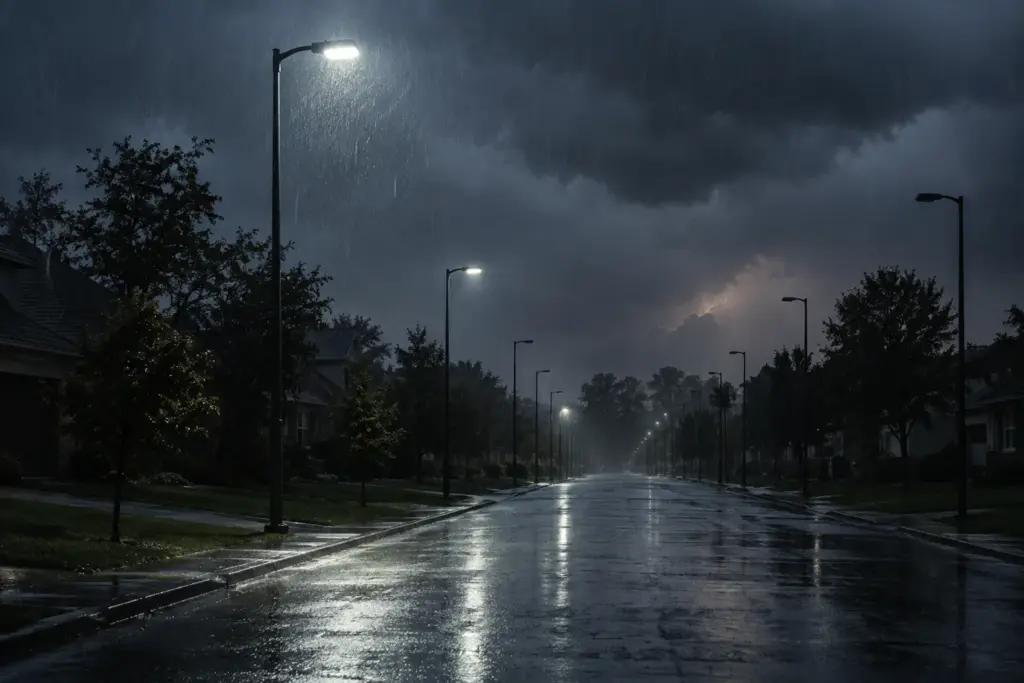
Surge first. The standard is ANSI C136.2-2023, which grades luminaire surge immunity into three exposure levels: 6 kV/3 kA (Typical), 10 kV/5 kA (Enhanced), and 20 kV/10 kA (Extreme) (CITEL, 2023). Match the level to the site: open terrain and high lightning density demand the top grade, as does any feeder with a history of switching transients. Two rules when you buy. First, demand the luminaire’s test report with the surge protector installed, because the standard tests the pair, not the module alone. Second, treat a “built-in 6 kV” line in a proposal as marketing, not specification. Budget drivers ship with 2-4 kV protection, which will not survive an exposed site (BesenLED, n.d.). In lightning-prone regions, add an external Type 2 SPD in the pole base regardless of the luminaire’s rating.
Moisture next. An IP66 claim on a datasheet describes a test, not a lifetime. What keeps water out for ten years is the sealing system. That means gasket design and compression, cable gland quality, and a hydrophobic vent that lets the housing breathe without pumping humid air across cold surfaces. Ask the supplier how sealing is verified in production, not just whether the fixture once passed IPX6. Condensation that fogs a lens from the inside is a design question, and the answer lives in the vent.
Heat last. Junction temperature decides how long the electronics survive, so make the supplier prove it. Demand junction temperature data at a realistic ambient, not a laboratory 25 °C. Demand thermal foldback in the driver too, so a hot summer de-rates brightness instead of cooking electronics. Heat kills drivers first and accelerates lumen depreciation everywhere else, which is why it belongs in the same conversation as surge and water.
The matrix below is the working version: five failure modes, what they look like in the field, the specification that prevents them, and the maintenance action that catches them early.
Failure modes: symptom, spec, maintenance
| Failure mode | Field symptom | Spec to demand before purchase | Field maintenance action |
|---|---|---|---|
| Surge damage | Dead after storms, burned driver boards | ANSI C136.2 exposure level matched to site, test report with SPD installed, external SPD in high-risk areas | Inspect SPD modules after major storms, keep spares |
| Moisture ingress | Fogging, corrosion, intermittent faults | Gasket and gland design review, hydrophobic vent, production sealing verification | Annual gasket and vent check, dry and reseal early |
| Driver thermal failure | Flickering, dead heads in summer | Junction temperature data at real ambient, driver thermal foldback | Thermal scan of a sample fleet at peak summer |
| LED lumen loss | Dimming against baseline | LM-80 based lumen data, realistic ambient ratings | Annual illuminance measurement, clean at 20% drop |
| Pole and vandalism | Impact damage, missing parts | IK-rated optics, tamper-resistant fasteners, stainless hardware | Route-based visual inspection, fast stock of pole hardware |
Maintainability and Warranty: The Clauses That Pay Back
Prevention has a second half: when something does fail, how fast can a crew turn it around? Consider tool-less opening, a driver and module that swap without rewiring, and a standard photocell receptacle. Add a supplier promise to stock spares for 7-10 years, and a two-hour job becomes a twenty-minute one. None of these show up in a photometric comparison. All of them show up in your maintenance budget.
Warranty deserves the same scrutiny as the hardware. Ask four questions. Is the warranty on the whole lamp or only the chip? Is the claim window counted from install or from shipment? How fast does the supplier answer a claim, and does it repair to compliance before reshipping? And do products carrying a longer warranty come off their own production line, so the parts and process behind the extra years are not blended into standard builds? Get the claim procedure in writing before you sign, not after the first failure.
Calibrate all of it to the site. Sub-zero regions need gaskets and lenses rated for low temperatures, because standard seals harden and crack below about -20 °C. Coastal corridors need coating and stainless fastener specifications against salt. A fixture specified for the wrong site fails on schedule no matter whose name is on it.
The Business Case for Contractors and Tender Owners
Run the numbers from the first section again: about one fixture in six gets touched every year in a mature fleet. For a contractor, that means maintenance revenue is real but failure volume is the variable that decides whether the contract is profitable. Your crews’ speed is nearly fixed across suppliers. The number of failures you inherit is not, and that number is set at purchase.
This is why the cheapest fixture and the best deal are different objects. Say unit A costs 15% less and fails at three times the rate in its first two years. The price advantage is gone after the first round of truck rolls, parts, and callbacks, before a single warranty argument starts. Per thousand fixtures, the arithmetic is unforgiving. Failure rate times the full cost of one failure: a truck roll, a part, two hours of labor. Whichever way it rounds, that product dwarfs a per-unit price gap.
Warranty is the third leg, and fleets systematically undercollect it: recall the 15% of claims that go unfiled and the $28,000-$31,000 a year that tracking recovered for two fleets. For a contractor, warranty recovery is margin that already exists in the contract price. Writing claim windows, response times, and parts availability into the supply agreement is what turns it from a hope into a line item.
Six clauses to put in every street light tender
- Surge immunity per ANSI C136.2 exposure level, with the luminaire test report showing the SPD installed
- Sealing system specification: gasket design, glands, vent, and how production verifies it
- Thermal data: junction temperature at realistic ambient plus driver foldback
- Tool-less module replacement and a spare-parts availability commitment in years
- Whole-lamp warranty term, and confirmation that longer-warranty lines are produced separately
- Written claim procedure with a response time commitment
The tender-level formula puts it together: total cost equals purchase price, plus expected failure rate times the cost of one failure, minus warranty recovery. Where scoring rules force a lowest-price award, translate the formula into a lifecycle cost table so the arithmetic enters the scored bid instead of a cover letter. And read a long warranty the way an underwriter would. The term is only as good as the maker’s years in business, and its ability to ship a spare part to your region in month seven of year five.
At WOSEN, we build our 5-year-warranty street light lines on a dedicated production line, separate from standard builds. The components, processes, and tests behind the longer term never blend into ordinary production. We answer overseas inquiries within 12 hours, and a claimed lamp is repaired to compliance before it ships back. Our warranty and after-sale commitments spell out what is covered and how a claim runs, and the same logic applies across our adjustable LED street light series.
Cut the failure rate at the purchase order
Street light lines engineered against heat, surge, and moisture — backed by a 5-year whole-lamp warranty and a 12-hour response to overseas inquiries.
Talk to WOSEN about your corridorsReferences
- City of Los Angeles, Department of Public Works. “Street Lighting Maintenance & Repairs Continue to Light the Way.” n.d. https://dpw.lacity.gov/street-lighting-maintenance-repairs-continue-light-way
- New York City Department of Transportation. “Streetlights.” n.d. https://www.nyc.gov/html/dot/html/infrastructure/streetlights.shtml
- ZGSM. “Street lighting maintenance – tips and benefits.” n.d. https://www.zgsm-china.com/blog/street-lighting-maintenance-tips-and-benefits.html
- OxMaint. “Traffic Signal & Street Lighting Maintenance Management.” 2026. https://oxmaint.com/blog/post/traffic-signal-street-lighting-maintenance-management
- BesenLED. “Stop 1-Year Street Light Failures: Essential Checklist.” n.d. https://besenled.com/how-to-eliminate-1-year-failures-in-street-lights-a-practical-checklist-for-heat-surge-moisture
- CITEL. “Surge Protectors for LED Roadway and Area Lighting to ANSI C136.2.” 2023. https://citel.us/en/surge-protectors-for-led-roadway-and-area-lighting-to-ansi-c1362
- WOSEN. “After-Sale Services.” n.d. https://www.wosenled.com/after-sale-services/
- WOSEN. “LUMINA Series Adjustable LED Street Lights.” n.d. https://www.wosenled.com/portfolio/series-lumina-adjustable-led-street-lights/
- WOSEN Lighting Technology Co., Ltd. n.d. https://www.wosenled.com/

 English
  Spanish
  French
  German
  Italian
  Arabic
  Russian
  Portuguese
  Dutch
Dutch  Indonesian
  Turkish
  Polish