
Introduction: The High Stakes of Stadium Lighting
The sports lighting field has long passed the sphere of visibility; it has become one of the most significant elements of infrastructure that determines the success of contemporary sports facilities, including soccer fields. There are three masters of high-performance stadium lighting, including the athletes who need accuracy and protection, spectators who want to enjoy an excellent illumination and vivid ambiance, and the global broadcasting audience who need 4K /8K visualization. One flickering light or a spot of dark light may ruin a multi-million dollar broadcast, or worse, cause injury to the athlete because of inadequate depth perception.
Reliability is stated in 2026 as a manufacturer capable of providing the same quality of light even when the environmental conditions are the harshest. The lighting system should enhance the viewing experience and be flexible such that it can support a high-energy football match while also minimizing energy costs when switched to an energetic light concert immediately. The choice of a trusted manufacturer is not just a procurement choice, but a long term commitment to brand and efficiency of operations of the venue.
The Shift to Solid-State: Why LED is Now Non-Negotiable
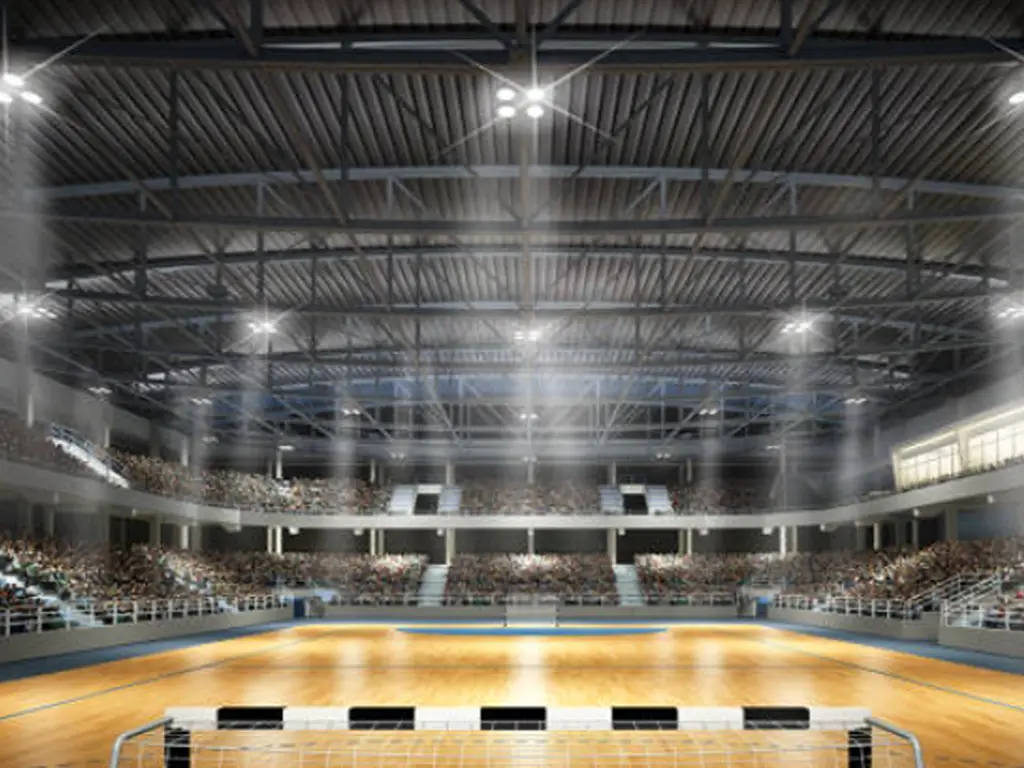
The move beyond the old Metal Halide (MH) technology to that of Light Emitting Diode (LED) technology is not just a luxury upgrade anymore, but rather an industrial necessity for outdoor use. Over decades, MH lamps have been the norm, but they had serious shortcomings, such as the need to warm up (as long as 20 minutes) and the fact that the lumen decline was so rapid that managers had to over-light stadiums at first simply to get to sixteen feet after a year. The LED technology has practically solved these problems because it has the ability of an instant-on/off, and due to decades of research, it still offers more than 90% of the original light output, making it one of the most efficient lighting solutions available.
In terms of finance, the ROI of LED cannot be disputed. The current LED stadium lights use as much as 70% of the energy used by the old system, which is the HID systems, but they use less energy while providing a much better quality of light, resulting in less time spent on energy costs. Moreover, the spectral power distribution of the LEDs can be adjusted to increase the Color Rendering Index (CRI) and Television Lighting Consistency Index (TLCI), so that greener grass appears to be greener and the skin tones appear natural to the camera. Solid-state lighting is the only way to go with high-performance projects in a world with skyrocketing energy prices and tight sustainability requirements.
Key Factors to Evaluate a Reliable Stadium Light Manufacturer
When assessing a manufacturer, one has to go beyond the lumens per watt sticker and dig deeper into the inner workings of the manufacturing, supported by a skilled team of experts. There are three pillars of reliability, which consist of Precision Optics, Thermal Management, and Regulatory Compliance.
Precision Optics and Glare Control
A high optical engineering would decide where the light does and does not go in stadium lighting solutions. To shape the beam by a surgically precise optic, reliable manufacturers employ secondary optics, including TIR (Total Internal Reflection) lenses or special reflectors. This allows high Uniformity Ratio, i.e. there are no dark spots or hot spots on the pitch which may distract the players.
More importantly, high glare control (reducing UGR to a low level) not only preserves athletes against temporary blindness in high play situations but also promotes customer satisfaction by avoiding trespass of light to adjacent residential zones. More recent precision optics are also concerned with the TLCI (Television Lighting Consistency Index), which is the quality of the light being optimised in relation to fixed-flicker, ultra-high-definition broadcasting.
Thermal Management and Longevity
The major adversary of LED chips and drivers is heat. A good quality fitting should have a good quality heat sink, usually composed of high quality die-cast aluminum such as ADC12, which allows effective dissipation of heat by means of optimum surface area while ensuring uniform illumination. When the thermal design of a manufacturer is poor, the junction temperature of the LED will increase and cause the color shifting to be irreversible and lumen depreciation to be premature.
In addition to mere cooling, seek other manufacturers with breathable design (built-in vents or special GORE-tex valves) and high-efficiency LED flood lighting. This enables pressure to equalize and avoid moisture condensing internally, a silent killer of electronics commonly, but still rates well in IP66 or IP67 ratings of complete weather protection.
Certification and Compliance
Trust and global interoperability is based on industry certification, including advancements in lighting technology. A trusted manufacturer should be able to show evidence of UL/ETL (in North America), CE/CB (in Europe), and DLC (DesignLights Consortium) qualification which frequently determines qualification to energy rebates.
Also, because of the special requirements of the stadium conditions and sports arenas, fixtures have to pass 3G vibration tests to verify that they can handle the constant oscillation of the wind and movement of structures. 10kV to 20kV surge protection should be also an integrated characteristic of high-performance units as they will be protecting the sensitive LED arrays against lightning strikes and grid instability typical in large-scale industrial areas.
Top 6 Reliable Stadium Light Manufacturers to Consider
Signify
Recommendation: ★★★★★
To B or C: To B
Main Markets: Global Professional Sports (FIFA/Olympic), Smart City Infrastructure, Elite Broadcast Venues.
Under its top brand of Philips ArenaVision, Signify has been the global leader in professional sports lighting, including spartan sports lighting solutions. Their technical advantage lies in the ArenaVision LED gen3.5 system, the design of which is specifically aimed at surpassing the requirements of the flicker-free requirements of 8K super-slow-motion broadcasting. Whereas competitors are competing on raw lumen output, Signify is competing on lighting quality to television, having a Television Lighting Consistency Index (TLCI) of more than 90. Their connection with the Interact Sports software platform can also be used in control of individual fixtures in real time which allows the synchronization of entertainment light shows which can be triggered by game events such as goals or halftime shows.
Signify also distinguishes itself through advanced optical engineering in addition to the hardware. Their lamps use a glare shield called honeycomb and special TIR (Total Internal Reflection) lenses that provide light with a surgical accuracy and thus helps in a large reduction of UGR (Unified Glare Rating). This makes sure that the spectators and athletes are not blinded by stray light as the pitch is brilliantly lit. In addition, they also have Lighting as a Service (LaaS) financial models, which enable operators of stadiums to upgrade to world-class infrastructure without colossal initial investment and supported by an international maintenance network that ensures that there is one hundred percent uptime of events aired.
Musco Lighting
Recommendation: ★★★★★
To B or C: To B
Main Markets: North America, Municipal Sports Complexes, Professional Arenas, Residential Area Stadiums.
Musco Lighting, with headquarters based in the USA, is the company that introduced Total Light Control-TLC of LED(r). The main distinction between them and Techline Sports Lighting is the fact that they do not sell lamps alone, but an entire, factory-integrated system with pre-flown concrete bases, poles, wire harnesses, and remote driver cabinets. This “factory-oriented strategy employs laser-alignment technology to make sure the lighting plan on paper converts to the field and there is no human error as it is on the ground and in the field. This systemic dependability has seen them being the favorite in terms of local Little League fields, as well as, NFL stadiums.
In technical terms, Spill Light Management is the industry leader of Musco. Their lamps have a new design known as light-trap which collects back the wasted photons and gets it back into the playing field. It not only enhances the general efficiency but also ensures that the surrounding community is not harmed by light pollution which is very crucial in the case of the stadiums that are situated in the residential areas. Their dependability is also fixed by their 25 year industry leading warranty of parts and labor. The result of this set it and forget it policy is long-term peace of mind and this is what makes the total cost of ownership (TCO) the lowest in the industry despite a high-upfront purchase price.
WOSEN
Recommendation: ★★★★★
To B or C: To B
Main Markets: Global Industrial Projects, High-Mast Infrastructure, Mid-to-Large Scale Sports Facilities, B2B OEM/ODM.
WOSEN is a pioneer in the use of high-performance lighting, which has had a background of more than 30 years in heavy-duty manufacturing. Compared to competitors who use a third-party assembly, WOSEN has an entirely vertically integrated manufacturing system, casting their own ADC12 die-cast aluminum, and coming up with their own proprietary, so-called private molds. This philosophy of building to depth gives each of the fixtures the strength to accommodate the extreme vibrations and wind pressures of 40-meter masts. WOSEN provides a distinct B2B service by integrating the ISO9001 principles with the 6S management principles and works with a network of qualified distributors to offer the factory-direct pricing levels and the top-tier engineering that is usually demanded by the high-end brands in the market.
A philosophy of Zero-Defect and a state of the art testing lab designed to meet CNAS standards drives reliability at WOSEN. Each led lamp is subjected to more than 50 strict tests to ascertain that the lamp is operationally flawless- with no flickering, overheating, or short circuiting. WOSEN has 1000W+ systems that carry a complete array of certifications such as UL, ETL, TUV, and CE with which it is designed to operate in any environmental condition. They have low junction temperatures due to their Advanced Thermal Management and hollow-out convection design, which ensures an authenticated L70 lifetime of more than 50,000 hours. WOSEN is complemented with the high uniformity and safety performance of the precision Long-Throw optics required of the professional athlete and the high-definition broadcast.
Siteco
Recommendation: ★★★★☆
To B or C: To B
Main Markets: Europe, Professional Football Arenas (UEFA Standard), Precision Engineering Projects.
Siteco, which is a company in Germany, is the embodiment of European precision and innovative design. Their series Floodlight 20/30 is famous for modularity and optical efficiency. Siteco has a huge technical differentiator in their Silver-Surface Reflector Technology. However, most manufacturers only use plastic lenses, whereas high purity silver reflectors are utilized in Siteco to shape the beam of light. This technique results in increased proportions of light output and a more desirable light quality that decreases eye strain to the athlete. Their engineering interests lie in their strong belief in the Human Centric Lighting that the spectral distribution must be optimized for both physiological comfort and visual acuity.
Regarding reliability, the Siteco fixtures are designed to endure the worst conditions in the environment, whether it is the salt-mist coastal stadiums to the freezing alpine stadiums. They use the use of specialized multi-layer powder coating which is proven to withstand extreme levels of corrosion. Moreover, Siteco is the pioneer of Smart City Integration, and fixtures are fully DALI-2 and Zhaga compatible, which will allow them to be nodes in a broader stadium IoT system. In the case of projects, in which the quality Made in Germany and extremely high optical efficiency are not negotiable, Siteco has offered an advanced, future-proof solution that can be used to any highest UEFA and FIFA standard.
Ephesus Sports Lighting
Recommendation: ★★★★☆
To B or C: To B
Main Markets: North America, Indoor Multi-purpose Arenas (NHL/NBA), Smart Stadiums.
Ephesus is a Cooper Lighting brand that is the digital disruptor of the world of stadiums. They became known as the pioneers of an all-LED installation in an NFL stadium and since then, they have concentrated on Software-Defined Lighting. With a strong emphasis on energy efficiency, the technical accomplishment that they have made is their incorporation of high-speed digital controls into the fitting. The Ephesus lights may be constantly monitored (on the health metrics) with their internal temperature and driver efficiency. This enables Predictive Maintenance, the system is able to alert a facility manager that there is a possibility of failure before the light is flickering at all, providing 100% uptime to high-stakes events.
One of the major notable distinctions of Ephesus is their Dynamic Spectrum Tuning. Their indoor oriented lights are capable of changing the color temperatures (CCT) dynamically where a venue can change to a cool white needed in a fast-paced hockey game to the warmer white needed in basketball or concerts. This robustness is accompanied with a patented Air-Flow housing that is able to cool high-output LEDs by natural convection, without the use of mechanical fans, which are commonly susceptible to failure. In the case of contemporary indoor multi-sport complexes with the need of high-performance lighting and current digital and versatility, Ephesus dominates the market.
GigaTera
Recommendation: ★★★★☆
To B or C: To B
Main Markets: East Asia, Retrofit Projects, Large-Scale Infrastructure, Wireless Control Environments.
The GigaTera of KMW Inc., South Korea, is the company that addresses the challenge of the “Weight-to-Power better than most. Their SUFA series have been known due to their extremely light structure, which has been made possible by advanced magnesium alloys and heat pipes that are highly efficient. This innovative approach is a decisive consideration to Retrofit Projects, in which current poles in stadiums may not be certified to support the excessive weight of typical LED floodlights. In contrast, high-quality options like Musco Sports Lighting can also meet these challenges. Opting to use GigaTera, operators are frequently able to save the enormous expense of addressing structural mast replacement, and yet, at the same time, upgrade to 1000W+ LED performance.
The Narrow Beam Precision is the secondary differentiation on GigaTera. They have used the technology of KMW who has experience in telecommunications and RF engineering to create optics which they could project light more than 200 meters and virtually zero dispersion of the light – very suitable in extremely tall high mast applications. They also have the added advantage that their proprietary Wireless Control System (Zigbee/Geofencing) is more resistant to signal interference than other standard Wi-Fi based systems. In stadiums having structural weight constraints or one in need of extreme range light projection in an environment with high interconnection, GigaTera provides a specially tuned engineering solution.
Understanding the Main Types of Stadium Fixtures
A stadium design determines the kind of lighting needed to evenly illuminate a stadium, including sports field lighting options. These categories should be known because they allow the matching of the manufacturer catalog to the physical limitations of the project.
High-Mast Floodlights for Outdoor Arenas
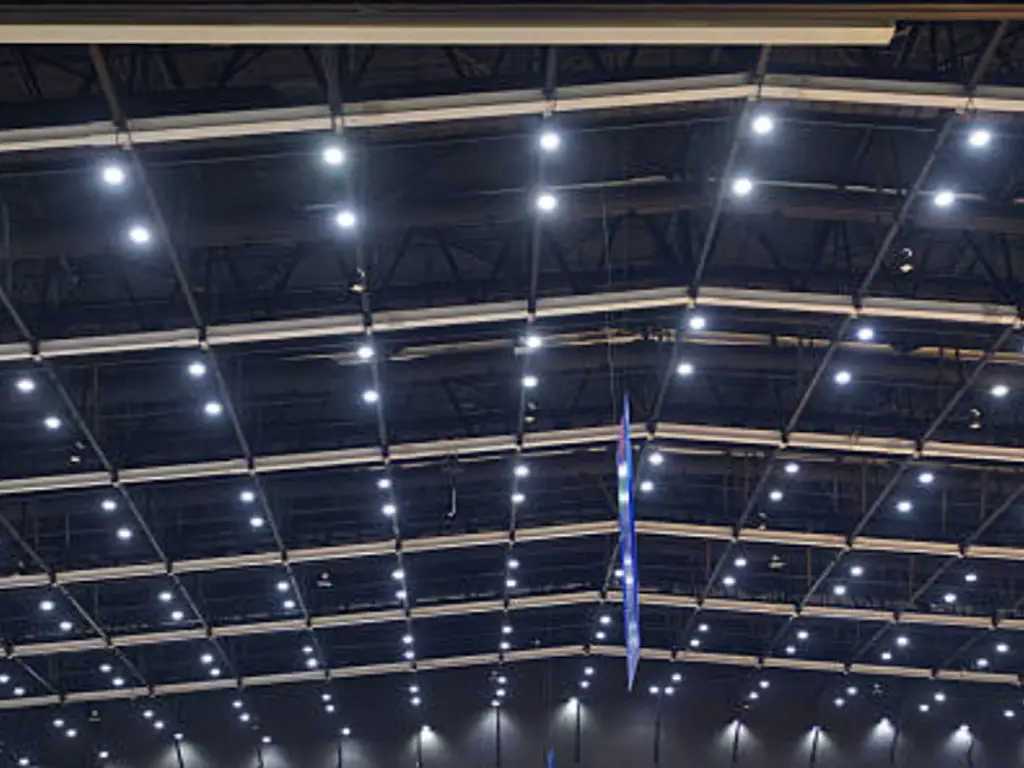
Outdoor stadiums use high-mast lighting in which the lights are supported by the use of extreme high height of the 20 to 50 meters. Such floodlights, which include energy-efficient sports lighting fixtures, should have a so-called long-throw ability, that is, they use very narrow beam angles (10deg or 30deg), which is precision engineered in order to blast through the air and create light at the heart of the field without scattering into the night sky.
Since they are constantly exposed to the elements, these fixtures should have a low EPA (Effective Projected Area) rating so that they will cause less wind resistance and would not impose any structural load on the masts in case of a storm. Additionally, the finish on it (like electrophoretic coating) should be of high quality to avoid corrosion particularly in coastal premises. Reliability in this case also includes the added provision of high-level surge protection (up to 20kV) in a bid to protect the system against lightning strikes, which is a constant danger to high-rise outdoor structures, making explosion proof lighting an essential consideration in such designs.
UFO High Bays for Indoor Sports Facilities
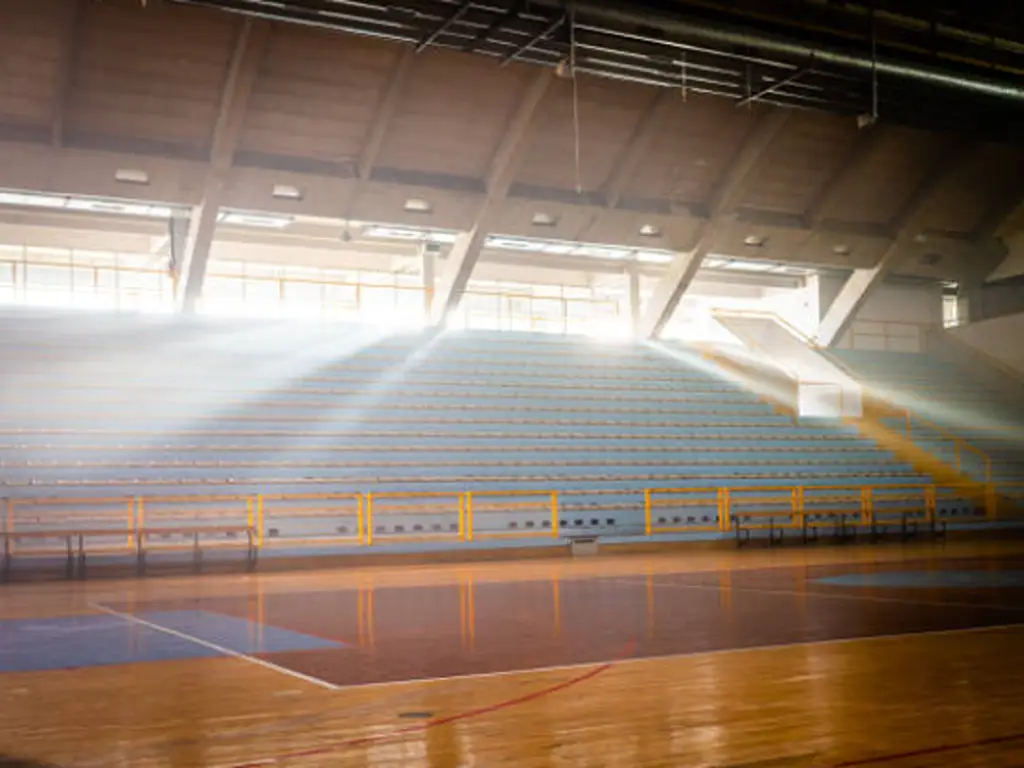
The shorter mounting height (8 to 15 meters) is commonly seen in indoor arenas, e.g. basketball courts, gymnasiums or swimming complexes. The more diffused light distribution in such facilities is unlike in outdoor lighting masts, where a significant amount of light is likely to blind the athletes looking upwards at any given moment during a play. The style of high bays used here is the UFO style or the special-purpose linear sports fixtures, as it takes up less space and gives a broad and uniform distribution of light.
In high impact applications of indoor sports, they should be characterized by very high IK ratings (usually IK08-IK10) so that they will not become unusable when impacted by a high velocity ball. Also, high-performance indoor drivers should be silent (low THD and flicker-free); closed acoustics of indoor facilities can increase the electronic hum of the less-quality components that can be a significant distraction to the players as well as the audience, especially when using LED lighting fixtures designed for sports environments.
ROI Beyond the Purchase: Why Reliability Matters for the Long Term
The sticker price of the fixture can be the most minor figure when computing the cost of the stadium lighting. The real cost is the Total Cost of ownership (TCO) in 10-15 years, including the rising utility costs. Selecting a trusted manufacturer will greatly save on the failure costs. The cost of a crane or a high reach bucket truck to replace one failed driver in a stadium setting will come at thousands of dollars per day. Even after the failure rate of a manufacturer has increased by a mere 3 percent more than that of a high-end competitor, such maintenance expenses will soon outweigh any savings.
Additionally, reliability has an effect on revenue. The venue which is capable of ensuring the presence of the same, broadcast worthy lights will have the chances of getting high profile tournaments and profitable T.V deals. The lighting in outdoor areas such as parking lots is also an aspect that enhances the fans experience which increases their ticket sales and concessions income. Through reliable investment in reliability, the owners of the stadiums are essentially insuring themselves against technical breakdown and preserving the long-term value of the facility as an asset.
Conclusion: Lighting the Path to Success with the Right Partner
Choosing a stadium lighting vendor is a long-term plan that will determine the success of a venue in its operations, safety of the athletes, and the experience of the audience over the coming twenty years. The international market in 2026 will be rich in a variety of specialists, including those who are also at the forefront in terms of innovations related to broadcasting and system accuracy, as well as those providing the right LED sports lighting for heavy-duty production and the lightness of structures. When you embark on a project of high-performance lighting, it is important that you go beyond the price label and look at the companies that offer clear technical information, certified internationally, and have a history of resilience in extreme conditions.
Finally, an efficient lighting system is an investment on the reputation and financial sustainability of the venue. Be it the local community pitch or a 100,000-seat national stadium, the appropriate partner will make sure the game is always seen in its best light and long term energy use and the concealed costs of regular maintenance, along with excellent customer service, is minimized. When you buy a manufacturer who has a record of engineering achievement you are not just purchasing equipment but you are buying the future of every event that is going to be run under those lights.

 English
  Spanish
  French
  German
  Italian
  Arabic
  Russian
  Portuguese