
Navigating the Cost Spectrum: The Strategic Transition to LED Tennis Court Lighting
The switch of Metal Halide (MH) to LED is an important financial optimization. Facility managers should consider more than purchase price to Total Cost of Ownership (TCO) in order to analyze the true Return on Investment (ROI). The savings are obvious to a typical 2-court facility (4 hours/night):
- Energy Efficiency: A 1080W MH lamp can be substituted with 320W LED that will save $132 per unit,every year (at $0.12/kWh). A 12-fixture system saves the electricity expenses by $1,584 annually.
- Maintenance & Lifespan: MH bulbs last between 3,000 to 5,000 hours at a high cost of replacing them with parts and renting lifts ($500-$1,000/day). Professional LED systems (L70) have the duration of 50,000-100,000 hours, which is virtually no maintenance during 15-20 years.
- Strategic Investment: Retrofit is expensive at $13,500-$19,000, but with a payback of only 24-36 months. The 70% decrease in power consumption is immediately converted to profit by the third year, which is expedited by utility rebates in such states as Texas and California.
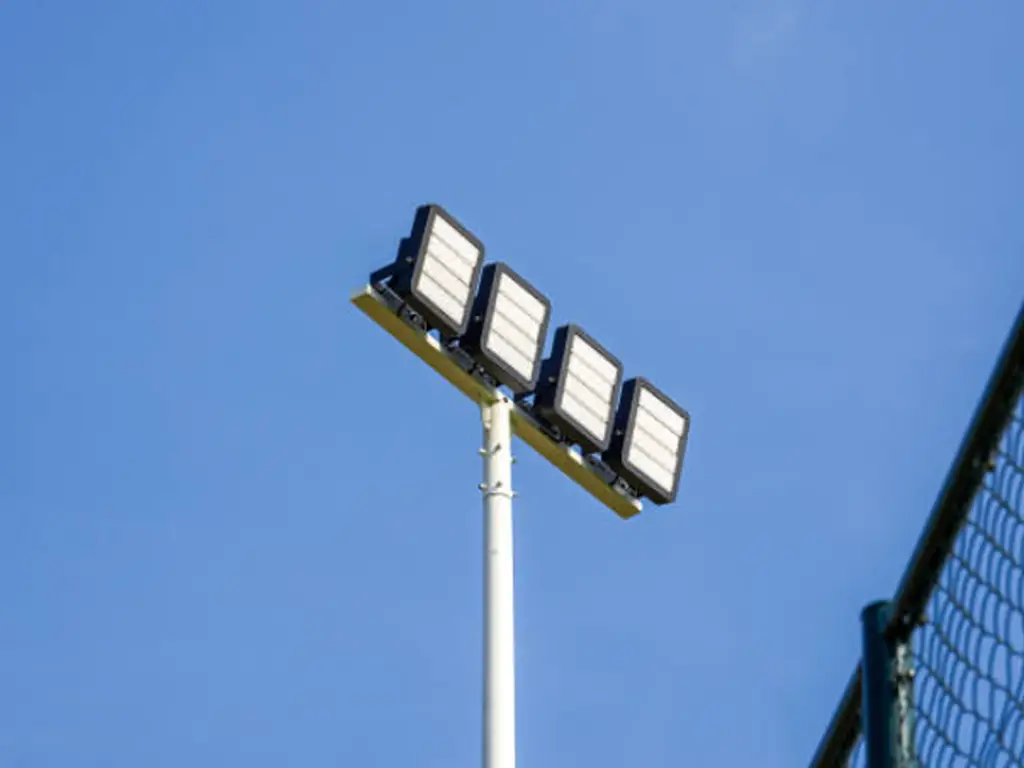
Defining Your Requirements: Understanding Lighting Classes and Performance Standards
The most technical stage of project planning is the identification of the right lighting class. It eliminates over-lighting (wasted capital) and under-lighting (taking risks with safety and playability). In 2026, the difference between a recreation grade facility and a pro-performance facility is in the accuracy of these specifications, which ensures optimal performance. The first step towards this balance is by first classifying the facility according to the individual tiers of play spelt out by the international standards.
The Tiers of Play: Categorizing Your Court from Class I to IV
Tennis courts are categorized by such organizations as ITF and IES so that lighting should be able to fulfill the physiological requirements of players at different speeds.
- Class IV (Residential & Recreational): The design is aimed at backyards and small HOA outdoor tennis court to provide simple visibility to play with others, with the consideration of the court size and dimensions. The need to have high-intensity contrast is less since the speed of ball is usually slower.
- Class III (Community & High School): The ‘Gold Standard’ for amateur competition. Safety becomes a primary driver here, requiring tighter uniformity to ensure players have consistent reaction times on a recreational tennis court.
- Class II (Commercial Clubs & Collegiate): Constructed to fit high end clubs with regional tournaments. Serves at this stage can also be in excess of 100 mph and this needs the illumination to be high contrast and flicker-free to enable the human eye to cope with such fast motion.
- Class I (Professional & International): Stadium-grade environments (e.g., ITF Pro Circuit). Every inch of the court must be perfectly illuminated to meet the rigorous vertical foot-candle requirements for 4K broadcasting.
| Class | Application | Play Level | Lighting Priority | Min. Lux (Avg.) | Broadcasting |
| Class IV | Residential & HOA | Recreational | Basic Visibility | 200 | None |
| Class III | High Schools & Local Clubs | Amateur | Uniformity & Safety | 300 | None |
| Class II | Collegiate & Commercial | Regional Pro | High Contrast (100+ mph) | 500 | Local/HD |
| Class I | Professional Stadiums | International | Vertical Illumination | 750 – 1250+ | 4K UHD |
Although the choice of a particular class predetermines the level of performance, the true quality of the experience is determined by the interaction of certain scientific indicators on the playing field.
Visual Performance: The Synergy of fc, Uo, and CRI
When diving into technical specifications, one must understand the deep synergy between Foot-candles (fc), illumination levels, and Uniformity (Uo):
- The Essence of fc: It is the measure of the real luminous flux density that falls on the ground (lumens/ft). Although the first sensory indicator is brightness, it is only a base.
- Balance and Uniformity (Uo): Uniformity is the ratio of minimum to the average lux on court. In case uniformity is low, then the court will possess light patches. The human pupil needs physiological time when a player dashes in a bright baseline, and to a dark net space. A 40fc court having uniformity of 0.7 is much better in terms of playability than a 60fc court having uniformity of 0.4.
- The Role of CRI: High Color Rendering Index (CRI > 80) is to make sure that the bright yellow ball is contrasted with blue or green surfaces. It decreases eye strain when making long rallies and enhances rotation recognition.
The “Value King” Strategy: Why Class III is the Real Starting Point
Once the synergy of fc, uniformity, and CRI is understood, it is necessary to realize that Class III is the actual beginning of commercial entities that include a standard tennis court. Although Class IV is less expensive to purchase initially, it tends to cause the so-called dark pockets that compromise the risks of injuries and decrease the professionalism of the facility. Class III on the other hand generates the professional ambiance (30-50 fc) required to warrant the increased membership fee and court rental rates. In 95 percent of business ventures, Class III provides the most sure over-the-long-run ROI, combining performance with cost without reducing the safety of the sport.
Engineering the Perfect Layout: Pole Design and Placement Standards
The design of your light system and light poles is the major determinant to whether your court will experience the blinding glare or experience the smooth professional grade of light.
- 4-Pole Layout: A layout that is positioned at the corner that is most economical solution to Class IV residential projects. Although it is affordable, this layout may form a shadow of the center court and decreased visibility because of the space between the light sources.
- 6-Pole Layout: This layout is the most effective in increasing the amount of light in the net line area, adding poles to enhance the layout, particularly in the verticals of that area. It offers the razor-sharp image that is needed in high-paced volleys and overhead smashes and it is therefore the standard in individual clubs and training facilities.
- 8-Pole Layout: This is a broad multidirectional design that makes sure that the lobs are strong in the sky such that they can be viewed in various directions. It successfully addresses the technical vanishing ball effect where the ball fades away on a dark sky on the summit of the flight, and it will give a shadow-neutral background to high-level competition.
| Layout Type | Recommended Class | Target Foot-candles (fc) | Uniformity (Uo) | Pole Height (ft/m) |
| 4-Pole | Class IV | 30 – 50 fc for recreational play | 0.5 | 20′ – 25′ (6m-8m) |
| 6-Pole | Class III / II | 30 – 50 fc | 0.6 – 0.7 | 25′ – 30′ (8m-10m) |
| 8-Pole | Class I / Pro | 75 – 125+ fc | 0.75+ | 30′ – 40′ (10m-12m) |
Option A: The Entry-Level Budget Plan for Residential Courts
The owners of residential buildings should negotiate between performance and environmental responsibility. At 2026, light pollution is no longer an irritation but a liability that must be followed by the law, and the chances of non-compliance with local regulations are obvious.
There are numerous ordinances on IDA (International Dark-Sky Association) and stringent Cut-off regulations, which are enforced by many municipalities nowadays. In areas such as Florida (along the coast) or Title 24 regions in California, which are sensitive ecosystems, the Light Trespass on to the property of a neighbor may result in fines and the compulsory removal of the system.
Asymmetric Optics is used in contemporary residential LED designs. These special lenses will block the light directly at the edge of the court unlike the conventional floodlights that sprinkle light in every direction (360 degrees). This guarantees the community that you will not disturb neighbors who might be asleep at a time of the year you enjoy a midnight match and also you are guaranteed that 100 percent of the laws will not be violated.
Option B: High-Performance Systems for Commercial Clubs and Professional Arenas
To the commercial operators, the lighting system is an internal infrastructure component that directly results in facility turnover, operational safety, and asset premium. The first line of defense to your investment is the Precision Thermal Management. The high-performance LEDs produce a lot of heat when operating during the night. The temperature of the LED junction will increase without specialized die-cast aluminum heat sinks (in many cases 6063 aviation grade), and the Air-Flow cooling technology and the chips will break down sooner (Color shifting, Lumen drop, and color temperature issues).
Moreover, the value of CRI (>80) and R9 is essential in professional play, which allows players to differentiate the ball on the texture of the court. The facility supports 4K cameras at 120fps when it is coupled with Flicker-Free Driver Technology. It is not only on TV anymore, but it is on the devices that members would wish to record their games to share on social media or coaching applications.
Finally, the fixtures should have IK08 impact rating. Tennis balls of 120 mph or more have enormous kinetic energy; an impactful lens will not break the expensive parts of this equipment, and no costly time will be lost.
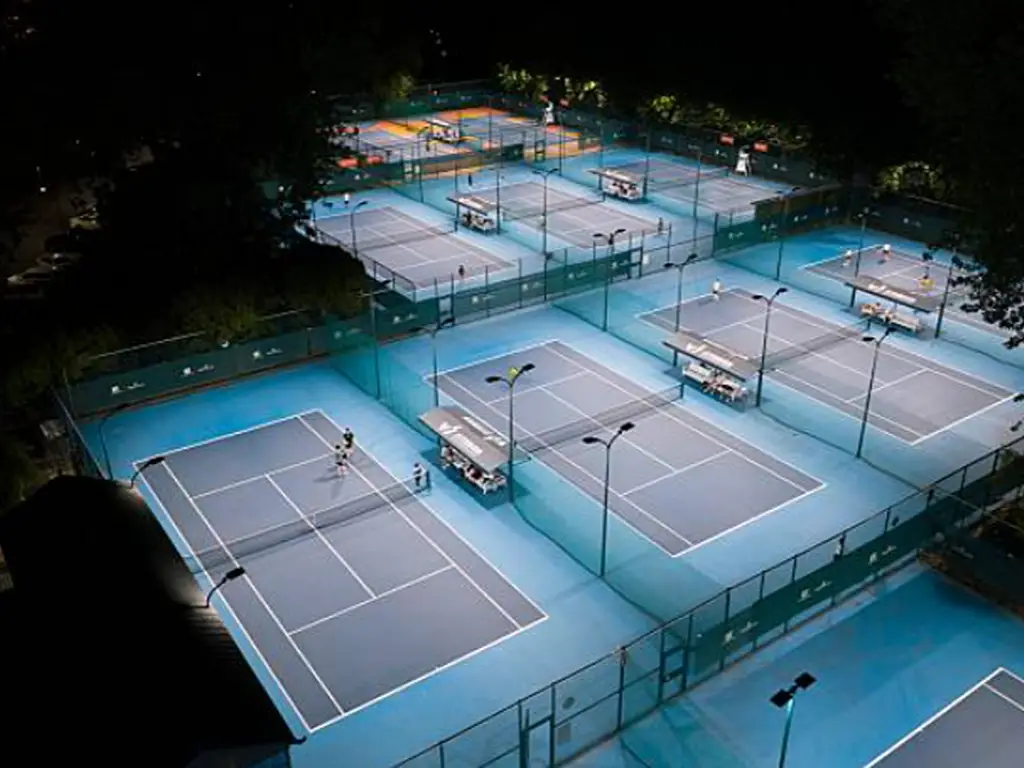
Maximizing 2026 ROI: Smart & Adaptable Systems
After the attainment of basic illumination, the emphasis is put on the visual quality, environmental resilience, and the Human-Centric lighting experience.
Compliance and Ethics: Glare Control and Dark Sky Standards
The industry is headed into a Glare Rating (GR) of less than 50. Recessing LED chips deeper into the exterior and applying special honey-comb louvers will give a more natural appearance of daylight, yet crisp white light which illuminates the ball, not the eyes of the player. This comfort feature has a direct influence on the image of a facility and a retention of players to the team—when players are not blinded in each service, they will play more and will come to the team more frequently, reducing the need for frequent replacements.
Case Study: Navigating Texas Heat and Regulations
Summer ambient temperatures are often above 100°F (38°C), and it is extremely humid in Texas cities such as Houston and Austin. This is a stress test of light fixtures and in most cases, these poor thermal designs are killed in less than two seasons.
Addressing these environmental extremes requires the specialized expertise of manufacturers who prioritize climate-resilient engineering, as demonstrated by WOSEN’s targeted design approach. In Texas WOSEN secures long-term ROI using UL/DLC certified fixtures engineered with 6063 aviation-grade aluminum and a hollowed-out heat dissipation structure. This design ensures optimal cooling during extreme heatwaves, while IP66 and IK10 ratings—coupled with UV-resistant coatings—protect against high humidity and physical impact. WOSEN’s Texas stadium projects prove that superior thermal engineering eliminates maintenance strain, surviving where conventional lighting fails.
Maximizing ROI: Multi-Sport & Smart Integration
The most recent ROI optimization is the zonal control and dimming protocols. Managers with smart IoT can only activate some areas (e.g., each Pickleball area of a larger court) to accommodate different lighting needs. It can conserve up to 50 percent of energy used in situations where there is no necessity of full-court lighting. This level of flexibility, along with the long lifespan of LED lighting systems, will be a condition in 2026 in order to reduce the cost of operation and improve the carbon footprint of the facility.
Direct-from-Factory: The Hidden Impact on Long-Term Operating Costs
One of the strategic benefits of acquiring lighting systems directly with the manufacturer is that it provides the best results over a long distance past the first invoice. The following are the main advantages of the model when it comes to long-term facility management:
- Financial Optimization: With the removal of the “Middleman Markup” which normally constitutes 30-40 percent of the total cost of the project, the facility managers will be able to channel the funds into more productive hardware that enhances energy efficiency.
- Deep Engineering Integration: All court settings are individual, influenced by the surrounding trees, buildings, or the current pole set-ups; therefore, direct access to factory-grade 3D Photometric reports ensures that no lumen is spent on the ground as an illuminance spill, addressing specific needs.
- Technical Lineage and Part Consistency: A direct-from-source model guarantees 20-year warranty support and part consistency, ensuring performance similar to natural daylight. In the event that one of the components, say a driver, has to be replaced in year 10, the facility will still be under the parameters of the original creator and will not be at risk like using third parties whose product distribution might change over the years.
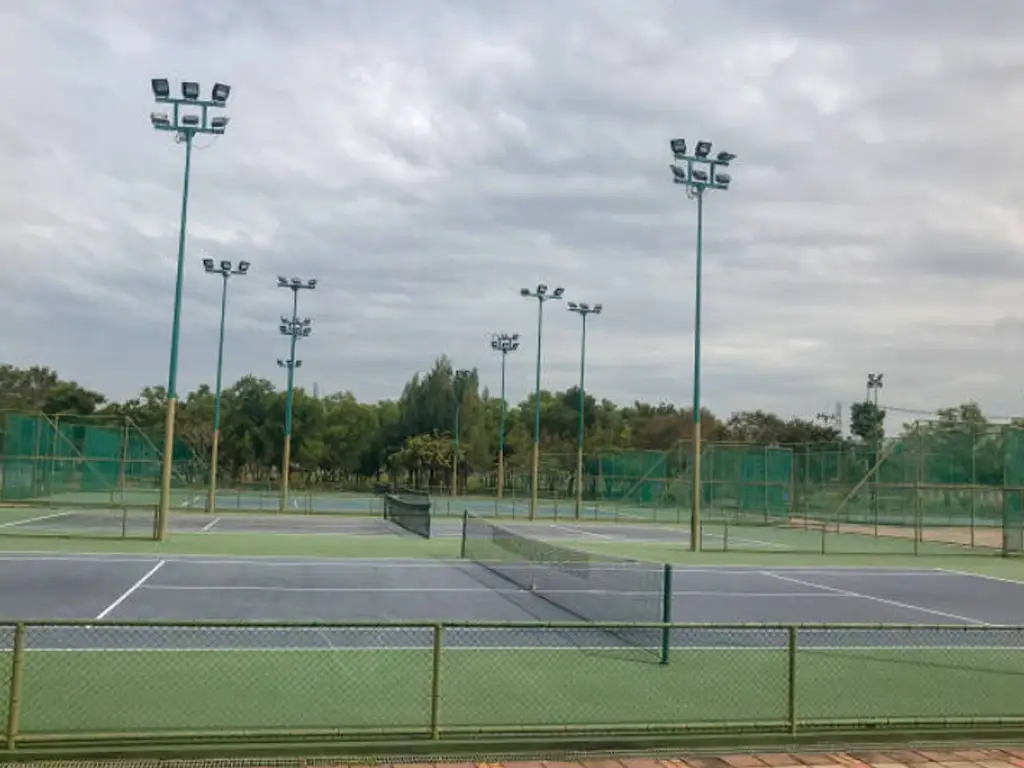
Installation Checklist: Essential Pre-Construction Audit for Technical Success
It is obligatory to have a technical audit before the first shovel falls on the ground in order to evade the traps of financing.
- Photometric Simulation: Requirement of a point-by-point plan of a light source in your outdoor sports lighting. It is your online blueprint. Otherwise, you will run the risk of dark spots that will result in member complaint and expensive retrofits that can cost you three times the original installation.
- Structural Integrity: Confirm EPA (Effective Projected Area) rating of poles exceeding 25ft of height and attain optimal pole height. Wind-load calculations are a must in storm-prone areas. Poor structures may fall over during strong winds causing devastating safety and lawsuits.
- Surge Protection Protocol: LED drivers are delicate semiconductor items. Make sure that there is at least 10kV/20kV protector to ensure that a lightning strike or grid surge will not fry the whole system in one shot. This is necessary to have uniform light distribution within the area in the long run.
- Voltage Drop Calculation: The proper gauging of the wires at the distance is important. Thin wires create a voltage drop that would induce flickering of the LEDs and therefore cause headaches to the players and greatly reduce the life span of the driver when the power source is distant to the court.
Conclusion: Investing in the Right Level for Long-Term Value
The tennis court lighting is a high investment profile where what might be deemed cheapest today may turn out to be the costliest in less than 24 months. Your choice of the appropriate class of play and an exact laid out layout is insuring you 20 years of asset and peak performance. The current LED lighting solutions models of light are the trendy bulbs of choice due to their efficiency in energy consumption, but they require a strict sense of application. WOSEN is determined to assist you in negotiating technicalities in 2026 standards so as to maximize your ROI. We will assist you to create a court that would appeal to more players and would not fade with time. Get in touch with our engineering department and get a tailored photometric analysis.

 English
  Spanish
  French
  German
  Italian
  Arabic
  Russian
  Portuguese
  Dutch
Dutch  Indonesian
  Turkish
  Polish